Why do you have the same scar my brother had?” the woman whispered from the doorway
“Julian.”
She swallowed.
“He disappeared when he was thirteen.”
I looked down at the pendant again.
“How long ago?”
“Twenty-five years.”
The number hit me strangely.
Not because it was impossible.
Because it wasn’t.
Twenty-five years ago, I had been thirteen too.
Before I could say anything, the front door opened.
An elderly woman stood there in a dark cardigan, one hand gripping the frame.
“Rebecca?”
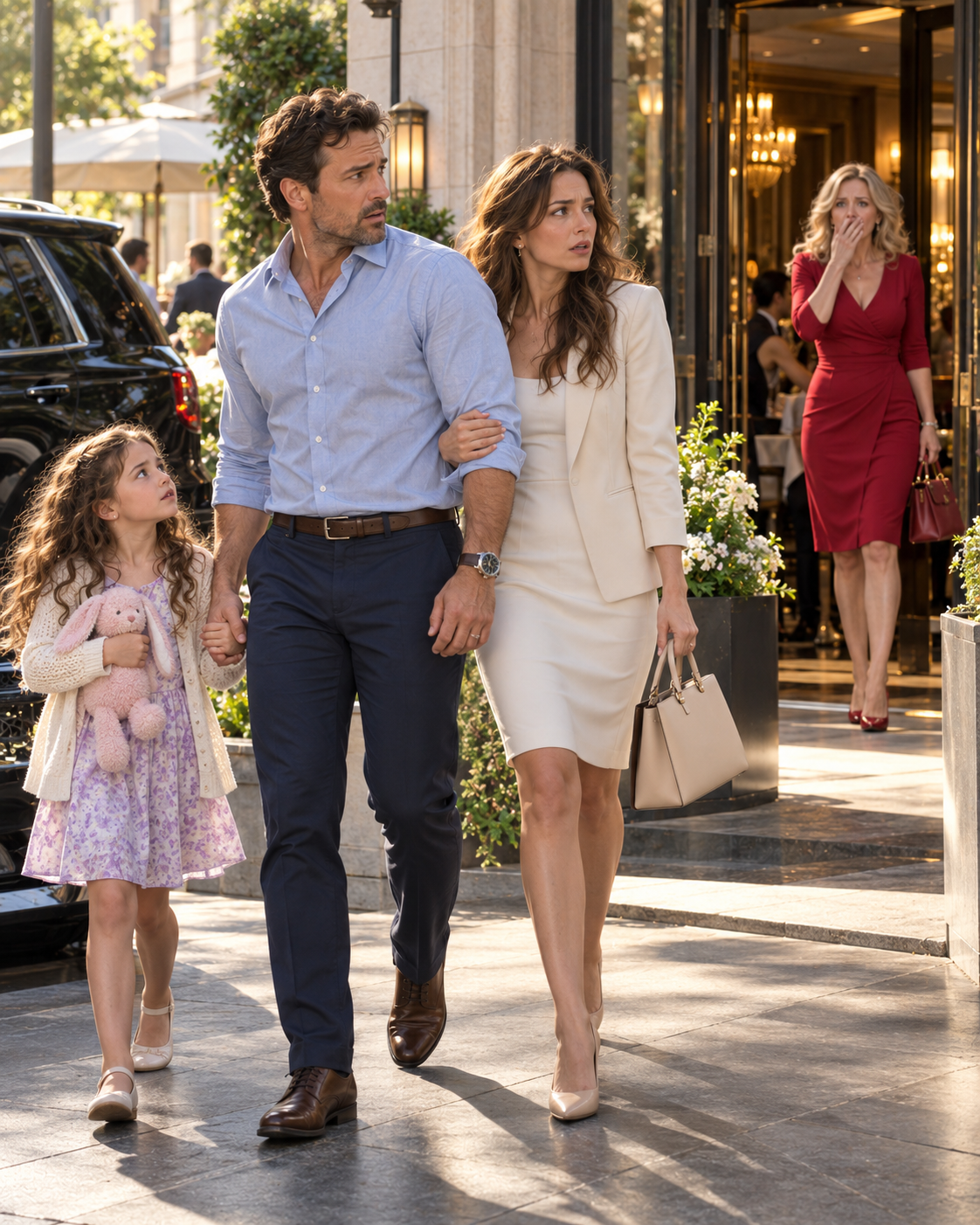
Her eyes moved to me.
Then to the necklace.
Then back to my face.
She stopped breathing.
I have seen people recognize a person after years apart. I have seen surprise.
This wasn’t surprise.
It was terror mixed with hope.
The woman stepped onto the porch.
“Who are you?”
“I’m Daniel.”
Her lips parted.
“Daniel what?”
“Mercer.”
She gripped the railing.
“Where were you born?”
I hesitated.
“Oakridge.”
The color disappeared from her face.
Rebecca turned toward her.
“Mom?”
The woman barely seemed to hear.
“What year?”
“1988.”
Her hand flew to her mouth.
“Your father?”
“Thomas Mercer.”
She made a sound I will never forget.
Not a gasp.
A broken little cry.
Then she looked directly at the scar above my eyebrow.
Her eyes filled with tears.
“You still rub your thumb against your palm when you’re frightened.”
I stopped moving.
Because I was doing it.
I’d been doing it since I was a kid.
Nobody had ever known why.
The woman took one trembling step down.
“Daniel,” she whispered.
Then, with tears running freely down her face, she said something that made the storm outside feel like a distant thing.
“That isn’t your name.”
Rebecca stared at her.
“Mom, what are you saying?”
The woman looked at me.
“Your name was Julian.”
My knees nearly gave out.
And then she whispered, “I have spent twenty-five years looking for you.”
The words didn’t make sense.
Not at first.
They floated between us with the rain blowing sideways behind them, too enormous to fit inside an ordinary sentence.
Your name was Julian.
I actually laughed.
It was a small, nervous sound, the kind that comes out when your mind can’t find any other response.
“I’m sorry,” I said. “You’ve got the wrong person.”
The woman shook her head.
“No.”
Rebecca looked from her mother to me.
“Mom, stop.”
“I’m not stopping.”
Her voice broke on the last word.
She came down another step.
“Look at me.”
I did.
Her face was wet with rain and tears.
“You had a scar here.” She touched her own eyebrow. “You got it climbing the chicken coop. Your father told you not to climb it, and you did it anyway because Julian dared you.”
I couldn’t breathe.
There was a chicken coop.
I hadn’t thought about it in years.
Not consciously.
But suddenly I could smell hay.
I could hear the furious clucking of hens.
I could feel a boy’s hand pushing between my shoulder blades.
Go on, Danny. You said you weren’t scared.
I stepped backward.
Rebecca caught my arm.
“Daniel?”
I pulled away.
“No.”
The woman on the steps closed her eyes.
“I know this is too much.”
“Too much?” I said. “You’re telling me I’m your missing son.”
“I believe you are.”
“Believe?”
“I don’t have the right to ask you to accept it in one night.”
“Then what exactly are you asking me to do?”
“Come inside.”
I almost said no.
Then the wind slammed the front door against the wall.
Rebecca flinched.
The storm had flooded the road behind me, and the power was still out across the neighborhood.
I looked at the dark SUV.
Then at the woman who had just told me I had another name.
Finally, I followed them inside.
The house was enormous, but without electricity it felt strangely intimate. Candles had been placed along the staircase. A fire burned low in the living room fireplace, throwing orange light across old furniture and framed photographs.
I noticed the pictures before I noticed anything else.
A little girl with missing front teeth.
A teenage boy in a baseball uniform.
A man who looked nothing like me.
And then—
I stopped.
A photograph showed two boys standing beside a red barn.
The older boy had one arm around the younger.
The younger one was grinning.
I knew that face.
Not because I remembered him completely.
Because some part of me had been carrying him all my life.
Rebecca came to stand beside me.
“That’s Julian.”
I pointed at the other boy.
“Who’s that?”
Evelyn didn’t answer.
I turned.
She was crying again.
“That’s you.”
I picked up the photograph.
My hands began to shake.
The boy beside Julian had my eyes.
My crooked smile.
My scar hadn’t happened yet, but the shape of my face was unmistakable.
There was writing on the bottom.
Brothers forever.
I sat down.
For a while, nobody spoke.
Then Evelyn crossed the room and lowered herself carefully into a chair opposite me.
“Your father was a difficult man,” she said.
Rebecca stiffened.
“Mom.”
“I’m not blaming him for everything.”
Evelyn folded her hands in her lap.
“But he was angry after the divorce. He took Julian and moved away without telling me where they were going. Your father had convinced himself he could raise you both alone.”
“Both?”
She nodded.
“You were nine. Julian was four.”
I stared at her.
The number landed strangely.
Nine.
That was the age I had always assumed I entered foster care.
But my paperwork had been confusing. My father had died. My placement records were fragmented. I’d never been given much information about what happened before.
“What happened to him?”
Evelyn looked toward the fire.
“Your father brought you boys back to Oakridge after several years away. Julian was thirteen.”
She paused.
“You were fourteen.”
I shook my head.
“No. I was thirteen.”
“Your birthday was in February. Julian’s was in November.”
I did the math.
She was right.
I had spent my whole adult life believing my age at the time was thirteen.
Another little piece of certainty broke loose.
“What happened?”
“Your father was driving you somewhere during a storm.”
My stomach tightened.
“A storm?”
“Yes.”
Rebecca sat beside me.
“Mom, you never told me this part.”
“Because I didn’t know what was true for years.”
Evelyn looked at me.
“There was an accident near the old quarry road. The car went through a barrier. You were both thrown from the vehicle.”
I heard the fire crack.
“Your father died.”
I closed my eyes.
“And Julian?”
“He survived.”
The room seemed to tilt.
“Then why was I told I was alone?”
Evelyn’s expression changed.
“Because when they found him, he didn’t know who he was.”
I opened my eyes.
“He had severe amnesia. The hospital called him an unidentified juvenile. We had no idea where you were. You had been thrown farther from the wreck.”
“How far?”
“Nearly two miles.”
I couldn’t speak.
“They found you three days later,” she continued. “But by then, you had a fever and severe dehydration. You kept telling people your name was Danny.”
“Danny.”
She nodded.
“Daniel was your middle name.”
My heart began pounding.
“Why didn’t you find me?”
“We tried.”
Her voice became quiet.
“God, Daniel, we tried.”
She told me about the hospital, the police reports, the missing-person posters, the searches along the quarry and creek. She told me she spent years calling social services offices and county records departments.
But the records didn’t connect.
The boy found near the quarry had been registered as Julian Stone.
The boy found miles away had entered foster care under Daniel Mercer.
Neither side knew the other existed.
And Julian’s memory never returned.
“Where is he now?” I asked.
Evelyn stared at me.
“In California.”
I waited.
“He remembers almost nothing before the accident. A few images. A barn. A boy.”
My throat tightened.
“Does he know about me?”
“Not until recently.”
Rebecca suddenly stood.
“Recently?”
Evelyn looked at her daughter.
“Three months ago, I found a photograph in an old box.”
She went to a cabinet and removed a folder.
“Julian had been trying to identify the boy in his childhood memories.”
She handed me a photocopy.
It was another picture.
Two boys.
The same barn.
And on the back, written in faded blue ink:
Danny says he’ll never leave me.
I stared at the handwriting.
I recognized it.
Not the words.
The shape.
The way the D leaned forward.
I had written that.
I knew I had.
I remembered sitting beneath the barn window with a stub of a pencil.
I remembered Julian crying because our father was angry.
I remembered telling him we would always find each other.
Then the memory disappeared again, swallowed by years of foster homes and survival.
I pressed the heel of my hand against my forehead.
Rebecca crouched beside me.
“I’m sorry.”
I looked at her.
“For what?”
“For not knowing.”
There was something fragile in her face.
“What do you mean?”
She glanced at Evelyn.
Then back at me.
“If Julian is your brother, then you’re my brother too.”
I couldn’t answer.
She gave a shaky laugh.
“That sounds insane when I say it out loud.”
It did.
But it also sounded strangely familiar.
She had the same gray-green eyes as the little girl in the family photograph.
I had noticed them earlier without understanding why.
Now I couldn’t stop seeing it.
My phone buzzed.
Maya.
I nearly dropped it.
Her name glowing on the screen brought me back to the life I understood.
I answered.
“Dad?”
Her voice was small.
“Hey, peanut.”
“Are you coming home?”
I looked toward the windows.
The storm was still hammering the glass.
“I am.”
“When?”
I glanced at the flooded driveway.
“I don’t know yet.”
She was quiet.
Then she said, “You promised cookies.”
The guilt hit harder than anything Evelyn had told me.
“I know.”
“You said we’d make the stars first.”
I closed my eyes.
“I remember.”
A small sniffle.
“I saved the blue sprinkles.”
I swallowed.
“I’ll make them with you.”
“Really?”
“Really.”
When the call ended, I sat there staring at my phone.
Rebecca heard enough to understand.
“She shouldn’t be out in this.”
“No.”
“Then don’t bring her.”
I looked at her.
“I can’t leave her alone.”
“I didn’t mean alone.”
She stood.
“I’ll send someone.”
“I don’t need a favor.”
“This isn’t a favor.”
She reached for her phone.
“It’s family.”
I didn’t know what to do with that word.
Family had always meant paperwork.
Emergency contacts.
People who had once lived in a house with me and eventually stopped answering.
But Rebecca said it as though it were a fact.
She made two calls.
Within fifteen minutes, a driver from the estate’s security team had been dispatched with a four-wheel-drive vehicle and emergency supplies.
I tried to protest.
Rebecca ignored me.
“You brought me home through a flood,” she said. “Let me bring your daughter somewhere safe.”
That was the first time I smiled.
Just a little.
While we waited, Evelyn brought out more boxes.
Letters.
School records.
Birthday cards.
Photographs.
In one envelope, I found a drawing made with crayons.
Two boys stood beneath a crooked yellow sun.
Above them, someone had written:
Danny + Julian.
Best brothers.
I touched the paper.
“I remember this.”
Evelyn’s hand covered her mouth.
“What?”
“The yellow sun.”
She sat down hard.
“I drew it,” I whispered. “Julian said my sun looked like an egg.”
Rebecca laughed through her tears.
Evelyn cried openly.
For the first time that night, I didn’t feel like I was standing inside someone else’s tragedy.
I felt like I was standing inside my own forgotten life.
Then Evelyn opened one final envelope.
Inside was a newspaper clipping.
The headline described the accident.
The article said two children were involved.
One had died.
One had survived.
I read the names.
Thomas Mercer.
Julian Stone.
I looked up.
“Where’s my name?”
Evelyn’s face changed.
“There was a mistake.”
“What kind?”
She hesitated.
“The police initially believed there was only one surviving child.”
My skin prickled.
“Why?”
“Because the second boy wasn’t found until three days later.”
I stared at the clipping.
Then I noticed a handwritten note in the margin.
Evelyn had written:
Daniel located. Foster placement confirmed.
Underneath that was another line.
Julian transferred to Stone family.
I looked at her.
“You adopted him?”
She nodded.
“I was his biological mother. Your father took you boys away before I could stop him. After the accident, when they finally identified Julian, the court allowed me to regain custody.”
“But not me.”
Her eyes filled again.
“You had already been placed under another name.”
“Why didn’t anybody tell me?”
“I didn’t know where you were.”
The anger came suddenly.
Not explosive.
Worse.
Quiet.
All those years I’d believed nobody had come looking.
But someone had.
Someone had searched.
Someone had been waiting.
And I had spent thirty years thinking I wasn’t worth finding.
“I need air.”
I stepped toward the back door.
Rebecca followed.
“Daniel.”
“Don’t.”
She stopped.
“I need a minute.”
I went outside onto the covered porch.
The rain had softened.
For the first time in hours, I could hear something besides wind.
Water dripping from the gutters.
Branches moving.
The world breathing after being held underwater.
Then headlights appeared through the trees.
A large vehicle came slowly up the driveway.
My heart began pounding.
The back door opened.
Maya jumped out before the driver could reach her.
“Dad!”
She ran through the rain.
I dropped to my knees.
She hit me so hard I nearly fell backward.
Her arms went around my neck.
“You came.”
“I promised.”
She pulled back and stared at my face.
“Why are you crying?”
I laughed.
“I think I’m just tired.”
She wiped my cheek with her mitten.
“You look weird.”
“Thanks.”
She smiled.
Behind her stood Rebecca.
For a moment, the two of them simply stared at each other.
Then Rebecca crouched.
“Hi.”
Maya looked at me.
“Who is she?”
I didn’t know how to answer.
Not yet.
So I said the only thing I could.
“Someone I just met.”
Rebecca smiled.
“That’s true.”
Maya noticed the silver star necklace in my hand.
“What’s that?”
Before I could answer, Evelyn came outside.
She had been waiting at the door.
When she saw Maya, something softened in her face.
“Is this your daughter?”
“Yes.”
Maya looked between us.
Evelyn stepped closer.
“What’s her name?”
“Maya.”
Evelyn smiled.
“Beautiful name.”
Maya nodded politely.
Then she noticed the star.
“That’s pretty.”
Evelyn looked at me.
“It belonged to Julian.”
Maya frowned.
“Who’s Julian?”
No one answered immediately.
I was about to explain when Evelyn reached for my hand.
Her fingers were cold.
She placed the necklace in my palm.
“There’s something else you need to know.”
I looked at her.
“What?”
She glanced toward the house.
“Julian isn’t in California anymore.”
My pulse quickened.
“Where is he?”
Evelyn’s eyes filled.
“He was flying here tonight.”
I stared at her.
“Tonight?”
“His flight was diverted because of the storm.”
Rebecca’s phone rang.
She answered.
Her expression changed almost immediately.
“Hello?”
She listened.
Then she looked at me.
The color drained from her face.
“What happened?”
A long pause.
She covered the phone with her hand.
“Daniel.”
I stood.
“What?”
“Julian’s plane landed at the regional airport twenty minutes ago.”
My heart stopped.
Rebecca put the phone back to her ear.
“Yes. We’re here.”
She listened again.
Then she whispered something I could barely hear.
“He asked for the Stone family.”
I felt my knees weaken.
Because somewhere in the deepest, most damaged corner of my memory, another voice was waking up.
Danny.
Don’t leave me.
I had spent thirty years believing that voice belonged to a dream.
Now I understood it had belonged to my little brother.
Rebecca ended the call.
“He remembers the barn.”
No one moved.
Maya slipped her hand into mine.
I looked down at my daughter.
Then at Evelyn.
Then at Rebecca.
And for the first time in my life, I understood that coming home wasn’t always about recognizing a place.
Sometimes it was about finally recognizing the people who had been waiting there for you.
The next hour passed in fragments.
A fire was built higher.
Maya was given hot chocolate and a blanket.
Evelyn found a box of old Christmas ornaments, and Maya immediately became obsessed with a wooden angel missing one wing.
Rebecca called the airport again.
The roads were still dangerous, but the emergency crews had begun clearing the main route.
I kept the silver star in my hand.
I couldn’t put it on.
Not yet.
At midnight, headlights appeared again.
This time, there was only one vehicle.
A county transport van stopped near the porch.
The door opened.
A man stepped out.
He was around my age.
Dark hair touched with gray.
A small scar ran along his jaw.
He stood in the rain, staring toward the house.
Evelyn made a sound behind me.
“Julian.”
The man looked at her.
Nothing happened for a second.
Then his eyes moved past her.
They found me.
He froze.
I couldn’t move either.
Rebecca whispered, “That’s him.”
Julian took one step.
Then another.
His eyes dropped to the necklace in my hand.
His face changed.
“Where did you get that?”
My throat closed.
“Your sister dropped it.”
He shook his head.
“No.”
His voice trembled.
“Not Rebecca.”
He pointed at me.
“That.”
I lifted the pendant.
His lips parted.
“Danny?”
The name nearly broke me.
Nobody had called me that since I was a boy.
I nodded once.
“I think so.”
He crossed the porch in three steps.
Then stopped.
He was crying.
So was I.
Neither of us seemed to know how to bridge thirty years.
Finally, Julian whispered, “You said you’d come back.”
I laughed through the tears.
“I got lost.”
He nodded.
“I did too.”
Then he hugged me.
Not carefully.
Not cautiously.
Like a thirteen-year-old boy had been waiting behind his eyes all this time.
I held him.
And for a while, nobody spoke.
Later, when Maya fell asleep on the couch, I sat beside the fireplace with Julian.
We talked until almost three in the morning.
Not about the accident.
Not at first.
We talked about the barn.
The creek.
The stupid chickens.
The time he put a frog in my shoe.
“You screamed,” he said.
“I did not.”
“You screamed like a girl.”
“I was nine.”
“You were terrified.”
“So were you.”
He smiled.
Then the smile disappeared.
“I remembered your hand.”
I looked at him.
“What?”
“After the accident.”
He stared into the fire.
“I couldn’t remember your face. But sometimes I’d wake up and remember holding someone’s hand.”
He rubbed his thumb against his palm.
I stared.
He noticed.
“What?”
I rubbed my thumb against my palm.
He went still.
“You still do that.”
“So do you.”
He looked down at his own hand.
Neither of us spoke.
It was the smallest proof.
But somehow it mattered more than all the photographs.
Near dawn, Evelyn came into the room carrying a folded blanket.
She looked at both of us.
“Do you know what your father used to say?”
Julian smiled faintly.
“What?”
“He said brothers were like stitches. You could tear the cloth apart, but the thread remembered where it belonged.”
I looked at my brother.
“That’s something he actually said?”
Evelyn laughed softly.
“He said it once.”
“Sounds unlike him.”
“It was.”
She placed the blanket over Julian’s shoulders.
Then she turned to me.
“You don’t have to forgive him.”
I hadn’t realized until that moment that I’d been waiting for permission.
“I don’t know if I can.”
“You don’t have to decide tonight.”
That mattered.
Because I had spent so much of my life believing forgiveness meant pretending nothing had happened.
Maybe it didn’t.
Maybe it meant allowing the past to be true without letting it make every future decision for you.
Maya stirred on the couch.
“Dad?”
I went to her.
She was half asleep.
“Are we still making cookies?”
I smiled.
“Absolutely.”
“Today?”
“Today.”
She thought about that.
“Can Julian help?”
I looked across the room.
My brother smiled.
“I’d like that.”
By sunrise, the storm had passed.
The roads were covered in branches and dirty snow, but the sky had begun turning pale over the trees.
The power came back at 6:17.
The Christmas tree in the corner suddenly lit up.
Maya woke and gasped.
“Whoa.”
Rebecca laughed.
Evelyn stood behind us with both hands pressed to her heart.
Julian was beside the tree.
He picked up the wooden angel with the missing wing.
“Still broken,” he said.
Maya looked at him.
“We can fix it.”
He smiled.
“Yeah.”
I watched my daughter hand him a roll of tape.
It was such an ordinary thing.
That was what made it beautiful.
Not the photographs.
Not the necklace.
Not the unbelievable history that had somehow brought me to this house.
A little girl simply deciding that a broken angel was worth repairing.
A brother sitting beside his brother after thirty years.
A mother watching two sons in the same room again.
Rebecca came to stand beside me.
“Do you know what I kept thinking all night?”
“What?”
“That I almost never came home.”
I looked at her.
She shrugged.
“I was going to spend Christmas at a hotel because I didn’t want to argue with Mom.”
“About Julian?”
“About everything.”
She looked toward Evelyn.
“I thought she was obsessed with a past that wasn’t coming back.”
I watched Julian help Maya tape the angel’s wing.
“Maybe she was.”
Rebecca smiled sadly.
“Maybe.”
Then she took my hand.
“Can I ask you something?”
“Sure.”
“Would you mind if I called you my brother?”
I looked at her.
The answer should have been complicated.
Instead, it wasn’t.
“No.”
Her eyes filled.
“Okay.”
She squeezed my hand.
“Brother.”
I laughed.
It sounded strange.
Then right.
A few minutes later, Evelyn brought out the silver necklace.
She held it toward me.
“Julian always said the star belonged to both of you.”
I looked at my brother.
He nodded.
“Put it on.”
I turned around.
Evelyn fastened the chain around my neck.
The pendant settled against my chest.
For years, I’d thought my life began with a funeral, a foster home, and a last name written by someone who barely knew me.
I had built everything after that.
A career.
A marriage.
A daughter.
A life.
None of those things became less real because I had discovered another life underneath them.
Maya climbed onto the couch beside me.
“Dad?”
“Yeah?”
“Can we bake now?”
I looked at the clock.
It was Christmas morning.
I laughed.
“Yeah, peanut.”
She grabbed my hand.
“Come on.”
Julian followed.
Rebecca came too.
Evelyn stayed behind for a moment, watching us disappear toward the kitchen.
Then she called after me.
“Daniel?”
I turned.
She was holding the old photograph of the two boys beside the barn.
“You should have this.”
I walked back.
She placed it in my hand.
On the back, beneath the faded words Brothers forever, there was something I had never noticed.
A second sentence.
Written in my childhood handwriting.
When we get lost, we’ll find our way home.
I stared at it for a long time.
Then I looked toward my brother.
He was waiting in the kitchen.
Maya was already pulling flour from the cabinet.
Rebecca was arguing with her about whether sugar cookies needed more frosting.
And for the first time in thirty years, I didn’t wonder where I belonged.
I knew.
Not because the past had suddenly become simple.
Not because every wound had healed.
But because when I walked into that kitchen, three people moved over to make room for me without asking whether I deserved the space.
So I sat down beside my brother.
And we made Christmas cookies together.