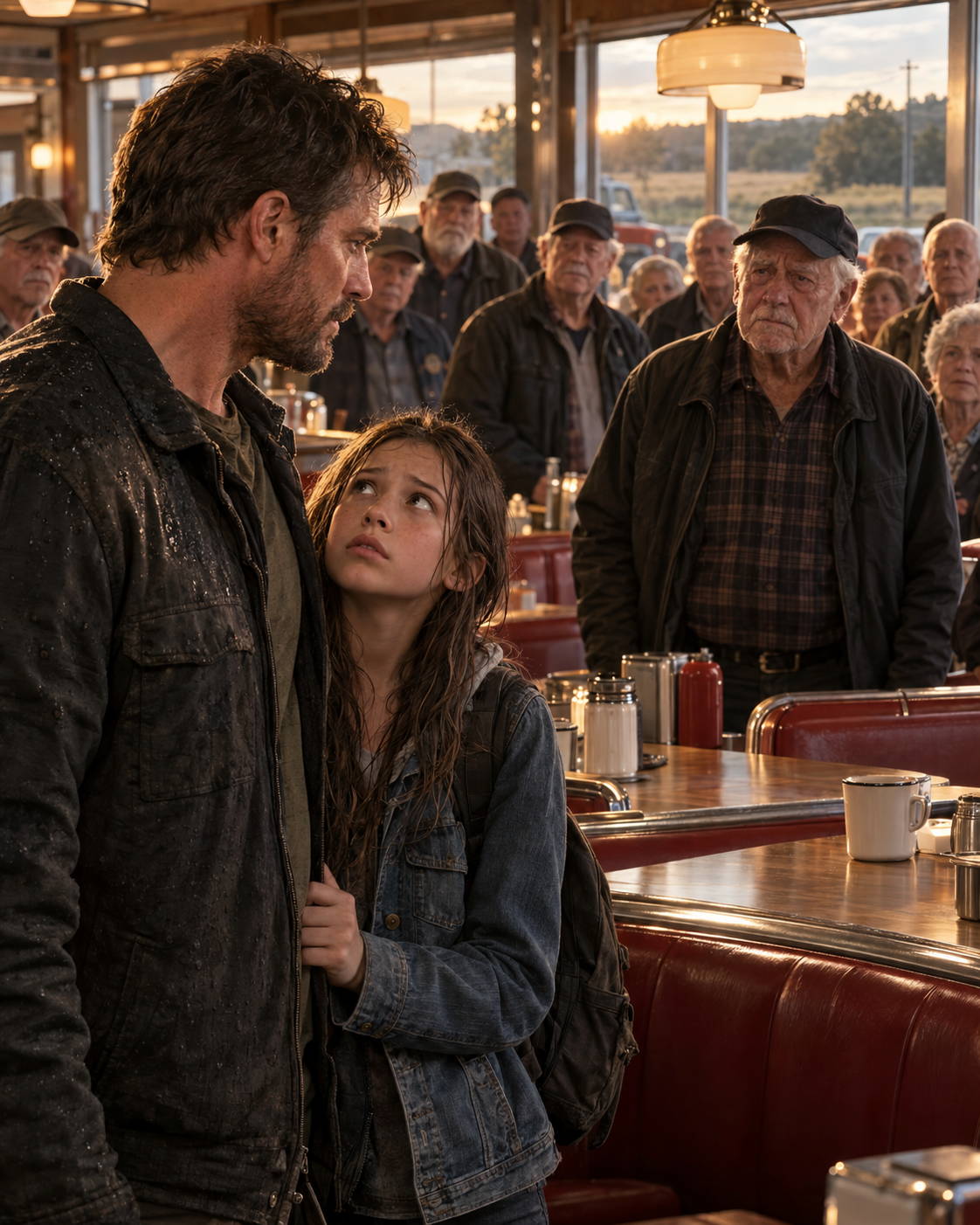
When twenty-three veterans suddenly stood beside their tables in a storm-soaked Texas diner while my twelve-year-old daughter stared
I turned the envelope over three times before opening it.
My hands were shaking so badly that Chloe finally reached out and held the bottom corner steady.
“You don’t have to read it tonight,” she whispered.
I almost believed her.
Then I saw the date.
September 19th, twelve years earlier.
I opened it.
Inside was a single folded sheet of paper.
The first line made my chest tighten.
“Daniel, if you’re reading this, I finally found a way to say thank you without asking you to carry anything for me.”
I stopped.
Chloe looked at my face.
“What does it say?”
I swallowed.
“It’s from Julian.”
I kept reading.
He wrote about the hospital.
About waking up and being told five men had survived.
About asking who had pulled him out.
About being told that the mechanic from the recovery vehicle had refused to leave.
Then came the part that hurt the most.
“Daniel, you keep thinking about the people we lost, but I need you to understand something you couldn’t see from that burning valley.”
I stared at the next sentence until the words blurred.
“You didn’t only save five soldiers.”
My breathing changed.
“You gave five families another Christmas morning.”
I lowered the letter.
For years, I had measured that day by the men who never came home.
Julian had measured it by the children who did.
That difference felt like a door opening somewhere inside a room I had kept locked for twelve years.
Chloe sat on an old toolbox beside me.
“Why didn’t you ever tell me?”
I looked at her.
Because I was ashamed of how afraid I had been.
Because every time someone called me brave, I remembered the men whose voices had disappeared beneath the gunfire.
Because I had confused surviving with deserving to be happy.
Because after Sarah died, I was terrified that if Chloe knew how much I had already lost, she would become afraid of losing me too.
But none of those answers sounded fair anymore.
“I thought the memories would hurt you,” I said.
Chloe looked down at the medals in my hand.
“Maybe hiding them hurt you.”
I didn’t have an answer.
She picked up one medal carefully.
“Did Mom know?”
That question hit differently.
I sat beside her.
“Sarah knew some things.”
“Some?”
“She knew I had been in Afghanistan.”
“Did she know about the rescue?”
I shook my head.
“Not everything.”
Chloe studied me.
“Why?”
I looked toward the dark garage door.
“Because when I came home, I wasn’t the person she married.”
Sarah had been the kind of woman who noticed everything.
She noticed when I stopped sleeping.
She noticed when fireworks made me flinch.
She noticed when I woke up sweating and stood at the kitchen sink until sunrise.
But she never forced the words out of me.
One night, years before Chloe was born, she found me sitting on the porch with my boots still on.
She sat beside me.
“You don’t have to tell me tonight,” she had said.
“Thank you.”
“But someday, Daniel, you have to stop punishing yourself for coming home.”
At the time, I had smiled and changed the subject.
I didn’t understand what she meant.
Now I did.
I had mistaken guilt for loyalty.
I thought remembering the dead required me to remain miserable.
Sarah had understood that remembering someone could also mean living enough to honor what they lost.
Chloe leaned against my shoulder.
“I wish you had told me sooner.”
“I know.”
“But I’m glad you told me now.”
That sentence stayed with me.
The next morning, I called Julian.
He answered on the second ring.
“You opened it.”
“Yes.”
There was a pause.
“What did you think?”
“I think you knew me better than I knew myself.”
He laughed softly.
“That’s what old friends are for.”
We talked for almost an hour.
He told me about his family.
His oldest daughter was applying to college.
His son had started playing baseball.
His youngest was obsessed with dinosaurs and apparently believed every large bird was secretly a velociraptor.
I listened to every detail.
Not because they were extraordinary.
Because they were ordinary.
Beautifully, painfully ordinary.
Those details were the part of the story I had never allowed myself to imagine.
Julian wasn’t just the medic I had pulled from a burning vehicle.
He was a father who packed lunches.
A husband who forgot anniversaries.
A man who complained about grocery prices and stayed up too late watching baseball.
He had a life.
A whole life.
And somehow, I had been standing at the edge of that life for twelve years without realizing it.
A week later, Julian invited us to his house.
I nearly said no.
Then Chloe said, “We’re going.”
So we went.
His wife opened the door and hugged me before I could say anything.
“Thank you,” she whispered.
I stepped back.
“You don’t have to thank me.”
She shook her head.
“I know.”
Then she looked at Chloe.
“We’re thanking you for something else.”
“For what?”
She smiled.
“For giving us the chance to know the man who helped our family exist.”
I couldn’t speak.
Behind her, Julian’s children were arguing about pizza.
One wanted pepperoni.
One wanted cheese.
The youngest was insisting dinosaurs preferred tacos.
I stood there listening.
And for the first time, the memory of September 18th didn’t begin with an explosion.
It began with laughter.
That changed everything.
Over the next few months, I started doing small things I had avoided for years.
I opened the garage box.
I cleaned the medals.
I read old letters.
I answered messages from veterans I had ignored because I didn’t know what to say.
Some nights were still hard.
Some memories still arrived without warning.
But they no longer owned every room in my life.
Chloe began asking questions.
Not all at once.
Never cruelly.
She asked what Afghanistan looked like.
She asked whether I had been scared.
She asked if the men I saved were my friends.
Sometimes I answered.
Sometimes I told her I wasn’t ready.
She accepted both.
One evening, she found me sitting at the kitchen table with the Christmas cards I had been sending for years.
“You still do them?”
“Yes.”
“Can I help?”
I looked at her.
“Are you sure?”
She nodded.
So that year, we sat together and wrote cards.
We didn’t pretend the words could fix anything.
We simply told families that their loved ones had not been forgotten.
When Chloe finished her first card, she stared at it for a long time.
“What if they don’t want to remember?”
I thought about that.
“Then they can put it away.”
“And if they do?”
“Then maybe they’ll know someone remembers with them.”
She nodded.
That was enough.
The following September, Julian called me before sunrise.
“I need you to come somewhere.”
“Where?”
“The valley.”
I stopped breathing.
He didn’t say anything else.
I knew what he meant.
For twelve years, I had never gone back.
I had avoided photographs.
I had avoided maps.
I had even avoided the word itself.
But that morning, I said yes.
I didn’t tell Chloe immediately.
When I finally did, she looked frightened.
“Are you going alone?”
“No.”
“Can I come?”
I hesitated.
She was twelve.
The answer should have been easy.
Instead, I realized I didn’t want to keep making decisions for her based on fear.
“We’ll talk about it.”
We didn’t end up going overseas.
The location was too dangerous, and Julian didn’t want either of us taking that risk.
Instead, he found an old training range in Texas where the landscape looked strangely similar.
A narrow road.
Dry hills.
A line of rust-colored earth beneath a wide sky.
When I stepped out of the truck, my body remembered before my mind did.
My hands went cold.
My hearing seemed to disappear.
For a moment, I wasn’t standing in Texas.
I was back there.
Smoke.
Metal.
Gunfire.
Julian touched my shoulder.
“Daniel.”
I couldn’t answer.
“Look at me.”
I did.
“You’re here.”
I nodded.
“Not there.”
Another nod.
“You’re here.”
I took a breath.
Then another.
Chloe stood a few feet away, watching.
She didn’t interrupt.
She didn’t cry.
She simply stayed.
That was the moment I understood something I had missed for years.
Healing wasn’t erasing the battlefield.
It was learning that the battlefield no longer had the final word.
Julian had three children because he survived.
His wife had a husband because he survived.
I had Chloe because I survived.
And somewhere beyond all of us were families who had lost someone that day.
Their grief was real.
Our lives were real too.
Both could exist at the same time.
Later that evening, Julian gave me a photograph.
It showed five young soldiers standing together before deployment.
I recognized every face.
I had carried their names in my memory for years.
On the back, Julian had written the names of their families and the lives they had built afterward.
Not because it made the losses smaller.
Because it made them human.
We sat outside beneath a dark Texas sky.
Chloe leaned against me.
“Dad?”
“Yeah?”
“Do you think they would want you to be sad forever?”
I looked at the photograph.
“No.”
“What do you think they would want?”
I thought about the question for a long time.
“Probably the same thing anybody wants.”
“What?”
“That the people they loved keep living.”
Chloe smiled faintly.
“Then you should probably listen.”
I laughed for the first time that day.
A year after the diner, we returned to the same roadside restaurant.
The storm was gone.
The windows were bright with afternoon sunlight.
Julian arrived with his wife and children.
The same veterans came from different towns, states, and retirement communities.
Some had changed.
Some walked with canes.
Some had gray hair they hadn’t had the year before.
Nobody stood when I entered this time.
Instead, Julian handed me a slice of birthday cake.
“What are we celebrating?”
He looked toward his youngest son.
“His tenth birthday.”
The boy grinned.
I looked at Julian.
He smiled.
“And twelve years since you gave me the chance to see it.”
I shook my head.
“That’s not what we’re celebrating.”
He raised an eyebrow.
“What then?”
I looked around the table.
At the families.
At Chloe.
At the veterans.
At the ordinary lives filling the room.
“We’re celebrating that we’re still here.”
Nobody spoke for a moment.
Then the youngest child lifted his fork.
“Can we celebrate with cake?”
Everyone laughed.
The sound was so ordinary that it nearly broke my heart.
I looked at Chloe.
She was smiling.
For years, I had believed the most important part of my story was the moment I pulled five men from burning wreckage.
I was wrong.
The rescue was only the beginning.
The real story was everything that happened afterward.
The birthdays.
The marriages.
The children.
The Christmas cards.
The quiet mornings.
The arguments over pizza.
The laughter in a diner while rain beat against the windows.
The people who kept going even when someone they loved could not.
I finally understood that courage wasn’t the absence of fear.
Sometimes courage was simply refusing to let fear decide what happened next.
That night, when Chloe and I drove home, she fell asleep in the passenger seat.
I glanced at her and smiled.
At the next red light, I reached into the glove compartment.
Julian’s old letter was there.
I had carried it with me ever since that night in the garage.
I unfolded it again.
There was one sentence near the bottom I had never noticed before.
“Daniel, someday your daughter will ask you why you came home when so many others didn’t.”
I stared at the words.
Then I read the final line.
“When she asks, don’t tell her you survived because you were stronger than them.”
I felt my eyes burn.
“Tell her you survived so you could become the father she needed.”
The light turned green.
I drove slowly toward home.
And for the first time in twelve years, I didn’t feel like I was driving away from the past.
I felt like I was carrying it somewhere safe.
When we reached the house, Chloe woke up.
“Dad?”
“Yeah?”
She pointed toward the garage.
“Are you going to put the medals back in the box?”
I looked at the closed garage door.
“No.”
She smiled.
“Good.”
I thought that was the end of it.
Then she opened her backpack and pulled out a small envelope.
“I found this in Mom’s things.”
My heart stopped.
“Where did you find that?”
She handed it to me.
There was no name on the front.
Only a date.
September 18th.
I looked at Chloe.
She was watching me carefully.
“I think Mom knew more than you ever told me.”
I turned the envelope over in my hands.
For twelve years, I had thought I was the one keeping secrets.
But as I stood beneath the garage light with Sarah’s handwriting staring back at me, I realized there might still be one piece of that day that even Julian didn’t know.
And this time, I wasn’t afraid to open it.