When the base commander told me to stay in the simulator bay while everyone else scrambled toward the runway
The folder felt heavier than paper should have felt.
I looked at Lin, then at Colonel Calder.
“That’s impossible.”
Lin didn’t blink.
“We thought so too.”
She opened the folder on the hood of a service truck while the sunrise turned the frost pink around us.
Inside was a copy of the command signature that had overridden part of Ghost Rider Two.
Beneath it was an older signature from the Syria incident.
They matched.
Not my credentials.
Not Nolan’s.
A third authorization belonged to someone with access far above squadron level.
I knew the name immediately.
Colonel Adrian Vale.
He had been the senior operations officer during the mission that ended my career.
For three years, I had believed Vale’s report had been the final word.
Now I realized it had only been the version he wanted preserved.
“Where is he?” I asked.
“Retired from active duty,” Lin said.
“Consulting for Northstar Dynamics.”
The same contractor that had built Ghost Rider’s adaptive network.
My stomach tightened.
Nolan limped out of the medical building before anyone could stop him.
He looked exhausted, but he was smiling.
“You always did know how to make an entrance.”
I handed him the folder.
His smile disappeared.
He read the first page.
Then he looked at me.
“They used the Syria code to take Ghost Rider.”
“And possibly to remove me from the cockpit three years ago.”
Nolan sat on a low concrete barrier.
“I remember something.”
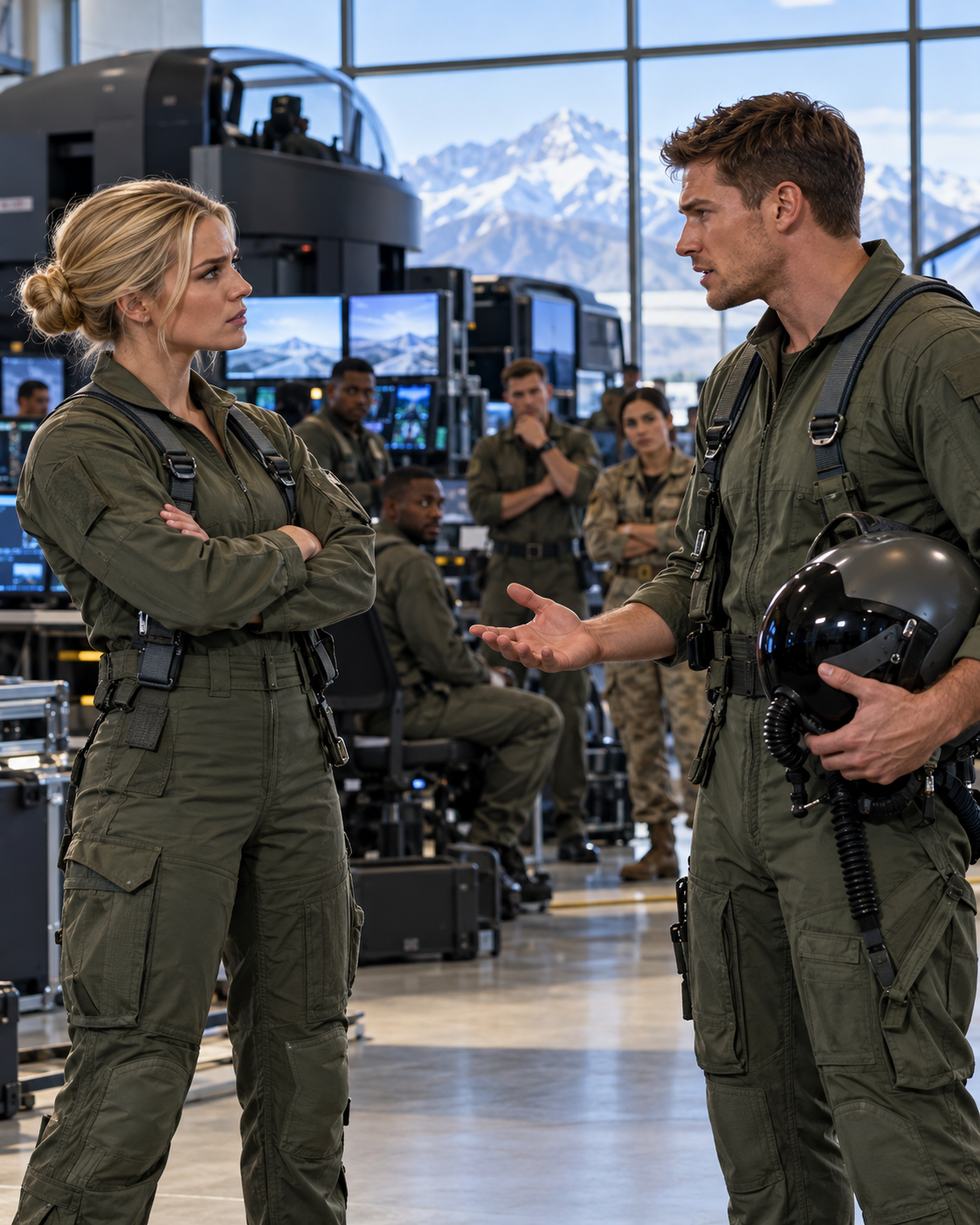
“What?”
“Before we flew that night in Syria, Vale told me you were unstable.”
I stared at him.
“He said your judgment was compromised.”
“You believed him?”
“I was nineteen minutes from launching.”
He looked ashamed.
“I believed everyone except you.”
That confession hurt more than I expected.
Not because I blamed Nolan.
Because it reminded me how quickly a person can become a story once authority gives everyone the same version.
We took the evidence to Calder.
He ordered a secure review team assembled.
For the first time, I wasn’t waiting outside a locked door.
I was sitting at the table.
The investigation uncovered a pattern buried across years of test programs.
Northstar had developed an autonomous combat architecture designed to learn from human reactions.
During classified trials, engineers had secretly introduced stress events and recorded how pilots responded.
A handful of officers had objected.
Those officers had been reassigned.
A few had been discredited.
And one mission had nearly exposed the entire program.
Mine.
The Syria extraction had not been a simple protocol dispute.
My wingman had been trapped because a Northstar routing update had corrupted our mission data.
The approved route would have left him behind.
I had ignored the route and flown into an improvised corridor to bring him home.
The report called it reckless.
The hidden telemetry called it necessary.
I sat alone after reading that line.
Three years.
Three years of wondering whether saving one man had destroyed everything I had worked for.
The truth was almost crueler.
I had saved him, and someone had needed my career destroyed because I had accidentally uncovered the flaw in their system.
Brennan found me in the simulator bay that evening.
He leaned against the doorway.
“You okay?”
“No.”
He nodded.
“Good.”
I looked at him.
“Good?”
“People who are actually okay don’t look like they’re trying to rebuild their bones from the inside.”
I laughed despite myself.
He stepped closer.
“You don’t have to prove anything tonight.”
“I’ve been proving myself for three years.”
“That’s why you don’t have to.”
I looked at the simulator screens.
For years, they had been my punishment.
Now they felt like witnesses.
“I thought if I stopped flying, I’d stop remembering.”
Brennan shook his head.
“You don’t stop carrying something by putting it in a closet.”
The next morning, I returned to the simulator.
Not as an instructor.
As a pilot.
The first motion made my stomach turn.
The second made my palms sweat.
By the third, my body remembered.
I flew through the scenario that had haunted me for years.
Syria appeared on the screen.
The same valley.
The same weather.
The same simulated voice warning me to remain on course.
This time I ignored the command.
Not because I was reckless.
Because I knew the command was wrong.
I brought the wingman home.
When the simulation ended, I sat in silence.
Lin entered the room.
“Colonel Calder wants you upstairs.”
“What happened?”
“Vale disappeared.”
My blood ran cold.
His house had been emptied overnight.
His consulting office had been wiped.
His company accounts were already being transferred through shell corporations.
And one encrypted message had been intercepted before he vanished.
It contained only six words.
“Banshee is awake. Burn everything.”
Calder assembled a joint team within the hour.
Federal investigators arrived.
Military lawyers arrived.
Northstar executives began declining interviews.
Then we discovered something that changed the case.
The Ghost Rider breach had not been designed simply to make the aircraft attack.
It had been designed to create an impossible emergency that would justify emergency data deletion across several connected test platforms.
The AI was never the final weapon.
It was the eraser.
Comstock-style failures.
Testbed losses.
Pilot injuries.
Missing maintenance logs.
All of them could be blamed on autonomous systems becoming unpredictable.
The people who caused the failures would disappear behind the technology.
And if someone survived, the system could be blamed for that too.
I thought about Nolan, unconscious over the Bering Sea.
I thought about Daniel Pike, the technician whose warning vanished.
I thought about my wingman in Syria.
I thought about how many people had spent years believing themselves guilty of mistakes someone else had designed.
Then we found Vale.
He was not hiding far away.
He was inside a Northstar training facility less than two hundred miles from Fairbanks.
He had returned to retrieve one final archive.
Calder wanted a tactical team.
I volunteered.
He looked at me for a long moment.
“This isn’t about revenge.”
“I know.”
“Do you?”
I nodded.
“It’s about preventing the truth from disappearing again.”
We arrived before dawn.
The facility looked abandoned.
Snow had buried the access road.
Every window was dark.
Lin detected a faint signal beneath the main building.
We entered through a service corridor.
The deeper we went, the warmer the air became.
At the end of the corridor, a door opened.
Vale stood inside.
Older than I remembered.
Tired.
But not afraid.
He smiled when he saw me.
“Banshee.”
I kept my weapon lowered.
“You destroyed my career.”
“I protected the program.”
“You lied about me.”
“I made you believable.”
The words hit with a strange emptiness.
“Believable?”
“You had disobeyed orders.”
“I saved my wingman.”
“Exactly.”
He stepped toward the console.
“You made the perfect scapegoat because everyone wanted clean heroes and clean villains.”
I felt something inside me crack.
Not rage.
Something quieter.
Understanding.
“Was Daniel’s death part of it?”
Vale looked away.
“No.”
The answer surprised me.
Then he said, “Daniel found the corruption before we were ready.”
“What happened?”
“He threatened to expose it.”
“And you let him die.”
Vale said nothing.
That silence answered enough.
Lin whispered through my earpiece.
“Claire, he’s preparing a purge.”
Vale reached for the console.
I moved.
He triggered the sequence.
The facility alarm exploded into life.
Red lights flashed.
Doors slammed shut.
The servers began wiping themselves.
I ran for the central terminal while Brennan’s team secured the corridor.
Vale tried to block me.
I caught his arm.
He fought harder than I expected.
We crashed into the console.
For a second, I saw only the old flight deck.
The old cockpit.
The moment my career had disappeared.
Then I remembered something Brennan had told me.
You don’t stop carrying something by putting it in a closet.
I stopped fighting Vale long enough to look at the screen.
The purge had a manual interruption.
The same design flaw as Ghost Rider.
A delay in the lower system during a priority reroute.
I smiled.
It was almost poetic.
“Claire?”
“I know this system.”
I reached beneath the panel.
There.
A maintenance isolation switch.
I pulled it.
The purge stopped.
Every screen froze.
The room became silent.
Federal agents entered seconds later.
Vale didn’t resist.
He simply looked at me.
“You always were difficult.”
I met his eyes.
“No.”
I looked at the frozen archive.
“I was just paying attention.”
During those months, I finally met Daniel’s family.
His sister, Elena, invited me to a quiet house outside Spokane.
I almost turned around three times before ringing the bell.
When she opened the door, she looked at me for a long moment.
“You’re Claire.”
I nodded.
She pulled me into a hug before I could say anything.
I cried against her shoulder.
“I should have called sooner,” I whispered.
“You were a victim too,” she said.
That sentence stayed with me.
For years, I had carried Daniel’s death like a private debt.
His family taught me I did not owe them a punishment.
They showed me letters he had written before the mission.
In one, he mentioned me by name.
“Claire thinks flying is the only way to feel alive.”
Then, underneath it, he had written, “She’s wrong.”
“She makes people feel alive just by showing up.”
I read that line until the words blurred.
After I returned to Alaska, I placed the letter inside my flight log.
Not as a memorial.
As a reminder.
The people we lose don’t need us to spend our lives proving we miss them.
They need us to live the lives they believed we could.
The new squadron also changed the way I taught.
I stopped rewarding pilots for looking fearless.
I taught them to speak when something felt wrong.
I told them about the moments I had been afraid to challenge authority.
I told them how easy it was to mistake silence for discipline.
Sometimes the younger pilots looked uncomfortable.
Good.
Discomfort could save a life.
One afternoon, a lieutenant asked me why I insisted that every crew member, regardless of rank, had the right to call for an emergency stop.
“Because the person closest to the problem is often the first person who sees it.”
“What if they’re wrong?”
“Then we correct them.”
“And if they’re right?”
I looked at him.
“Then everyone gets to go home.”
The investigation lasted months.
It exposed contracts, hidden test data, falsified reports, and a culture that had confused obedience with safety.
Northstar’s executives faced federal charges.
Vale entered a plea agreement and agreed to testify.
The old Syria investigation was formally reopened.
My record was cleared.
Not because someone felt sorry for me.
Because the evidence finally said what I had known in my bones for three years.
I had made a hard choice in a dangerous moment.
It had saved a life.
And the punishment had been manufactured to protect people who had made far worse choices.
The medal ceremony was held on a cold March morning.
I stood beneath the same hangar lights where I had once watched my flight wings taken away.
Nolan stood in uniform beside me.
My former wingman, now using a cane, was in the front row.
Colonel Calder stepped to the podium.
He didn’t give a long speech.
He simply said, “Major Mercer was removed from flight status for choosing human life over a compromised order.”
He paused.
“The record now recognizes that choice for what it was.”
Then he saluted.
I saluted back.
When the ceremony ended, people came toward me.
Some apologized.
Some shook my hand.
One young instructor approached nervously.
“Ma’am?”
“Yes?”
“I trained under you three years ago.”
“I remember.”
“I thought you were the toughest instructor here.”
I smiled.
“That isn’t what people said.”
He shook his head.
“They were wrong.”
For the first time, I didn’t need to argue with him.
That afternoon, Calder offered me permanent command of the new Arctic emergency aviation unit.
I accepted.
But I changed one thing before signing the paperwork.
The unit charter began with a sentence no one in the room expected.
“Mission success never outranks the preservation of human life.”
Brennan read it twice.
“That’s going to make some people uncomfortable.”
“Good.”
He smiled.
“Then it might actually matter.”
Months later, the simulator bay felt different.
The same machines were still there.
The same screens.
The same cold metal.
But I was no longer hiding inside the room.
Young pilots came to me for advice.
Nurses came to train in emergency aviation.
Engineers came to test rescue systems.
And sometimes, when the building emptied, I sat alone with the lights off.
I still dreamed about Daniel.
I still remembered the pressure in my chest when I pulled nine Gs.
I still woke some nights hearing alarms that weren’t there.
Healing, I learned, wasn’t becoming the woman I had been before the trauma.
It was becoming someone who no longer needed to be that woman.
One summer evening, Nolan and I stood beside the runway.
“You ever regret getting back in?” he asked.
I watched an F-35 disappear into the sunset.
“Every time I remember what almost happened.”
He nodded.
“And still?”
I smiled.
“Still.”
He laughed.
“That’s the most Banshee answer I’ve ever heard.”
Maybe he was right.
Maybe courage was never about becoming fearless.
Maybe it was about refusing to let fear make all your decisions.
A year after Ghost Rider, our squadron launched its first real-world rescue mission.
A civilian aircraft had gone down in severe weather north of the Arctic Circle.
The weather was closing.
The terrain was brutal.
The clock was moving.
I climbed into the cockpit.
My helmet locked into place.
The canopy came down.
For three years, I had thought the sky had rejected me.
Now I understood something simpler.
The sky had never rejected me.
People had.
And people could be wrong.
I started the engines.
“Banshee,” Brennan said over the radio.
“You’re cleared.”
I looked through the canopy at the mountains.
“Copy.”
The aircraft rose into the cold blue morning.
Below me was everything I had survived.
Above me was everything I hadn’t.
And somewhere between the two was the lesson I wished I’d learned sooner: you can lose your title without losing yourself, lose your place without losing your purpose, and lose years to someone else’s lie without surrendering the years that come next.
I had spent three years hiding because I believed disappearing would keep the past from hurting me.
Instead, it only gave the past more room to decide who I was.
So I stopped hiding.
Not because the scars vanished.
Because they no longer had the authority to define me.
And as the aircraft climbed toward the horizon, I heard Nolan’s voice through the radio.
“Banshee, we’ve got another call.”
I smiled.
“Then let’s go.”
The sky opened in front of me.
For the first time in years, I didn’t feel like I was returning to who I had been.
I felt like I was finally becoming who I was supposed to be.