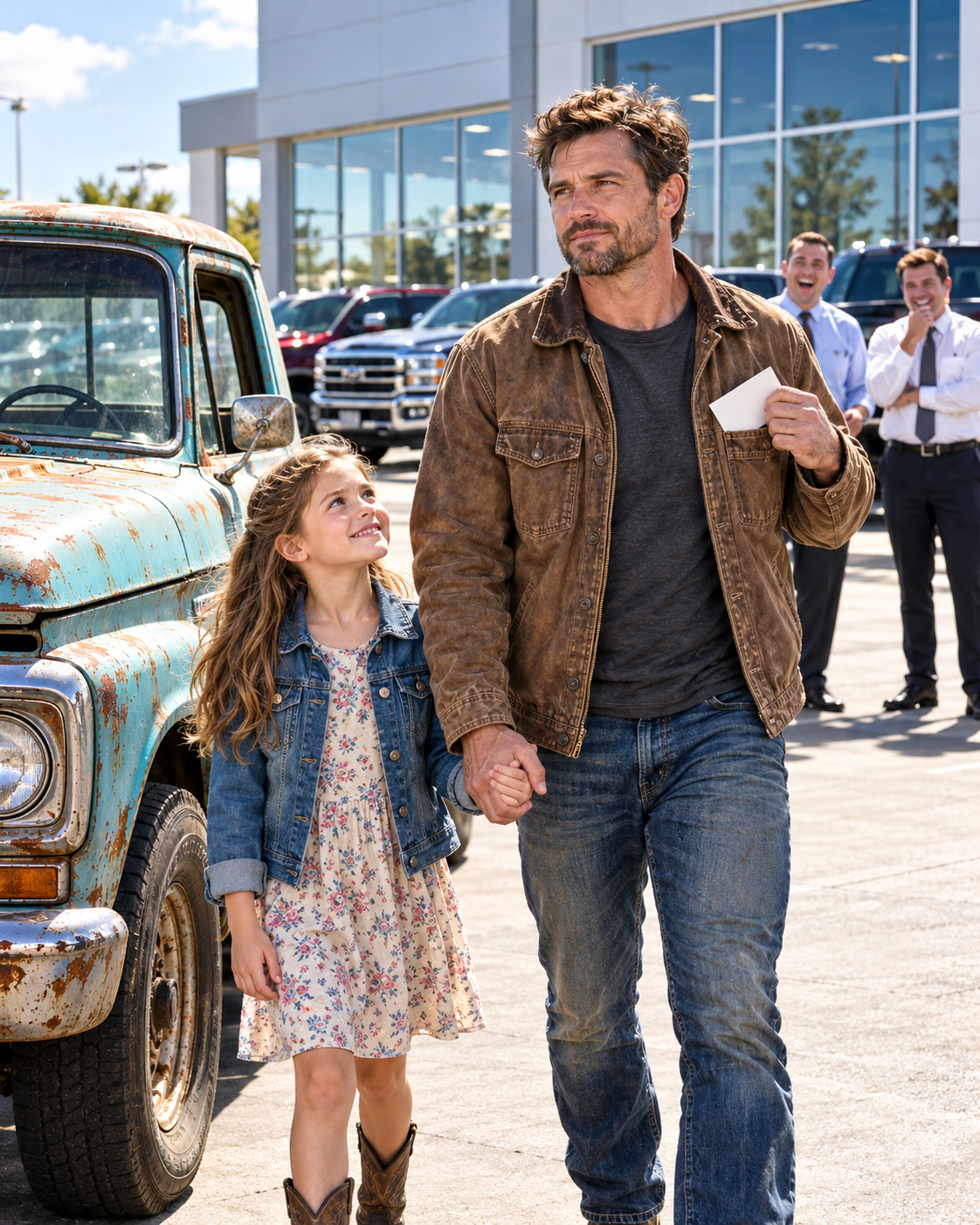
When my rust-covered pickup coughed to a stop outside Oakridge Motors, a senior salesman laughed in my face
Part 2
I read the sentence three times before my mind accepted the meaning of the words.
The photograph was old, probably from the 1970s, and the woman in it had Clara’s eyes, Clara’s narrow chin, and the same slight tilt of her head that appeared whenever she was listening instead of speaking.
I turned the picture over again, hoping the handwriting might somehow change.
It didn’t.
There was no name on the front of the photograph.
No date.
No explanation.
Only that sentence.
I called the number printed on the return address.
An elderly man’s voice answered after the fourth ring.
“Mr. Mercer?”
“Yes.”
“My name is Walter Hale.”
I held my breath.
“How do you know me?”
He was quiet for a moment.
“I know who you married.”
My chair scraped the floor as I stood.
“How?”
“Because Clara was my granddaughter.”
The room seemed to shrink around me.
I had spent four years believing Clara’s family history was simple, if painful.
Her adoptive parents had raised her from infancy.
She knew she was adopted, but they had always told her that her biological mother had died young and that her father had never been identified.
There had never been a grandfather.
There had never been a factory.
There had never been a Walter Hale.
I told him I needed proof.
He said, “You should.”
The following afternoon, he arrived at my office with a worn leather case and a face that looked carved by decades of regret.
Chloe was at school.
I had deliberately kept the meeting private.
Walter placed several documents on my desk.
The first was a birth certificate.
The second was an old court record.
The third was a photograph of the same woman from the envelope, this time standing beside a younger Walter outside a manufacturing plant in Pennsylvania.
Her name was Margaret Hale.
Walter told me Margaret was his only daughter.
She had fallen in love with a mechanic named Thomas Reed when she was barely twenty.
Her father disapproved.
“They disappeared for a while,” Walter said. “Then Margaret came back pregnant.”
“What happened?”
Walter looked down at his hands.
“That is the part I have spent fifty years wishing I could change.”
Margaret did not marry Thomas.
She gave birth to a baby girl and vanished from the hospital records almost immediately afterward.
Walter said his daughter had been pressured by relatives who believed the child would destroy the family’s reputation.
The baby was placed for adoption.
Walter searched for Margaret for years.
He found her once, briefly, in Ohio.
She told him she wanted nothing to do with the family.
After that, she disappeared again.
“Why did you never find Clara?” I asked.
Walter closed his eyes.
“Because I didn’t know there was a Clara.”
He explained that the adoption had been handled through intermediaries, and the records were sealed.
He had spent decades searching for Margaret, not realizing she had died young and that the child he had been looking for had grown up under another surname.
Then, months before he contacted me, Walter saw an anonymized business article about the Oakridge Motors transaction.
The article mentioned an eight-hundred-truck logistics company, a widowed owner, and an unusual thirty-one-year-old pickup kept for sentimental reasons.
Walter recognized the truck before he recognized the business.
I frowned.
“How could you recognize my pickup?”
He stared at me with wet eyes.
“Because I knew the man who built that factory.”
He tapped the photograph.
“That factory belonged to my family.”
I looked down at the picture of Margaret again.
Walter leaned forward.
“That truck was produced using components from our original manufacturing division during a limited run.”
He explained that the model had an unusual frame configuration and a factory stamp known to collectors.
Years before his company collapsed, Walter had personally overseen the production line.
But there was more.
He opened another folder.
Inside was a letter dated forty years earlier.
The letter had been written by Margaret.
Walter had never received it.
It had been stored among documents from an old estate liquidation and only recently found its way back to him.
I unfolded the brittle paper carefully.
Most of it was about ordinary things.
Money.
A broken relationship.
A promise to come home.
Then I reached one paragraph that made my hands go numb.
Margaret wrote that she had discovered something terrible about the family and was afraid her father would be harmed if she spoke openly.
She mentioned a missing ledger.
She mentioned a false death certificate.
And she mentioned a child whose identity had been deliberately buried.
I looked at Walter.
“What was in the ledger?”
“I don’t know.”
“Who made the death certificate?”
He shook his head.
“I never learned.”
The story should have frightened me.
Instead, what broke me was the idea that Clara might have spent her entire life carrying answers no one had ever given her.
I thought about the nights she had talked about feeling like she belonged to several families and none of them at the same time.
I remembered asking once whether she ever wanted to search for her biological relatives.
She had laughed softly and said, “People usually go looking because they expect to find something missing.”
Then she had rested her head on my shoulder.
“I already found you.”
I had assumed she was speaking about me.
Now I wondered what else she might have meant.
Walter stayed at my office until sunset.
Before he left, I asked him one final question.
“Why contact me now?”
His answer was almost a whisper.
“Because I was too late for Margaret, too late for Clara, and I was terrified I would be too late for you.”
After he left, I sat alone with the photograph.
For the first time since Clara died, grief felt different.
It was no longer only the pain of losing her.
It was the realization that there might be parts of her life I had never known.
That night, Chloe found me at the kitchen table with the photograph in front of me.
“Is that Mom?”
I looked at the picture.
“Yes.”
“Who is the man?”
“Someone who knew her family.”
She climbed into the chair beside me.
“Are you sad?”
I swallowed.
“A little.”
She studied the photograph.
“Does this mean Mom had secrets?”
I looked at my daughter and understood that she deserved the truth, but she did not deserve the weight of every unanswered question.
“Everyone has parts of their life they don’t get to explain,” I said.
Chloe touched the photograph with one finger.
“Do you think Mom knew?”
I stared at her hand.
“I don’t know.”
That was the hardest answer I had ever given her.
Over the next several weeks, Walter and I searched through archived records, court filings, factory documents, and old newspaper reports.
We found no smoking gun.
We found no neat ending.
We found fragments.
A company account with unexplained withdrawals.
A property deed transferred under suspicious circumstances.
A sealed adoption entry.
A newspaper article about Margaret’s disappearance that had never been followed by a full investigation.
Every answer created two new questions.
Then we found the name of a lawyer who had handled the original adoption.
He was dead.
His office had been demolished.
His files were supposedly destroyed.
Supposedly.
One afternoon, Walter called me sounding different.
He had found a retired secretary who once worked for the lawyer.
She remembered one detail.
There had been another family involved in the adoption.
A family with influence.
A family that had insisted the child’s identity remain hidden.
And beside that information in the secretary’s old notebook was a surname I recognized instantly.
Hale.
My stomach dropped.
The secret had not been outside Clara’s family.
It had been inside it.
Part 3
Three months later, Walter and I stood in a storage facility outside Harrisburg, staring at a rusted filing cabinet that had survived two office moves and a warehouse fire.
The retired secretary had kept it because she believed one day someone would come looking for the truth.
Inside was a single envelope addressed to Margaret.
The seal had never been broken.
Walter’s hands trembled as he opened it.
The letter was from Thomas Reed, Clara’s biological father.
He had written that he knew the family wanted the baby given away, but he refused to sign away his parental rights.
He had planned to fight them in court.
Then, three days before the hearing, he vanished.
The official record said he had left town voluntarily.
The letter suggested otherwise.
There was no proof of murder.
No proof of kidnapping.
No proof of a conspiracy large enough to satisfy the darker instincts my mind immediately reached for.
There was only evidence that powerful people had controlled information, manipulated records, and buried a truth because they believed they could.
Walter cried when he finished reading.
“My daughter lost her father,” he said, “and I lost both of them because I trusted the wrong people.”
I did not know what to say.
So I put a hand on his shoulder.
Sometimes there are wounds words cannot close.
They can only be witnessed.
We eventually learned that Clara had been adopted legally and lovingly by people who had not been responsible for the original deception.
Her adoptive parents had genuinely believed they were protecting a child from a dangerous family conflict.
That distinction mattered.
The truth was ugly, but it was not simple.
There were no perfect villains waiting at the end of the story.
There were frightened people, selfish people, grieving people, and people who convinced themselves that controlling the truth was the same thing as protecting someone from it.
I wondered whether Clara would have hated them.
I wondered whether she would have forgiven them.
Most of all, I wondered what she would have done with the truth.
Then I remembered who she had always been.
She would have chosen Chloe.
She would have chosen home.
She would have chosen whatever left the fewest scars on the people she loved.
So I did the same.
I told Chloe enough to understand that her mother’s family history had been complicated and that some truths had been hidden from Clara herself.
I did not give her every document.
I did not turn her childhood into an investigation.
I told her that being loved is still real even when parts of the past are not.
She listened quietly.
Then she asked, “Did Mom do anything wrong?”
“No.”
“Did you?”
I thought about the pickup.
The years of work.
The nights I had spent angry at the world for taking Clara.
“No,” I said. “I think I just spent too long believing I had to carry everything alone.”
Chloe wrapped her arms around me.
That hug lasted longer than the question.
A year later, I drove the old pickup back to the factory where Walter had once worked.
The building had been renovated into a private archive and small transportation museum.
He had arranged for the original production records to be preserved there.
I parked beneath a faded sign and turned off the engine.
For a moment, everything was still.
I could almost hear Clara laughing at the dashboard, complaining that I was driving too slowly.
Chloe sat beside me now, older by a year, wiser than a child should have needed to become.
She looked through the windshield at the old factory.
“Was this where Mom’s family worked?”
“Part of it.”
She nodded.
Then she touched the cracked dashboard.
“Was this truck here before I was born?”
“Before I met your mother.”
She smiled.
“Mom would have liked that.”
I smiled too.
“She probably would have complained about the rust.”
We walked through the archive with Walter.
On the final wall hung the photograph of Margaret, restored and framed.
Beside it was a copy of the letter that had changed everything.
There was no grand revelation.
No confession that neatly explained every tragedy.
No villain stepping from the shadows to admit what had been done.
Instead, there was something quieter and harder.
There was the truth that families can break under fear, that silence can outlive the people who created it, and that children can inherit mysteries they never asked for.
Walter looked at me before we left.
“Do you ever regret keeping that old truck?”
I glanced back at it through the open garage door.
“Never.”
He smiled.
“Why?”
I thought of Clara in that rainy parking lot, telling me that a good business should remember what it cost to become honest.
“Because she chose it with love,” I said.
“And because every time somebody sees an old truck and assumes they know the man behind the wheel, I remember how wrong appearances can be.”
That evening, Chloe and I sat on our front porch as the sky turned violet above the trees.
The company had continued to grow, but I had stopped measuring my life by truck counts, contracts, and bank balances.
There were things I valued more now.
A child who still held my hand when she was afraid.
A photograph that had returned a piece of Clara to us.
An old man who finally got to say goodbye to the family he had spent a lifetime searching for.
And a battered pickup that carried more history than anyone in that dealership could have guessed.
Chloe leaned against my shoulder.
“Dad?”
“Yeah?”
“Do you think Mom is proud of us?”
I looked toward the driveway.
The old truck sat beneath the porch light, its rust glowing softly in the darkness.
“I know she is,” I said.
I did not say it because ghosts had spoken to me.
I said it because everything Clara had taught us was still alive.
She had taught me that dignity is not something you buy.
She had taught me that wealth does not excuse cruelty.
She had taught me that the smallest promises matter when the world falls apart.
And she had taught me that love can survive even when answers never arrive in the order we want.
The next morning, I drove that same thirty-one-year-old pickup to work.
At the first red light, I looked down at the worn steering wheel where Clara’s hand had rested a thousand times.
For years, I had thought the truck was an anchor to the past.
Now I understood it was a bridge.
It connected the man I had been, the woman who believed in him, the daughter they had raised, and the truth that had taken decades to find its way home.
People still judged the truck.
People still judged me.
Some always would.
But I had finally stopped needing strangers to see what mattered.
Because the world can mistake rust for ruin, quiet for weakness, and humility for poverty.
It can laugh at what it does not understand.
And sometimes, the people who look down on you have no idea that the thing they are mocking is holding together the story that made you who you are.
I parked outside our office, shut off the engine, and sat there for a moment.
Then I whispered the words Clara had once told me in that rainy parking lot.
“Let’s keep going.”
And for the first time, those words did not feel like a command to survive.
They felt like permission to live.