When my mother stood beneath the crystal chandeliers of a packed vineyard ballroom and read a speech about our “reconciliation”
Part 2
The retirement gala was held at a vineyard outside Charlotte, the kind of place with sweeping hills, polished stone walls, and enormous windows overlooking rows of grapevines.
Two hundred people were expected.
Coworkers.
Neighbors.
Church members.
Extended relatives.
People who had heard Martha’s version of my life for two years.
I knew because Uncle Thomas kept me updated.
He never pressured me to attend.
He never told me what to do.
He simply said, “Whatever you decide, don’t let her decide it for you.”
Kendra sat beside me that night at our kitchen table.
The house was quiet.
Rain tapped against the windows.
“Do you want to go?” she asked.
I looked at her.
“No.”
She nodded.
“Then don’t.”
There was no guilt in her voice.
No accusation.
No warning.
Just permission to trust myself.
The next morning, Thomas sent me a photograph.
It was the printed program for the gala.
There, beneath Martha’s name, was a special section titled “A Mother’s Greatest Blessing.”
I read the first few lines.
It described me as the child she had “never stopped loving despite his tragic distance.”
There was no mention of the ultimatum.
No mention of the wedding.
No mention of Kendra.
Just enough sadness to make her look abandoned and noble.
Then I saw the final line.
“Tonight, I hope my son finally comes home.”
I put the phone down.
Kendra touched my shoulder.
“You don’t owe anyone a performance.”
I knew she was right.
So I stayed home.
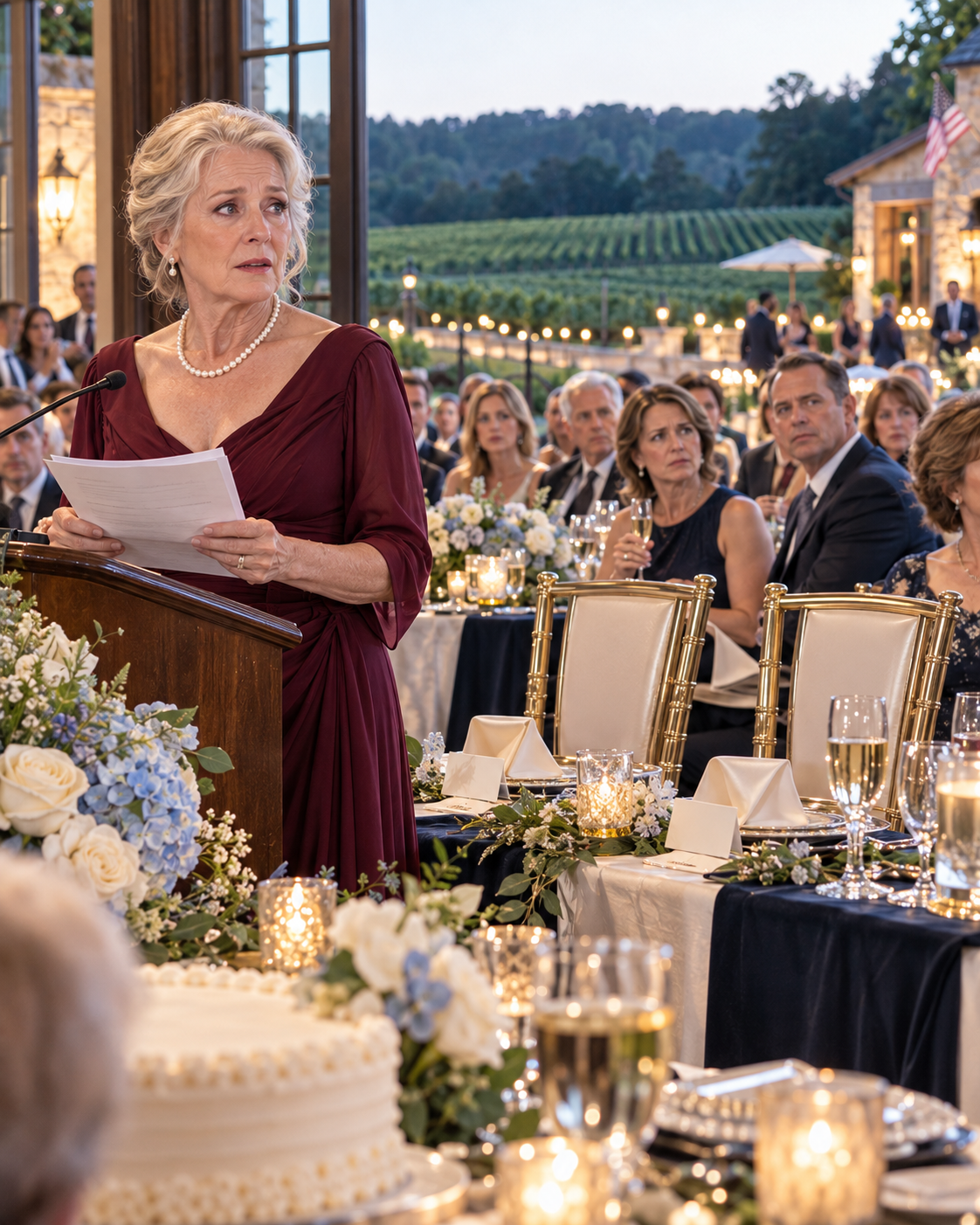
At the vineyard, Martha walked into a ballroom filled with candlelight, champagne glasses, and carefully arranged flowers.
Two chairs waited beside her at the head table.
Mine.
Kendra’s.
They remained empty.
At first, people probably assumed we were late.
Then dinner ended.
The speeches began.
Someone praised Martha’s dedication.
Someone else talked about her generosity.
Brenda reportedly smiled through every word.
And then Martha stood.
She held a laminated speech in both hands.
Thomas later told me that her voice sounded confident at first.
She thanked everyone for coming.
She talked about her career.
She talked about resilience.
Then she looked toward the two empty chairs.
“I have one more thing to say tonight,” she announced.
The room grew quiet.
She began reading about forgiveness.
About family.
About how no disagreement should ever be stronger than a mother’s love.
People listened.
Then she reached the part where she had written about welcoming her son home.
Her voice reportedly cracked.
She looked at my empty chair.
Then at Kendra’s.
And for the first time, there was no applause waiting for her.
There was only silence.
Two hundred people suddenly understood something they had not been told.
My absence wasn’t part of a reconciliation.
It was the evidence that there had never been one.
Martha finished the speech anyway.
She lowered the paper.
No one moved.
Thomas told me that someone near the back whispered, “Where is he?”
Another person asked, “Did she invite him?”
Martha had no answer that could survive the room.
She had built the entire evening around the assumption that I would eventually obey.
When I didn’t, the illusion collapsed in front of everyone.
She drove home alone that night.
For the first time in decades, Martha had nowhere to hide behind applause.
She had told a story in which she was the abandoned mother and I was the ungrateful son.
But the empty chairs had become a question no speech could answer.
A week later, someone knocked on our front door.
I opened it.
Martha stood on the porch.
She looked smaller than I remembered.
Not physically.
Emotionally.
There was no polished smile.
No prepared speech.
No accusation.
She held both hands together like she was afraid they might start shaking.
Kendra came into the hallway behind me.
Martha looked at her.
Then she looked back at me.
“I was wrong.”
I didn’t answer.
She swallowed.
“I thought if I lost control of you, I would lose you.”
Her eyes filled with tears.
“So I convinced myself that controlling you was protecting you.”
I felt anger rise in my chest.
“You told everyone I abandoned you.”
“I know.”
“You told them Kendra manipulated me.”
“I know.”
“You told me I couldn’t come home if I married my wife.”
Martha closed her eyes.
“I know.”
For a long moment, nobody spoke.
Then Kendra quietly said, “Would you like some tea?”
Martha looked at her as though she hadn’t expected kindness to still be possible.
“Yes,” she whispered.
We sat around our kitchen table.
It was almost surreal.
The same kind of table where Martha had once delivered the ultimatum.
But this time, she had no power over the room.
I told her the truth.
“We are not going to pretend the last two years didn’t happen.”
She nodded.
“We’re not going to erase what you said.”
Another nod.
“And you don’t get access to our life just because you’re sorry.”
Her eyes lowered.
“I understand.”
I leaned back.
“If you want a relationship with us again, there are conditions.”
Martha looked at me.
“What conditions?”
“You correct the lies.”
She went still.
“With the family.”
I continued.
“With the people at church.”
I paused.
“And anyone else you’ve told.”
She looked terrified.
For once, I understood that fear.
It was the same fear I had carried for years.
But I did not use it against her.
“And Kendra gets absolute respect,” I said.
“No comments disguised as compliments.
No silent punishment.
No guilt.
No competition.”
Martha wiped her eyes.
“I can try.”
I shook my head gently.
“Trying isn’t enough anymore.”
She looked at me for a long time.
Then she nodded.
“I’ll do it.”
She left that afternoon without asking to come inside again.
I watched her walk down the driveway.
Kendra slipped her hand into mine.
“How do you feel?”
I thought about it.
“Sad.”
She waited.
“And relieved.”
That night, I slept better than I had in weeks.
Part 3
Change did not happen overnight.
For the first month, Martha stumbled constantly.
She called relatives and corrected parts of the story.
Some believed her.
Some didn’t.
Some asked difficult questions.
Thomas told me she had gone back to people she had once impressed with her version of events and said, “I didn’t tell you the whole truth.”
That sentence cost her something.
I knew it did.
Because telling the truth after spending years building a lie is not one grand heroic act.
It is a thousand humiliating little admissions.
Martha made them anyway.
She told Brenda.
She told church friends.
She told former coworkers.
She even contacted people who had never asked for clarification because she realized they deserved one.
She said the ultimatum had been hers.
She said Kendra had not stolen me.
She admitted that I had left because I wanted a marriage that was not controlled by fear.
Six months passed.
Martha still had difficult days.
Sometimes she slipped into old habits.
Sometimes she asked questions that were really demands.
But now, when I heard that old tone, I recognized it immediately.
And instead of shrinking, I said, “That’s not okay.”
The first few times, she became defensive.
Then she stopped.
“I’ll think about that,” she would say.
That sentence meant more to me than any dramatic apology could have.
Because it meant she was learning to pause before reaching for control.
One Sunday afternoon, Martha came over for coffee.
There was no ceremony.
No big reconciliation.
No cameras.
No audience.
Just three people sitting at a kitchen table.
Kendra asked her about retirement.
Martha talked about books.
I told a ridiculous story from work.
At one point, Martha laughed.
A real laugh.
Not the polished laugh she used at the vineyard.
I looked at her and realized something strange.
I no longer needed her to become the mother I had wanted when I was ten.
I only needed her to become an adult capable of loving me without owning me.
Maybe that was the only kind of reconciliation worth having.
Before she left, Martha stood near the door.
“I’ve been thinking about your wedding,” she said.
I tensed.
She noticed.
“I’m not asking you to talk about it.”
She looked down.
“I just wanted to say I’m sorry I wasn’t there.”
I waited.
“I missed something beautiful because I was more afraid of losing you than interested in loving you.”
Those words stayed with me.
I didn’t hug her.
Not yet.
But I opened the door.
“Drive safe.”
She smiled faintly.
“You too.”
After she left, Kendra came beside me.
“You okay?”
I nodded.
“Yeah.”
I looked down the driveway until Martha’s car disappeared.
For most of my life, I had thought boundaries were walls.
I thought protecting myself meant becoming cold.
Kendra taught me something different.
A boundary isn’t always a locked door.
Sometimes it’s an open door with a clear threshold.
You can come in.
You can sit at the table.
You can be loved.
But you cannot bring the chains with you.
I still have the photograph from our wedding.
There is one empty chair in it.
For years, I hated that chair.
Now I see it differently.
It reminds me of the day I finally understood that love without freedom is not love.
And sometimes the hardest person to forgive is not the one who hurt you.
It is the version of yourself who spent years believing you deserved it.
I don’t know what the future with Martha will look like.
Maybe we will become close.
Maybe we will always have certain scars between us.
Maybe trust will remain something we build slowly, one ordinary Sunday at a time.
But I know this now.
My mother taught me that love could feel like a leash.
Kendra showed me that love could feel like a hand held gently, without ever closing into a fist.
And when I finally stopped mistaking guilt for gratitude, I discovered the truth I had been too afraid to face.
You can honor everything someone sacrificed for you without surrendering your entire life to them.
You can forgive without forgetting.
You can leave the door open without handing someone the key.
And sometimes, the most loving thing you can say to the person who raised you is not, “I’ll do whatever you want.”
Sometimes it is simply, “I love you, but I am no longer afraid of losing you.”