When my mother publicly told me I was UNINVITED from Thanksgiving so my new sister-in-law could have a peaceful dinner
I stared at the envelope for nearly a minute before opening it, because there was something about my mother’s handwriting that still had the power to make my chest tighten.
Inside was a photocopy of a receipt from the same catering company, dated three weeks before Thanksgiving.
The total was $6,800.
My name was printed beneath the words “responsible party.”
But there was something else.
At the bottom of the receipt, someone had handwritten a note in blue ink.
“Payment confirmed by phone.”
I knew immediately who had written it.
Karen.
I called her that night.
“Karen, I’m sorry to bother you, but I need to ask about this receipt.”
She recognized my voice.
“I’ve been wondering when you’d call.”
That sentence made my skin prickle.
“What do you mean?”
She hesitated.
Then she told me something that changed the way I remembered the entire year.
“Your mother called us in October,” she said.
“She asked whether we could keep the order under your account because you had supposedly approved it.”
I sat down slowly.
“October?”
“Yes.”
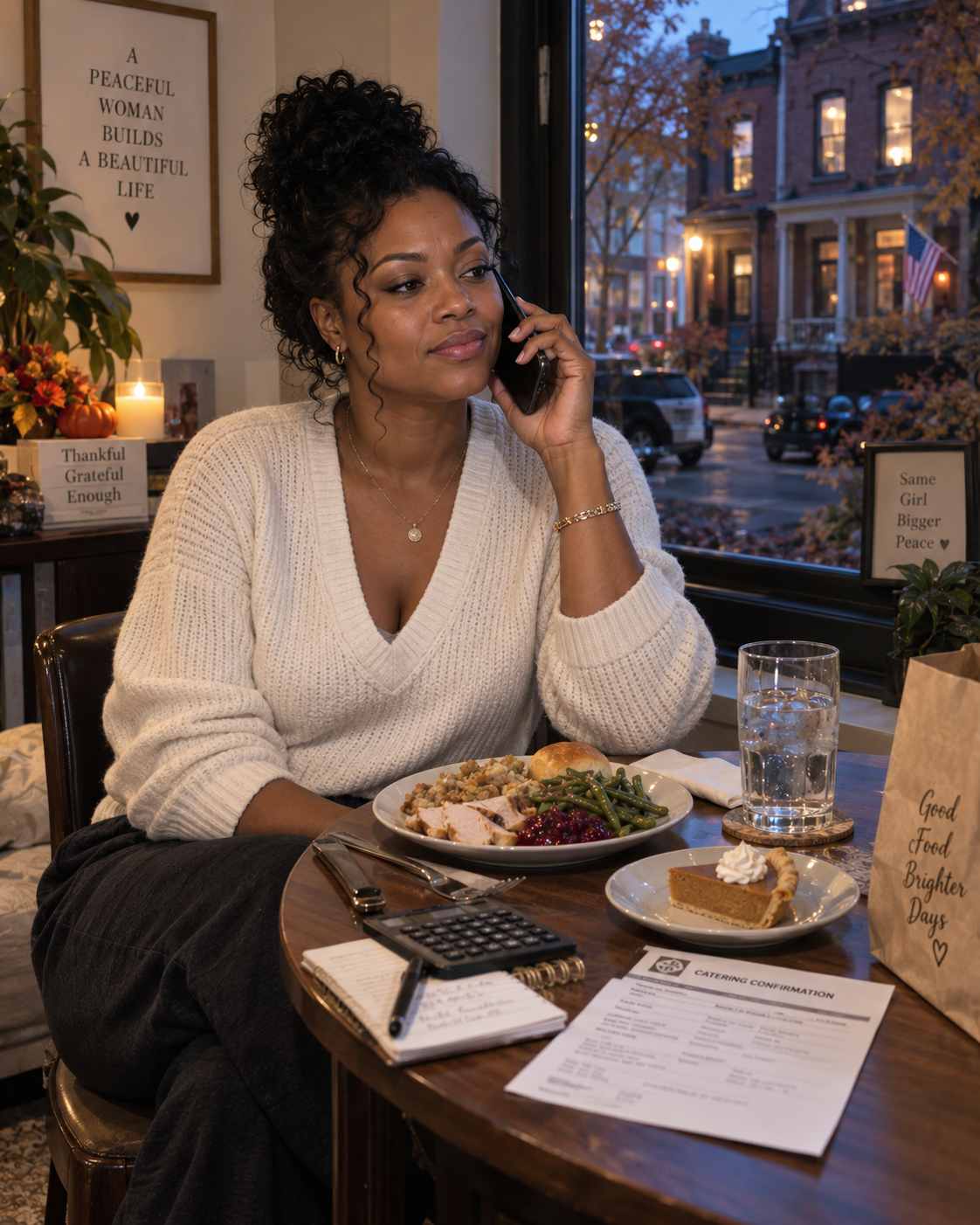
She explained that my mother had called twice.
The first time, she confirmed the guest count.
The second time, she changed the menu and asked whether my card information was still saved.
I felt a strange numbness spreading through me.
Thanksgiving hadn’t been a sudden decision.
The dinner had been planned weeks before my mother ever told me I wasn’t invited.
And my exclusion had apparently never included my responsibility to pay.
“Did she ever say why I wouldn’t be there?”
Karen paused.
“No.”
She sounded uncomfortable.
“But she did say Chloe’s family was coming, and that she wanted everything to be perfect.”
I thanked her and hung up.
For a long time, I sat in my living room without moving.
The worst part wasn’t the money.
It was realizing that my mother had been able to separate me into two different people.
There was the daughter she didn’t want sitting at the table.
And there was the daughter whose credit card she still expected to use.
I thought about all the holidays I had spent making sure everyone had enough.
I remembered arriving early with grocery bags cutting into my fingers.
I remembered staying late to wash dishes while everyone else watched movies.
I remembered my mother saying, “You’re so good at handling these things.”
At the time, I heard affection in those words.
Now I heard convenience.
The next morning, Leo called.
I almost let it go to voicemail.
Instead, I answered.
“Hey.”
He sounded tired.
“Mom told me you called the caterer.”
“I didn’t call to cause a problem.”
“You canceled Thanksgiving.”
“No,” I said. “I canceled a charge on my credit card.”
He went quiet.
“Those aren’t the same thing.”
“They became the same thing when I was uninvited.”
He exhaled.
“I know that hurt you.”
“Do you?”
“Yes.”
“Then why did you let her put the dinner under my name?”
Another silence.
This one was longer.
Finally, he said, “I didn’t know.”
I wanted to believe him.
I really did.
But something about his answer bothered me.
“Did Mom tell you who was paying?”
He didn’t answer immediately.
“She said you always handled Thanksgiving.”
That was not an answer.
“Leo.”
“What?”
“Did you know?”
“I knew Mom expected you to take care of it.”
My eyes filled with tears.
“So you knew.”
“I didn’t think it was a big deal.”
That sentence hurt more than anything else he had said.
Not because he thought the dinner mattered.
Because he had decided my sacrifice didn’t matter.
“I hope you understand something,” I said.
“What?”
“You don’t get to call my generosity a family tradition after you turn it into an obligation.”
He started apologizing.
But I stopped him.
“I don’t need another apology that lasts until the next bill.”
Then I hung up.
For several weeks, I heard almost nothing from them.
It was strangely peaceful.
No frantic calls about deposits.
No messages asking me to “just handle” something.
No emergencies that somehow always became mine.
I began noticing how much of my life had been built around anticipating other people’s needs.
Without them, I had free evenings.
I had quiet weekends.
I cooked for myself.
I went on long walks along the Schuylkill River.
And for the first time in years, I wasn’t waiting for someone to need something from me.
Then, one Sunday morning, my mother showed up at my apartment.
She stood outside my door holding a grocery bag.
I almost didn’t recognize the woman who looked back at me.
She looked smaller somehow.
“Can I come in?”
I stepped aside.
She placed the bag on the counter.
Inside were canned soup, bread, and a box of cookies.
“I brought you something.”
“Thank you.”
She nodded.
Neither of us knew what to say.
Finally, she whispered, “I handled Thanksgiving badly.”
I looked at her.
“That’s one way to describe it.”
Her eyes filled.
“I was worried about Chloe.”
“Why?”
“She told Leo she didn’t want to spend the holiday around conflict.”
“What conflict?”
Mom looked down.
“You.”
The word landed quietly.
I waited.
“She said you made her feel judged.”
“I barely knew her.”
“I know.”
“Then why did you believe her?”
My mother rubbed her hands together.
“Because I wanted Leo’s marriage to work.”
That was the first honest thing she had said.
I sat across from her.
“So you sacrificed me to keep her happy.”
“I didn’t think of it that way.”
“But that’s what happened.”
She nodded.
Then she said something I never expected.
“Your father used to do the same thing to me.”
I frowned.
“He would keep everyone happy by making one person absorb the disappointment.”
She looked at me.
“And I think I learned it.”
For a moment, I felt sorry for her.
Not enough to erase what she had done.
But enough to understand that people sometimes pass their wounds down without realizing they are handing them to their children.
“I understand why you did it,” I said.
“But understanding isn’t the same as accepting it.”
She nodded.
“I know.”
Then she reached into her purse.
There was another envelope.
This time, I recognized the handwriting on it.
Mine.
“What is that?”
“Something I found when I was cleaning.”
She handed it to me.
Inside was a handwritten budget from Thanksgiving two years earlier.
My handwriting covered the page.
Food.
Flowers.
Dessert.
Wine.
Rental chairs.
Emergency groceries.
At the bottom was a sentence I had written without thinking.
“Total: $7,214.53.”
Underneath, in my mother’s handwriting, were three words.
“Family is worth it.”
I stared at them until the ink blurred.
Mom watched me.
“I wrote that because I was proud of you.”
I swallowed.
“And now?”
“Now I realize I used those words to make you feel guilty whenever you said no.”
Neither of us spoke.
Then she stood.
“I don’t expect you to forgive me today.”
“Good.”
She gave a small, sad smile.
“I just wanted you to know that I finally understand.”
After she left, I sat on the floor beside the coffee table and cried.
Not because I wanted things to go back.
Because I finally understood why going back had always felt so exhausting.
A month later, Leo asked me to meet him at a diner.
I almost refused.
Then I agreed.
He was already sitting in a booth when I arrived.
He looked nervous.
“I owe you the truth,” he said.
I waited.
He told me Chloe had been uncomfortable around me from the beginning.
She thought I had too much influence over our family.
She thought everyone listened to me because I paid for things.
And instead of defending me, Leo had stayed quiet.
“Why?” I asked.
“Because I was afraid she’d leave.”
I looked at him for a long moment.
“Then you chose her.”
He lowered his eyes.
“At the time, yes.”
That honesty hurt, but I appreciated it.
“Are you happy?”
He didn’t answer.
Not immediately.
“I don’t know.”
I didn’t ask anything else.
Some answers were too fragile to touch.
Before we left, he pushed an envelope across the table.
“What is this?”
“Your share of the Thanksgiving money.”
I opened it.
There was a check for $2,000.
“I don’t want this.”
“It’s not charity.”
“Then what is it?”
“An acknowledgment that what happened wasn’t okay.”
I looked at the check.
“Keep it.”
He frowned.
“Why?”
“Because I don’t want money to be the thing that fixes this.”
He nodded slowly.
“What do you want?”
I thought about it.
“I want you to stop assuming I’ll save everyone.”
He looked down.
“I can do that.”
“And if you need help?”
“I’ll ask.”
“And if I say no?”
He gave a tired smile.
“I’ll respect it.”
That was the first apology from my family that actually sounded like change.
It didn’t repair everything.
But it gave me something better than an apology.
It gave me space.
Spring came quietly.
I replaced the dining table in my apartment with a smaller wooden one that seated four people.
I liked it because it reminded me that a table didn’t need twenty chairs to be full.
I started inviting friends over for dinner.
There were no expensive caterers.
No elaborate centerpieces.
Sometimes we ate takeout.
Sometimes someone brought a pie from the grocery store.
Nobody kept score.
Nobody asked who paid.
One evening, I was setting plates when my phone buzzed.
It was my mother.
“Can I ask you something?”
I stared at the message.
Then another one appeared.
“Chloe is pregnant.”
I stopped breathing for a second.
A third message followed.
“Leo wants you to be part of the baby’s life.”
I put the phone down.
For the first time, the decision didn’t feel like an emergency.
I didn’t have to rescue anyone.
I didn’t have to prove I was a good daughter or sister.
I didn’t have to pay for forgiveness.
I simply had to decide what kind of relationship I was willing to have.
That night, I wrote my mother back.
“I want to meet the baby when the time is right, but being family will never again mean being financially responsible for everyone.”
She replied almost immediately.
“Understood.”
Then, after a pause, another message appeared.
“I love you.”
I looked at those words for a long time.
Once, I would have needed them to erase everything.
Now, I could let them simply be words.
I loved my family too.
But love without boundaries had turned me into a resource instead of a person.
I had spent years believing that saying yes proved how much I cared.
Now I knew sometimes the most honest form of love was saying no and allowing people to carry what belonged to them.
The following Thanksgiving, I didn’t organize anything.
I didn’t call the caterer.
I didn’t offer my card.
I didn’t ask who was bringing dessert.
My mother hosted dinner herself.
When she called that morning, I expected tension.
Instead, she said, “We’re having frozen lasagna.”
I laughed.
“Sounds peaceful.”
“It is.”
There was a pause.
Then she said, “I finally understand something.”
“What?”
“Thanksgiving was never supposed to be about who paid for the biggest meal.”
I smiled.
“No.”
“It was supposed to be about who wanted to sit at the table.”
I looked around my apartment.
Four chairs.
Four plates.
Four people I had chosen.
And for the first time, the table felt bigger than any one I had ever paid for.
That evening, my mother sent me a picture.
Everyone was sitting around her table.
The lasagna was slightly burned.
The grocery-store rolls were sitting in a plastic basket.
And tucked into the corner of the photograph was a handwritten note.
“We saved you a seat.”
I stared at it for a long time.
Then I looked at the empty chair beside me.
I realized I didn’t need to rush toward it.
A seat offered after someone finally understands your worth is different from a seat offered because they need something from you.
I put my phone down and listened to my friends laughing in the kitchen.
For once, nobody needed my credit card.
Nobody needed me to fix the evening.
Nobody needed me to make myself smaller so somebody else could feel comfortable.
I had spent years confusing being needed with being loved.
That Thanksgiving, I finally learned the difference.
And just before midnight, my phone buzzed again.
It was Leo.
There was only one sentence.
“There’s something Mom never told you about the Thanksgiving order.”
I stared at the screen.
Then another message appeared.
“I think you deserve to know what really happened.”