When Julian Thorne laughed over a dead soldier’s body in Oakridge Memorial’s trauma bay and promised to TEAR UP
I read the sentence three times before my hands started shaking.
“CIPHER WASN’T THE ONLY ONE WHO SURVIVED.”
The handwriting meant nothing to me, which somehow made it worse.
People imagine fear as panic, but real fear is often mathematical.
I counted the possible entrances to my office, the distance to the stairwell, the blind angle beside the records room, and the number of people who knew enough about Cipher to write those words.
The answer should have been three.
Marcus.
Liam.
Me.
Yet someone had placed an envelope inside a locked room on the sixth floor of Oakridge Memorial.
I folded the note and slipped it into my coat.
Then I checked the hallway.
A resident pushed a medication cart past me, laughing at something on her phone.
A respiratory therapist complained about cafeteria coffee.
Life continued with insulting normality.
That was what frightened me most.
I called Marcus from the stairwell.
He answered after one ring.
“You’re using your private phone.”
“You told me to call if something impossible happened.”
Silence followed.
“What happened?”
“Someone left me a message.”
“What does it say?”
I read him the six words.
Marcus stopped breathing for half a second.
I heard it anyway.
“Claire, leave the hospital.”
“No.”
“That wasn’t a suggestion.”
“I have two surgical cases.”
“Cancel them.”
“I spent eight years letting people with classified badges decide where I was allowed to exist.”
My voice hardened.
“They don’t get my hospital too.”
Marcus lowered his voice.
“This may not be about the hospital.”
“Then tell me what it’s about.”
Another silence.
That answer scared me more than the envelope.
“Marcus.”
“There were seven people on your final deployment,” he said.
My chest tightened.
“I know.”
“Three died on site.”
“Four.”
“That’s what you were told.”
I closed my eyes.
Eight years vanished.
Sand hit my face.
A generator screamed in the darkness.
A field hospital burned beneath a sky without stars.
My hands were inside Captain Elias Voss’s chest while blood soaked through my sleeves.
Elias had commanded our extraction team.
He was irritatingly calm, relentlessly disciplined, and incapable of leaving anyone behind.
He was also the last man I had seen alive before an explosion threw me into a concrete wall.
When I regained consciousness two days later, Marcus had been sitting beside my bed.
He told me the facility had been destroyed.
He told me Elias was dead.
He told me Cipher needed to die too because too many hostile networks had learned enough about our team to keep hunting us.
So Claire Mercer was returned to the world.
Elias Voss was buried without a body.
“Who survived?” I asked.
Marcus did not answer immediately.
My stomach dropped.
“You knew.”
“I knew there was uncertainty.”
“You told me he was dead.”
“I told you what I had authorization to tell you.”
I almost laughed.
The sound came out broken.
“Eight years, Marcus.”
“I was trying to keep you alive.”
“You let me mourn someone who might have been breathing.”
“I didn’t know where he was.”
“But you knew there was a chance.”
“Yes.”
The word landed harder than any lie.
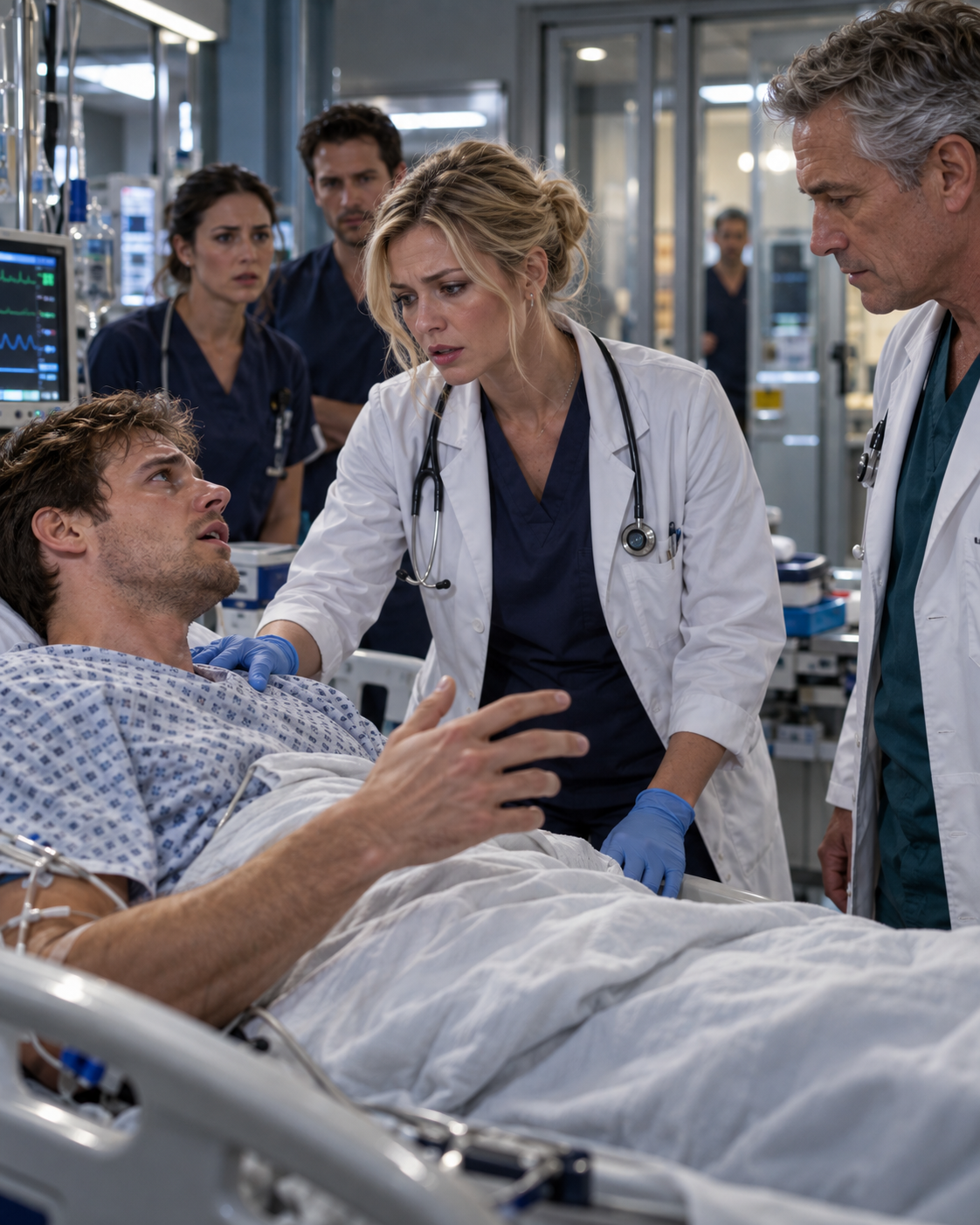
Before I could answer, the trauma pager screamed on my belt.
Multiple casualties.
Highway collision.
I looked through the stairwell window toward the emergency entrance.
Three ambulances were already turning into the bay.
“I have to go.”
“Claire, listen to me.”
“I listened eight years ago.”
Then I hung up.
The trauma floor swallowed everything else.
A school activity bus had collided with a delivery truck in freezing rain.
Within minutes, every available surgeon, nurse, and resident was moving.
This was the world I understood.
Blood did not manipulate.
A collapsing lung did not hide motives.
A torn artery did not ask who you used to be.
It simply demanded an answer.
Julian was already beside the first stretcher.
“Sixteen-year-old female, hypotensive, probable abdominal bleed.”
His eyes flicked toward me.
“You take lead.”
Six weeks earlier, he would have fought me for the position.
Now he stepped aside.
I worked for nearly three hours.
When I finally removed my gloves, the girl had a pulse, a future, and a mother sobbing into Sylvia’s shoulder outside recovery.
For a while, that was enough.
Then I returned to my office.
The black envelope was gone.
I had locked it in the bottom drawer.
The drawer was still locked.
Nothing had been forced.
Only the envelope was missing.
My phone rang.
Unknown number.
I answered without speaking.
A man breathed quietly on the other end.
Then he said, “You still favor your left hand when you’re frightened.”
My knees nearly gave out.
Only one person had ever teased me about that.
“Elias.”
The line went silent.
I gripped the desk.
“Say something.”
“You shouldn’t have brought Cross back.”
His voice was rougher than I remembered, but underneath it lived the same restrained calm.
“Where are you?”
“That’s not the question you should ask.”
“I watched you die.”
“No.”
“I watched the building come down.”
“You watched what they needed you to watch.”
A cold pressure formed behind my ribs.
“Who is they?”
“You still trust Marcus?”
I looked toward the hallway.
“No.”
“Good.”
Then he ended the call.
I stood there until Sylvia appeared in the doorway.
She studied my face.
“You look like you’ve seen a ghost.”
“I think the ghost called me.”
She closed the door.
For most of my life, secrecy had been a habit stronger than hunger.
But Oakridge had already taught me what institutional silence could cost.
So I told Sylvia enough to make her understand.
Not mission names.
Not locations.
Not operations.
Just the truth that someone from my classified past had resurfaced and that the hospital might be involved.
She listened without interrupting.
When I finished, she said, “Do we evacuate?”
“I don’t know.”
“Then we prepare as if the answer is yes.”
That was Sylvia.
No drama.
No worship of authority.
Only responsibility.
Marcus arrived forty minutes later with two federal security officers.
Sylvia blocked them at the trauma administration doors.
“This is a hospital, not your command post.”
Marcus looked exhausted.
“I need access to Dr. Mercer.”
“You can ask.”
His jaw tightened.
“Claire.”
I stepped into the corridor.
“Tell me everything.”
“Not here.”
“Here.”
Residents passed behind us.
Nurses moved charts.
Julian stood at the far end pretending not to listen.
Marcus lowered his voice.
“Elias Voss survived the blast.”
The words still hurt even though I already knew.
“He was recovered by an allied intelligence unit.”
“And?”
“He disappeared before debriefing.”
“You lost him?”
“We believe he chose to disappear.”
“Why?”
“Because he thought the mission had been compromised from inside.”
Something in my memory shifted.
That final night.
Our evacuation coordinates had changed twice.
Elias had argued over encrypted radio with someone I never heard.
Then the attack came exactly forty-three minutes after our new location was transmitted.
“Compromised by whom?”
“We never proved it.”
“Did you suspect him?”
“At first.”
I stared at Marcus.
“So you buried him.”
“We buried everyone.”
“You buried me.”
“To protect you.”
“That sentence is becoming convenient.”
His face changed.
For the first time, Marcus looked less like a liaison and more like the man who had once sat beside my hospital bed while I cried without making a sound.
“I made choices that kept you breathing, Claire.”
“Maybe.”
I stepped closer.
“But breathing and living are not the same thing.”
Marcus accepted that without defending himself.
Then Julian approached us.
“Sorry to interrupt this deeply unsettling reunion, but Liam Cross is downstairs.”
I turned.
“What?”
“He showed up asking for you.”
Marcus swore softly.
We found Liam in a private consultation room wearing civilian clothes and carrying a sealed military evidence bag.
He looked healthier than the last time I had seen him, but his expression belonged to a man who had not slept.
“You were told not to contact Dr. Mercer,” Marcus said.
Liam ignored him.
He placed the bag on the table.
“Someone broke into my apartment last night.”
Inside was a small black device, scorched at one corner.
My stomach tightened.
I recognized it.
An encrypted field beacon from our old unit.
On the back, someone had scratched a sequence of numbers.
Julian leaned closer.
“What is that?”
“A date,” I said.
It was the date of our final deployment.
Liam shook his head.
“Not just a date.”
He entered the numbers into his phone.
They translated into coordinates.
Marcus went pale.
I noticed.
“Where?”
He looked at me.
“An abandoned federal medical storage site forty miles north.”
Sylvia crossed her arms.
“Of course it is.”
We did not rush there.
That was the old Claire.
Cipher would have grabbed a weapon and driven into the dark with no backup.
I had spent too many years confusing isolation with strength.
So we called local federal investigators through a channel Marcus could not control alone.
We documented the beacon.
We copied the coordinates.
We created a record too visible to erase.
That decision probably saved us.
At 2:13 the next morning, investigators entered the abandoned facility.
They found medical crates, archived field equipment, and stacks of paper records dating back more than a decade.
No Elias.
But they found something worse.
Patient transfer logs.
Unidentified wounded personnel had been moved through the site after overseas operations.
Some were treated under temporary numbers rather than names.
Several had officially been declared dead before arriving.
My hands turned cold as I read the scanned pages.
“They were hiding survivors.”
Marcus shook his head.
“Or protecting them.”
“From whom?”
“That’s what we have to determine.”
Then I saw an entry dated four days after our final mission.
Patient 7C.
Male.
Thoracic trauma.
Blast injuries.
Severe burns.
Transferred under sealed authority.
Beside it were three handwritten letters.
E.V.V.
Elias Vincent Voss.
He had been alive.
Not maybe.
Not uncertain.
Alive.
I looked at Marcus.
“You said you didn’t know.”
“I didn’t.”
“Your agency processed the transfer.”
“My agency has thousands of compartments.”
“So the system knew, even if you didn’t.”
He did not argue.
That distinction mattered legally.
Emotionally, it meant nothing.
The next morning, Oakridge received an anonymous data dump.
Hundreds of pages.
Invoices.
Emails.
Internal communications.
And buried inside them was a connection between the abandoned federal site and Northstar Medical Logistics, the same contractor that had persuaded Oakridge executives to centralize critical trauma equipment on separate floors.
Sylvia read the documents twice.
“This company advised our board.”
Julian’s face hardened.
“They caused the delay that nearly killed Liam.”
“Maybe not deliberately,” I said.
“But someone needs us to see the connection.”
Liam leaned against the conference table.
“Elias?”
“Probably.”
Marcus shook his head.
“Or someone using him.”
That was the problem with surviving a secret war.
Eventually you stopped knowing whether evidence was a gift or bait.
Federal investigators descended on Northstar.
Oakridge’s former corporate executives hired attorneys.
Reporters gathered outside the hospital.
My carefully rebuilt civilian life became news without anyone knowing why.
The story the public received was simpler.
A medical contractor had influenced hospitals to adopt equipment-placement policies that increased dependence on centralized emergency supply services.
Northstar denied wrongdoing and called the allegations misleading.
The investigation remained open.
But inside the sealed documents, a darker pattern emerged.
Several hospitals near military treatment hubs had adopted the same policy.
Equipment moved farther away.
Response times increased.
Emergency outsourcing contracts followed.
Profits rose.
Whether anyone intended patient deaths was unclear.
But someone had repeatedly been warned that the delays were dangerous.
The warnings had been ignored.
I understood that kind of negligence.
Sometimes evil did not arrive carrying a weapon.
Sometimes it arrived carrying a spreadsheet and calling suffering an acceptable operational variance.
Three days later, Elias called again.
“Now you see it.”
“Part of it.”
“Northstar was funding the network that moved wounded assets off-book.”
“Why?”
“Control.”
“That isn’t an answer.”
“It’s the only one that survives classification.”
I pressed the phone tighter to my ear.
“Come in.”
He laughed softly.
“You still believe rooms with flags are safer than rooms without them?”
“I believe hiding forever destroys people.”
“You seem functional.”
“I’m not talking about me.”
Silence.
There he was.
For one second, beneath eight years of secrets, I heard the man I remembered.
“Where have you been, Elias?”
“Trying to learn who sold us.”
“And did you?”
“Yes.”
My heart accelerated.
“Who?”
“I’ll tell you in person.”
The meeting location arrived ten minutes later.
An old veterans’ rehabilitation chapel outside Baltimore.
Marcus demanded to come.
I refused.
Sylvia demanded someone come.
I compromised.
Liam drove.
He stayed in the parking lot while I entered alone.
Rain tapped against stained glass.
The chapel smelled like dust and old wood.
A man stood near the front pew.
He turned slowly.
Half his face carried pale burn scars.
His right hand trembled slightly.
But I knew his eyes.
For eight years, I had imagined Elias frozen in the moment before the explosion.
Seeing time on his face hurt more.
“You got old,” I whispered.
His mouth curved.
“So did you.”
I crossed the distance before I could decide whether I wanted to hit him or hold him.
I did both.
My fist struck his chest.
Then my arms were around him.
He held me without speaking.
I hated him.
I missed him.
I hated myself for missing him.
“Eight years,” I said into his shoulder.
“I know.”
“You let me think you were dead.”
“I thought you were dead for six months.”
I pulled back.
“What?”
“Your death certificate was cleaner than mine.”
The room tilted.
“They told me the cover protected me.”
“It protected the operation.”
“From what?”
“From the person who betrayed us.”
He reached into his coat and handed me a tiny storage drive.
“Everything I could recover.”
“Tell me the name.”
Elias looked toward the chapel door.
Then back at me.
“Deputy Director Aaron Vale.”
I knew the name.
Everyone in our old program knew it.
Vale had overseen logistics and covert medical extraction.
He had signed the commendation attached to my sealed retirement.
“Why?”
“Money first.”
Elias’s voice turned bitter.
“Then leverage.”
Northstar had allegedly used medical logistics networks to move people, equipment, and information outside standard oversight.
Vale controlled who disappeared into those channels.
Some were protected.
Some were exploited.
Some never returned.
“Why expose Oakridge?”
I asked.
“Because Liam’s accident created something I never had before.”
“What?”
“A living witness connected to Cipher.”
I understood.
When Liam spoke my call sign, records systems began searching old compartments.
The search created access logs.
The logs exposed people who still cared whether Cipher existed.
“You used us.”
“I used the attention.”
“That attention nearly destroyed my life.”
Elias looked ashamed.
“I know.”
“No, you don’t.”
I stepped away.
“I built something here.”
“I was trying to finish what killed our team.”
“And you thought that gave you permission to gamble with mine?”
His jaw tightened.
“Three people were murdered.”
“And how many more were you willing to endanger?”
He had no answer.
That silence changed something between us.
For years, Elias had been preserved in my memory as the man who never left anyone behind.
The living version had learned to sacrifice pieces of people in the name of a larger victory.
Maybe survival had changed us both.
“Come with me,” I said.
“Where?”
“To investigators.”
“No.”
“Then nothing changes.”
“I gave you proof.”
“You gave me stolen files from the shadows.”
“They’re real.”
“Real evidence still needs daylight.”
He shook his head.
“Daylight gets people killed.”
“Darkness already did.”
His eyes hardened.
“You sound like a civilian.”
For once, the word did not insult me.
“I am one.”
Then the chapel doors opened.
Marcus entered alone.
Elias moved instantly, hand disappearing beneath his coat.
“Don’t,” I said.
Both men froze.
Marcus looked at Elias like someone seeing a grave open.
“Elias.”
“Marcus.”
“You knew she was coming here.”
“I knew her well enough to predict it.”
I turned on Marcus.
“You followed us.”
“I protected you.”
Elias laughed.
“There’s that word again.”
Marcus ignored him.
“We need to leave.”
“Why?”
“Vale knows about the data dump.”
As if summoned by the name, headlights flooded the chapel windows.
Three vehicles entered the parking lot.
Liam called my phone.
I answered.
“Claire, we have company.”
Marcus drew his weapon.
Elias did the same.
I looked at two men who had spent half their lives believing guns were solutions.
“No shooting unless somebody gives us no choice.”
Elias stared at me.
“This isn’t a trauma bay.”
“Then pretend it is.”
Men emerged outside.
Federal badges.
Not Northstar security.
Not assassins.
Inspector General investigators.
The woman leading them entered with empty hands raised.
“Dr. Mercer?”
“Yes.”
“We’re here for Elias Voss.”
Elias’s posture changed.
Marcus whispered, “How did they find us?”
I looked at the drive in my hand.
Then at Elias.
“You wanted daylight.”
He studied my face.
For a long moment, nobody moved.
Then he slowly removed his weapon and placed it on the pew.
The next months were uglier than any clean ending deserves.
Vale was placed under investigation and later indicted on charges involving fraud, obstruction, unlawful disclosure of protected information, and conspiracy tied to the off-book logistics network.
Several allegations remained classified, and his attorneys denied the government’s broader characterization of his conduct.
Northstar lost federal contracts while civil investigations expanded.
Executives blamed rogue employees.
Rogue employees blamed executives.
Everyone suddenly discovered a deep respect for procedures they had spent years circumventing.
Elias entered protective custody and gave testimony.
Marcus testified too.
So did I.
Not about missions I was still forbidden to describe.
I testified about consequences.
About what secrecy had done when accountability vanished.
About Liam.
About equipment four floors away while a soldier died beneath fluorescent lights.
About a hospital memo ignored because fixing danger was less convenient than managing liability.
Oakridge changed.
Sylvia created a permanent emergency-readiness committee with nurses, technicians, residents, and transport staff given equal authority to flag dangerous policies.
No executive could relocate lifesaving equipment without simulation testing.
Every delay became something to study instead of something to hide.
Julian surprised me most.
One afternoon, I found him teaching residents beside the same trauma bay where he had once humiliated me.
A nervous intern gave the wrong answer.
Old Julian would have destroyed him.
Instead, Julian asked, “What made you choose that?”
The intern explained.
Julian nodded.
“Good reasoning, wrong conclusion.”
Then he taught him.
Later, I said, “Who are you, and what did you do with Julian Thorne?”
He almost smiled.
“I discovered terror is an inefficient educational model.”
“Expensive discovery.”
“Very.”
He looked through the glass toward the trauma rooms.
“I keep thinking about that day with Liam.”
“So do I.”
“I pronounced him dead because I was tired, angry, and certain.”
He swallowed.
“The certainty bothers me more than the mistake.”
I understood.
Certainty had nearly destroyed all of us.
Liam eventually returned to military service in a limited training role.
Before leaving, he came to my office carrying two coffees.
“I still owe you a heartbeat,” he said.
“Hospital policy prohibits repayment.”
He laughed.
Then his expression softened.
“You know, when I called you Cipher, I thought I was saving you.”
“You almost got me fired.”
“I said I thought.”
At the door, he turned.
“Are you glad he survived?”
He meant Elias.
I looked down at my hands.
“Ask me in another eight years.”
Liam nodded as if that were enough.
Elias and I exchanged letters through protected channels.
Not romantic letters.
Not confessions.
Just two survivors learning each other again without the mythology.
He apologized once.
Not for disappearing.
For using Oakridge as part of his plan.
I believed him because he did not ask forgiveness afterward.
Some wounds become worse when people demand that healing happen on their schedule.
A year after the hearing, I stood outside Oakridge Memorial at sunrise.
The glass doors reflected someone I almost recognized.
I remembered my first morning there.
Eleven seconds.
That was how long I had given myself to abandon eight years of my life.
I had thought survival required dividing myself into acceptable pieces.
Claire here.
Cipher buried there.
Doctor.
Operative.
Civilian.
Ghost.
But a person cannot heal by pretending half of her never existed.
The doors opened behind me.
Sylvia stepped outside.
“Board meeting starts in ten minutes.”
“I know.”
“You planning to attend?”
“Unfortunately.”
She smiled.
“You’re the director.”
“I know that too.”
We stood quietly as ambulances moved through morning traffic.
“Do you ever regret hiring me?” I asked.
Sylvia considered it.
“You created three federal investigations, terrified the board, revived a dead soldier, exposed a contractor network, and somehow made Julian tolerable.”
She took a sip of coffee.
“So administratively, yes.”
I laughed.
Then she became serious.
“But hospitals are built around one promise.”
“What promise?”
“That when a human life is in front of us, convenience comes second.”
She looked at me.
“You remembered that when other people didn’t.”
A trauma alert sounded inside.
We both turned.
Somewhere upstairs, strangers were already preparing a room.
Someone’s worst day had just begun.
I reached for the door.
For years, I thought courage meant running toward gunfire, keeping secrets, and surviving things nobody would ever know about.
I was wrong.
Sometimes courage was much quieter.
It was admitting you made a mistake before someone died from it.
It was questioning the person with more authority.
It was telling the truth when silence protected your career.
It was letting people help you even when isolation felt safer.
And sometimes courage was understanding that exposing the truth was only the beginning, because truth without responsibility could become another weapon.
I walked back into Oakridge as Claire Mercer.
Not Cipher.
Not a ghost.
Not a classified file somebody else could lock away.
Just a surgeon who finally understood that the past did not have to disappear for the future to belong to me.
As the trauma doors opened and another stretcher came racing toward us, Julian met my eyes from across the bay.
“Ready?”
I pulled on my gloves.
“Always.”
The patient reached us.
The room erupted into motion.
And for the first time in a very long time, when my hands moved with the instincts Cipher had given me, I did not feel ashamed of the woman who had survived long enough to become me.
Some truths destroy the life you built.
Others finally give you permission to live it.