When I ran into Ridge View’s infirmary and saw my five-year-old daughter bleeding into her school collar
I recognized Kendra because of the tiny silver crescent around her neck.
Arthur had once told me it was a piece of jewelry he’d never seen before.
He had lied.
She stopped three feet from the cot, one hand covering her mouth.
“Toby,” she whispered.
The boy reached for her.
Arthur didn’t move.
I looked at him.
“Kendra?”
Her eyes filled immediately.
“I didn’t know you’d be here.”
“That’s funny,” I said. “I didn’t know you existed.”
The paramedics arrived before anyone could answer. Two of them moved toward Chloe, and another crouched beside me.
“Mom, what’s her name?”
“Chloe Bennett. Five years old.”
“Any loss of consciousness?”
“I don’t know.”
Arthur answered for me.
“No.”
I turned toward him.
“You don’t know that.”
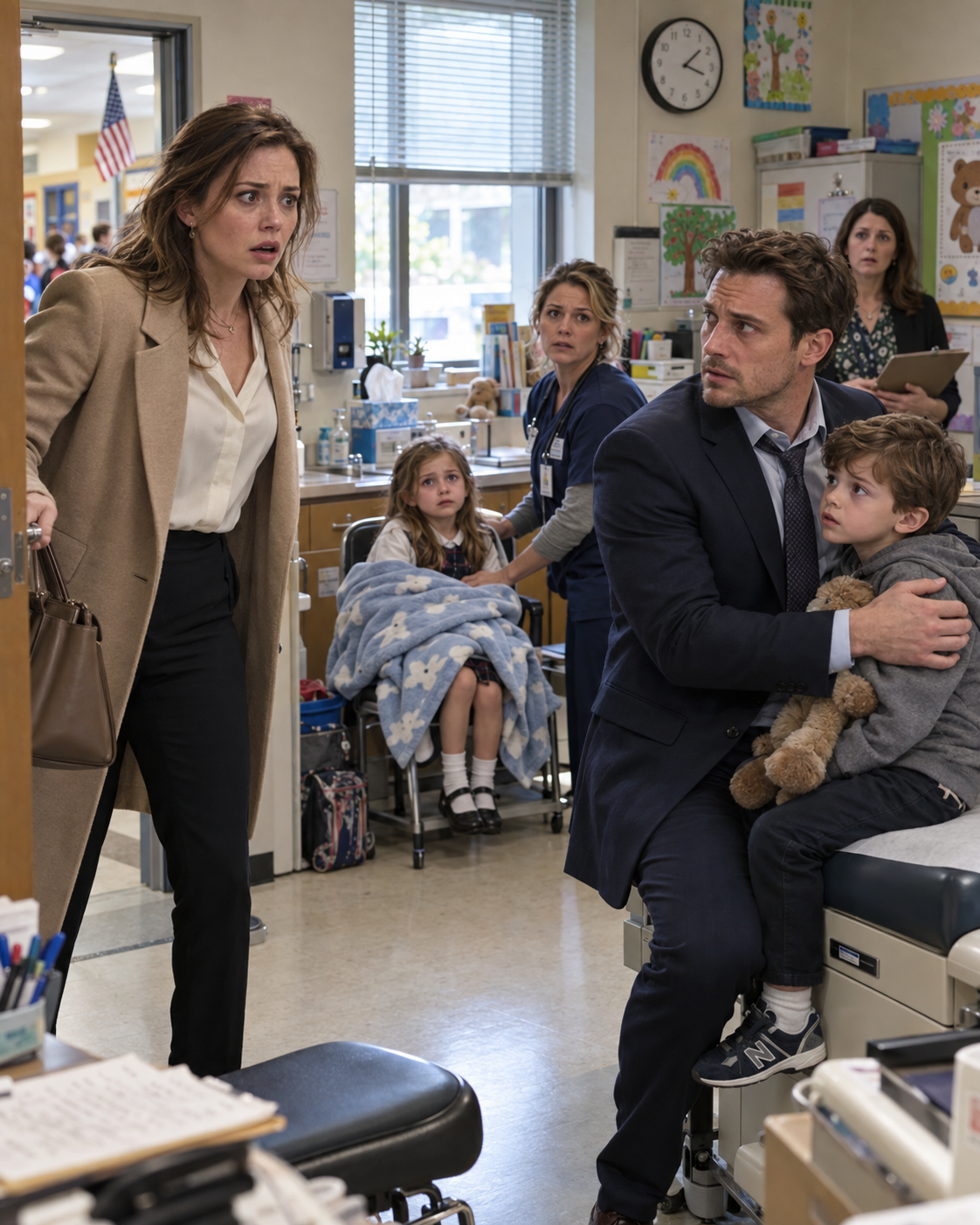
The paramedic looked at me, then at Arthur, and gently asked him to step aside.
For the first time since I had entered the room, my husband looked less like a man in control and more like a man who had just discovered the floor beneath him was disappearing.
At the hospital, Chloe needed four stitches.
The CT scan showed a concussion but no skull fracture or intracranial bleeding. The doctor told me she would recover, but she needed observation, rest, and someone paying attention to changes in her behavior.
I sat beside her bed until she fell asleep.
Arthur never came into the room.
He waited in the hallway.
Kendra left with Toby before the police arrived.
That detail bothered me.
So did the fact that Principal Caldwell never once asked me how Chloe was doing.
Instead, he asked whether I understood how damaging an incident like this could be to Ridge View’s reputation.
That was the moment I called Marcus.
Marcus had been my attorney before he became my friend, and my friend long before either of us admitted how much we relied on the other.
I didn’t tell him everything.
I didn’t have to.
“Come to the hospital,” I said.
“Are you safe?”
“Yes.”
“Is Chloe?”
“She’s sleeping.”
“Then I’ll be there in twenty minutes.”
He arrived carrying coffee I didn’t touch.
He listened without interrupting.
When I finished, he leaned back.
“Emily, before we discuss divorce, there’s something you need to understand.”
“What?”
“The Safe Spaces program.”
My stomach tightened.
“What about it?”
“Arthur’s consulting firm has been licensing it.”
“I know.”
“No,” Marcus said. “I don’t think you know how much.”
He slid a folder across the table.
My signature was on the original licensing agreement.
So was Arthur’s.
Clause 7 sat halfway down the page.
If a licensee became subject to an investigation involving child safety, falsification of safeguarding records, or material misconduct affecting implementation, I could suspend commercial use of the program pending review.
I read the paragraph twice.
Then I looked at Marcus.
“Freeze it.”
“That’s what I thought you’d say.”
By midnight, I had filed for divorce.
By morning, Arthur had sent me seventeen messages.
The first said he was sorry.
The second said we needed to talk.
The third said Kendra had been “misunderstood.”
The fourth said Toby was innocent.
The fifth asked me not to destroy his company over a family misunderstanding.
I stopped reading after that.
There was one message from Chloe’s teacher, Miss Albright.
It arrived at 6:42 a.m.
“I should have told you sooner. I have something you need to see.”
She met me after school in an empty conference room.
Her hands shook as she placed a binder on the table.
Visitor logs.
Staff emails.
Incident reports.
She had highlighted several dates.
“These are all the times Arthur came to school,” she said.
I looked at the entries.
Every visit was listed under Toby’s name.
Not Chloe’s.
Not mine.
Toby.
“He attended six parent events,” she said. “Every time, he signed in as Toby’s father.”
My throat tightened.
“Why didn’t anyone tell me?”
“Because Principal Caldwell told us Toby’s family situation was private.”
“And the attack?”
Miss Albright swallowed.
“There were three incidents before yesterday.”
I stared at her.
“What?”
“The first was a shove on the playground. The second was a pencil thrown at Chloe. Yesterday wasn’t the first time Toby hurt her.”
“Then why wasn’t I called?”
She looked down.
“Because Mr. Caldwell said your husband was handling it.”
I understood then why everyone in that infirmary had looked frightened.
They weren’t protecting Toby.
They were protecting a system.
A system that had decided my daughter was the easiest person to silence.
That afternoon, Marcus and I went through every document I had.
There was one thing I kept remembering.
Chloe had worn her little purple smartwatch to school for three months. I had bought it after she wandered away from me at a crowded summer fair. It had an emergency recorder that activated when she pressed the side twice.
I had never thought of it as evidence.
I thought of it as a way for a nervous mother to sleep.
Marcus asked, “Does it store audio?”
“Only if she activates it.”
“Check.”
The first file was twenty-three seconds long.
Children laughing.
A chair scraping.
Then Chloe’s voice.
“Stop, Toby.”
A boy’s voice answered.
“Your daddy said you’re not supposed to tell.”
Then a sharp wooden crack.
Chloe screamed.
I closed my eyes.
The second recording was worse.
Not because Toby sounded cruel.
Because he sounded confused.
“I don’t want to hurt you,” he said.
Then a woman’s voice.
Kendra.
“Just leave her alone.”
There was no urgency in her voice.
No alarm.
Just irritation.
Then Arthur.
“Chloe, go sit somewhere else.”
My daughter cried.
“I need Mommy.”
Arthur answered, “Enough.”
I stopped the recording.
Marcus didn’t speak.
Neither did I.
The cloud footage came from the classroom’s automatic safety archive.
Ridge View had installed cameras after a previous parent complaint, but Caldwell had repeatedly told me the footage was only retained for seven days.
It wasn’t.
The system had been automatically backing up everything for thirty days.
We watched the footage frame by frame.
Toby grabbed the wooden block.
Chloe backed away.
Kendra entered the classroom and saw them.
She did nothing.
Arthur arrived minutes later.
He crouched beside Toby.
He didn’t check Chloe.
He didn’t call the nurse.
He waved her toward the hallway.
And then Principal Caldwell walked in.
The three adults spoke.
Arthur pointed at Chloe.
Caldwell shook his head.
Then Caldwell took the incident form from the teacher’s desk and crossed something out.
Miss Albright’s original note had read: “Toby struck Chloe in the head with wooden block.”
The final report said: “Chloe sustained minor injury during unstructured play.”
I felt something inside me go very quiet.
Not rage.
Not yet.
Just certainty.
The next morning, the school board suspended Caldwell pending investigation.
The district notified the state licensing ministry.
Police requested the original records.
And Arthur finally came to my house.
He stood on the porch looking exhausted.
For a second, I saw the man I had married.
The man who used to make pancakes shaped like dinosaurs on Saturday mornings.
The man who slept with one hand resting on my pregnant stomach because he was terrified he would miss the baby moving.
That memory hurt more than I expected.
“Emily,” he said.
I didn’t invite him in.
“Tell me about Toby.”
Arthur looked down.
“I met Kendra before you got pregnant.”
I closed my eyes.
There it was.
The truth we’d been circling.
“I knew she was pregnant,” he continued. “I didn’t know she would keep the baby.”
“You knew?”
“Yes.”
“And when I was pregnant with Chloe?”
He nodded.
“You were with her?”
“Not like that.”
I laughed once, without humor.
“Arthur, there are not many ways to interpret a pregnancy.”
He flinched.
He told me Kendra had wanted him involved but had agreed to keep the relationship secret. Arthur said he was ashamed, afraid I’d leave, afraid our marriage would collapse before Chloe was born.
So he stayed.
He told himself secrecy was protection.
Then Toby was born.
And instead of telling me, Arthur began visiting Ridge View as Toby’s father.
He eventually convinced Caldwell that keeping Toby’s identity private was necessary.
When Toby entered Chloe’s class, Arthur told himself the children would benefit from being near each other.
“Why would you put them together?”
“I thought I could manage it.”
“You couldn’t even manage the truth.”
He had no answer.
Then came the detail that changed the shape of the whole story again.
“Arthur,” I said, “why did Kendra need you to protect Toby so badly?”
His eyes moved away from mine.
“Because she was afraid you’d take him from her.”
“He’s not mine.”
“I know.”
“No. You don’t.”
I stepped closer.
“You keep talking as if this was about protecting children. It wasn’t. You were protecting yourself.”
He started crying.
I didn’t comfort him.
That was new for me.
A week later, Kendra posted a video online.
She claimed Chloe had bullied Toby because he was “different.”
She said I had used my influence over the school to punish a child whose father happened to be my husband.
Within hours, strangers were calling me a monster.
The video was polished enough to look spontaneous.
It wasn’t.
Marcus found the original upload file.
The metadata showed it had been edited on a laptop registered to Arthur’s consulting firm.
Then he found the messages.
Arthur had written to Kendra:
“Keep it emotional.”
“Don’t mention the block.”
“Say Chloe cornered him.”
“People respond to a mother defending her child.”
Kendra answered:
“Will you say I’m telling the truth?”
Arthur wrote:
“I’ll handle it.”
I read those messages alone in my kitchen.
For the first time, I understood something I hadn’t allowed myself to see.
Arthur wasn’t just hiding an affair.
He had built an entire alternate version of reality around his fear.
And whenever reality threatened it, he recruited other people to help him maintain the lie.
The ministry hearing lasted six hours.
Miss Albright testified.
The school nurse testified.
Marcus presented the original reports.
Investigators authenticated the smartwatch recordings.
Forensic analysts verified the cloud footage.
Then they played the audio of Arthur telling Chloe to stop crying.
The room went silent.
Caldwell’s attorney tried to argue that the records had been altered.
Then the investigators produced the server history.
Every edit had a timestamp.
Every deleted line had a recovery copy.
Caldwell had personally changed the report.
The ministry revoked his administrative credentials and referred the falsification to police.
Arthur’s firm lost its largest education contracts within weeks.
The Safe Spaces license was suspended under Clause 7.
Arthur filed an emergency motion claiming the curriculum was marital property.
Marcus had been waiting for that.
“Tell them who wrote it,” he said.
I testified that I had developed the curriculum before Arthur’s company ever existed.
We produced drafts from my old laptop.
Workshop notes.
Pilot lesson plans.
Emails with teachers.
Even a spiral notebook where I had written the original principles in blue ink while pregnant with Chloe.
The arbitration panel ordered a forensic audit.
It found something worse.
Arthur had been transferring marital funds to Kendra for years.
Rent.
Legal bills.
Childcare.
Private-school expenses.
Not because she had blackmailed him.
Not because she had forced him.
Because he had chosen to maintain two lives and had used our shared money to finance both.
I expected that discovery to make me hate him.
Instead, I felt tired.
Deeply, physically tired.
When Arthur asked to see me after the ruling, I agreed.
We sat in a quiet room at the courthouse.
He looked older.
“I love you,” he said.
I stared at the table.
“I know you believe that.”
“I do.”
“But love isn’t the same thing as safety.”
He nodded.
“I want another chance.”
I finally looked at him.
“Arthur, I spent years thinking forgiveness meant reopening the door.”
He wiped his face.
“I’d do anything.”
“I believe you.”
That surprised him.
“But I’m not giving you my life to prove it.”
The custody order gave me primary and sole physical custody of Chloe, with Arthur’s visits strictly supervised.
Kendra was barred from attending them.
Toby was not allowed to participate in the visits.
The judge made no statement about him being a bad child.
He was five.
He had been born into a situation adults had made complicated, and he had copied what the adults around him taught him about silence.
That mattered to me.
So did something else.
I refused to let Chloe grow up believing Toby was the monster.
He had hurt her.
That was true.
But the adults had taught him that hurting someone could be followed by secrecy instead of accountability.
I wanted her to understand the difference.
Months later, we moved to Westboro.
Our new house had a crooked porch, a narrow driveway, and a backyard that received sunlight almost all afternoon.
The first night, Chloe carried her stuffed rabbit from room to room, deciding where he would sleep.
She chose the smallest bedroom for herself.
“This one feels safe,” she said.
I didn’t ask her why.
I just helped her unpack.
I relaunched Safe Spaces as a free community resource.
No licensing fees.
No corporate branding.
No private contracts.
Teachers could download the materials.
Parents could use them at home.
Schools could adapt them.
I added a section about what to do when the adult responsible for solving a problem is part of the problem.
That section took me the longest to write.
Arthur eventually began therapy.
At first, his visits with Chloe were awkward.
He brought coloring books.
She barely spoke.
Then one afternoon, he arrived carrying a tomato plant.
He held it up through the visitation-room window and said, “Your mom says you like gardening.”
Chloe looked at me.
I nodded.
She took the plant.
That was all.
It wasn’t reconciliation.
It wasn’t redemption.
It was simply a five-year-old deciding she could accept a tomato plant without accepting an apology she wasn’t ready to hear.
I learned to respect that difference.
A year after the day at Ridge View, Chloe and I planted tomatoes in our backyard.
The first ones were small and lopsided.
One had a deep crack down the middle.
Chloe picked it anyway.
“Look, Mommy.”
She held it in both hands as if it were something precious.
“It’s ugly.”
“It’s beautiful,” I said.
She considered that.
Then she bit into it.
Juice ran down her wrist.
She laughed.
Across town, Arthur was sitting in a therapist’s office, slowly learning that regret was not the same as repair.
I didn’t need to know whether he would become the man he should have been.
I only needed to know that Chloe and I no longer had to organize our lives around the man he had chosen to be.
That evening, she brought me the cracked tomato and asked if we could save its seeds.
I showed her how.
We scooped them into a little glass jar and set it on the windowsill.
Outside, the garden was uneven and stubborn and alive.
For years, I had thought safety meant building walls high enough that nothing painful could reach us.
My daughter taught me something gentler.
Sometimes safety was simply knowing that when you said, “This hurts,” someone would believe you.
And when Chloe reached for my hand in the warm kitchen light, I held it—not because I was afraid she might disappear, but because she was finally free to let go.