When Gavin told me to sleep in the study because Vanessa said the missing emerald brooch was in my suitcase
I didn’t call my father that night.
I sat in the driver’s seat with the photograph open on my phone until the screen dimmed, then turned it back on and read those four words again.
She can never know.
There were a dozen explanations, and every one made me feel worse.
By dawn I was on a flight west.
Douglas met me at the airport himself, which was how I knew something was wrong. My father had drivers, assistants, lawyers, and an executive protection detail that usually appeared before he did. He hated waiting in baggage claim. He hated crowds. He hated surprises.
But when I walked through the sliding doors, he was standing alone in a navy coat, holding my old leather suitcase tag between two fingers.
He didn’t hug me immediately.
He looked at my face.
Then he said, “What happened?”
I handed him my phone.
He read the document without blinking.
When he reached Gavin’s handwriting, his expression changed so subtly that another person might have missed it.
I didn’t.
“You knew,” I whispered.
Douglas closed his eyes.
“I knew about the agreement.”
“Did you know he signed it?”
“Yes.”
“Did you know he was hiding it from me?”
A pause.
“No.”
That answer should have comforted me.
It didn’t.
We drove to his house in silence. By the time we reached the kitchen, there was coffee waiting, but I couldn’t drink it.
“Start at the beginning,” he said.
So I did.
I told him about the brooch. Vanessa. The study. The baby. Frank’s message. Everything.
My father listened with both hands around his coffee mug.
When I finished, he said, “Nora, there is something I should have told you years ago.”
I almost laughed.
Apparently, that was the family tradition.
He opened his laptop.
What appeared on the screen wasn’t a simple investment report. It was a map of companies, trusts, credit facilities, and holding entities stretching across North America.
At the center was Ashford Capital.
I stared.
“No.”
“Yes.”
“That’s Gavin’s firm.”
“It was.”
He turned the screen toward me.
“Holloway Enterprises never owned Ashford outright. That would have been too obvious. Instead, we provided bridge financing when the firm nearly failed before your wedding. We bought distressed debt. We guaranteed certain loans. We acquired preferred positions in subsidiaries and placed covenant protections around them.”
I felt sick.
“You built his company.”
“We kept it alive.”
“Why?”
My father finally looked at me.
“Because you loved him.”
The simplicity of it hurt more than the numbers.
He explained that Gavin had inherited a prestigious name but a damaged business. Ashford had excellent clients, terrible liquidity, and a board that had spent years hiding losses inside subsidiaries. Douglas had stepped in because he believed marriage might make Gavin more responsible, not less.
He had been wrong.
But there was another part.
After the wedding, Gavin started taking aggressive loans against assets Holloway had protected. When Douglas refused to increase the guarantees, Gavin shifted more risk into subsidiaries whose debt was quietly held by Holloway affiliates.
The strategy wasn’t to destroy Ashford.
It was to contain the damage.
“If Gavin had behaved ethically,” my father said, “the protections would eventually have released. The firm could have stood on its own.”
“And the agreement?”
“It said those protections would end if the marriage ended under certain circumstances.”
I stared at the highlighted sentence.
“So he knew.”
“Yes.”
My throat tightened.
“He knew my father was keeping his company alive, and he still let me believe he had built a life I needed to fit into.”
Douglas didn’t answer.
He didn’t have to.
There was one more thing I couldn’t stop thinking about.
The sentence on the agreement had been highlighted before I ever saw it. Gavin hadn’t written the highlight. The yellow marker belonged to someone else.
Miriam confirmed it when she examined the scanned original.
“Your father marked that provision during the negotiation,” she said.
“Why?”
“Because he wanted Gavin to understand the consequences.”
That distinction mattered.
For days I had been building a version of my father in which he had quietly manipulated my marriage from behind a curtain. The truth was less sinister and, in some ways, more painful. Douglas had tried to protect me without asking whether protection was what I wanted.
I confronted him that evening.
“You made decisions about my life because you thought you knew better.”
He didn’t defend himself.
“Yes.”
“I needed you to trust me.”
“I know.”
“And you didn’t.”
“I was afraid.”
That stopped me.
My father had always seemed impossible to frighten.
He admitted that after losing my mother, he had become obsessed with preventing another person he loved from being hurt. He saw Gavin’s debt, saw the instability in Ashford, and believed money could build a wall around me.
Instead, it had built another room I had been trapped inside.
“I should have told you,” he said.
“Yes.”
“I am sorry.”
I believed him.
Forgiveness did not arrive all at once, but neither did anger.
Sometimes both sat at the same table.
A week later, I asked Miriam to trace the first transfer from Holloway into Ashford.
She found something none of us expected.
The money hadn’t gone directly to Gavin.
It had been routed through a charitable foundation Gavin’s grandfather had established decades earlier.
Vanessa had been asking about that foundation.
And suddenly her interest in Holloway’s structure made sense.
She hadn’t only wanted Gavin.
She had been looking for a way into money she believed existed behind his family name.
That discovery changed how I remembered every conversation with her.
The tears.
The sudden questions.
The way she once asked whether my father had “old family trusts.”
She had been fishing.
Gavin had been insecure.
I had been grieving.
Three different vulnerabilities had met in the same house, and for too long I had mistaken the resulting disaster for a single person’s evil plan.
That didn’t excuse what any of them had done.
But it made the truth harder, and more human.
Miriam placed three folders on the table.
“The first concerns Ashford’s financing. The second concerns Vanessa Vale. The third concerns the brooch.”
I looked at her.
“Why does Vanessa have a folder?”
“Because she has been asking questions about Holloway’s trusts for eleven months.”
My stomach dropped.
Miriam slid over a timeline.
Vanessa had contacted a cosmetic clinic under a different surname. She had obtained copies of another woman’s prenatal records. She had also sent emails to a private investigator asking about my father’s estate structure.
“Why?”
“We don’t know yet.”
That was the first thing anyone had said that made the situation feel real.
Not everything was known.
Not every villain had a master plan.
Some people were simply opportunistic, frightened, and willing to keep lying once the first lie became too expensive to admit.
I called Frank.
He answered on the second ring.
“Mrs. Ashford?”
“Frank, what did you photograph?”
There was a long silence.
“I should have told you sooner.”
He explained that Gavin had asked him six months earlier to move a locked file from the study. Frank had seen the agreement and recognized Holloway’s name. He hadn’t understood the financial details, only that Gavin had become furious when Frank asked whether Mrs. Holloway knew.
“And the brooch?” I asked.
“I saw Vanessa put it in her handbag.”
My hand tightened around the phone.
“Why didn’t you tell me?”
“Because Mr. Ashford told me if I interfered, he would fire me. My wife is sick, and I needed the insurance.”
The anger I had been carrying toward him loosened.
Not vanished.
Just changed shape.
“Thank you for telling me now.”
“I am sorry.”
“So am I.”
When I hung up, I cried for the first time since leaving Calgary.
Not because of Gavin.
Because I suddenly understood how many people in that house had been surviving him in small, quiet ways.
Three days later, I flew back.
I didn’t go to the Ashford house.
I went to Holloway Tower.
The forty-second floor had always been my father’s territory, a world of glass walls, limestone, and views that made Calgary look almost miniature. I had visited as a child and spent afternoons drawing on legal pads while adults discussed acquisitions around me.
I had never imagined I’d sit at the head of the conference table.
Miriam placed the brooch in front of me.
Vanessa had returned it through her attorney after learning we had photographs of her planting it.
Beside it were copies of the forged medical records.
The clinic had confirmed they were fake.
Then another envelope arrived.
This one was from Gavin.
He wanted to meet.
I almost refused.
Instead, I said yes.
He came alone.
He looked older than he had four days earlier.
Not ruined. Not yet.
Just stripped of the certainty he had worn like a tailored suit.
He stopped when he saw the conference room.
“You knew?”
I shook my head.
“I didn’t know anything.”
He sat.
For a while neither of us spoke.
Finally he said, “I wrote that sentence.”
“I know.”
“I wasn’t hiding the agreement because I wanted to control you.”
“Then why?”
He rubbed both hands over his face.
“Because when I found out your father had financed us, I was ashamed.”
I waited.
He told me the truth in pieces.
His firm had nearly collapsed before our wedding. He had hidden the worst numbers from me because he believed he could fix them before I ever noticed. When Douglas’s people stepped in, Gavin felt humiliated. Then Vanessa discovered the financing through a contact at the bank.
“She started telling me I was living on your father’s charity.”
“And you listened.”
“I was angry.”
“At me?”
“At myself.”
That answer was the first honest thing he’d given me in years.
Then he ruined it.
“I thought if I could prove Ashford was mine, eventually none of it would matter.”
I stared at him.
“And what did that require?”
“Keeping you out of the business.”
“Lying to me.”
“Yes.”
“Choosing Vanessa.”
His eyes dropped.
“I didn’t sleep with her.”
“I didn’t ask.”
He looked up.
“She knew exactly what to say when I was ashamed.”
That, somehow, was worse.
Because it meant Vanessa hadn’t needed to seduce him.
She had simply found the wound and pressed on it.
I told him about the sidewalk.
About the day our baby died.
“You answered her call,” I said.
His face collapsed.
“I know.”
“No. You remember. That’s different.”
He started crying.
I didn’t move toward him.
For three years I had confused compassion with obligation.
I was finished doing that.
The next morning, Ashford Capital received formal notices from six lenders.
The calls came within an hour of one another.
Two subsidiaries lost their covenant protections. A real estate lender accelerated repayment. A private credit fund refused to roll a maturity. Three directors resigned before noon.
Gavin called me eleven times.
I didn’t answer.
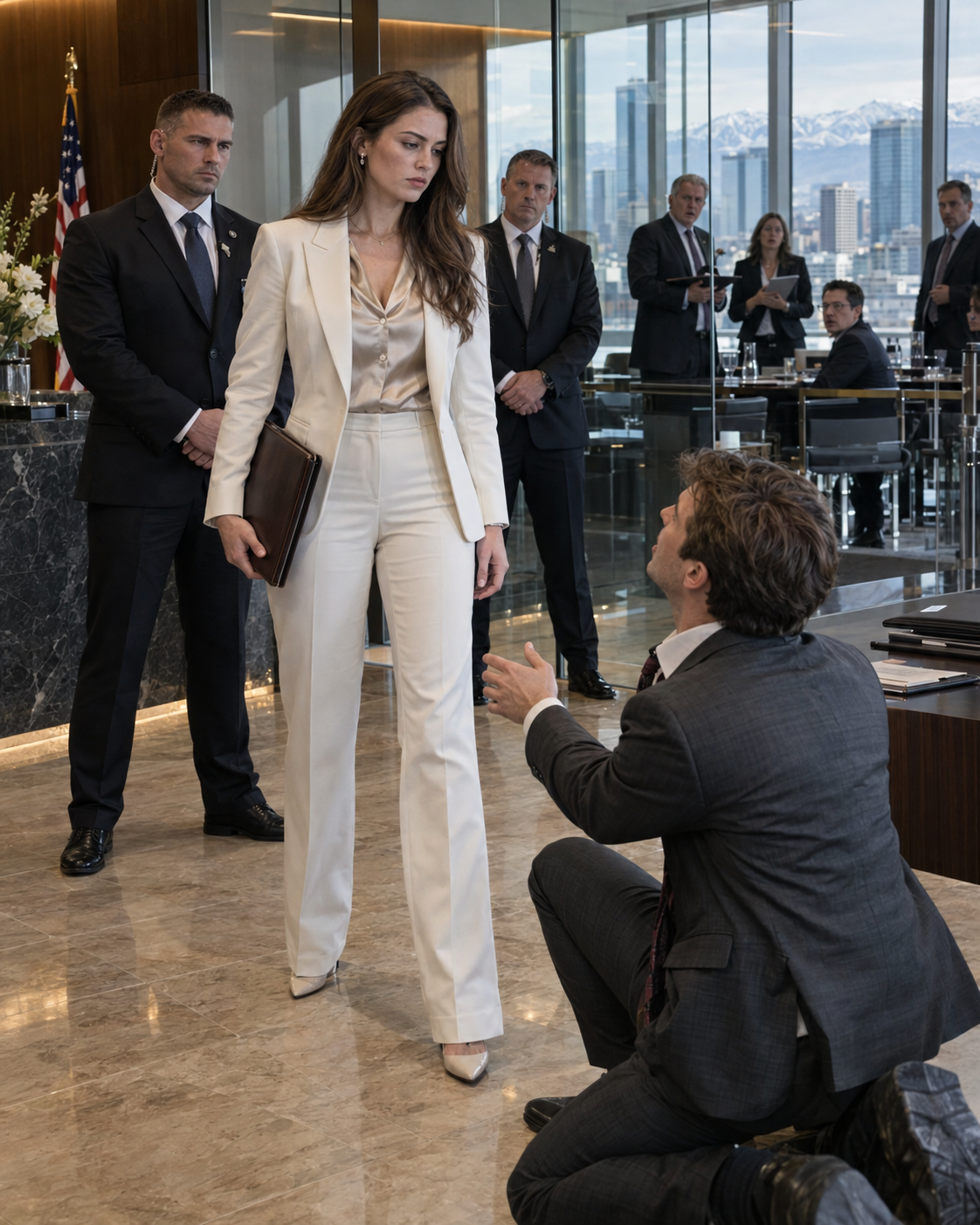
By Friday, he came to Holloway Tower.
Security called upstairs.
“He says he needs to see you.”
“Send him up.”
When the elevator opened, Gavin walked out with no briefcase.
No assistant.
No confidence.
He crossed the marble floor and stopped several feet away.
“I need help.”
I looked at him for a long time.
Then I said, “Do you remember what you told me when you sent me to the study?”
He swallowed.
“I said we needed space.”
“No. You said I should be grateful you were letting me stay in your house.”
He closed his eyes.
“I remember.”
“Then you understand why I’m not going to rescue you.”
He stepped closer.
“I’ll sign anything.”
“I know.”
“I’ll give you the company.”
“You don’t have a company to give me.”
That was the moment he finally understood.
Ashford hadn’t collapsed because I had attacked it.
It had collapsed because the scaffolding holding it up had never belonged to him.
He sank to his knees.
The security team shifted uneasily.
I stared at him on the travertine floor.
For one ugly second, I remembered the study.
The suitcase.
The way he had pointed toward the door.
“Please,” he said.
I could have made the moment cruel.
Part of me wanted to.
Instead I said, “Stand up.”
He didn’t.
“I said stand up, Gavin.”
Slowly, he did.
I handed him an envelope.
Inside was a settlement removing his personal guarantees, provided he surrendered control of the remaining assets and accepted an independent review of every transaction involving Holloway-backed funds.
He looked at me.
“Why are you doing this?”
“Because I don’t want to become you.”
His eyes filled.
That was the last time we spoke privately.
Vanessa’s confrontation came two days later.
She arrived at Holloway Tower furious, claiming I had ruined her life.
Miriam had already arranged the conference room.
When Vanessa saw the screens, the color drained from her face.
One showed the clinic’s confirmation that the prenatal records were fabricated.
Another showed the cosmetic records under a different identity.
The third showed security footage of her removing the brooch from her bag and placing it in my suitcase.
Vanessa stared at the screen.
Then at me.
“You don’t understand.”
“Then explain.”
She couldn’t.
Not convincingly.
Her story changed three times in seven minutes.
Finally she grabbed her purse.
As she reached the door, she screamed that Gavin had promised to leave me.
I said nothing.
Because that was between them.
She fled with her attorney behind her.
There was no satisfaction in watching her go.
Only exhaustion.
Weeks passed.
The Ashford properties were sold in orderly pieces.
Gavin lost the house, the cars, the memberships, and the illusion that his surname could protect him from arithmetic.
I kept none of the trophies.
I didn’t need them.
Helen came to Holloway Tower one rainy afternoon.
She looked smaller without the house behind her.
“I was wrong,” she said.
I poured her tea.
She cried before she sat down.
“I treated you terribly.”
“Yes.”
She flinched.
I didn’t soften it.
“I thought you were trying to take Gavin away from us.”
“I wasn’t.”
“I know that now.”
She asked whether there was anything I could do for her.
I thought about it.
“There is.”
Her face lifted.
“Frank.”
She nodded immediately.
“He needs work and medical coverage for his wife.”
“I can arrange that.”
“And you?”
She looked down.
“I’ll manage.”
I believed her.
Not because she suddenly deserved my trust, but because for the first time she was asking without demanding.
I offered her a modest apartment for six months, nothing more.
She accepted.
I never gave Gavin another dollar.
Months later, I stood on the forty-second floor after everyone had gone home.
Calgary spread beneath me in a field of lights, the mountains dark beyond the glass.
My name was on the office door now.
Not Mrs. Ashford.
Not someone’s wife.
Nora Holloway.
I had spent years thinking inheritance meant money.
It didn’t.
It meant having somewhere to stand when everything else fell away.
My father came in carrying two coffees.
“You okay?”
I nodded.
Then I corrected myself.
“I will be.”
He smiled.
That was enough.
I looked down at the city and thought about the woman who had walked out of the Ashford house at 1:17 in the morning with one suitcase and a broken heart.
I didn’t hate her anymore.
She had been trying to survive.
I finally understood that leaving had not been the moment I lost my marriage.
It was the first moment I chose not to lose myself.
The building settled into its nighttime silence.
My father left.
I stayed by the window for another hour, listening to the quiet, and for once the quiet didn’t feel like punishment.
It felt like mine.