When dozens of wedding guests crowded outside a locked hotel ballroom, my future mother-in-law called me selfish
The unanswered question was waiting for me in a manila folder Brandon had forgotten in the bottom drawer of our desk.
I found it two days after the wedding that never happened, while I was sorting through the last pieces of my old life.
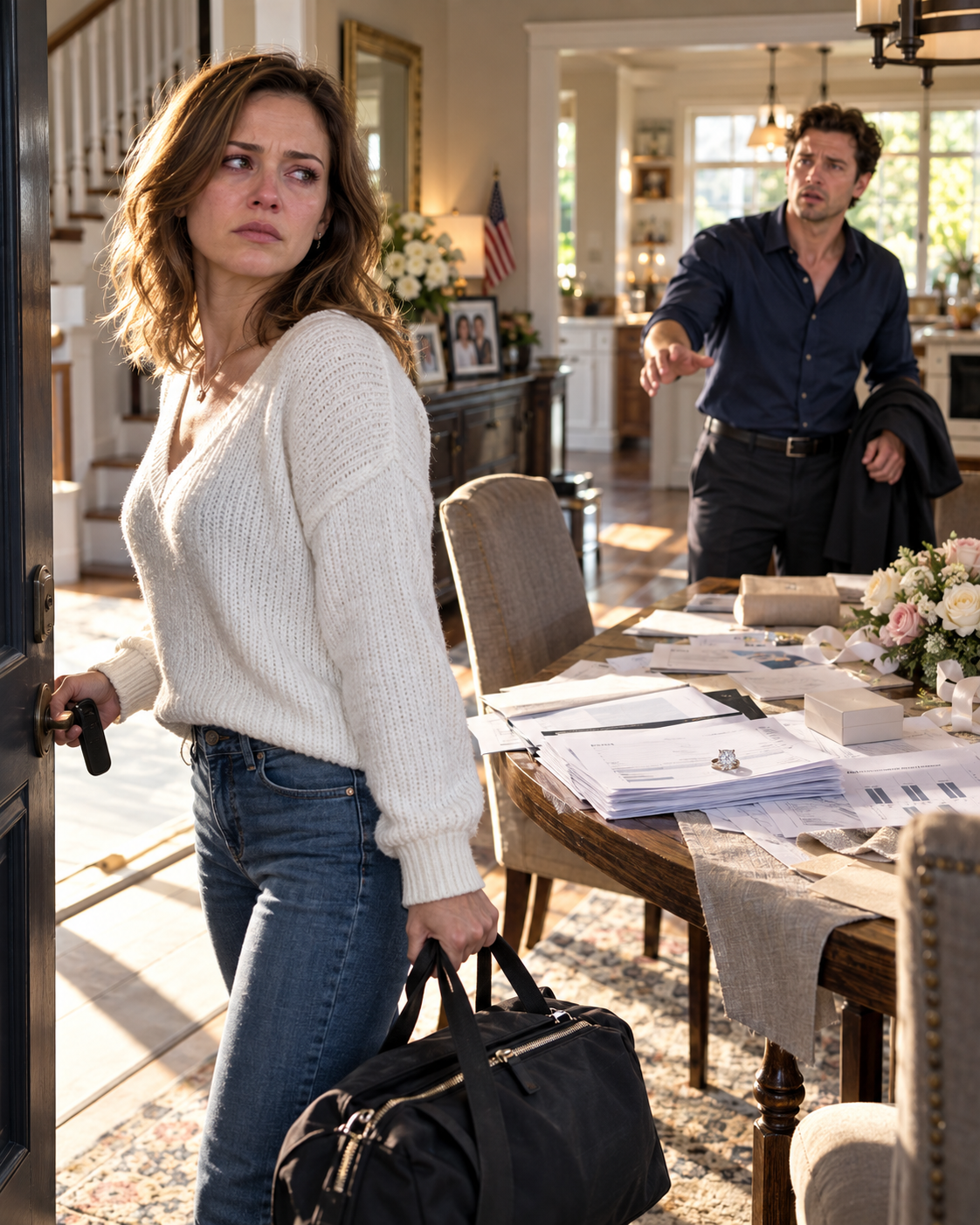
The folder was labeled “Household Consolidation.”
Inside were copies of the draft bank forms I had seen on the diner screen, a projected monthly budget, and a page of handwritten numbers.
My salary was at the top.
My savings was underneath.
My pre-approved mortgage amount sat on the final line.
Beside all three, Beatrice had written one sentence in blue ink.
“Once the marriage is official, he can finally breathe.”
I read it twice.
Then a third time.
There was no romance in those words.
There was only extraction.
For months, I had believed every conversation about our future was about choosing paint colors and finding a neighborhood where we would grow old.
They had been planning a balance sheet.
I closed the folder and called the attorney my coworker’s husband had recommended.
I expected to feel embarrassed telling a stranger that the man I had planned to marry had tried to use my credit to rescue his company.
Instead, the attorney asked calm, practical questions.
Had I signed anything?
No.
Had I granted access to my bank accounts?
No.
Had we opened joint accounts?
No.
Had the mortgage closed?
No.
“Then you may have stopped this before the financial damage reached you,” she said.
May have.
Those three words stayed with me.
Because I was beginning to understand that escaping the trap did not mean the trap had disappeared.
Brandon still had creditors.
His company still had debts.
Beatrice had still co-signed some of the obligations.
And somewhere between their panic and my silence, they were probably trying to figure out who to blame.
Three days after the canceled wedding, I learned the answer.
My phone lit up just after seven in the morning.
Brandon had left a voicemail.
His voice sounded softer than it had in the coffee shop.
“I know you’re angry, but please call me.”
I deleted it.
Another arrived twenty minutes later.
“You don’t understand how bad this is.”
I stared at the screen.
That sentence was probably the closest he had ever come to telling me the truth.
I still did not call back.
By afternoon, an email arrived from his company’s outside accountant.
The message was formal and careful, asking whether I had “knowledge of any recently prepared joint financial instruments.”
I forwarded it to my attorney.
She told me not to answer directly.
Instead, we reviewed every document again.
That was when we found something I had missed.
A signature page had been prepared with my full legal name typed beneath a blank line.
The date beside it was the day after our planned wedding.
Someone had planned my consent before they ever received it.
I felt cold all over.
It was not merely a bad idea.
It was a timetable.
A sequence.
A life arranged around the assumption that I would obey.
I changed my passwords that night.
I froze my credit.
I called my bank and removed every old authorization that could be questioned.
I changed the mailing address for my financial statements.
I even called the mortgage company and told them I had withdrawn from the planned purchase.
The woman on the phone said, “You’re the first person this week who sounded relieved while canceling a house.”
I laughed for the first time in days.
Then I cried.
Not because of the house.
Because I had finally realized I was allowed to want a life that did not require surviving someone else.
A week later, Brandon showed up outside my office.
He waited near the employee parking lot holding a bouquet of white roses.
The flowers were beautiful.
That almost made me angry.
He had always known how to make a pretty gesture when an ugly conversation was waiting underneath it.
“Please,” he said.
I kept my distance.
“I need five minutes.”
“You already had two years.”
His face tightened.
“I made mistakes.”
“You made plans.”
“My business was struggling.”
“You were going to marry me because my finances could absorb the damage.”
“That wasn’t the only reason.”
I looked at the roses.
“Then tell me the other reason.”
He went silent.
I saw the shame cross his face for the first time, and for one dangerous second, I wanted to comfort him.
Then I remembered Beatrice’s voice.
“She’s our mule.”
I stepped back.
“Take the flowers.”
He left them on the hood of his car.
They stayed there until they wilted.
The company’s collapse happened faster than I expected.
Without the promised liquidity from my savings and the protection of a joint household, vendors stopped extending credit.
Two major clients terminated contracts after learning the firm was behind on payments.
A payroll service filed a demand.
A lender accelerated repayment.
Then a notice arrived that the company was entering receivership.
I learned most of it through public filings and secondhand conversations, never through Brandon directly.
That was the strangest part.
I had spent years believing I would be standing beside him when his life became difficult.
Instead, I was watching from a distance while strangers untangled the consequences of choices I had not made.
The first time I saw his name attached to a receivership document, I expected to feel victorious.
I felt tired.
There is nothing glamorous about watching a person you once loved lose everything.
Even when that person tried to make you the thing he could spend.
Two weeks into the receivership, Beatrice came to my office.
She walked through the lobby in a cream coat and sunglasses, looking exactly like the woman who had once chosen our wedding flowers with me.
The receptionist called my extension.
“There’s a woman here who says she’s your future mother-in-law.”
I closed my eyes.
“Send her up.”
Beatrice entered my office and shut the door.
“You have made this far worse than it needed to be.”
I gestured toward the chair.
“You came all the way here to say that?”
“You knew Brandon’s business was struggling.”
“I knew what he told me.”
“He is being destroyed.”
“He is facing the consequences of his debts.”
Her jaw tightened.
“You could still help.”
There it was.
Not an apology.
Not remorse.
A request.
A calculation.
She placed a folder on my desk.
“It’s a restructuring agreement.”
I did not touch it.
“What do you want me to sign?”
“Nothing unreasonable.”
“That is not an answer.”
She leaned closer.
“You can refinance the townhome later.”
My stomach dropped.
She knew I had bought one.
She had found my new address.
“You’re asking me to put my new home at risk to rescue a company I never owned.”
“We are family.”
I looked directly into her eyes.
“No.”
She blinked as if the word itself had offended her.
“You loved him.”
“I did.”
“You still can.”
I felt something inside me become very still.
“Love does not make me collateral.”
For the first time, Beatrice had nothing ready to say.
She gathered the folder and stood.
At the door, she turned around.
“Someday you will regret being this cold.”
I answered quietly.
“Maybe.”
Then I opened my laptop and returned to work.
My hands were shaking for almost an hour.
But I did not chase her.
I did not call Brandon.
I did not apologize for protecting myself.
That night, I added one more lock to my front door, not because I was afraid of them, but because I was learning that boundaries are not cruel just because someone dislikes them.
Three days later, Beatrice’s attorney sent a letter demanding that I preserve all communications relating to Brandon and his company.
My attorney responded on my behalf.
Every message was preserved.
Every document stayed exactly where it was.
Nothing had to be exaggerated because the truth was already heavy enough.
After that, the calls stopped.
Then Beatrice’s house went on the market.
The white colonial with black shutters, the house where she had hosted bridal brunches and holiday dinners, appeared online with a professionally staged photograph.
The listing said the property had “timeless charm.”
I stared at the picture for a long time.
I remembered sitting in that kitchen while Beatrice told me stories about Brandon as a boy.
I remembered the crystal glasses she brought out when she wanted to make an ordinary evening feel important.
I remembered her hand on my shoulder when she said, “You are exactly what this family needs.”
Now I understood what she meant.
She had not been welcoming me into the family.
She had been assessing my value.
The house sold six weeks later.
A mutual acquaintance told me Beatrice had used the proceeds to address guarantees connected to Brandon’s company.
I never called to confirm it.
I did not need to.
The documents were enough.
For the first time since I had overheard that conversation, I stopped checking their names online.
I stopped wondering whether Brandon would call.
I stopped imagining some dramatic apology that would rearrange the past.
Healing, I discovered, was much less theatrical than betrayal.
It was changing the sheets.
It was grocery shopping without wondering whether someone else was silently calculating the cost.
It was sitting in a room and hearing only the refrigerator hum.
It was learning that peace can feel uncomfortable when chaos has been your normal for too long.
I used the recovered deposits, along with money I had already saved, to secure a modest townhome in a quiet neighborhood twenty minutes from my office.
It was not the house Brandon and I had chosen.
There was no wedding registry in the kitchen.
No custom dining table.
No framed engagement photographs.
But the first night I slept there, I woke before dawn and realized I was smiling.
There was nobody beside me asking whether the account had cleared.
Nobody waiting for a signature.
Nobody turning love into leverage.
I made coffee and opened the curtains.
Morning sunlight spilled across the empty living room.
The room felt unfinished.
So did I.
But unfinished was different from broken.
A month later, I received one final envelope.
There was no return address.
Inside was a photocopy of a page from Brandon’s business records.
At the bottom was a note in his handwriting.
“I never told you everything.”
That sentence would have terrified me once.
Now it only made me curious.
I called my attorney before reading further.
She told me to preserve the document and avoid contacting Brandon.
So I sat at my kitchen table and read the next page alone.
It contained a list of names, amounts, and dates.
Some I recognized.
Some I did not.
At the bottom was a payment marked “Family Assistance.”
The recipient was not Brandon.
It was Beatrice.
For a few seconds, I could not breathe.
Then I turned the page.
There was another notation.
“Original source withheld.”
I looked out at the quiet street.
A part of me wanted to know everything.
Who had really been financing Brandon?
How long had Beatrice been covering the gaps?
What had they intended to do if I had discovered the truth after the wedding instead of before it?
But another part of me, the part that had survived the locked ballroom and the cold coffee and the cruelest sentence I had ever heard, finally understood something.
Not every door deserves to be opened.
Some answers do not set you free.
Sometimes freedom is deciding you no longer need them.
Months passed.
I went back to work.
I accepted invitations again.
I laughed without forcing it.
I bought a small dining table for the townhome and placed a ceramic bowl in the center.
There was something healing about ordinary objects.
A bowl could simply be a bowl.
A key could simply open a door.
A signature could belong to you.
And love could be love without being a financial strategy.
One Saturday afternoon, I took the old wooden box of my grandmother’s things from the closet and opened it.
Inside was a photograph of her standing beside my grandfather in front of their first apartment.
They had almost nothing.
Yet in the picture, they were smiling like they owned the whole world.
Tucked behind the photograph was a note in my grandmother’s handwriting.
“Never build a home with someone who needs you smaller to keep theirs standing.”
I read it until my eyes blurred.
I had heard those words as advice before.
Now I understood them as inheritance.
Not money.
Not property.
Wisdom.
The kind that arrives too late to prevent every wound, but early enough to keep one wound from becoming your whole life.
I placed the note in a frame beside the photograph.
Then I opened the front door and let the afternoon air move through the house.
For the first time, I did not feel like I had escaped from someone.
I felt like I had returned to myself.
I still sometimes think about that kitchen island.
The ivory linens.
The unlocked side door.
The phone I almost forgot.
It is strange how a life can turn on something so ordinary.
One missing phone.
One accidental overheard conversation.
One moment when the truth slipped through a crack because somebody was arrogant enough to believe you would never hear it.
People sometimes ask what I lost when I called off the wedding.
The answer used to be everything.
The venue.
The deposits.
The dress.
The photographs.
A future.
A man I thought I knew.
But that was not really what I lost.
What I lost was the version of myself who believed being loved meant being useful.
And what I gained was harder to measure.
I gained my name back.
My money back.
My choices back.
My silence back.
Most of all, I gained the right to build a future without wondering what part of me someone was planning to spend.
The last time I drove past Beatrice’s old neighborhood, another family was moving into the colonial.
There were cardboard boxes on the porch and a child’s bicycle near the garage.
Life had replaced the wreckage without asking permission.
I kept driving.
I did not know whether Brandon ever admitted the truth to anyone.
I did not know whether Beatrice ever regretted what she had said.
And I never found out who had written “Original source withheld.”
Maybe one day I will.
Maybe I won’t.
Either way, I know this now: the greatest betrayal was not that they wanted my money.
It was that they wanted me to mistake being needed for being loved.
And once I understood the difference, they could no longer use either word to keep me trapped.
Sometimes the person who saves your life is not the one who stays.
Sometimes it is the version of you who finally walks away.
And sometimes the most important wedding you ever cancel is the one where you were preparing to marry someone else at the cost of yourself.