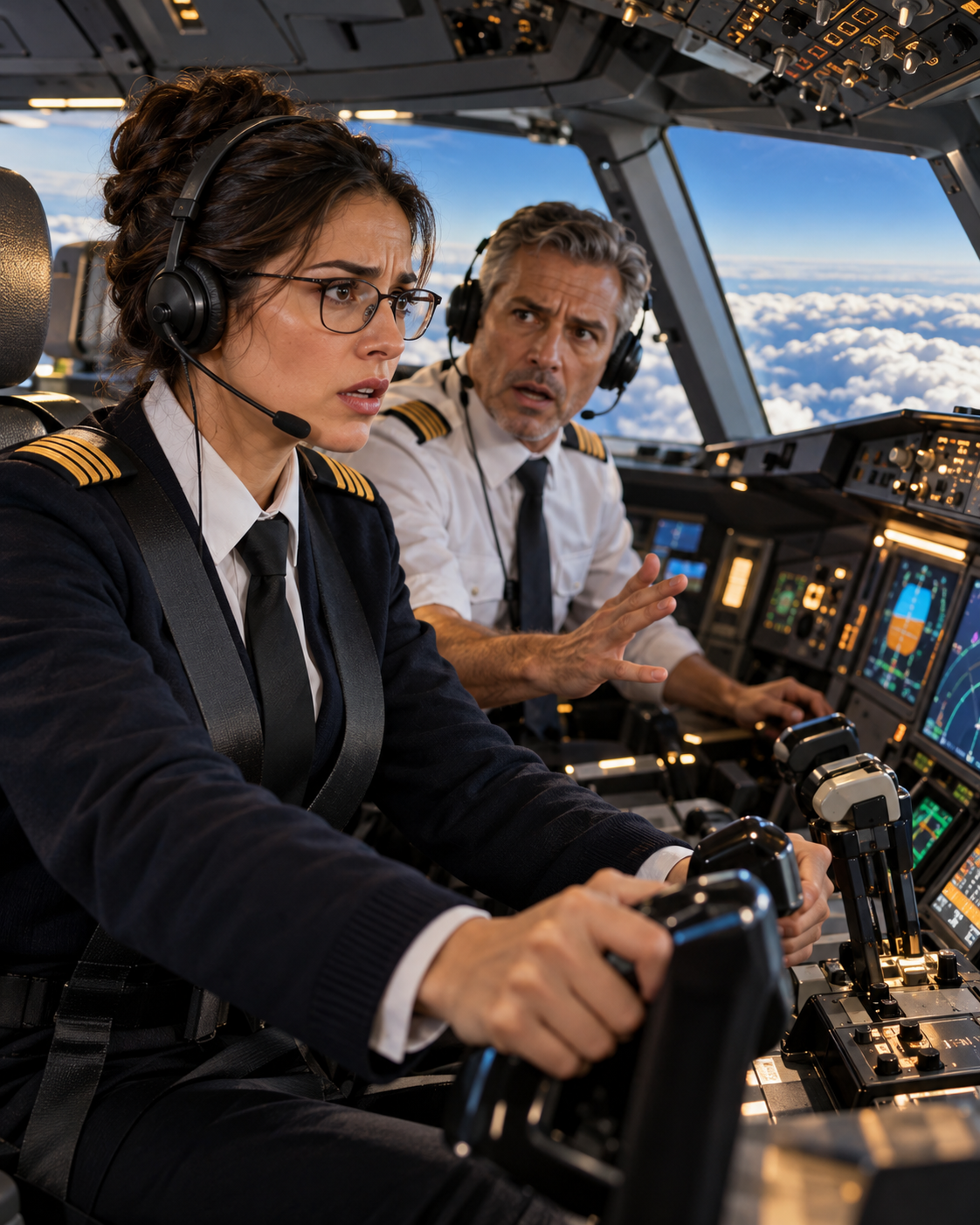
When Captain Sterling froze over the North Atlantic and called me a useless diversity hire while our dying Boeing 777
For several seconds, I could hear nothing except the distant hiss of the engines cooling outside the terminal.
People were still cheering behind me, taking photographs, hugging flight attendants, thanking the crew for saving their lives, while the man standing in front of me looked as if he had walked into a room carrying a secret too heavy for his own hands.
“Major Vance,” he said again, more quietly this time.
I stared at him.
“No one calls me that anymore.”
His eyes moved toward Captain Sterling.
“That’s exactly why I’m here.”
Sterling rose from his seat slowly, one hand pressed against his bruised jaw.
“You know her?”
The investigator did not look at him.
“I know who she was.”
The sentence landed harder than any alarm had.
Sterling’s expression changed.
He had spent the entire flight believing I was inexperienced, overly cautious, and lucky to be sitting beside him.
Now he looked at me as if I were someone who had stepped out of a photograph he had once seen in a war briefing.
The investigator extended his hand.
“I’m Colonel Daniel Mercer.”
I did not take it.
“Why are you here?”
He glanced around the crowded gate.
“Not here.”
He nodded toward a secured service corridor.
I looked back at my passengers.
A little girl was hugging a flight attendant.
An elderly man was crying into his wife’s shoulder.
A young couple stood beneath the airport windows, holding each other as if they had only just realized they were still alive.
I had spent five years trying to forget what it felt like to watch people survive because of something I had done.
I remembered another runway.
Another night.
Another group of people who did not all make it home.
That was why I had left the Air Force.
That was why I had become Corinne Vance.
“Give me ten minutes,” I said.
Mercer nodded.
“I’ll give you twenty.”
I walked into the terminal.
Passengers recognized me immediately.
One man grabbed my hand.
“Thank you.”
A woman began crying before she could finish speaking.
Another passenger asked for a photograph.
I smiled because I did not know what else to do.
Then the little girl from row eighteen approached holding a plastic toy airplane.
She looked at me seriously.
“Are you the captain?”
I crouched beside her.
“No.”
She thought for a moment.
“You should be.”
Then she ran back to her mother.
I stood there until my eyes burned.
Some words are too simple to survive inside you without breaking something open.
Ten minutes later, I followed Mercer through the secured door.
He closed it behind us.
On the table inside the small conference room was a black file.
No insignia.
No labels.
Just my old callsign stamped across the front.
NIGHTFALL.
I sat down.
“I thought this program was declassified.”
“The program was.”
“Then why am I holding a classified file?”
Mercer did not answer immediately.
He opened the folder.
Inside were photographs from twelve years earlier.
A forward operating base.
A damaged runway.
A burning aircraft.
And me.
Younger.
Without glasses.
Without hesitation.
I turned the next page.
There was a list of names.
Most were crossed out.
At the bottom was one name I had spent years trying not to remember.
Lieutenant Evan Hale.
My copilot.
Mercer watched my face.
“We found something.”
My fingers tightened around the page.
“Evan was killed.”
“We know.”
“Then what did you find?”
Mercer placed a small digital recorder on the table.
“Listen.”
A crackle filled the room.
Then a man’s voice emerged through static.
“If Nightfall gets pulled from the program, someone needs to know why.”
I stopped breathing.
Evan’s voice.
Older recordings had blurred memories into something distant, but this was unmistakable.
He continued.
“The official report won’t tell the truth.”
The recording ended.
I looked at Mercer.
“Where did you get that?”
“From an evidence archive reopened three months ago.”
“Why now?”
“Because someone accessed your old mission file last week.”
The room suddenly felt colder.
“Who?”
Mercer slid another photograph across the table.
A man leaving a military records facility.
I recognized him immediately.
Captain Travis Sterling.
I stared at the image.
“No.”
Mercer nodded.
“He’s been asking questions about you for months.”
I pushed the photograph away.
“Why?”
“We don’t know yet.”
I remembered Sterling’s voice.
Maybe for people who don’t trust themselves.
I remembered the way he froze in the cockpit.
The way he shoved the throttles forward.
The way he pulled us toward a stall.
Then I remembered something else.
Before takeoff, he had asked me what I thought of the northern routing.
I had assumed it was casual conversation.
Now I wondered whether he had been testing me.
Mercer leaned closer.
“There’s more.”
He turned the file around.
A weather analysis showed that the volcanic ash cloud had not been visible on standard commercial forecasting systems.
“Was the route approved?”
“Yes.”
“Was the ash detected?”
“Not in time.”
“So what’s the problem?”
“The cloud wasn’t supposed to be there.”
I stared at him.
“Volcanic activity can change.”
“Correct.”
He tapped the report.
“But someone knew the risk had increased.”
My heart started beating harder.
“Who?”
“The warning never reached civilian dispatch.”
I looked at him.
“Why not?”
“That’s what we’re investigating.”
The door opened.
Sterling stepped inside.
“I need to talk to her.”
Mercer stood.
“No.”
Sterling ignored him.
“I wasn’t trying to hurt anyone.”
I looked at him.
“What did you know?”
His face hardened.
“I knew the weather was unstable.”
“How unstable?”
“I don’t know.”
“You knew enough to ask me about the route before takeoff.”
He said nothing.
I stood.
“You’ve flown with me for six months.”
“Yes.”
“You spent six months treating me like I had no idea what I was doing.”
He looked away.
“Because I thought you were hiding something.”
I felt the blood drain from my face.
“What did you think I was hiding?”
His answer came quietly.
“Military training.”
Mercer turned toward him.
“Who told you?”
Sterling hesitated.
“No one.”
“That’s a lie,” Mercer said.
Sterling looked at him.
Then at me.
“The old aviation community talks.”
My hands curled into fists.
“About Nightfall?”
He nodded.
“Some people never believed you left.”
“Who are those people?”
He did not answer.
Mercer did.
“Three weeks ago, someone attempted to pull your military medical records.”
That stopped me.
My records had been sealed when I left the service.
Only a handful of people knew the access procedure.
“Was Sterling one of them?”
Mercer looked at him.
Sterling said nothing.
I turned to Mercer.
“Take him away.”
Sterling’s expression changed.
“You don’t understand.”
“No.”
I looked him directly in the eyes.
“I understand exactly enough.”
He walked out under escort.
I remained in the room long after the door closed.
The same question kept returning.
Why me?
Why now?
Mercer finally broke the silence.
“Because your flight wasn’t the first.”
He opened another file.
Two commercial flights had reported brief engine disturbances in the North Atlantic corridor over the previous month.
Both aircraft had landed safely.
Both crews had dismissed the incidents as unexplained atmospheric contamination.
But in both cases, the electronic data showed unusual interference.
“Someone is testing something,” Mercer said.
My mouth went dry.
“Testing what?”
“We don’t know.”
“And the flight today?”
“We think it was the first time someone underestimated how quickly conditions could become catastrophic.”
I stood.
“You’re telling me 284 people almost died because someone was experimenting with an aircraft environment?”
“We’re telling you we don’t know who is behind it.”
I looked through the glass wall at the airport beyond.
Passengers were still celebrating.
Some were posting videos.
Some were probably already telling their families they had survived the worst flight of their lives.
I wondered how many would ever know how close they had come to becoming numbers in a report.
Mercer handed me the recorder again.
“There is one more thing.”
I pressed play.
Static.
Then Evan’s voice returned.
“I don’t think they want the mission exposed.”
A pause.
“They want Nightfall blamed.”
The recording ended.
I felt something inside me break loose.
For five years I had believed I left the military because I was traumatized.
That was true.
But maybe it was not the whole truth.
Maybe I had also been pushed out.
Maybe someone had needed the pilot who knew too much to disappear.
I looked at Mercer.
“You said someone accessed my file last week.”
“Yes.”
“Who?”
He hesitated.
“We traced the login.”
My pulse quickened.
“To where?”
Mercer closed the folder.
“Your airline’s operations center.”
The silence that followed was unbearable.
I thought about every briefing.
Every crew room.
Every schedule change.
Every face that had looked ordinary.
“Someone at the airline?”
“Possibly.”
“Who?”
“We’re still tracing it.”
I laughed bitterly.
“Everyone keeps saying that.”
Mercer looked at me.
“Because every answer opens another question.”
For the first time, I believed him.
I returned to the hotel that night and could not sleep.
The city outside was dark and wet.
I stood at the window wearing the same oversized sweater that had once made me invisible.
I removed my glasses.
In the reflection, I saw the face I had spent years trying to recognize again.
Nightfall.
Then my phone vibrated.
Unknown number.
I answered.
No one spoke.
I waited.
Finally, a distorted voice whispered, “You should have stayed retired.”
The call ended.
I froze.
A second message appeared.
A photograph.
It showed me walking through the airport that afternoon.
Taken from across the terminal.
Below the photograph were four words.
WE KNOW WHAT HAPPENED.
I stared at the screen.
Then another message arrived.
This one contained coordinates.
Not to a military base.
Not to an airport.
To a small coastal airfield south of Reykjavik.
There was one final line.
ASK ABOUT EVAN.
I called Mercer.
He answered immediately.
“I got it too.”
I felt a chill.
“You knew?”
“No.”
“Then why did you receive the same message?”
Silence.
“Mercer?”
His voice changed.
“Because whoever sent it wants us looking in the same direction.”
The next morning, I returned to Keflavik.
Not in uniform.
Not as Nightfall.
Just Corinne.
Mercer met me near a private hangar.
Inside was an old transport aircraft covered in dust.
On the fuselage was a faded military emblem.
I recognized it instantly.
I had flown that aircraft once with Evan.
The same aircraft that appeared in the last photograph of my military career.
“You said Evan was dead,” I whispered.
Mercer stared at the plane.
“He was.”
“Then why is his name on the flight manifest?”
Mercer did not answer.
I walked closer.
The manifest was dated three days after Evan’s reported death.
Passenger number seven.
Evan Hale.
Status: transported.
My hands began to shake.
“That isn’t possible.”
Mercer handed me a second document.
A transfer record.
A medical evacuation.
No destination listed.
No receiving hospital.
No burial confirmation.
Nothing.
Just a missing signature.
I looked up.
“Someone moved him.”
“That’s what it appears.”
“And the military never told me?”
“No.”
I turned toward Mercer.
“Why?”
Before he could answer, the hangar lights went out.
For one second there was complete darkness.
Then emergency lights flickered red.
Somewhere behind the aircraft, metal scraped against concrete.
Mercer drew his sidearm.
I froze.
Not from fear.
From memory.
My body knew that sound.
The sudden silence before danger.
The instinct before thought.
I grabbed the flashlight from the workbench.
“Back door,” I whispered.
Mercer looked at me.
“You heard something?”
“I heard someone breathing.”
We moved through the shadows.
A figure ran between the aircraft.
Mercer shouted.
The figure disappeared through a service exit.
We reached the door seconds later.
Outside, there was only wind.
And footprints leading toward the water.
I looked down.
One footprint had a distinctive tread pattern.
Military issue.
Not current.
Old.
The same kind used by our unit twelve years earlier.
Mercer stared at it.
Then his face changed.
“What?”
He pointed.
Beside the boot print was a second object.
A silver identification tag.
I bent down.
The name was scratched nearly smooth.
But I could still read it.
HALE.
My knees nearly gave way.
“He’s alive,” I whispered.
Mercer shook his head.
“No.”
I looked at him.
“The tag doesn’t prove that.”
He stepped closer.
“It proves someone wants you to believe he is.”
The wind howled across the runway.
For five years, I had thought the worst thing war had taken from me was my past.
Now I understood it had taken something more dangerous.
My certainty.
I had built a new life because I believed the old one was finished.
I had learned to fly quietly.
To sit in the back of rooms.
To let louder people underestimate me.
I had mistaken invisibility for peace.
But peace is not the same as hiding.
Sometimes hiding only gives the truth more time to follow you.
Mercer looked toward the dark shoreline.
“You don’t have to do this.”
I placed the identification tag in my pocket.
“I know.”
“Then why are you staying?”
I thought of the little girl at the airport.
Are you the captain?
You should be.
I thought of the 284 people who had trusted a cockpit without knowing the history of the woman sitting in it.
I thought of Evan.
I thought of every person who had disappeared behind an official report because admitting the truth would have been inconvenient for someone powerful.
Then I looked toward the ocean.
“Because someone spent years deciding what I was allowed to remember.”
I put my glasses back on.
“That ends now.”
We returned to the hangar.
On the old transport aircraft, beneath layers of dust and faded paint, I noticed a marking I had never seen before.
A single black circle beneath the cockpit window.
My old unit used that symbol for missions that never existed on paper.
Mercer saw it too.
Neither of us spoke.
Then the hangar phone rang.
Once.
Twice.
Three times.
I answered.
A man’s voice came through.
Weak.
Older.
But unmistakable.
“Corinne?”
Every breath inside me stopped.
“Evan?”
Silence.
Then he said the words that would change everything.
“Don’t trust Mercer.”
The line went dead.
I slowly turned around.
Mercer was standing behind me.
He looked pale.
And in his hand was a second identification tag.
Not Evan’s.
Mine.
The name beneath the scratches was my military callsign.
NIGHTFALL.
Then Mercer whispered, “We need to talk about the night you left the Air Force.”
And suddenly the story I thought I had survived was no longer the story I was trying to remember.
It was the story someone had been trying to erase.