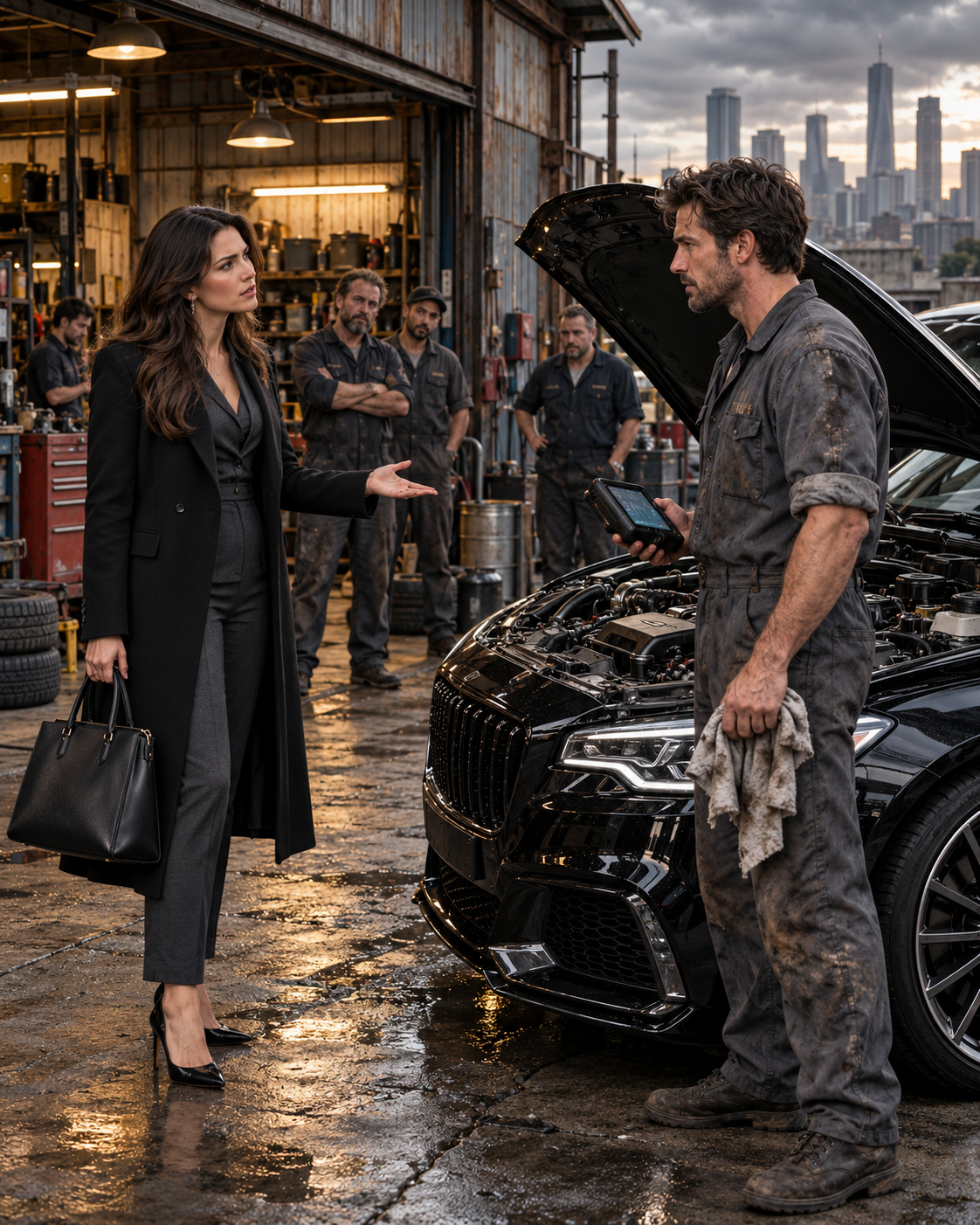
Veronica Caldwell laughed beside her stalled black SUV on my cracked Cleveland driveway
The words on that report followed me home that night.
I sat at the kitchen table after Chloe had fallen asleep, staring at the paper beneath the yellow light above the sink.
The report wasn’t from Caldwell Tech.
It wasn’t from my garage.
It came from a testing facility in Ohio I’d never heard of.
Six months before Veronica’s SUV had stalled, an engineer named Daniel Mercer had documented the same thermal delay.
His conclusion was brutally simple.
The valve wasn’t defective by accident.
It had been installed knowing exactly how it would behave under rapid load changes.
I read the sentence three times.
Then I noticed the signature at the bottom.
Daniel Mercer.
I knew the name.
Everyone in the fleet industry did.
He had been Caldwell Tech’s chief thermal systems engineer before disappearing from the company.
I searched through old trade publications until I found a photograph of him.
Gray hair.
Thin glasses.
A tired expression.
And beneath the picture, one sentence.
“Mercer resigned after a disputed internal safety review.”
I couldn’t sleep.
The next morning, I called Julian.
He listened without interrupting.
When I finished, he said, “Don’t touch anything until we know what this is.”
“I’m not trying to start a war.”
“Neither was Mercer.”
That sentence stayed with me.
Two days later, Daniel Mercer walked into my old garage.
He looked older than his photographs.
He carried a metal case and kept glancing through the window as if someone might be watching him.
“You found the report,” he said.
I hadn’t told him about it.
I closed the garage door.
“How did you know?”
“Because I left it where someone would eventually find it.”
He placed the metal case on my workbench.
Inside were thermal readings, manufacturing records, emails, and photographs of damaged components.
There were hundreds of pages.
“What happened?” I asked.
Daniel rubbed his forehead.
“Caldwell was under pressure to deliver a new fleet platform before competitors could catch up.”
He explained that the original thermal architecture had a flaw.
It could be corrected.
But the correction required redesigning a component and delaying production.
That would have cost millions.
“So they shipped it anyway?”
He nodded.
“They told customers the shutdowns were caused by aggressive driving, poor maintenance, and software instability.”
My stomach tightened.
“How many vehicles?”
“We stopped counting.”
I looked at the files.
“And the forty-million-dollar contract?”
“That contract was supposed to make the problem disappear.”
Daniel explained that Caldwell needed a major fleet customer to validate the platform publicly.
If the contract closed, the company could raise new financing and bury the earlier failures beneath a successful rollout.
Veronica hadn’t created the deception.
But she had inherited it.
And she had chosen to protect the company instead of confronting it.
I thought about the way she had stood outside my garage.
I had hated her for that moment.
Now I understood there had been something uglier underneath it.
Fear.
Not an excuse.
But a reason.
“Why come to me?” I asked.
Daniel looked toward the old lift.
“Because you solved the problem without knowing the politics.”
He paused.
“And because you didn’t have enough money to be afraid of losing it.”
I almost laughed.
“I had plenty to lose.”
“I know.”
He looked at the photograph of Chloe taped beside my workbench.
“That’s why you were dangerous.”
That evening, I took the files to our attorneys.
We verified every document.
The evidence was real.
But another problem surfaced.
Several reports had been altered after Daniel resigned.
Some test results had disappeared.
And one internal memo referenced a private meeting between Veronica and a senior executive named Harold Caldwell.
Her father.
The founder of Caldwell Manufacturing.
He had died two years earlier.
I assumed that meant the trail ended.
It didn’t.
A handwritten note in Daniel’s case said, “Harold knew.”
The next line said, “Ask Veronica what happened in Detroit.”
I called her.
She answered after four rings.
“What do you want?”
“To talk.”
“About what?”
“Detroit.”
Silence.
Long enough for me to hear her breathing.
“Where did you get that name?”
“From Daniel Mercer.”
She came to the garage alone.
She didn’t wear a designer coat this time.
She wore jeans, a dark sweater, and the exhausted expression of someone who had spent too many years carrying a secret.
“I thought Daniel was dead,” she said.
“He isn’t.”
She closed her eyes.
Then she told me about Detroit.
Three years earlier, before she became CEO, a prototype fleet vehicle had suffered a catastrophic thermal shutdown during testing.
A driver had been seriously injured.
The company settled quietly.
Harold ordered everyone to stop discussing the failure.
Veronica had argued with him.
She had demanded a recall.
Her father told her something she never forgot.
“Companies don’t survive because they’re innocent, Veronica.”
“They survive because nobody asks the wrong questions.”
She walked away from him that night.
But she never walked far enough.
When Harold died, she inherited the company, the debt, the contracts, and the culture he’d built.
“I thought I could fix it from inside,” she whispered.
“And did you?”
She looked at me.
“No.”
There was no defense in her voice.
Only exhaustion.
“I became the thing I hated.”
That sentence changed how I saw her.
Not because it erased what she’d done.
It didn’t.
But because I finally understood that people rarely wake up one morning and decide to become cruel.
Sometimes they make one compromise.
Then another.
Then one day they look around and realize they’ve built a life they no longer recognize.
I told her about Daniel’s documents.
She wasn’t surprised.
“I knew some of it.”
“Some?”
“Enough to know I should have stopped it.”
She looked toward Chloe’s old pink coat hanging by the door.
“I was afraid.”
“Of what?”
“Losing everything.”
I almost said, “You did.”
Instead, I said, “So did everyone driving those vehicles.”
She nodded.
“I know.”
The investigation became public three weeks later.
Federal regulators opened a review.
Fleet operators came forward.
Former employees testified.
Drivers who had been blamed for failures finally had their records corrected.
Caldwell’s old executives denied wrongdoing.
Some claimed they had never seen the reports.
Others blamed Harold.
The truth was messier than a single villain.
There were signatures.
Emails.
Warnings.
Ignored test results.
People who knew too much.
People who knew just enough to remain silent.
And people who convinced themselves that silence was temporary.
My company was asked to provide technical evidence.
I spent long days in conference rooms where lawyers argued over words while I thought about drivers sitting beside broken vans in freezing parking lots.
One man named Marcus told investigators his wife had missed three chemotherapy appointments because his delivery van failed repeatedly.
He had been fined for late deliveries.
He had blamed himself.
When he heard our system had proven the thermal defect, he called me.
His voice shook.
“They told me I was careless.”
I closed my eyes.
“I’m sorry.”
He answered quietly.
“You fixed more than my van.”
That night, I walked through the factory alone.
The machines were silent.
Rows of unfinished regulators waited beneath bright lights.
I ran my hand over one of them.
I thought about the first one I’d built on my workbench.
It had looked ugly.
The welds weren’t perfect.
The casing had scratches.
But it worked.
Sometimes I wondered if that was what mattered most.
Not looking impressive.
Not winning the room.
Not having the biggest office.
Just doing the thing correctly when nobody was watching.
Months passed.
The investigation eventually resulted in recalls, settlements, and major changes to Caldwell’s fleet program.
Veronica resigned from executive leadership.
She didn’t ask me for a job.
I wouldn’t have known what to say if she had.
Instead, she started a small nonprofit that helped drivers and independent fleet owners navigate equipment safety disputes.
She sent me a letter.
I kept it.
She wrote that she couldn’t undo what had happened.
But she could spend the rest of her life refusing to repeat it.
I believed her.
Not completely.
Not immediately.
Trust isn’t a light switch.
It’s a bridge rebuilt plank by plank.
Our factory continued growing.
But I refused to turn it into another version of the company we’d replaced.
Every engineer could stop a production line if they believed something was unsafe.
Every technician had access to testing records.
Every failure had to be documented.
No customer complaint could disappear into a spreadsheet.
We called the rule the Chloe Standard.
She hated the name at first.
“Why does everything have my name?”
I laughed.
“Because you’re the reason I care.”
She thought about that.
Then she smiled.
“Okay.”
Years later, she would tell me that was the first time she understood what work really meant.
Not money.
Not status.
Responsibility.
One winter evening, after the final shift had gone home, Chloe and I stood outside the old garage.
Snow covered the cracked concrete.
The community repair bay was quiet.
Someone had left a broken bicycle near the door.
I handed Chloe the keys.
“Your turn.”
She looked confused.
“For what?”
“Open the garage.”
She unlocked the door.
Inside, the same old workbench stood beneath the same crooked lamp.
The place hadn’t changed much.
That was intentional.
I wanted one room in my life to remember where we started.
Chloe walked to the wall where I’d once taped my ninety-day blueprint.
The paper was yellow now.
She touched it gently.
“You really thought this would work?”
“No.”
She looked at me.
“You didn’t?”
“I thought I had to try.”
She smiled.
Then her expression changed.
“Dad.”
“What?”
She pointed toward the workbench.
There was another envelope sitting there.
Plain brown.
No name.
No address.
My chest tightened.
For a moment, neither of us moved.
I opened it.
Inside was a photograph.
Daniel Mercer stood beside a younger Harold Caldwell outside a factory I’d never seen.
Behind them was a prototype vehicle.
On the back of the photograph was a handwritten date from twenty years earlier.
And beneath it were seven words.
“THE FIRST FAILURE WASN’T THE ONE THEY BURIED.”
I stared at the sentence.
Chloe whispered, “What does it mean?”
I didn’t answer.
Because beneath the photograph was a second document.
A manufacturing schematic.
Not for the thermal valve.
For something far older.
Something designed before Caldwell Tech had ever existed.
At the bottom of the page was a familiar signature.
Daniel Mercer’s.
But the date beside it was impossible.
It was from twenty years before Daniel had joined the company.
I looked through the garage window toward the glowing sign of Thorne Driveworks.
For the first time in years, I felt the old uncertainty return.
Not fear.
Not exactly.
Something colder.
The feeling that I’d spent years believing I had discovered the beginning of a story when I’d really only uncovered the middle.
Chloe slipped her hand into mine.
“Dad?”
I folded the document carefully.
“Let’s go home.”
We turned off the lights.
But before I locked the garage, I looked back at the workbench.
For just a second, I imagined someone standing there in the darkness.
Waiting.
Watching.
Then the streetlight flickered.
And I realized the hardest lesson of all wasn’t that powerful people could hide the truth.
It was that sometimes the truth could survive for decades, quietly waiting for the right person to care enough to find it.
I locked the door and walked away with Chloe beside me.
Behind us, the old garage disappeared into the snow.
But the envelope stayed in my pocket.
And whatever had happened twenty years ago was no longer buried.
It had found us.