Vanguard 2.” I said it before I could stop myself, because the woman behind the naval emergency-room desk
Captain Mercer said it quietly, almost as if he were afraid the wrong volume might break something.
“Nora.”
She turned toward him.
“Captain.”
The two of them stared at each other while the emergency department continued moving around them.
Mercer was older than I remembered, broader through the shoulders, his hair silver at the temples. He had been a battalion commander when I was still wearing a uniform. The kind of officer who could make a crowded room go silent without raising his voice.
His gaze moved from Nora’s face to the radio in her hand.
“What happened to you?”
Nora looked away.
“Long story.”
“I’ve got time.”
“No, sir. You don’t.”
That was when another alarm sounded.
A medic rushed through the doors.
“Sir, we have at least six trapped at the north barracks. Two confirmed conscious. Fire is moving through the east side.”
Mercer turned toward the operations officer.
“Who’s running the rescue?”
“Fire and emergency response is en route.”
“How long?”
“Four minutes.”
Nora glanced at me.
“Four minutes is a long time if the roof is moving.”
Thorne stepped forward.
“Staff Sergeant Vance is not assigned to this incident.”
Mercer looked at him.
“I didn’t ask about her assignment.”
“She is a civilian nurse.”
“She is also Staff Sergeant Vance.”
“Former Staff Sergeant.”
Nora’s expression tightened.
“Captain.”
Mercer studied her.
“Are you active reserve?”
Silence.
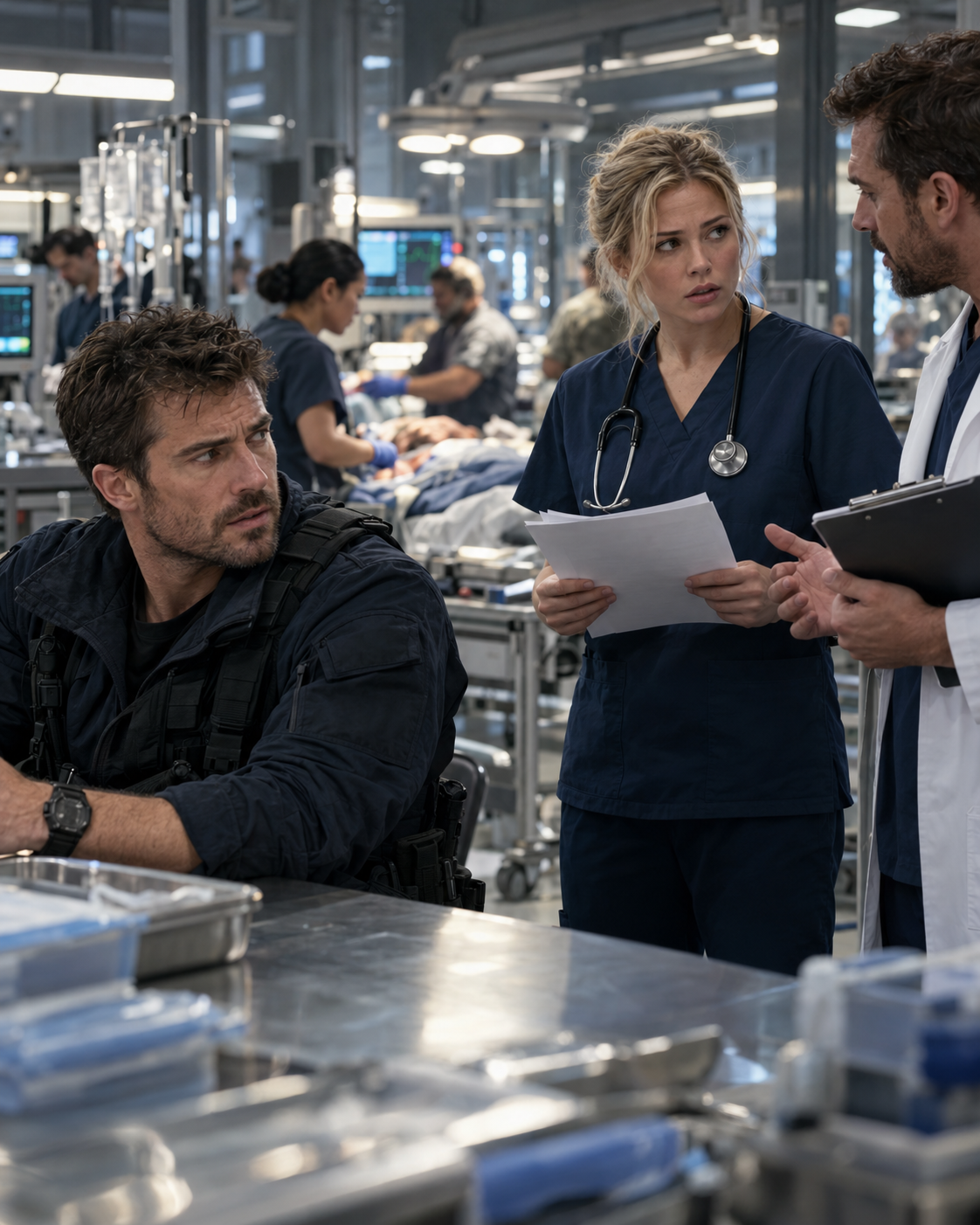
I watched something pass across her face.
Not fear.
Resignation.
Finally, she nodded.
“Technically.”
Thorne stared at her.
“Technically?”
Mercer exhaled through his nose.
“That explains the sealed file.”
Nora looked at him sharply.
“You knew?”
“I knew enough to know you weren’t discharged the way everyone thought.”
Her jaw tightened.
“I wasn’t looking for another uniform.”
“I can see that.”
Outside, a siren screamed.
Nora handed me the radio.
“Tell them we’re taking the west access road.”
Thorne stepped in again.
“You are not taking my staff into an unstable structure.”
Nora turned toward him.
“Then don’t take your staff.”
The sentence landed hard.
She pointed toward the monitors.
“You have twelve injured people coming in. Your trauma bays need every qualified set of hands you’ve got. Keep them here.”
Thorne’s expression changed.
For the first time, he wasn’t looking at her rank.
He was looking at the problem.
And the problem was larger than his pride.
Mercer nodded.
“Cross, you’re with her.”
I grabbed my medical bag.
Nora was already moving.
We drove in a response vehicle toward the training facility, the radio filling with overlapping voices.
The base looked different from the road.
Smoke rolled across the morning sky.
A section of the barracks had collapsed inward, leaving a jagged opening where the second floor had been.
Firefighters were setting up lines.
Personnel were shouting names.
Someone was crying.
Nora jumped out before the vehicle fully stopped.
“Who has the structural report?”
A lieutenant approached.
“North wall is unstable.”
“Anyone inside?”
“Two confirmed. Maybe more.”
“Where?”
“Second-floor corridor.”
Nora crouched near the debris.
She touched the concrete.
Then she listened.
Not with her ears alone.
With the strange stillness of someone who had learned to read destruction.
“Daniel.”
“Yeah?”
“There’s a void here.”
She pointed toward a narrow gap beneath a fallen beam.
“Can you get medical gear through?”
“Some of it.”
“Good.”
A firefighter shook his head.
“Too dangerous.”
Nora looked at him.
“Then give me the safest route you have.”
He pointed toward the west side.
“Crawlspace.”
She nodded.
Mercer arrived behind us.
“You’re not going in alone.”
“I wasn’t planning to.”
He looked at me.
I understood.
We crawled.
The smell inside was awful—burned insulation, dust, fuel, something chemical that caught in my throat.
Nora moved ahead of me with a flashlight.
“Talk to me,” I whispered.
“About what?”
“Anything.”
A pause.
“There’s a pipe under my left hand.”
I smiled despite myself.
“That’s not conversation.”
“It’ll do.”
We found the first man beneath a collapsed section of ceiling.
He was conscious.
Barely.
“Navy corpsman,” he whispered.
Nora knelt beside him.
“What’s your name?”
“Eli.”
“Eli, we’re getting you out.”
“Can’t move my leg.”
“Don’t try.”
She assessed him while I stabilized what I could.
A second voice came from deeper inside.
“Help!”
Nora turned.
“Two voices.”
We moved toward them.
The second man was trapped behind a metal support.
The third was unconscious.
A pipe had pinned the first man’s lower body.
Nora grabbed the pipe.
It didn’t move.
“Daniel.”
“Yeah.”
“On three.”
I braced beside her.
“One. Two. Three.”
Nothing.
She repositioned.
Her boots slipped in the dust.
Again.
This time the pipe shifted enough for us to pull the injured sailor free.
We dragged him toward the opening.
Behind us, something cracked.
Nora stopped.
“Move.”
We crawled.
A section of ceiling dropped where we’d been seconds earlier.
Outside, firefighters pulled the sailor away.
Nora immediately went back.
I grabbed her arm.
“Wait.”
She looked at me.
“There is another man in there.”
“I know.”
“You’re bleeding.”
She glanced at her forearm.
A long scrape had opened along the sleeve.
“Not important.”
“It is if you’re the person everyone is counting on.”
She stared at me.
Then, unexpectedly, she smiled.
“You always did that.”
“What?”
“Argue with me when I was right.”
“Still works.”
“Not today.”
She went back in.
I followed.
The second rescue took longer.
The trapped sailor had lost consciousness, and the structure was deteriorating by the minute.
Nora found a way around the debris.
When she finally emerged carrying the man’s shoulders, I saw her face.
She wasn’t thinking about herself.
She never had.
That was when the memory hit me.
Syria.
A different collapse.
A different body.
The same expression.
Seven years disappeared.
We got the sailor to the medics.
Nora stepped back.
Her breathing was hard.
Her hands were shaking.
I thought it was exhaustion.
Then I realized it wasn’t.
Her hands were shaking because she was looking at the burning barracks.
And she wasn’t seeing the barracks.
She was seeing somewhere else.
“Vance.”
Mercer’s voice was gentle.
She didn’t answer.
“Nora.”
She blinked.
“I have to go back.”
“No.”
“There may be another person.”
“Fire says the structure is lost.”
She looked at the building.
“I left someone once.”
Nobody spoke.
She swallowed.
“I am not doing it again.”
Mercer stepped closer.
“You don’t have to.”
Her eyes filled.
“I know.”
It was the first time I had ever seen her cry.
Not dramatically.
Not even visibly at first.
Just one tear escaping before she turned away.
I understood then.
The secret hadn’t been about pride.
It had been about grief.
We returned to the hospital.
By then the emergency department was overflowing.
Thorne was everywhere.
Giving orders.
Helping with procedures.
Moving people.
When Nora walked back through the doors, he met her.
For a moment, neither spoke.
Then he said, “I owe you an apology.”
She looked exhausted.
“For what?”
“For assuming your rank told me the limits of your competence.”
She shook her head.
“You were trying to keep the department organized.”
“I was also wrong.”
“Yes.”
He almost smiled.
“I appreciate the honesty.”
Nora leaned against the wall.
“So do I.”
He looked toward the trauma bay.
“The patient you treated earlier would have died without that intervention.”
“I know.”
“You saved him.”
She glanced at the floor.
“I did what needed doing.”
Thorne nodded.
“That is precisely what I failed to recognize.”
Later that evening, Mercer found me in the cafeteria.
“She’ll tell you eventually.”
“Tell me what?”
He took a seat.
“Why she disappeared.”
I stared at him.
“You know?”
“I was there when the paperwork was written.”
“What happened?”
Mercer folded his hands.
“Her unit took fire seven years ago. A convoy was hit. Nora coordinated the evacuation and stayed behind to direct air support.”
I remembered.
The dying headset.
Her voice.
“Then?”
“She made the call that brought the helicopters in.”
He paused.
“Three people lived because of it.”
I waited.
“Four didn’t.”
My chest tightened.
“Was she blamed?”
“No.”
“Then why disappear?”
Mercer looked toward the cafeteria windows.
“Because she blamed herself.”
That was not what I expected.
“She believed she should have seen the secondary threat earlier.”
“Could she have?”
“No.”
“Then why—”
“Because surviving can make people cruel to themselves.”
I didn’t answer.
Mercer continued.
“She asked to leave active duty. I approved it. But she never fully separated from the reserves.”
“Why keep her status open?”
“Because I thought one day she might want to come back.”
I thought of Nora standing in that burning building.
Maybe she had never really left.
The next afternoon, I found her sitting alone on a bench outside the hospital.
Two paper cups rested between her hands.
I sat beside her.
“Coffee?”
She handed me one.
“You still drink it too sweet.”
“You remember?”
“I remember everything.”
For a while we watched people crossing the courtyard.
Then she said, “I lied to you.”
“I know.”
“I wasn’t trying to deceive you.”
“I know.”
“I was trying to become someone who didn’t have to remember.”
I turned toward her.
She stared at the cup.
“When people called me Vanguard 2, they didn’t just mean the person who could coordinate an airstrike. They meant the person who was supposed to stay calm when everyone else was afraid.”
Her voice softened.
“I got tired of being that person.”
“You were allowed to.”
“I didn’t believe that.”
She took a breath.
“After Syria, every time I heard a radio crackle, my heart started racing. Every time someone shouted, I was back there.”
“So you became a nurse.”
“Yes.”
“Why?”
“Because here, when someone is hurt, I can touch them.”
That sentence broke something open in me.
She continued.
“In Syria, I could send people toward danger from a distance. Sometimes all I had was a voice. I wanted a life where saving someone meant standing beside them.”
I looked at her hands.
“You still saved people the same way.”
She smiled sadly.
“That’s what scares me.”
“Why?”
“Because the instinct never went away.”
“No.”
She shook her head.
“That’s not the whole truth.”
I waited.
“I thought I had buried Vanguard 2.”
She finally looked at me.
“But yesterday, she came back.”
“What did that feel like?”
She considered it.
“Like meeting someone I had abandoned.”
We sat quietly.
Then I said, “You didn’t abandon her.”
Her eyes watered.
“You don’t know that.”
“I do.”
“How?”
“Because yesterday, when everyone else was looking at the building, you were listening for the people inside.”
She looked down.
“I was afraid.”
“I know.”
“I was terrified.”
“I know.”
She laughed softly through her tears.
“That doesn’t sound like Vanguard 2.”
“No.”
I smiled.
“It sounds like Nora.”
A month later, Captain Mercer came back to the hospital with a proposal.
He wanted a joint tactical medicine program between the naval medical center and the base’s operational units.
Not a return to combat.
Not a recruitment pipeline.
Training.
Simulation.
Mass-casualty coordination.
Field medicine.
Communication between people who rarely trained together until someone was bleeding.
Thorne agreed.
So did Nora.
The first session was held in a warehouse on a rainy Tuesday morning.
There were nurses.
Corpsmen.
Firefighters.
Physicians.
Junior officers who looked nervous around the older veterans.
Nora stood at the front with a marker in her hand.
She looked at the group.
Then at me.
“Ready?”
I smiled.
“Always.”
She turned to the board.
For a moment, she was silent.
Then she wrote two words.
“Nora Vance.”
Underneath them, after a pause, she added:
“Vanguard 2.”
She stepped back.
Nobody applauded.
Nobody needed to.
She had spent seven years believing those two names belonged to different women.
They didn’t.
One was the nurse who learned how to hold a patient’s hand.
The other was the soldier who learned how to keep breathing when everyone else couldn’t.
Both had survived.
Both had saved people.
And neither had to disappear anymore.
Months later, I found her on the same hospital bench where we’d had that first coffee.
She was wearing her nurse’s badge.
The old tin dog tag she kept tucked beneath her collar showed for just a second when the wind caught her shirt.
“Still hiding things?” I asked.
She smiled.
“Some things deserve privacy.”
“Fair.”
She looked toward the training field.
“You know what I finally understand?”
“What?”
“Leaving the past behind isn’t the same as pretending it never happened.”
I nodded.
She leaned back.
“I thought healing meant becoming someone else.”
“And now?”
“Now I think it means letting all the versions of yourself sit at the same table.”
She picked up her coffee.
I lifted mine.
The hospital doors opened behind us, and a young corpsman hurried inside carrying a radio, his face tense, his voice already calling for help.
Nora stood automatically.
Then she stopped.
She looked at me.
Not because she needed permission.
Because she wanted someone beside her.
I stood too.
Together, we walked toward the doors.
And somewhere beneath the fluorescent lights, between the woman named Nora Vance and the voice once known as Vanguard 2, I finally understood that some identities aren’t meant to be buried.
They are meant to be carried home.