Under the crystal chandeliers of the Coastal Officers Club, my ex-husband laughed at my navy dress
The ballroom doors closed behind Derek, but the silence he left behind seemed to remain suspended beneath the chandeliers.
Clara rested her cheek against my shoulder, completely unaware that the man being escorted outside had once been the center of my entire world.
Julian kept his hand at the small of my back.
“You all right?”
I nodded, though my heart was beating harder than it should have.
“I think so.”
He studied my face for a moment.
“You don’t have to be strong for anyone tonight.”
That sentence nearly broke me.
Because for seven years, strength had been the only language I knew.
I had learned to survive without asking anyone to carry even a corner of my burden.
But Julian never treated my independence as proof that I needed no one.
He treated it as something precious.
Across the ballroom, guests slowly returned to their conversations, although every few seconds someone glanced toward the doors.
The celebration resumed.
The orchestra began playing again.
Champagne glasses rose.
People smiled.
But I couldn’t stop thinking about Derek’s face.
Not the arrogance.
Not the humiliation.
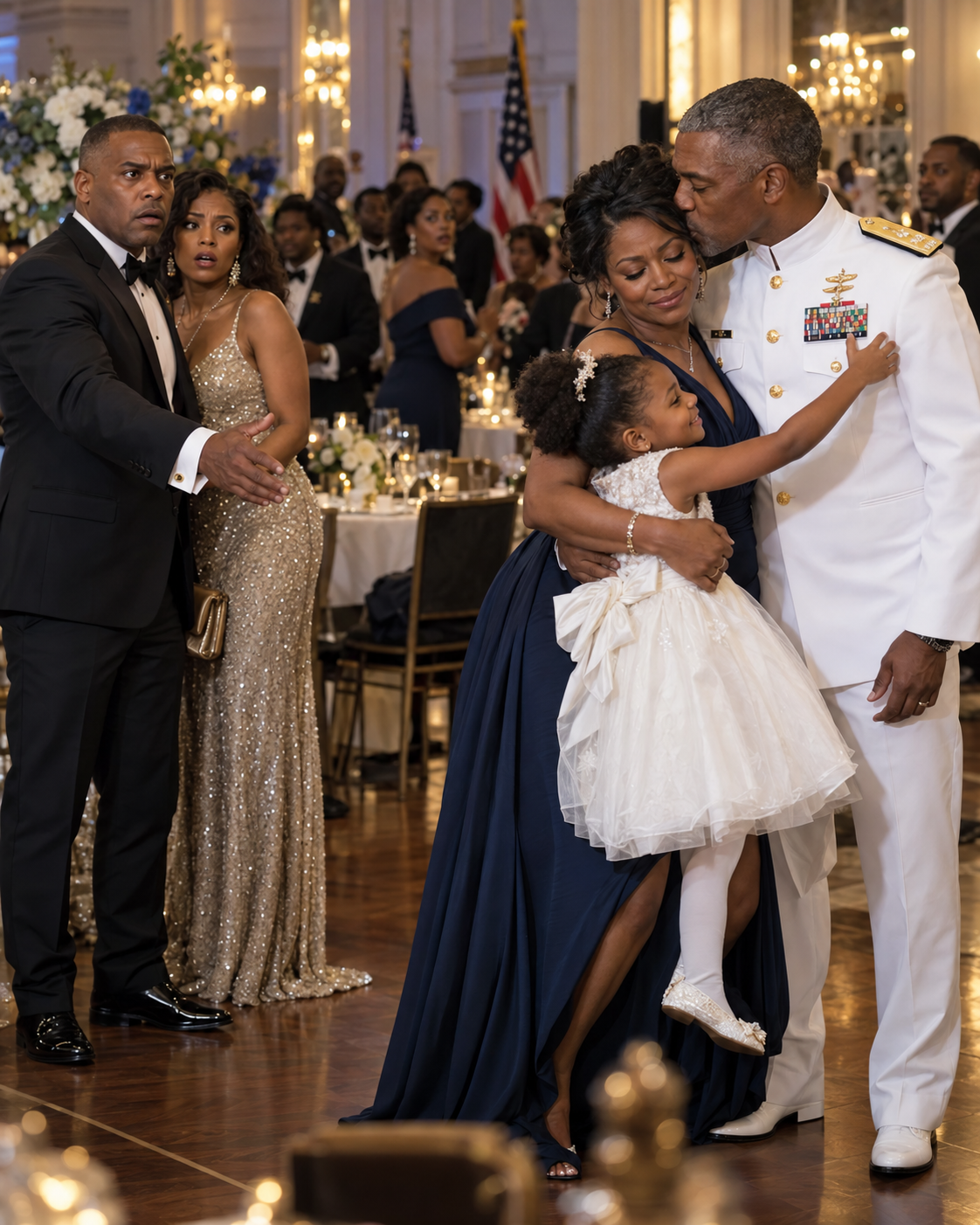
The fear.
Three months earlier, when the foundation hired me to lead the restructuring of its charitable endowment, I had expected numbers, regulations, donor agreements, and endless meetings.
I had not expected Derek Caldwell.
His company had submitted a bid for a massive naval logistics support contract connected to the foundation’s new supply network.
At first, I barely noticed the name.
Caldwell Strategic Logistics was successful, nationally recognized, and exactly the kind of company that would normally make it through the preliminary review.
Then I noticed something strange.
Three subcontractors listed on Derek’s proposal shared nearly identical corporate addresses.
That alone wasn’t illegal.
But their ownership records were unusually difficult to trace.
So I kept digging.
I found invoices that didn’t match delivery records.
I found consulting payments routed through companies with no apparent employees.
I found charitable donations connected to executives who later appeared as preferred subcontractors.
None of it proved criminal conduct by itself.
But together, it formed a pattern.
And patterns are what I had learned to fear.
I didn’t tell Julian at first.
Not because I didn’t trust him.
Because I needed to know whether I was seeing facts or ghosts from my old marriage.
For years, Derek had made me doubt my own judgment.
He would move numbers around in presentations and then smile when I questioned them.
“You’re overthinking it,” he used to say.
Eventually, I stopped questioning him.
That was one of the deepest wounds he had left behind.
So when the first irregularity appeared, I forced myself to verify it three different ways.
Then five.
Then ten.
The more I checked, the worse it became.
The strangest discovery came two weeks before the gala.
One of the shell companies connected to Derek had received a transfer from a private investment firm.
The investment firm had previously purchased a minority interest in one of Derek’s vendors.
And buried inside an old corporate filing was a familiar name.
Mine.
I stared at the screen for nearly a minute.
My name appeared as a former authorized financial officer for a company I had never heard of.
My signature was attached to a document dated six years earlier.
Six years ago, I had been living in that tiny studio.
I had no company.
No investment.
No reason to authorize anything.
Someone had forged my signature.
That was the moment I understood why Derek had looked frightened.
The compliance violations weren’t the whole story.
Someone had built a paper trail that could eventually make me look responsible.
I closed the file and sat alone in my office until sunrise.
Then I called our legal team.
We verified the signature was fraudulent.
We traced the filing.
We discovered that the document had been submitted through an outside corporate services provider.
And then we found the person who had requested the filing.
A former executive from Derek’s company.
Someone who had left two years after our divorce.
Someone who was now living under a different corporate title.
I remember staring at the name and feeling something inside me go cold.
Derek had not simply rebuilt his company after our divorce.
He had been cleaning up something.
Something he had been hiding long before he discarded me.
The next morning, I brought everything to Julian.
He read the documents without interrupting.
When he reached the forged signature, his jaw tightened.
“You should have told me sooner.”
“I needed proof.”
“You had proof.”
“I needed to believe myself first.”
He closed the folder.
“Then I’m glad you finally do.”
I looked at him.
“Are you angry?”
“No.”
He reached across the table and took my hand.
“I’m angry someone tried to make you carry their crime.”
That sentence stayed with me.
Not because it was dramatic.
Because it was simple.
And true.
After the gala, we went home with Clara asleep in the back seat.
The house was quiet.
Julian carried her upstairs while I stood in the kitchen staring at the dark window.
I expected relief.
Instead, I felt the old fear returning.
What if Derek retaliated?
What if he dragged my name through the press?
What if everyone believed him the way I once had?
Julian came back downstairs.
He found me exactly where he had left me.
“She’s asleep.”
I nodded.
Then I finally admitted what I had been afraid to say.
“I’m scared.”
He walked toward me.
“Of him?”
“Of becoming that woman again.”
“What woman?”
“The woman who thinks she has to earn the right to exist.”
Julian’s expression softened.
“You aren’t her anymore.”
I wanted to believe him.
Then my phone rang.
It was our foundation’s outside counsel.
She sounded unusually serious.
“We found another document.”
My stomach dropped.
“What kind?”
“A transfer authorization.”
“Whose?”
“Yours.”
I closed my eyes.
“That’s impossible.”
“I know.”
She paused.
“Because the transaction happened four months before you ever joined the foundation.”
The next morning, federal investigators arrived at the foundation.
The situation had escalated beyond a contract review.
Someone had been attempting to move restricted charitable funds through a chain of shell organizations.
And my forged identity was sitting in the middle of the paperwork.
For two days, I barely slept.
Every email felt dangerous.
Every unknown number made my heart race.
Derek’s attorneys sent a letter claiming I had a personal vendetta against his company.
They accused me of manipulating the audit because of our divorce.
It was almost laughable.
Almost.
Because I knew exactly how believable Derek could make a lie.
Then an investigator showed me something that changed everything.
A scanned page from an old internal report.
My handwriting appeared in the margin.
Except I had never written it.
The handwriting looked like mine because it was mine.
I stared at the page.
Then I remembered.
Seven years ago, shortly before our divorce, Derek had asked me to sign several blank administrative forms.
He told me they were routine corporate documents.
I had trusted him.
I had been exhausted.
I had signed.
I had forgotten.
He hadn’t.
Those blank pages had become weapons.
The investigators believed Derek had used my old signatures to create false authorizations and establish a layer of deniability.
But there was one question they couldn’t answer.
Why had he waited seven years?
The answer came from a former accountant who agreed to testify.
Derek’s company had been surviving on borrowed time.
Several contracts had generated impressive revenue but concealed serious cash-flow problems.
The shell companies weren’t just for tax games or accounting tricks.
They were being used to shift obligations from one entity to another.
And the naval contract would have given Derek enough money to stabilize everything.
The bid I rejected wasn’t simply another opportunity.
It was his escape route.
I sat in the conference room listening to the accountant speak, and suddenly I understood Derek’s desperation at the gala.
He hadn’t been afraid of losing a contract.
He had been afraid of losing the future he had spent years manufacturing.
Still, one question haunted me.
Why had he targeted me?
The accountant looked down.
“Because he knew you’d be the last person people suspected.”
I couldn’t breathe.
“Why?”
“Because everyone believed you were the one who benefited from the divorce.”
I laughed once, but there was no humor in it.
Of course.
Derek had spent years telling people I was bitter.
Emotional.
Unsuccessful.
Dependent.
He had built the perfect story.
And I had unknowingly spent seven years building the evidence that proved it false.
The investigation continued for months.
Derek’s company lost the contract.
Several executives resigned.
The shell companies were examined.
Records were subpoenaed.
The forged documents became part of a much larger case.
I never celebrated his downfall.
That surprised me.
For years, I had imagined what it would feel like to watch him lose everything.
When the moment finally came, I felt nothing like triumph.
I felt tired.
One evening, I returned home to find Julian sitting on the porch with Clara.
She ran toward me.
“Mommy!”
I dropped my bag and caught her.
She wrapped her arms around my neck.
“I made you something.”
She handed me a piece of paper covered in crooked stars.
At the top, in enormous letters, she had written:
OUR FAMILY.
I looked at Julian.
He smiled.
And suddenly, I understood something I had spent seven years trying to learn.
Derek had been wrong about the most important thing.
He had believed my life belonged to whatever he could take away from me.
My career.
My home.
My confidence.
My name.
But none of those things had been the real measure of my life.
The real measure was the woman I became after losing them.
The woman who learned to trust her own mind.
The woman who stopped confusing sacrifice with love.
The woman who could sit across from power and still tell the truth.
The woman Clara called Mommy.
That night, after Clara went to bed, Julian and I stood together beneath the porch light.
“I never told you something,” he said.
I looked at him.
“What?”
He reached into his pocket and handed me a small envelope.
Inside was a photograph.
It was old.
Seven years old.
It showed me leaving the courthouse on the day my divorce became final.
I stared at it.
“Where did you get this?”
“From my chief of staff.”
I looked up, confused.
“Why would he have this?”
Julian hesitated.
“Because the first time I met you, it wasn’t actually the first time I had seen you.”
My heart stopped.
“What do you mean?”
He turned the photograph over.
There was a handwritten note on the back.
I recognized the handwriting immediately.
Derek’s.
The note contained only one sentence.
“She doesn’t know what she signed.”
I felt the world tilt beneath me.
Julian reached for my hand.
“I found this years ago, before we were married.”
“Why didn’t you tell me?”
“Because I didn’t know what it meant.”
I stared at the photograph again.
Then I noticed something I had never seen before.
In the far background, beside the courthouse steps, stood a man watching me.
Not Derek.
Not a reporter.
Not a lawyer.
Someone else.
Someone I didn’t recognize.
And suddenly, the question wasn’t whether Derek had planned to destroy me.
The question was who had been helping him.
Seven years after my marriage ended, I had finally rebuilt my life.
But as I looked at that photograph beneath the porch light, I realized the story I thought had begun with my divorce might have started much earlier.
And somewhere, someone had been waiting for me to remember.
I squeezed Julian’s hand.
“I think we’re not finished.”
He looked toward the dark street.
“No,” he said quietly.
“I don’t think we are.”
And for the first time in years, I wasn’t afraid of what the truth might take from me.
I was ready to find out what it had been protecting me from all along.