Uncle Frank stopped me beside my mother’s kitchen doorway, squeezed my shoulder hard enough to hurt
“There’s one more transfer.”
Frank’s voice had gone quiet.
Not softer.
Quieter, the way a person gets when he knows the next sentence is going to change the shape of somebody else’s life.
“How much?”
He turned the phone toward me.
“Eight thousand.”
I stared at the screen.
The transfer was dated two months before the forty-thousand-dollar withdrawal.
Same account.
Same recipient.
Beatrice.
My mother’s handwriting appeared in the memo field again.
For Darren.
I sat back against the step.
Fifty-three thousand dollars.
Not forty.
Not a mistake.
Not one desperate transaction.
A pattern.
For several seconds, I could hear everything at once—the rain, the children’s laughter through the screen door, the hiss of grease on the grill, the muffled music playing from someone’s Bluetooth speaker.
My family was ten feet away, eating potato salad and arguing about baseball.
And my father was suddenly sitting beside me in memory, wearing his work boots at our old kitchen table.
He had never trusted paperwork he couldn’t understand.
“Don’t sign anything just because somebody tells you it’s good for you,” he’d once said. “Read the part nobody wants you to read.”
I thought about my mother.
She had spent twelve years telling me she wanted security.
Maybe she did.
Maybe Beatrice had simply convinced her that security was something you could buy by sacrificing one truth at a time.
Frank slipped the phone back into his pocket.
“You can’t confront Beatrice tonight.”
“Why not?”
“Because you don’t know enough.”
“I know fifty-three thousand dollars left Mom’s account.”
“You know that much.”
“I know where it went.”
“Part of where it went.”
I looked at him.
“What’s the rest?”
He sighed.
“I’ve been digging because I didn’t trust the story your mother gave me. She said Darren had some temporary trouble. But the court records don’t look temporary.”
“How bad?”
“Bad enough that your aunt was terrified you’d find out.”
That sentence stayed with me.
Not because I liked the implication.
Because it didn’t fit what I’d always believed.
Beatrice wasn’t afraid of me.
She had spent my entire life acting as though I were beneath her notice.
Why would she be afraid of what I might discover?
I went back inside.
Hannah met me in the hallway.
She didn’t ask whether I had found the medicine.
She looked at my face.
“What’s wrong?”
I took her into the laundry room and closed the door.
“Do you remember that note you kept?”
She nodded slowly.
“Yes.”
“Can I read it?”
She unlocked her phone.
The note was thirty-seven pages long.
Dates.
Quotes.
Patterns.
Little details I had dismissed.
February 14: Beatrice told Evelyn that Evan was “too proud to understand money.”
March 2: Asked Evelyn whether Evan had ever given her access to his company accounts.
April 19: Told Evelyn Darren was “one bad month away from losing his condo.”
May 7: Told Hannah that women shouldn’t let men become “comfortable providers.”
July 3: Asked whether my mother’s retirement account was “still untouched.”
I read in silence.
Hannah watched me.
“I didn’t want to weaponize it,” she said.
“You weren’t.”
“I just wanted you to stop thinking I was paranoid.”
I handed the phone back.
“You weren’t.”
Her eyes softened.
“What happened outside?”
I told her.
She listened without interrupting.
When I finished, she said, “What do you want to do?”
“I want to ask Mom.”
“Tonight?”
I shook my head.
“No.”
That surprised her.
I surprised myself.
“I want to know exactly what happened before I ask her anything.”
Hannah nodded.
“Then let’s find out.”
Over the next two weeks, I became someone I barely recognized.
Not angry.
Methodical.
I pulled public court records with Frank.
We found judgments.
Tax liens.
A civil suit from a contractor who claimed Darren had failed to pay for renovations.
A bank filing connected to the condo.
A divorce petition.
Another judgment.
Then we found something that changed the story again.
Darren hadn’t simply made one bad investment.
He had taken on several debts trying to save the first one.
And Beatrice had spent nearly two years hiding the damage from him.
Frank found the first payment from my mother.
Eight thousand dollars.
Then another.
Then the forty thousand.
The money had not gone directly to Darren.
Beatrice had controlled it.
She had paid some debts, moved some money between accounts, and apparently covered expenses Darren never knew had been paid.
It was complicated enough that even Frank stopped calling it theft and started calling it what it was.
“Financial manipulation,” he said.
“She lied to your mother about the purpose.”
“Why would Mom agree?”
“Because she thought she was saving her nephew.”
“From what?”
Frank looked at me.
“From his own mother.”
That sentence landed harder than everything else.
I had spent two weeks building a picture of Beatrice as the villain.
But Darren was part of the picture too.
He had made terrible financial decisions.
He had signed loans.
He had tried to protect a lifestyle he couldn’t afford.
He had hurt people.
Yet he had apparently been kept ignorant of the money supposedly being used to rescue him.
Nobody in this family was standing on clean ground.
The only question was who had known where the ground was collapsing.
My mother knew some of it.
Beatrice knew almost all of it.
Darren knew almost none.
And I knew only what I had found.
I asked Frank if we should confront Beatrice privately.
He shook his head.
“She’ll deny everything.”
“Then what?”
“Make her tell the truth where she can’t rewrite it afterward.”
Two weeks after the cookout, Beatrice invited everyone to dinner.
She called it a peace offering.
Her message to the family group chat said:
We are family. I hate how the Fourth of July ended. Let’s sit down like adults.
Hannah read it over my shoulder.
“That’s almost funny.”
“It isn’t.”
“No.”
She put down her phone.
“It really isn’t.”
Dinner was at Beatrice’s house.
Candles.
China plates.
Roast chicken.
The whole performance.
She greeted me at the door with a hug I didn’t return.
“I’m glad you’re here.”
“So am I.”
She smiled too brightly.
“I’ve been worried about you.”
“I know.”
Inside, my mother looked exhausted.
Dale sat beside her.
Dale had always been the quiet one.
Retired postal worker.
Gentle.
Patient.
The kind of man who could spend twenty minutes explaining why a particular mailbox was badly installed.
He smiled at me.
“Good to see you, son.”
“You too.”
Darren arrived ten minutes late.
I hadn’t seen him since the cookout.
He looked different.
Not ruined.
Just tired.
He had lost some weight.
His shirt was wrinkled.
He hugged my mother.
Then he came to me.
“Hey.”
“Hey.”
Neither of us knew what else to say.
Beatrice entered carrying a casserole dish.
“There,” she said. “Look at this. Everybody together.”
I sat down.
Dinner was almost normal.
That was the strangest part.
Beatrice talked about her garden.
Dale complained about the traffic.
My mother asked Hannah about the kids.
Darren barely spoke.
Then Beatrice raised her wineglass.
“I think we should all agree that families sometimes say things badly.”
Her eyes landed on me.
“I was worried about you, Evan.”
There it was.
The old script.
Concern.
Not cruelty.
Concern.
“I know,” I said.
“I shouldn’t have spoken that way.”
“Probably not.”
She smiled.
“I’m glad we’re moving past it.”
I picked up my fork.
For several seconds, I considered letting her have that moment.
Then I put the fork down.
The sound was small.
But everyone heard it.
I looked at my mother.
“Mom, did Beatrice ever pay back the forty thousand dollars?”
The room stopped.
My mother’s face emptied.
Beatrice’s glass froze halfway to her mouth.
Dale frowned.
“What forty thousand?”
Nobody answered.
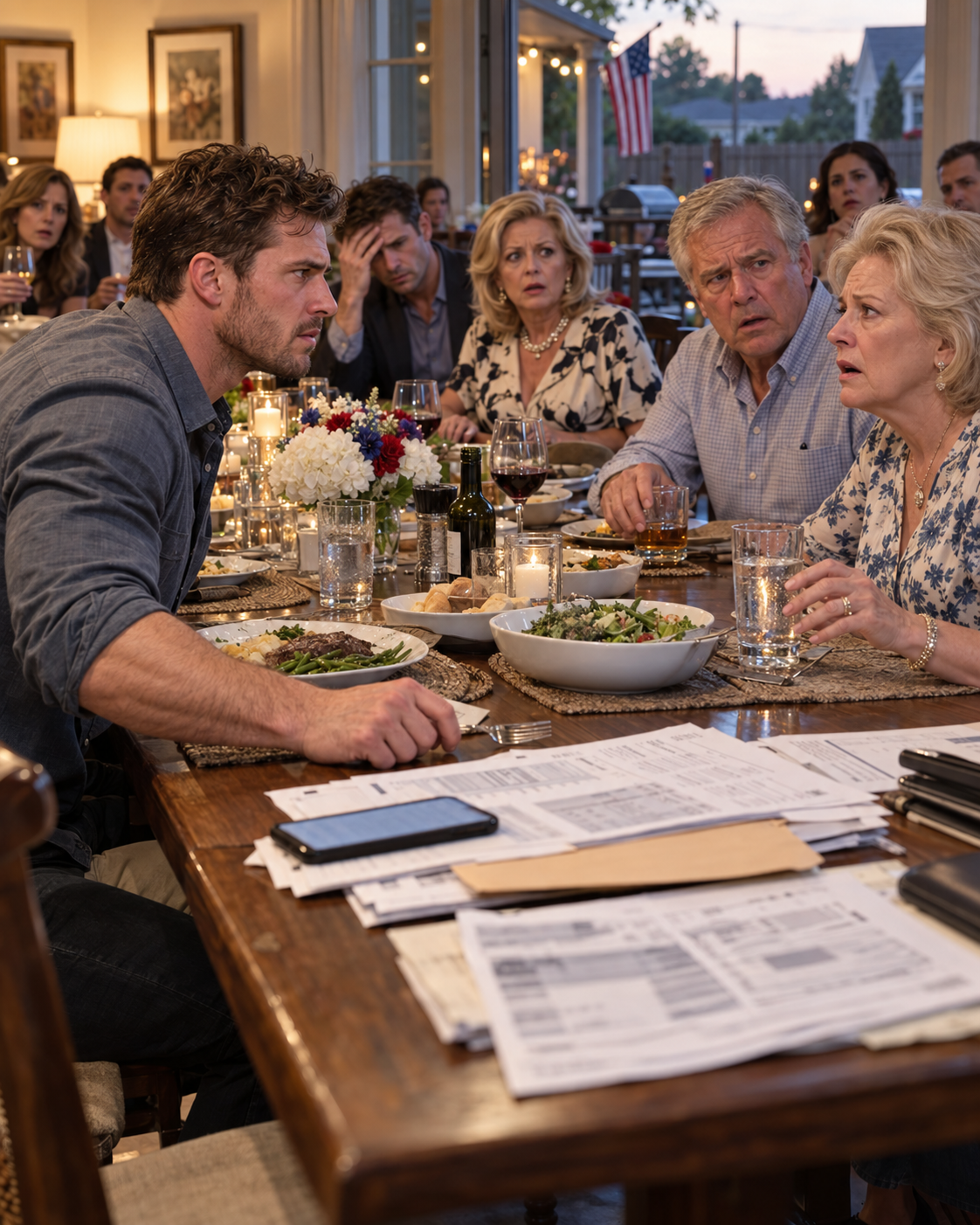
I reached into my folder.
I had brought copies, not originals.
Bank statements.
Transfer records.
Public court documents.
Frank’s notes.
Not accusations.
Evidence.
Beatrice set down her glass.
“Evan, this isn’t appropriate.”
Dale’s voice cut through hers.
“What forty thousand?”
Mom closed her eyes.
Darren looked from one face to another.
“What’s going on?”
I slid the first statement across the table.
Mom’s hand trembled as she touched it.
Dale picked it up.
His eyes moved down the page.
Then he looked at Beatrice.
“Did you take this money?”
“She gave it to me.”
“For Darren,” I said.
Beatrice snapped toward me.
“Yes.”
Darren stood up.
“What?”
Beatrice looked at him.
“I was trying to save you.”
“I didn’t ask you to.”
“You didn’t know what was happening!”
“I didn’t know you were using Aunt Evelyn’s money!”
The room erupted.
Darren’s chair scraped backward.
Dale slammed his palm against the table so hard the silverware jumped.
“Fifty-three thousand?” he said.
My mother began crying.
Dale turned toward her.
“You gave her fifty-three thousand dollars?”
“I thought—”
“You thought what?”
“I thought we were helping Darren.”
Dale’s face broke.
Not anger.
Betrayal.
“You didn’t tell me.”
My mother whispered, “I was afraid.”
“Afraid of what?”
She looked at Beatrice.
And suddenly I understood.
She wasn’t afraid of Darren.
She wasn’t even afraid of losing the money.
She was afraid of Beatrice.
Beatrice had spent years teaching my mother that disagreement was betrayal.
That saying no was selfish.
That family meant absorbing whatever the loudest person demanded.
Darren sank back into his chair.
He put both hands over his face.
“I thought the lender was giving me a payment extension.”
Everyone turned toward him.
He lowered his hands.
“Mom told me she had arranged it.”
He stared at Beatrice.
“You said you borrowed against your house.”
Beatrice said nothing.
Darren laughed bitterly.
“You told me that.”
“Because you needed help.”
“You lied to me.”
“I protected you.”
“No.”
His voice cracked.
“You protected your image.”
Nobody spoke.
Darren looked at me.
“I didn’t know about the judgment.”
I studied his face.
“You should have.”
“I know.”
It was the first honest thing I’d heard him say in years.
Then came the setback.
Beatrice reached for her purse.
“I’m done with this.”
She stood.
Frank’s voice came from behind me.
“No, you’re not.”
I hadn’t even realized he had entered the room.
He placed a folder on the table.
Beatrice stared at him.
“Frank.”
“You told Evelyn the forty thousand was going to a lender.”
He opened the folder.
“It wasn’t.”
He placed the transfer record beside the court filing.
“Some went toward Darren’s debts. Some went elsewhere.”
Beatrice’s face changed.
Dale noticed.
“So where did the rest go?”
Beatrice didn’t answer.
Frank did.
“Credit cards. Household expenses. Two transfers to an account she controls.”
Darren stared at his mother.
“Why?”
She looked at him.
And for the first time, I saw something other than arrogance.
Fear.
“I was trying to keep us from losing everything.”
Darren shook his head.
“You already lost it.”
She sat down.
The room became painfully quiet.
I had expected satisfaction.
I felt none.
Only exhaustion.
Dale pushed a legal pad toward her.
“You will sign a repayment agreement.”
She looked at him.
“What?”
“You heard me.”
“I don’t owe him.”
“No,” Dale said. “You owe Evelyn.”
That mattered.
Because my father had left the money to my mother.
It was her security.
Her choice.
Her loss.
I didn’t want revenge.
I wanted the lie to stop.
Beatrice’s attorney later helped draft the agreement.
Strict monthly payments.
Automatic transfers.
No access to my mother’s accounts.
No borrowing from her.
No financial decisions made on her behalf.
Dale insisted on overseeing the payments.
Beatrice signed.
She left without saying goodbye.
The door closed behind her.
Nobody moved.
Then Darren spoke.
“I’m sorry.”
I looked at him.
“For what?”
“For the things I believed about you.”
I said nothing.
He continued.
“Mom told me you were jealous of me.”
I almost laughed.
“Why?”
“Because of your business.”
He looked embarrassed.
“I believed her.”
I sat across from him.
“I thought you were arrogant.”
“I was.”
He smiled sadly.
“Probably still am sometimes.”
That broke the tension just enough for both of us to breathe.
We started talking.
Not every day.
Not immediately.
But gradually.
Darren took a second job consulting for smaller pharmaceutical companies.
He sold the condo.
He stopped borrowing money to maintain appearances.
He hired a financial counselor.
The first time he showed me his debt spreadsheet, I stared at it for a long moment.
“You actually made this?”
“Yeah.”
“You’re serious.”
“I’m tired of pretending.”
I nodded.
“Good.”
He looked at me.
“Do you think Dad would have hated me?”
I knew exactly whose dad he meant.
My father had always treated Darren kindly.
“No.”
Darren swallowed.
“Then what?”
“He’d probably tell you to stop digging.”
“Digging?”
“Holes.”
Darren laughed.
Then he cried.
I didn’t fix it.
I just stayed.
That was something I had learned from my own father.
Sometimes standing beside someone was more useful than saying anything.
My mother and Dale started counseling.
It wasn’t dramatic.
There were no slammed doors.
No speeches.
Just difficult conversations every Thursday evening.
My mother admitted she had been afraid of disappointing Beatrice for most of her life.
Dale admitted that his silence had sometimes made it easier for everyone else to pretend nothing was wrong.
They began rebuilding slowly.
So did I.
Every other Sunday, my mother came to my house for dinner.
At first, we talked about the kids.
Then recipes.
Then my business.
Eventually, we talked about Dad.
Not his death.
His life.
The way he sang badly in the garage.
The way he always carried peppermints.
The way he could diagnose a bad electrical connection by smell before he ever opened the panel.
One evening, she handed me an envelope.
Inside was a check.
Eight thousand dollars.
I looked at her.
“Mom.”
“First repayment.”
“You don’t have to give me anything.”
“I’m not giving it to you.”
She tapped the envelope.
“I’m putting it back where it belongs.”
Her voice trembled.
“I should have protected this.”
I shook my head.
“You were manipulated.”
“I still signed the checks.”
That was the difference between an excuse and accountability.
I put my hand over hers.
“We’ll figure it out.”
She smiled.
“Your father would say that.”
“Probably.”
We sat there quietly.
For years, I’d thought honoring my father meant keeping everything he built untouched.
The toolbox.
The money.
The stories.
The reputation.
But sitting across from my mother, I finally understood something different.
His legacy wasn’t the insurance account.
It wasn’t even the electrical business with my name on the trucks.
It was the way he had taught me to work carefully, tell the truth when it cost something, and never leave a dangerous connection hidden behind a wall.
My family had spent years doing exactly that.
We had covered the cracks.
Painted over them.
Called the damage normal.
Until one summer, somebody finally opened the panel.
Now my mother’s retirement account was rebuilding one payment at a time.
Dale was learning to speak before resentment hardened.
Darren was learning to live without pretending.
And Beatrice, whether she liked it or not, was finally paying for the choices she had made.
As for me, I went back to work.
Some mornings I still passed my father’s old toolbox before opening the shop.
I would run my hand over the dent in its lid and think about the man who had died on a job site when I was twenty-two, leaving me with grief, a trade, and a lifetime of unfinished lessons.
My children now knew his name.
They knew Grandpa Raymond had worked with his hands.
They knew he had taught me how to strip wire without nicking the copper.
They knew he laughed too loudly at his own jokes.
And they knew that sometimes the best thing a person could do for a family was tell the truth before a small fault became a fire.
On one of those Sunday dinners, my mother brought dessert.
She had made peach cobbler from an old recipe of Dad’s.
She put the dish on the table and smiled.
“I found this in the back of the cabinet.”
I took a bite.
It wasn’t perfect.
Too much cinnamon.
The peaches were slightly overripe.
I smiled anyway.
“Needs more butter.”
She laughed.
“Your father used to say that.”
We ate until the dish was empty.
Outside, my work truck sat beneath the porch light, the company logo shining on the door.
I thought about how easily money had turned into secrecy, how pride had turned into silence, and how long people could mistake avoidance for peace.
Then my mother reached across the table and squeezed my hand.
Neither of us said anything.
We didn’t need to.
For the first time in a long time, there was nothing hidden between us.