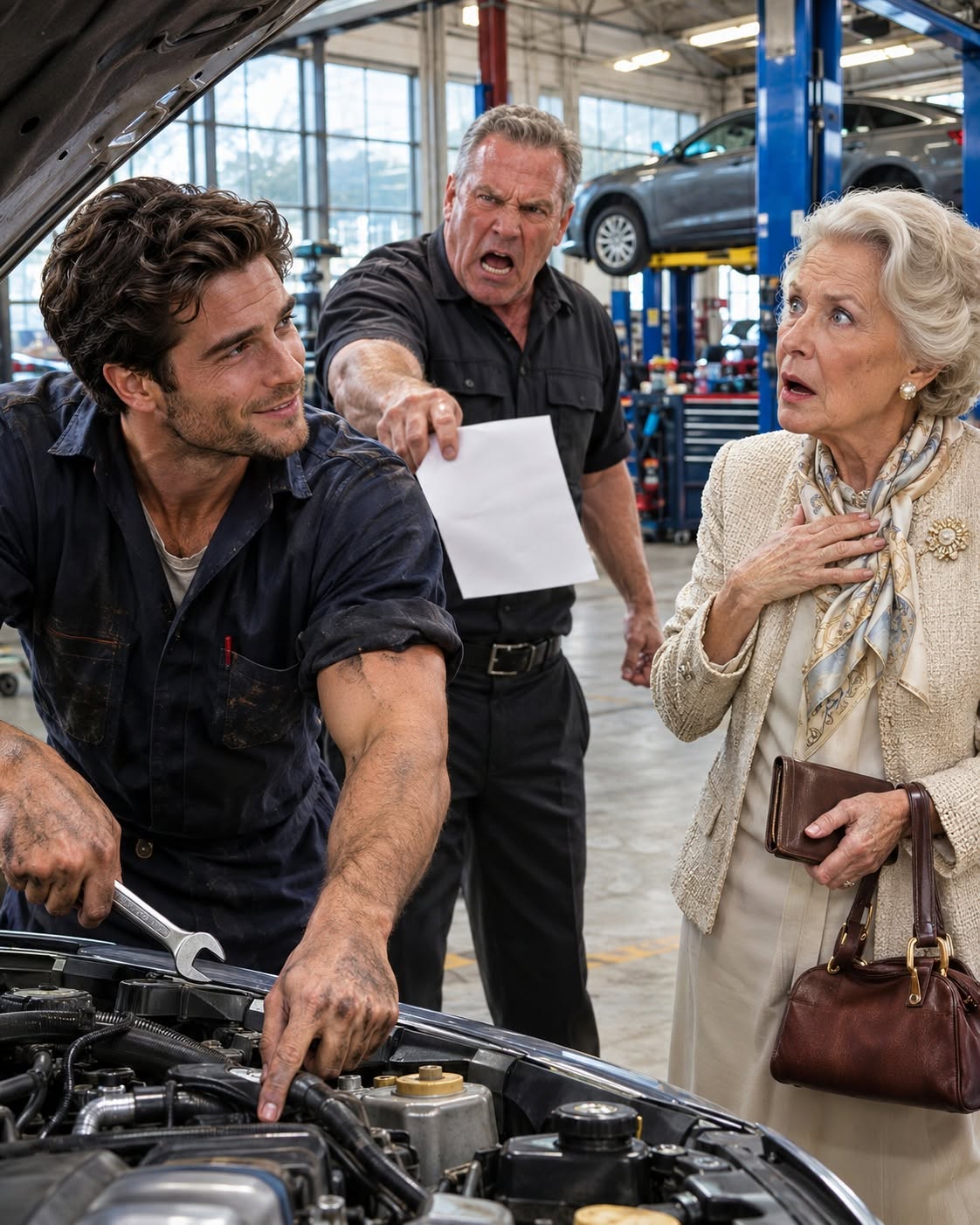
“Two hundred and fifty dollars,” my manager snapped at the elderly woman. “Pay it, or get your car towed.”
THE MECHANIC WHO LOST HIS JOB FOR HELPING A STRANGER — AND THE SECRET THAT CHANGED HIS DAUGHTER’S LIFE FOREVER
CONTINUED STORY — FINAL PART
The elderly woman stepped into the boardroom, and every person at the table immediately stood.
Victor remained seated.
His mouth opened, but no words came out.
“Good morning, gentlemen,” she said calmly.
Then she looked directly at me.
“Daniel Carter. I’m glad you came.”
I stood frozen, still trying to understand what was happening.
“Ma’am… what are you doing here?”
She smiled.
“First, please allow me to introduce myself properly. My name is Eleanor Whitmore. I’m the founder and majority owner of Horizon Holdings.”
I blinked.
Horizon Holdings.
The name was printed across the top of the building, on the invitations, and on the documents sitting in front of me.
It was one of the largest automotive service and transportation groups in the state.
I looked at Victor.
He had turned almost gray.
Eleanor pulled out a chair and gestured for me to sit.
“Please, Daniel. We have a great deal to discuss.”
I sat down slowly.
She placed a photograph on the table.
It showed the same elderly woman standing beside a young man in a mechanic’s uniform.
“That’s my son, Michael,” she said.
Her voice softened.
“He died eleven years ago in a highway accident. He was a mechanic. He believed that fixing someone’s car wasn’t just about repairing an engine. Sometimes, it meant helping a person get home safely.”
She paused, touching the photograph.
“After he died, I spent years trying to preserve the values he believed in. But somewhere along the way, the company became more interested in numbers than people.”
I remembered the rain, her trembling hands, and the way she had apologized for needing help.
“I don’t understand,” I said. “Why did you bring me here?”
Eleanor folded her hands.
“Because last week, you reminded me of my son.”
Victor finally found his voice.
“Mrs. Whitmore, I can explain what happened at the shop. Daniel violated several company policies. He abandoned his assigned duties and used unauthorized parts.”
Eleanor turned toward him.
“Unauthorized parts?”
Victor nodded quickly.
“He used his own supplies without approval. It was a serious violation.”
“Did you charge the elderly woman two hundred and fifty dollars for a repair that cost less than ten?”
Victor shifted in his chair.
“That was the standard diagnostic and emergency service fee.”
“Did you threaten to tow her car?”
“It was company procedure.”
Eleanor leaned back.
“Interesting. Because I own the company, Victor, and I don’t remember approving a policy that allows employees to intimidate elderly customers stranded in the rain.”
Nobody moved.
She opened a folder.
Inside were printed customer complaints, employee reports, and financial statements.
“I had our internal audit team review the AutoPro location after Daniel was dismissed. What they discovered was disturbing.”
Victor’s fingers tightened around his pen.
Eleanor continued.
“For nearly eighteen months, customers have been charged for unnecessary repairs. Employees have been pressured to meet inflated sales targets. Several workers who questioned these practices were dismissed.”
She slid a document across the table.
“And the emergency repair fees? They were never approved by headquarters.”
Victor stared at the page.
“Those charges were necessary to maintain profitability.”
“No,” Eleanor replied. “They were necessary to maintain your personal bonus.”
The room became completely silent.
I looked at Victor.
For the first time, I understood that the man who had humiliated me in front of that elderly woman was now afraid of losing something himself.
Eleanor closed the folder.
“Victor, your employment is terminated, effective immediately. Security will escort you out. Our legal department will contact you regarding the financial investigation.”
Victor pushed his chair back.
“You can’t do this! I’ve spent seven years building that location!”
Eleanor didn’t raise her voice.
“Then you should have spent seven years building something worth keeping.”
Two security officers appeared at the door.
Victor looked at me as they approached him.
“This is because of you, Carter!”
I didn’t answer.
He was escorted out, still muttering about lawyers and unfair treatment.
When the doors closed, Eleanor turned toward me.
“Daniel, I owe you an apology.”
I frowned.
“For what?”
“For allowing my company to become a place where someone like Victor could treat people that way.”
She handed me another folder.
Inside was a formal employment offer.
DIRECTOR OF CUSTOMER SERVICE AND ETHICAL OPERATIONS.
I stared at the title.
“Ma’am, I think there’s been a mistake. I’m a mechanic. I don’t have a business degree. I’ve never managed a department.”
Eleanor smiled.
“Neither did my son. But he understood something that many executives forget.”
“What?”
“People remember how you treat them when they have nothing to offer you.”
She pointed to the salary.
It was more money than I’d ever imagined earning.
There was also health insurance, paid leave, and a housing allowance.
I swallowed hard.
“This is generous, but I don’t know if I’m qualified.”
Eleanor studied me.
“Daniel, I didn’t invite you here because you know how to repair a radiator. I invited you because you demonstrated judgment when doing the right thing came at a personal cost.”
I looked down at the offer.
Then I thought about Lily’s winter boots.
I thought about the overdue electricity bill sitting on our kitchen counter.
And I thought about how many nights I’d told my daughter everything would be okay when I wasn’t sure it would.
“I’d like to accept,” I whispered.
Eleanor smiled.
“Good. But I have one more thing to show you.”
She reached into her handbag and removed a small envelope.
It was addressed to me.
“Before you read that, I want you to understand something. This decision is not charity. You’ll have responsibilities, expectations, and work to do. I expect you to challenge the decisions I make if you believe they’re wrong.”
I nodded.
Then I opened the envelope.
Inside was a photograph of a little girl standing beside a bicycle.
On the back, someone had written:
For the people who make sure every child gets home.
I looked up, confused.
Eleanor’s eyes were glistening.
“My son used to keep that photograph in his toolbox. He believed that every child deserved to grow up knowing there was someone who would come for them.”
She took a breath.
“I saw the way you spoke about your daughter during the background review. I learned that you’ve been raising her alone since her mother passed away.”
My throat tightened.
“I don’t talk about that much.”
“I understand.”
She pushed the photograph toward me.
“I think Michael would have liked you.”
For several seconds, I couldn’t speak.
Then I finally whispered, “Thank you.”
That afternoon, I drove home in my old pickup.
For the first time in months, I wasn’t calculating how many groceries I could afford.
But I didn’t know that the biggest surprise was still waiting.
When I opened our apartment door, Lily ran toward me.
“Daddy!”
I lifted her into my arms.
“Hey, princess.”
She held up a drawing.
It showed a little girl, a man, and a bright yellow house with a tree in the yard.
“Look! I made our new house!”
I smiled.
“That’s beautiful.”
“Do you think we’ll ever live somewhere with a backyard?”
I looked at her little face.
“Yes, sweetheart. I think we might.”
She studied me.
“Why are you smiling like that?”
“Because Daddy has some good news.”
I told her about the new job.
I told her that we wouldn’t have to worry quite so much about bills.
And I told her that maybe, just maybe, she could get those winter boots sooner than expected.
She wrapped both arms around my neck.
“Does that mean you won’t have to work so much?”
I held her close.
“That’s what I’m hoping for.”
For the first time in a long while, I allowed myself to cry.
Not because I was afraid.
Because I finally felt like we had a chance.
THREE MONTHS LATER
My first weeks at Horizon Holdings were harder than I expected.
I had imagined that fixing a broken company would be like fixing a broken engine.
Find the problem.
Replace the damaged part.
Get everything running again.
But people weren’t machines.
There were employees who had lost faith in management. Customers who refused to trust us. Managers who believed that changing the system would threaten their careers.
Some people thought I was a joke.
A mechanic with no business degree sitting in executive meetings?
One regional manager even told me privately that Eleanor had made an emotional decision.
I didn’t argue.
I simply asked him to spend one afternoon answering customer complaint calls.
He refused.
So I answered them myself.
I listened to an elderly man explain that he’d been charged for a battery he never received.
I listened to a mother describe how she’d been left stranded with two children after a repair shop refused to release her vehicle until she paid an unexpected fee.
I listened to a young delivery driver who had been pressured into buying unnecessary services because he couldn’t afford to lose his job.
And every time I hung up, I wrote down what needed to change.
We introduced transparent estimates.
We required customer approval before additional repairs.
We created an emergency assistance program for customers who couldn’t afford essential safety repairs.
Most importantly, employees were given a protected way to report dishonest practices without fear of retaliation.
Some executives resisted.
A few resigned.
But the people who stayed began to understand that the company was changing.
Then, one Monday morning, something happened that nearly brought me to my knees.
A woman walked into my office carrying a small cardboard box.
She was in her late thirties, wearing a faded blue jacket.
“Are you Daniel Carter?”
“Yes.”
She placed the box on my desk.
“I was hoping you’d remember me.”
I didn’t.
She opened the box.
Inside was a photograph of an old sedan with a cracked windshield.
Then she showed me another photograph.
A little boy sat in the passenger seat, smiling.
“Last year, my husband died. I was working two jobs and raising our son. One afternoon, my car broke down outside your old AutoPro location.”
My stomach tightened.
“I remember that day,” I said carefully. “But I don’t think I helped you.”
She smiled sadly.
“You didn’t. Victor refused to let anyone inspect my car without charging a diagnostic fee I couldn’t afford. I sat in that parking lot for nearly two hours.”
I lowered my eyes.
“I’m sorry.”
“Don’t apologize. I’m not here because of what happened that day.”
She took a folded letter from her pocket.
“I’m here because last month, one of your new technicians repaired my car through the emergency assistance program. He didn’t charge me anything. I was able to keep my job, and my son was able to stay in his school.”
She handed me the letter.
Inside was a child’s drawing.
It showed a car, a house, and two people holding hands.
At the bottom, in uneven handwriting, were the words:
Thank you for helping my mommy.
I stared at it for a long time.
Then the woman said something I would never forget.
“When you help one person, you may never know how many lives you’ve changed.”
After she left, I placed the drawing beside Michael’s photograph.
Two pieces of paper.
Two reminders of why the work mattered.
SIX MONTHS LATER
Horizon Holdings announced the opening of its first community repair center.
It wasn’t a fancy facility.
It had four service bays, a small waiting room, and a children’s corner with books and toys.
But there was something different about it.
Anyone who needed an essential safety repair and couldn’t afford it could apply for assistance.
We also partnered with local charities to provide transportation support for people who needed to get to work, school, or medical appointments.
Eleanor attended the opening ceremony.
She stood beside me as a small crowd gathered outside.
“Michael would have loved this,” she said.
I nodded.
“I wish I could have met him.”
She smiled.
“You have met him, in a way.”
I looked at her.
She pointed toward the building.
“Every time you choose to treat someone with dignity, you keep a little of his spirit alive.”
I didn’t know what to say.
Then I saw Lily running across the parking lot.
She was wearing her new winter boots.
Bright purple ones with little silver stars.
She had been asking for them for almost a year.
“Daddy!”
I crouched down as she threw her arms around me.
“Look! I can run really fast!”
I laughed.
“You certainly can.”
She turned toward Eleanor.
“Are you the nice lady who gave my daddy his job?”
Eleanor knelt to her level.
“I suppose I am.”
Lily looked at her seriously.
“Thank you. My daddy smiles more now.”
Eleanor’s expression changed.
For a moment, she looked like she might cry.
“Then I think we both got something wonderful.”
Lily reached into her pocket and pulled out a folded piece of paper.
“I made you something.”
It was a drawing of an elderly woman standing beside a man in a mechanic’s uniform.
Above them was a yellow sun.
At the bottom, Lily had written:
Nice people help each other.
Eleanor held the picture with both hands.
“May I keep this?”
Lily nodded.
“It’s for you.”
That evening, Eleanor invited us to dinner at her home.
It was a beautiful house overlooking a lake, with a garden filled with white roses.
I felt uncomfortable walking through the front door in my work shoes.
But Eleanor insisted.
“Michael hated formal dinners,” she said. “He always said the best meals happened when people felt comfortable enough to be themselves.”
Lily sat beside her, telling stories about school.
Eleanor listened to every word.
After dinner, she showed us a room that had been closed for years.
It was Michael’s old workshop.
There were tools hanging on the walls, photographs on the shelves, and a workbench covered in carefully organized parts.
I noticed an old metal toolbox beneath the table.
Eleanor opened it.
Inside were dozens of handwritten notes.
Some were customer thank-you letters.
Others were small reminders Michael had written to himself.
One note caught my attention.
It read:
Never let someone’s financial situation determine how much respect you give them.
I read it twice.
Then I looked at Eleanor.
“Is this why you started Horizon?”
She nodded.
“My husband and I built the company because we believed reliable transportation gave people freedom. Michael wanted us to remember that. After he died, I became so focused on keeping the business alive that I forgot what it was supposed to stand for.”
She looked toward the window.
“Seeing you in that parking lot reminded me.”
I carefully returned the note to the toolbox.
“I don’t think I did anything special.”
Eleanor shook her head.
“That’s precisely why it was special.”
ONE YEAR LATER
The community repair program had expanded to twelve locations.
We had helped hundreds of families keep their vehicles running.
More importantly, the company had changed the way it treated its employees.
Mechanics received fair wages.
Overtime was properly compensated.
Workers were encouraged to raise concerns.
And no employee was ever punished for helping a customer in a genuine emergency.
I had also been promoted to oversee the company’s community operations.
But I still spent one Saturday each month working in the repair center.
I wanted to remember where everything began.
One rainy afternoon, an old pickup truck pulled into the parking lot.
A young man stepped out.
He looked no older than twenty.
His jacket was soaked, and he kept glancing at the passenger seat.
Inside sat a little girl, perhaps five years old.
He approached the service desk.
“I’m sorry to bother you,” he said. “My truck overheated. I have my daughter with me, and I don’t get paid until next week. I just need to know if there’s any way to get it running.”
The receptionist began explaining the emergency assistance program.
But I had already recognized the expression on his face.
It was the same expression I’d seen in the mirror countless times.
The fear of having to choose between paying for a repair and putting food on the table.
I walked over.
“What’s your name?”
“Chris.”
“I’m Daniel.”
I held out my hand.
“Let’s take a look at your truck.”
He followed me outside.
The problem was a damaged radiator hose.
Not complicated.
Not expensive.
But expensive enough to ruin a difficult week.
I repaired it while Chris stood beside me holding an umbrella over my toolbox.
When I finished, he looked at the engine and then at me.
“How much?”
“Nothing.”
He frowned.
“I can’t just accept that.”
“You can.”
“But why?”
I wiped my hands.
“Because somebody once helped me when I needed it. And I promised myself I’d never forget what that felt like.”
He looked down.
Then he asked, “Can I do something for you?”
I smiled.
“Someday, when you see someone struggling and you have the chance to help, do it. That’s all I ask.”
He nodded slowly.
As he drove away, his little girl waved through the window.
I waved back.
And suddenly I remembered the elderly woman in the rain.
I remembered Victor’s angry face.
I remembered walking home with my toolbox, terrified about how I would feed my daughter.
It had all begun with a fifteen-minute repair.
But the real repair had never been about the car.
It had been about restoring something much more important.
Trust.
THAT EVENING
When I arrived home, Lily was sitting at the kitchen table doing her homework.
She was seven now.
There was a photograph beside her notebook.
It showed the two of us standing outside the community repair center, smiling beneath its sign.
“Daddy?”
“Yes, sweetheart?”
“Do you remember when you lost your job?”
I sat beside her.
“Of course I do.”
“You were sad that night.”
I nodded.
“I was.”
She thought for a moment.
“Were you scared?”
I looked at her.
“I was very scared.”
“Then why did you help that lady?”
I considered the question.
Because she reminded me of my mother.
Because she needed help.
Because I couldn’t stand watching someone suffer.
Because sometimes doing the right thing is the only way to live with yourself.
“Because she needed somebody, sweetheart. And I was there.”
Lily nodded as if that made perfect sense.
Then she reached into her schoolbag and pulled out a sheet of paper.
It was an assignment titled:
WHAT I WANT TO BE WHEN I GROW UP.
She had drawn herself wearing a mechanic’s uniform.
Underneath, she had written:
I want to be like my daddy. He fixes cars, but he also fixes people’s bad days.
I read it once.
Then again.
My eyes filled with tears.
“Is that really what you want to be?”
She shrugged.
“Maybe. Or maybe I’ll be a teacher. But I want to help people like you do.”
I pulled her into my arms.
“You can be anything you want, Lily.”
She smiled.
“Even if I don’t make a lot of money?”
I kissed the top of her head.
“Especially then. Money can make life easier, but it doesn’t decide whether you’re a good person.”
She leaned against me.
“Okay, Daddy.”
Later that night, after she had fallen asleep, I stood by her bedroom door.
Her purple winter boots were neatly placed beside the bed.
The drawing from her school assignment was taped above her desk.
And for the first time, I understood something I hadn’t understood when I was younger.
I had spent years believing that being a good father meant making sure Lily never experienced hardship.
But perhaps it meant something different.
Perhaps it meant teaching her that hardship didn’t have to make her heart hard.
The next morning, I arrived at the repair center early.
On the wall near the entrance, we had placed a simple sign.
It wasn’t a company slogan.
It wasn’t a marketing message.
It was a sentence Eleanor had chosen from Michael’s old notebook:
“A person’s worth is never measured by the size of their wallet.”
I stood there for a moment, reading it.
Then I heard an engine sputter outside.
Another customer.
Another problem.
Another opportunity to make someone’s day a little less difficult.
I picked up my toolbox and walked toward the service bay.
And somewhere in the back of my mind, I could still hear the rain falling over that old AutoPro parking lot.
I could still see an elderly woman opening her purse with trembling hands.
I could still hear Victor saying that we weren’t running a charity.
He had been right about one thing.
A business wasn’t a charity.
But a business could still have a conscience.
And a person could still choose kindness, even when it cost them something.
That day, I lost a job.
I thought I’d lost the only security my daughter and I had.
Instead, I found a purpose that was bigger than a paycheck.
I found a place where people mattered more than profit.
And I learned that the smallest act of kindness can travel farther than we will ever know.
Sometimes, the person you help will never be able to repay you.
Sometimes, you’ll never even see them again.
But that doesn’t make the kindness worthless.
Because the greatest measure of a person’s life isn’t how much they earn, how many people they command, or how impressive their title looks on a business card.
It’s what they choose to do when someone vulnerable is standing right in front of them.
And sometimes, the most important thing you can repair isn’t a broken car. It’s someone’s faith that there are still good people in the world.