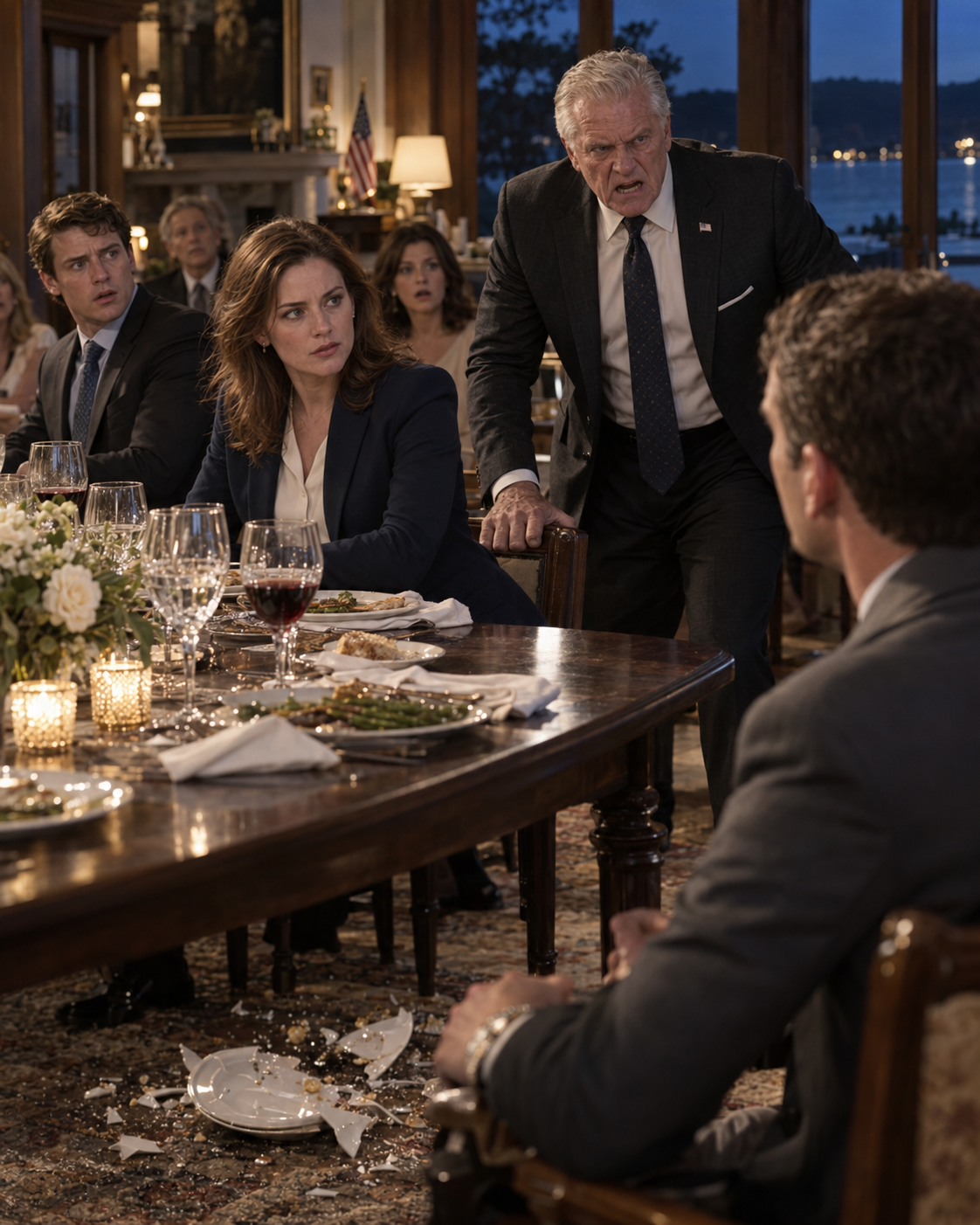
Trenton was still laughing when I said the word ‘Falcon,’ but the sound died so completely that I could hear my husband’s fork
The folder was thinner than I expected.
That was the first thing I noticed.
After everything Marcus had said, I had imagined some enormous binder filled with photographs, maps, statements, diagrams—the kind of record that could explain the worst night of my life in neat government language.
Instead, there were perhaps twenty pages clipped together beneath a faded cover sheet.
Marcus poured two fingers of bourbon into a glass and set it near my hand.
“I remember this report,” he said.
“I don’t.”
“You were seventeen years younger.”
“I was twenty-three.”
“I know.”
He sat across from me.
For the first time since I’d known him, the old general looked less like a monument and more like a tired man.
“I was the deputy commander at the time,” he said. “The report crossed my desk because your aircraft was attached to an operation under my command.”
I didn’t touch the folder.
“Why have you never said anything?”
“Because you never talked about it.”
I stared at him.
“Most people who do what you did don’t want to spend dinner telling stories about it.”
“That was not why.”
“I know.”
He leaned back.
“You didn’t tell Ethan either.”
“No.”
“Why?”
I ran my thumb along the edge of the folder.
“Because Ethan never asked me for a war story.”
Marcus nodded.
“I like him.”
A tiny laugh escaped me.
“That makes one of us.”
Marcus’s mouth twitched.
“He has better judgment than his brother.”
That almost made me smile.
Then I opened the folder.
The first page was a typed after-action summary.
I recognized the bureaucratic language immediately.
Time.
Coordinates.
Aircraft.
Personnel.
Mission objective.
Enemy fire.
Casualties.
Extraction.
The words were clean.
Too clean.
My memory wasn’t.
My memory was heat.
Rotor wash.
Dust.
The smell of hydraulic fluid.
A radio operator shouting over static.
A young soldier gripping my vest with both hands because he was bleeding too badly to stand.
And the sound of metal being struck.
Again.
Again.
Again.
Marcus watched me read.
“Seven impacts,” he said quietly. “Engine cowling.”
“I remember four.”
“You were busy.”
I turned the page.
There was a line beneath the casualty summary.
Aircraft remained on station despite significant mechanical damage until all designated personnel were aboard.
I looked at Marcus.
“You wrote this?”
“No.”
“You signed it?”
“Yes.”
“Why?”
“Because someone had to make sure the record said what happened.”
I lowered my eyes.
There was another line.
Pilot demonstrated exceptional judgment under sustained indirect fire.
My throat tightened.
“I wasn’t thinking about judgment.”
“No.”
“I was thinking about getting them out.”
“That is what judgment looks like when you’ve trained long enough.”
For a few minutes, neither of us spoke.
Then Marcus reached into the drawer and removed a second photograph.
It showed a helicopter on the ground after the mission.
The aircraft looked battered but intact.
The engine cowling was torn open in several places.
I stared at it.
“That bird flew home?”
“She did.”
“Barely.”
He smiled.
“You named her?”
“Every crew names their aircraft.”
“What was hers?”
“Mercy.”
Marcus nodded slowly.
“I remembered that.”
I put the photograph down.
Something had shifted inside me.
Not because Marcus had suddenly made me important.
Because he’d remembered something I had spent years trying not to remember.
When we returned to the dining room, nobody asked questions.
Trenton had already left.
Ethan was waiting near the front door.
His face was pale.
“What happened?”
I shook my head.
“Not here.”
He took my hand.
We drove home in silence.
Halfway there, Ethan finally spoke.
“You should have told me.”
“I know.”
“I don’t mean that as an accusation.”
“I know.”
He looked at the road.
“Why didn’t you?”
I watched the lights move across the windshield.
“Because when I came home, everyone wanted to know whether I was okay. Nobody wanted to know whether I still remembered the sound.”
His hand tightened around mine.
“I would have listened.”
“I know.”
That was the hardest part.
He would have.
The next morning, he made coffee and sat across from me at the kitchen table while I told him everything.
Not every detail.
Not the classified parts.
Just the truth of it.
I had been a medevac pilot attached to an Army aviation unit.
That night in 2018, an evacuation had gone wrong.
Mortars began landing near the landing zone.
We had been ordered in anyway.
The aircraft took damage.
I kept the helicopter in the air until the wounded were aboard.
Then we flew home.
One of the soldiers died before we reached the field hospital.
Two others survived.
I had spent years telling myself that survival meant I had done my job.
Marcus’s report made me understand something I hadn’t allowed myself to admit.
I had been brave.
And I had been terrified.
Those things had existed together.
For years, I had treated fear like evidence that I wasn’t strong enough.
Marcus had seen it differently.
Three days later, he called me.
“Clara.”
“Yes?”
“Have you heard from Trenton?”
“No.”
“You may.”
That afternoon, Trenton arrived at our house.
No sports car.
No expensive watch.
No polished confidence.
He stood on the porch with his tie loosened and a folder tucked under one arm.
“Can I come in?”
Ethan opened the door.
“What’s going on?”
Trenton looked at me.
“My company has a problem.”
I stepped aside.
“Come in.”
He entered the kitchen.
The same kitchen where I had once cried after a deployment because I couldn’t sleep.
The same table where Ethan and I now paid bills and argued about paint colors.
Trenton put the folder down.
“Our defense logistics contract got flagged.”
“By whom?”
“Federal review.”
I didn’t answer.
He rubbed his forehead.
“They’re saying our engineering documentation has inconsistencies.”
“What kind?”
“Telemetry.”
That word caught my attention.
“Explain.”
“They’re claiming our soil compression readings don’t match the independent site data.”
“Do they?”
His silence answered.
I pulled out a chair.
“Sit.”
He did.
For the first time in three years, Trenton looked at me without trying to dominate the room.
“Can Marcus help?”
I stared at him.
“With what?”
“Whatever this is.”
“You think my grandfather can make a federal compliance issue disappear?”
“I know people listen to him.”
“That’s not the same thing.”
He looked embarrassed.
“I don’t know what else to do.”
I opened the folder.
The first page was a contractor notice.
The second contained engineering summaries.
The third made my stomach turn.
Several density measurements had been duplicated.
Not similar.
Identical.
Down to the decimal.
I turned the page.
There were GPS coordinates.
Then testing times.
Then signatures.
I knew enough about compliance documentation to recognize the pattern.
Someone had copied acceptable readings into locations where the soil hadn’t actually met the required standard.
“Who approved these?”
Trenton hesitated.
“Our engineering team.”
“Who specifically?”
“I don’t know.”
“Then find out.”
He stared at me.
“Can you help me?”
I closed the folder.
“I can tell you what the documents say.”
“That’s not what I mean.”
“I know.”
His eyes dropped.
“You’re really in this world, aren’t you?”
“Yes.”
He nodded slowly.
Then he said something unexpected.
“I owe you an apology.”
I didn’t answer.
“I thought your job was pushing paper.”
“It is.”
He frowned.
“That’s all?”
“No. Sometimes paper is how you stop people from dying.”
He sat very still.
I didn’t enjoy saying it.
I wasn’t trying to punish him.
But I needed him to understand that paperwork wasn’t the absence of responsibility.
Sometimes it was the mechanism by which responsibility became enforceable.
Trenton left an hour later.
For two days, I heard nothing.
Then my supervisor called.
“Clara, you’re assigned to the Holloway Logistics review.”
My stomach dropped.
“You’re kidding.”
“I wish I were.”
“Conflict of interest?”
“We checked. Your relationship is disclosed, and you’re not on the procurement award team. You’re on the civilian technical oversight panel.”
I stared at my desk.
“Are you sure?”
“Yes.”
“What if I recuse myself?”
“You can request it. But you’re one of the few evaluators with the soil-compression expertise and federal inspection background.”
I understood.
They hadn’t chosen me because of Trenton.
They had chosen me despite him.
That distinction mattered.
I filed the required disclosure.
I documented the relationship.
I requested an independent reviewer for every finding I touched.
Then I went to work.
The deeper we went, the worse it became.
The telemetry wasn’t simply sloppy.
Several data points had been reconstructed after the fact.
A subcontractor’s field notes contradicted the official engineering database.
Two test locations didn’t exist at the coordinates provided.
And the signatures of three technicians appeared on reports dated while two of them were documented as being at another site.
There was one detail I couldn’t explain.
The fabricated data had made the project cheaper.
Much cheaper.
The difference wasn’t pocket change.
It was enough to change the company’s profit margin dramatically.
I brought the discrepancy to the review team.
Nobody used the word fraud.
Not yet.
We said “material irregularities.”
We said “unsupported certification.”
We said “potentially inaccurate submissions.”
Language mattered.
Accusations had consequences.
Evidence mattered more.
Meanwhile, Trenton called me twice.
The first time, he asked how bad it was.
The second time, he said, “I didn’t know.”
I believed him.
That didn’t make the situation disappear.
“I need you to understand something,” I told him.
“If you genuinely didn’t know, then your next responsibility is to help us find out who did.”
He was silent.
“Can you do that?”
“Yes.”
He hung up.
A week later, we found the first major reversal.
The engineering director admitted privately that he had altered several readings.
But he claimed he had been ordered to do it.
By whom?
The company’s chief financial officer.
The CFO denied it.
Then the CFO produced emails showing that the engineering director had proposed the changes himself.
The story became uglier and more complicated.
People were protecting themselves.
Others were blaming one another.
Trenton was caught between them.
And for the first time, I saw him without the armor he had worn at every family dinner.
He wasn’t a powerful businessman anymore.
He was a man discovering that the machine he had built could turn around and crush him.
One evening, he came to our house again.
This time, he didn’t ask Marcus for help.
He asked me for the truth.
“Am I going to lose my company?”
“I don’t know.”
“Can you tell me whether I deserve to?”
I studied him.
“No.”
He flinched.
“I don’t know whether you deserve it. That’s why there is a review process.”
He nodded.
After a long pause, he said, “I used to think you were pretending to be small.”
“What?”
“At family dinners.”
I smiled faintly.
“I wasn’t.”
He looked confused.
“I just didn’t think everything needed an audience.”
That stayed with him.
Two days later, the federal review board convened.
Trenton arrived with three attorneys.
I almost didn’t recognize him in the dark suit.
He saw me across the hearing room.
For one second, his face changed.
Not anger.
Not embarrassment.
Recognition.
He finally understood why I had never cared about winning arguments at dinner.
I had spent years in rooms where consequences mattered more than applause.
The hearing lasted six hours.
I presented findings.
I didn’t mention our family.
I didn’t mention Marcus.
I didn’t mention the dinner.
I didn’t mention the insult.
I cited the records.
Testing intervals.
Independent samples.
Site photographs.
GPS inconsistencies.
Contradictory field logs.
Unsupported density calculations.
At one point, one of Trenton’s attorneys challenged my interpretation.
“Ms. Holloway, are you suggesting these readings were intentionally falsified?”
I paused.
“No. I’m stating that the submitted readings cannot be substantiated by the available evidence.”
The attorney tried again.
“And what does that mean?”
“It means the bid cannot be relied upon in its current form.”
Silence.
The chair asked whether the contractor wished to respond.
Trenton stood.
He could have blamed the engineering team.
He could have attacked the process.
He could have tried to use Marcus’s name.
Instead, he said, “We need to withdraw the submission until we can establish which records are accurate.”
His attorneys looked startled.
So did I.
The chair granted a temporary suspension pending full corrective review.
There would be fines.
Independent testing.
A compliance audit.
Potential disciplinary action for individuals found responsible.
The contract itself was not awarded.
No shortcuts.
No family intervention.
No dramatic victory.
Just consequences.
Outside the building, Trenton stood beside his attorneys while they spoke in low voices.
Then he walked over to me.
“I thought you were going to destroy us.”
“I wasn’t.”
“I know that now.”
He looked exhausted.
“I was wrong.”
I nodded.
“Yes.”
He almost laughed.
“That’s it?”
“What do you want me to say?”
“I don’t know.”
I looked at him.
“Then maybe that’s enough for today.”
Three months later, the family dinner felt different.
Trenton arrived early.
He didn’t bring up contracts.
He didn’t talk about watches.
He asked Ethan about a park restoration project.
Then he asked me whether the independent audit had been completed.
I told him it had.
He nodded.
“Good.”
Marcus sat at the head of the table.
He hadn’t spoken much.
Halfway through dinner, Trenton put down his fork.
“Granddad.”
Marcus looked up.
“I owe Clara another apology.”
Marcus didn’t say anything.
Trenton turned toward me.
“I was arrogant because I thought being loud meant being important.”
Nobody laughed.
“I was wrong.”
I watched him for a moment.
Then I said, “Thank you.”
He nodded.
That was all.
Later, when everyone had left the table, Marcus and I stood together on the porch overlooking the lake.
“You handled yourself well,” he said.
“I did my job.”
“Yes.”
He smiled.
“You finally understand why I kept that report.”
I looked at him.
“Why?”
“Because I knew one day you’d need to remember that the woman who came home from that mission was not broken.”
The lake was dark beneath the moon.
“I thought she was.”
“I know.”
He rested both hands on the porch railing.
“Most strong people do, at some point.”
I didn’t answer.
There are things I still don’t talk about.
There are nights when a helicopter overhead makes my shoulders tighten before my mind catches up.
There are memories that remain sharp no matter how many years pass.
But I no longer mistake quietness for weakness.
I don’t need to dominate a room.
I don’t need to tell people what I’ve survived.
And I don’t need to become smaller just because someone else is uncomfortable with what I know.
The strangest part is that Trenton didn’t become a different man overnight.
He still talks too much sometimes.
He still buys ridiculous watches.
He still gets excited about expensive cars.
But now, when he walks into a room, he listens before he speaks.
And every once in a while, when a family conversation turns toward public service or military life, he catches my eye and gives me a small nod.
No performance.
No apology.
Just recognition.
As for Marcus, he kept the broken dinner plate.
I asked him why.
He said it reminded him that sometimes the thing that breaks the silence is the thing that needed to be said all along.
I told him that sounded suspiciously sentimental for a four-star general.
He laughed.
“Don’t tell anyone.”
I promised I wouldn’t.
But I kept the story.
Because that night at the lake wasn’t really about Trenton.
It wasn’t even about the classified report.
It was about a woman who had spent years believing that staying quiet was the same as staying safe.
And an old soldier who looked across a dinner table and reminded her that silence could be a choice—but it should never be a cage.