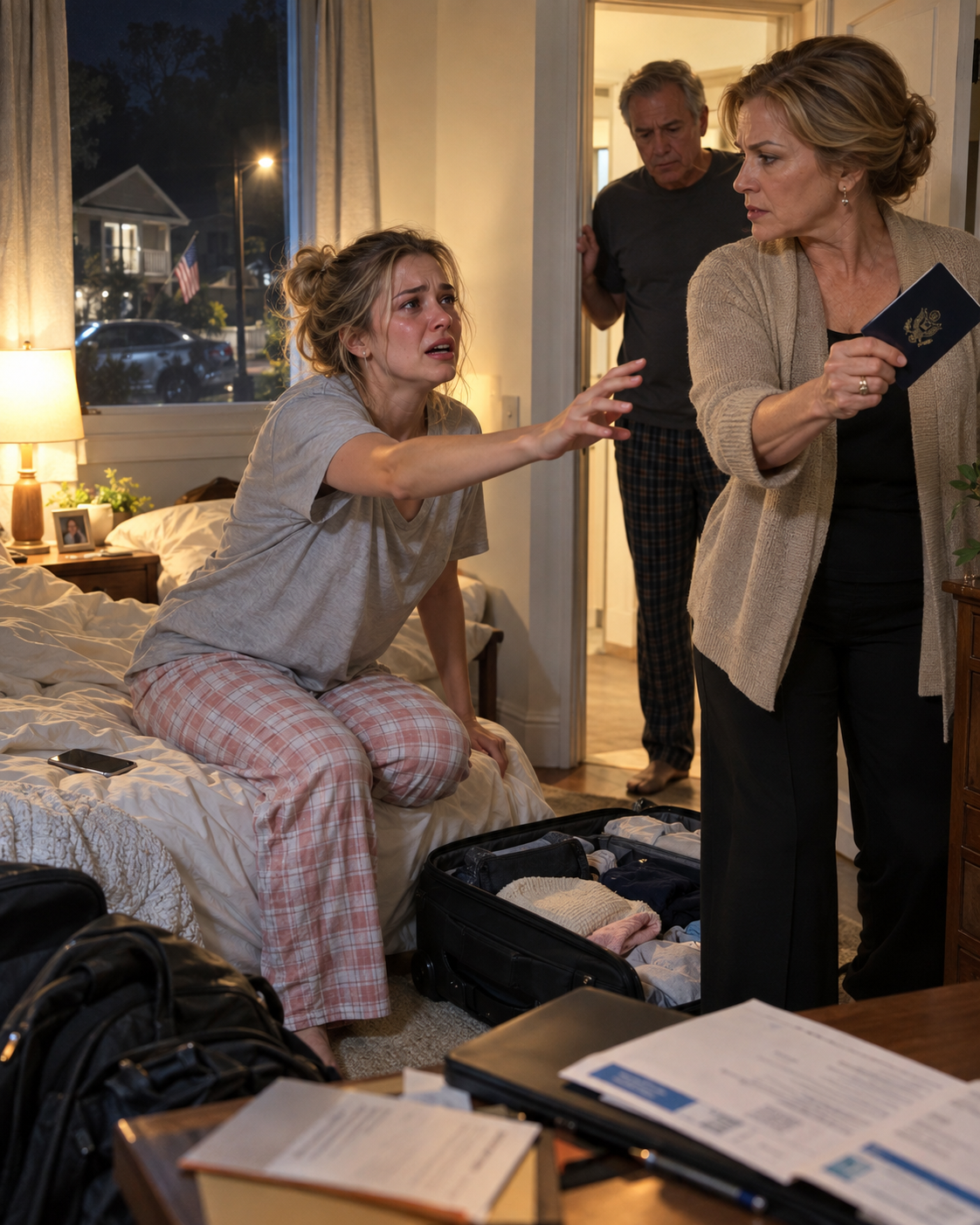
They took my passport from my bedroom floor at 2:00 a.m., and my mother coldly told me I was STAYING HOME
For several minutes, I sat at my kitchen table without breathing.
The photograph lay in front of me.
It showed the bedroom door exactly as I remembered it, the old brass handle catching the hallway light, a sliver of chipped paint near the bottom, and the shadow of my mother’s hand resting against the frame.
But that was not what frightened me.
It was the date written beneath the sentence.
The same date as my canceled flight.
The same night my parents had told me I was not allowed to leave.
“You were never meant to leave.”
I read it again.
Then I turned the photograph over.
There was nothing else.
I called Cynthia.
She answered on the second ring.
“Are you safe?”
“I’m at home.”
“Good.”
“I got a letter from my mother.”
“Do you want me to tell you what it means?”
“I need to know why she kept this.”
Cynthia went quiet.
“Send me a picture.”
I did.
A minute later, she called back.
“Don’t contact them.”
“I wasn’t planning to.”
“And don’t go to your childhood home.”
That made my stomach tighten.
“Why?”
“Because whoever sent this wants you to react before you understand what you’re looking at.”
I stared at the photograph.
“Do you think they’re threatening me?”
“I don’t know.”
Her voice softened.
“But I think someone knows you are finally independent, and they have decided you can be useful again.”
The next morning, I called Kendra.
She answered with a number I didn’t recognize.
“Hello?”
“Kendra, it’s me.”
There was a long silence.
Then she whispered, “You got it too.”
My heart stopped.
“Got what?”
“The letter.”
“What letter?”
“The one Mom sent you.”
“I only got a photograph.”
Kendra inhaled sharply.
“Then yours is different.”
She told me she had received an envelope three days earlier.
Inside was a photocopy of my university acceptance letter.
Beside it was a handwritten note.
“Kendra, if your sister ever asks, tell her we did what we had to do.”
My hands went cold.
“Did what?”
“I don’t know.”
“Where are you?”
“I’m not at home.”
“What happened?”
She hesitated.
“I left six months ago.”
I closed my eyes.
Six months.
Long enough to have happened while I was finishing my final semester.
“You never told me.”
“I was scared.”
“Of Mom?”
“Of Dad.”
That surprised me.
Kendra had always treated my father like a quiet, harmless wall.
She told me she had found something inside his desk after I left.
A stack of documents.
Old bank statements.
Insurance paperwork.
Copies of letters I had never seen.
And one envelope with my name.
She had opened it.
Inside was a legal notice dated eleven months before my planned departure.
It came from a financial institution.
The family home was behind on payments.
Thousands of dollars.
Then more.
Then even more.
The house was close to foreclosure.
My mother had told me they needed me to stay because they could not manage without my paycheck.
But that did not explain the passport.
Families in financial trouble ask for help.
They do not lock their adult daughter’s bedroom door.
Kendra sent me photographs of the documents.
I opened them one by one.
There were mortgage notices.
Utility shutoff warnings.
Credit-card statements.
And one account I didn’t recognize.
A joint savings account held in my name.
I stared at the screen.
“I never opened this.”
Kendra replied immediately.
“That’s why I’m scared.”
I called Cynthia again.
She told me to send everything.
Hours later, she found the missing thread.
My parents had used my identity years earlier to open a savings account and route several deposits through it.
The amounts were small enough to avoid immediate suspicion.
Over time, they had become substantial.
“They used your name as a financial buffer,” Cynthia explained.
“Could they have ruined my credit?”
“They could have.”
“Did they?”
“Not yet.”
The relief lasted only a few seconds.
“Why would they do that?”
“Because they believed you would stay.”
I looked down at the photograph on my table.
Suddenly, my mother’s words made sense in a way that hurt more than not understanding them.
You were never meant to leave.
They had never been preparing me for adulthood.
They had been preparing me to remain available.
My entire childhood rearranged itself in my memory.
The jobs I had been praised for taking.
The groceries I had been asked to buy.
The bills I had been told I was old enough to understand.
The way my mother had become irritated whenever I talked about college.
The way my father always said, “Later.”
Later had been a cage disguised as patience.
I spent the afternoon searching old emails.
I found one from my university admissions office that I had never seen.
It had been sent nearly a year before my flight.
The subject line was simple.
“Concern Regarding Withdrawal Request.”
Withdrawal request.
I opened it.
The admissions office explained that someone had contacted them claiming to be my authorized family representative and requested that my application be withdrawn.
They had refused because the request could not be verified.
I read the message three times.
Someone had tried to erase my future before I ever knew.
I called the university.
The administrator who answered transferred me to an older staff member named Patricia.
“Yes,” she said after searching the record.
“We kept the correspondence.”
“Who made the request?”
“We were not given a name at the time.”
“Is there a phone number?”
There was.
I recognized the last four digits.
My father’s cell phone.
The room seemed to shrink around me.
For twenty-five years, I had believed my parents were disappointed that I wanted to leave.
The truth was worse.
They were actively trying to prevent it.
Cynthia helped me report the identity misuse and secure a full freeze on my financial records.
Kendra did the same.
Then she asked me to meet her.
We chose a small diner halfway between our cities.
She arrived wearing a gray coat and carrying a cardboard box.
When she sat across from me, she pushed it toward the table.
“These were in Dad’s desk.”
Inside were old photographs, bank records, copies of school documents, and dozens of notes.
I lifted one.
It was written when I was nineteen.
My mother had listed household expenses beside my name.
Rent contribution.
Groceries.
Utilities.
Babysitting.
Transportation.
At the bottom she had written:
“She needs to understand that leaving has consequences.”
I looked at Kendra.
“Did she write this?”
Kendra nodded.
“She wrote hundreds of pages.”
“About me?”
“About keeping the family together.”
I felt something strange.
Not anger.
Not grief.
A kind of exhaustion so deep it felt peaceful.
I had spent years trying to understand what I had done wrong.
Maybe I had done nothing wrong.
Maybe the question had always been a trap.
Kendra began crying.
“I knew something was wrong, but I didn’t know how bad it was.”
I reached across the table.
“You were seventeen.”
“I should’ve helped you.”
“You were a kid.”
“So were you.”
I squeezed her hand.
That was the first time either of us said it aloud.
I had spent so much of my youth pretending to be the adult that I had forgotten I had once been someone’s child.
The following week, my father called.
I almost didn’t answer.
Then I did.
“Hello?”
He said nothing for several seconds.
Finally, “We need to talk.”
“Why?”
“Your mother is upset.”
I almost laughed.
“She’s upset?”
“She doesn’t want this to become public.”
There it was.
Not “I’m sorry.”
Not “How are you?”
Not “We hurt you.”
Public.
I closed my eyes.
“Did you try to withdraw my university application?”
Silence.
“Dad.”
“Things were difficult.”
“Did you?”
“Your mother thought—”
“Did you?”
“Yes.”
The word landed softly.
It hurt more than shouting would have.
“Why?”
“We needed you.”
“You needed my money.”
“We needed our family.”
“You needed control.”
He breathed heavily.
“Your mother loves you.”
I looked around my apartment.
At the books I had bought with my own money.
At the framed diploma.
At a photograph of friends who had become family.
“Love doesn’t lock a door.”
He said nothing.
Then, quietly, “You have no idea what we sacrificed.”
I answered, “Neither did you.”
The call ended.
I thought that would be the final wound.
It wasn’t.
Two days later, Cynthia sent me a message.
“Your mother’s attorney contacted mine.”
My heart sank.
“What do they want?”
“Nothing from you.”
“Then what?”
“They’re asking for a meeting.”
I refused.
She asked again.
I refused again.
Then she sent me one additional document.
It was a copy of my mother’s handwritten journal.
There was an entry from the week before my scheduled departure.
I almost didn’t read it.
Then I saw one sentence.
“The money will not last forever, and once she leaves, everything falls apart.”
Below it, another sentence.
“She cannot know why.”
I stared at those words until the room blurred.
There was a secret beneath the secret.
The debt wasn’t the whole story.
I called Kendra.
She had already found another document.
A life-insurance policy.
My father had taken one out years earlier.
The beneficiary was my mother.
That alone wasn’t strange.
Then Kendra noticed the date.
The policy had been increased shortly before my university acceptance.
The amount was enormous.
My stomach twisted.
“Why would Dad increase life insurance right before I was supposed to leave?”
“I don’t know.”
“Was it on him?”
“No.”
She stopped breathing for a moment.
“It was on you.”
I felt suddenly cold despite the heat in my apartment.
Cynthia received the document.
She did not speculate.
Instead, she told me to preserve every record and let the authorities determine what it meant.
That was the moment I understood how carefully I had to move.
My parents had not simply wanted me to stay.
They had built a financial structure around my inability to leave.
My passport had been the lock.
My paycheck had been the chain.
My guilt had been the key.
And whatever was hidden inside that insurance policy was something I did not yet understand.
Kendra and I met with an investigator.
He reviewed the documents for hours.
He asked careful questions.
When he reached the insurance policy, his expression changed.
“Who knew about this?”
“My parents.”
“Anyone else?”
“No.”
He closed the folder.
“I’m going to say something difficult.”
I nodded.
“This does not prove intent.”
“I understand.”
“But it is serious enough that we need to investigate.”
For weeks, I waited.
No one knew how much of my past was evidence and how much was simply the ugly machinery of a desperate family.
Then the investigator called.
He had found something.
A recording.
My father had left a voicemail with an insurance representative months after the policy began.
In it, he had asked what would happen if the insured person permanently relocated.
The representative told him the policy remained active.
My father had responded with one sentence.
“Good.”
I listened to the recording twice.
On the third time, I stopped.
I could not keep hearing his voice.
The investigation continued.
No criminal accusation was made against my parents at that stage.
Some evidence suggested financial manipulation.
Other pieces remained ambiguous.
But the emotional truth was already clear.
They had wanted me dependent.
They had wanted me reachable.
They had wanted my future small enough to fit inside their needs.
And for years, I had mistaken that for love because that was the only language they gave me.
I stopped waiting for them to become different people.
That was my real freedom.
Not the plane ticket.
Not the diploma.
Not the apartment.
The ability to stop standing at an imaginary doorway, hoping someone behind me would finally say, “We’re proud of you.”
They never did.
So I learned to say it to myself.
I built my career slowly.
I became the person younger employees came to when they were afraid to make a mistake.
I told them that ambition was not betrayal.
I told them that boundaries were not cruelty.
I told them that leaving a harmful situation did not mean you hated the people you left.
Sometimes it meant you finally loved yourself enough to survive.
Kendra eventually rebuilt her own life too.
She finished school.
She moved into her own apartment.
She studied nursing.
We spoke every week.
Sometimes about serious things.
Sometimes about nothing.
Those ordinary conversations became precious to me.
She once asked, “Do you ever wish you had stayed?”
I thought about that question for a long time.
“No.”
“Not even once?”
“Sometimes I wish I had a family who could have let me leave without making me choose.”
She nodded.
“That’s different.”
“It is.”
Years passed.
The investigation ended without giving us the dramatic answer everyone imagines when they hear the word secret.
There was no cinematic confession.
No courtroom speech.
No single document that explained everything.
There were financial violations, deception, and evidence of manipulation, but the most painful conclusion was much simpler.
My parents had created a life in which my freedom threatened their stability, and they had chosen their stability.
That was enough.
I never went back.
Not because I wanted revenge.
Not because I wanted them punished.
Because some doors are safer when they remain closed.
On the tenth anniversary of the night they took my passport, I sat alone beside my apartment window and opened the old photograph again.
The edges had softened.
The handwriting had faded.
“You were never meant to leave.”
For years, those six words felt like a threat.
That night, they felt different.
They sounded like a confession.
They had never imagined that I would leave.
They had never imagined that I would build a life without their permission.
They had never imagined that the little girl they raised to serve the family would become a woman who chose herself.
I put the photograph back in the envelope.
Then I opened my calendar.
Kendra had texted me earlier that day.
Her daughter was graduating from college.
I had promised to be there.
I smiled.
That was the inheritance I wanted.
Not money.
Not a house.
Not an apology.
A family where leaving for your dream did not mean abandoning anyone.
A family where success was celebrated instead of punished.
A family where love did not come with a locked door.
The next morning, I drove to the graduation ceremony with flowers in the passenger seat.
Kendra was waiting near the entrance.
She hugged me so tightly I nearly dropped them.
“You came.”
“I promised.”
She laughed through tears.
Then she whispered, “I think Mom would hate this.”
I smiled.
“Probably.”
She looked at me.
“And I think that’s why it matters.”
We walked inside together.
For the first time in my life, I understood that the opposite of what my parents taught me was not rebellion.
It was choice.
Real love does not ask you to disappear so someone else can feel secure.
Real family does not measure your worth by how much of your life you are willing to surrender.
And freedom is not the moment someone finally opens the door.
Freedom is the moment you realize you no longer need them standing on the other side.
I watched my niece walk across the stage.
The applause rose around us like sunlight.
Kendra reached for my hand.
I held it.
And somewhere between one life ending and another beginning, I finally stopped wondering whether I had been wrong to leave.
I knew the answer.
I had not walked away from my family that night.
I had walked toward the person I was supposed to become.