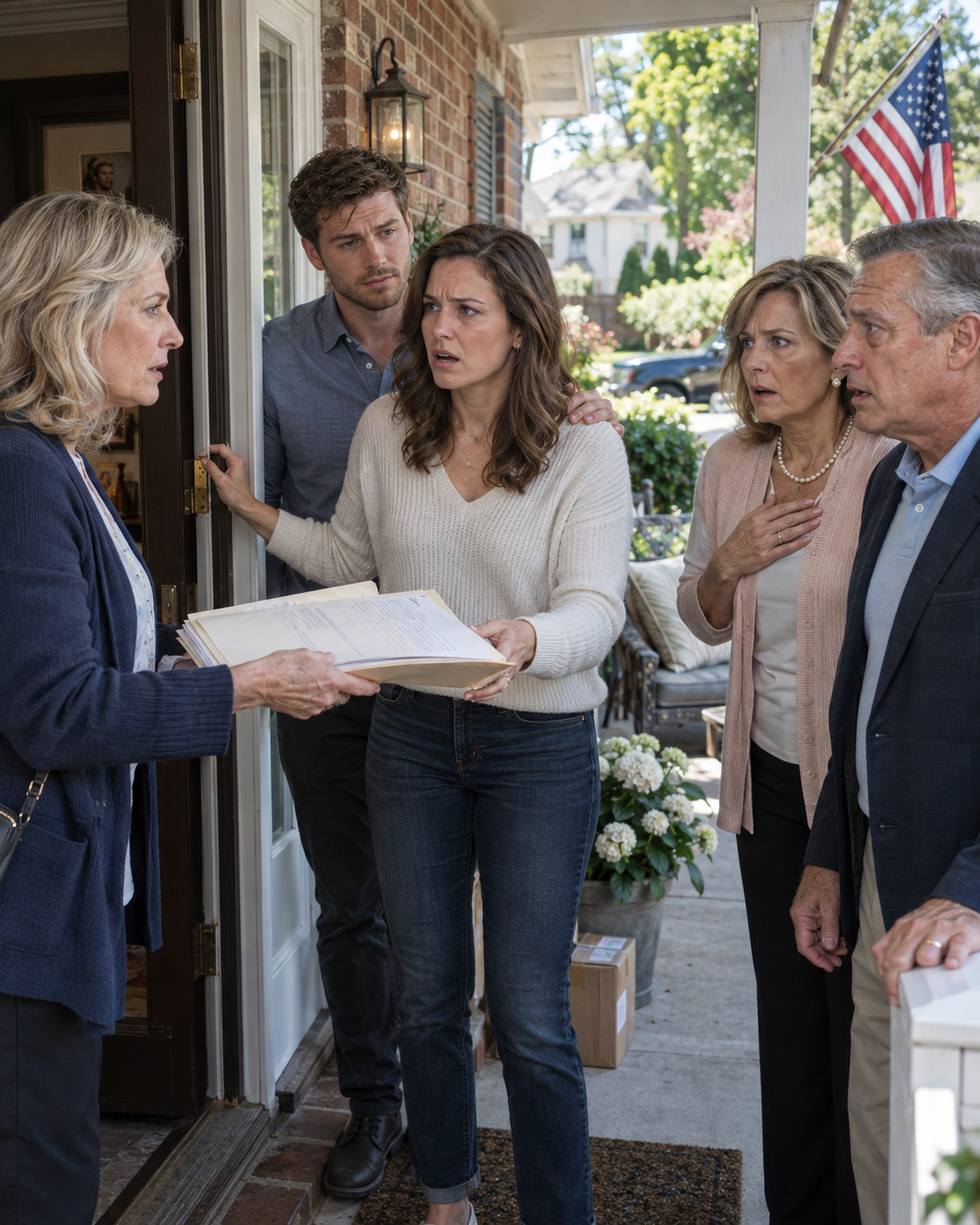
They stood on my front porch demanding one of my KIDNEYS, and my mother actually said I owed my brother for being raised
I stared at the envelope for almost a full minute before touching it.
The handwriting looked old-fashioned, careful, and strangely familiar.
My heart began beating faster.
Eleanor.
Grandma Eleanor had been dead for more than a decade.
I carried the envelope into the kitchen and placed it beside my coffee cup.
Elias watched me from across the counter.
“You don’t have to open it tonight.”
“I know.”
“But you’re going to.”
I gave him a tired smile.
“Yes.”
He came around the counter and squeezed my hand.
“Whatever is inside, you don’t have to face it alone.”
That sentence almost broke me.
For years, I had believed being strong meant needing nobody.
Elias had slowly taught me that there was a difference between independence and isolation.
I opened the envelope.
Inside was a single handwritten letter and a small brass key.
The letter began with my name.
“Dear Clara, if you are reading this, then something happened that I feared might happen after I was gone.”
I stopped breathing for a second.
The next line was worse.
“Your parents were never meant to control your inheritance.”
I looked at Elias.
He moved closer.
I kept reading.
“Your mother knows exactly what I intended for you, and she knows why I placed the trust in your name.”
My hands started shaking.
Grandma explained that when she became seriously ill, she had discovered Arthur had accumulated dangerous business debts.
Sylvia had promised her that none of the money intended for Clara would ever be touched.
Grandma didn’t believe her.
So she created a legal trust with an independent administrator.
The money was supposed to pay for my education, housing during school, and any medical emergencies.
It was never supposed to be available for Milo.
Then came the sentence that changed everything.
“I also left Clara a second account.”
I read it twice.
There was another account.
Not $84,000.
Something much smaller.
But it had been protected separately.
The brass key opened a safe deposit box at a local bank.
Inside was a second letter, several photographs, and an old audio cassette.
I stared at the cassette.
“Who still has something that plays that?”
Elias smiled faintly.
“Your nurse friends?”
I laughed despite myself.
The next morning, we found an old cassette player online.
I sat at the kitchen table while the machine clicked and hummed.
Then I heard her voice.
My grandmother.
Older.
Tired.
But unmistakable.
“Clara, sweetheart, if you’re hearing this, I couldn’t protect you the way I wanted to.”
My eyes filled immediately.
She continued.
“I need you to understand something before you hear what comes next.”
A pause.
“Your mother asked me to change the trust.”
I froze.
Grandma explained that Sylvia had begged her to give Milo access to the money.
She said Milo was more talented.
She said he would become successful.
She said Clara was strong enough to manage without help.
I closed my eyes.
Even then.
Even before I understood what was happening, they had already decided that my strength was an excuse to give my opportunities to someone else.
Then Grandma said something I had never expected.
“I refused.”
The recording continued.
“Your mother became angry and told me that if I didn’t cooperate, she would make sure you believed I didn’t love you.”
I felt sick.
“She threatened to keep you away from me.”
The room went silent except for the recording.
Grandma had spent the last years of her life believing I was angry with her.
But I hadn’t been.
I had simply been told she didn’t want to see me.
My parents had intercepted her letters.
They had returned her birthday gifts.
They had even told me she had stopped asking about me.
A sob escaped my throat.
Elias sat beside me.
I leaned against him and cried harder than I had cried in years.
All those years, I thought my grandmother had chosen not to love me.
She had been trying to reach me.
The cassette continued.
“I put the second account aside because I knew one day you would need proof.”
Then came a name.
Beatrice.
“Your aunt knows what happened.”
I looked at Elias.
“She knew.”
“Maybe she couldn’t get to you.”
“Maybe.”
But part of me still hurt.
That afternoon, I called Beatrice.
She answered immediately.
“I was wondering when you’d hear it.”
“You knew about Grandma’s letters?”
There was silence.
“Yes.”
“How many?”
“Dozens.”
My chest tightened.
“Why didn’t you tell me?”
“Because I was afraid.”
“Of my mother?”
“Of what your mother would do if she realized I was helping you.”
I stood by the window.
“You should have told me anyway.”
“I know.”
Her voice cracked.
“I’ve regretted it every day.”
I wanted to be angry.
Instead, I felt exhausted.
“Come over.”
She arrived an hour later.
For the first time, we sat together without my parents between us.
Beatrice brought a cardboard box.
“I kept these.”
Inside were letters.
My name was written across every envelope.
Some were birthday cards.
Some were short notes.
Some contained photographs.
One showed me at twelve years old, standing beside Grandma at a county fair.
I didn’t remember the picture being taken.
Grandma had written on the back.
“My brave girl.”
I held it against my chest.
Beatrice cried quietly.
“I should have fought harder.”
I shook my head.
“We all should have.”
That night, I called my mother.
She answered after the third ring.
“Clara?”
“Did Grandma write to me?”
Silence.
“Mom.”
“Where did you hear that?”
I closed my eyes.
“Did she?”
She finally whispered, “Yes.”
“How many?”
“I don’t remember.”
“Liar.”
The word came out quietly.
My mother began crying.
“Your grandmother hated your father.”
“No.”
I interrupted her.
“She loved me.”
Another silence.
Then she said something I would never forget.
“We needed the money.”
I sat down.
“You took my future because you needed money?”
“We were a family.”
“No.”
My voice shook.
“You were adults. I was a child.”
She cried harder.
“We thought Milo had a better chance.”
That sentence was the wound beneath every other wound.
Not that they needed money.
Not that they made mistakes.
They had looked at two children and decided one was worth investing in.
And it wasn’t me.
I ended the call.
For several days, I couldn’t sleep.
Then something unexpected happened.
Milo called.
I almost didn’t answer.
“Clara?”
“Yes.”
“I heard about Grandma.”
I said nothing.
“I didn’t know.”
“I believe you.”
He breathed shakily.
“I knew they paid my tuition, but I thought it came from their savings.”
I closed my eyes.
“You didn’t know about the trust?”
“No.”
He paused.
“Did you know they used your money for my condo?”
“Yes.”
“I gave them the money back.”
I opened my eyes.
“What?”
“I sold the condo.”
“Milo, you don’t have to.”
“I do.”
He swallowed.
“I spent years thinking I was the lucky one because I was better.”
My throat tightened.
“I never thought that.”
“I did.”
His voice broke.
“And I was wrong.”
He told me he had transferred the proceeds from the condo sale to the scholarship fund.
I tried to refuse.
He wouldn’t let me.
“Grandma wanted you educated,” he said.
“Maybe now someone else can have what you should have had.”
For the first time in my life, my brother sounded like my brother.
Not the golden child.
Not the favored son.
Just Milo.
A flawed man who finally understood the cost of the pedestal he’d been placed on.
Months passed.
The scholarship grew.
The first recipient was a nineteen-year-old nursing student named Jasmine who worked two jobs while caring for her younger siblings.
When I handed her the scholarship letter, she started crying.
“I don’t know how to thank you.”
I smiled.
“You don’t have to.”
She looked confused.
“Then what do I do?”
“Finish school.”
She nodded.
“And someday, when someone else needs help, remember what it felt like to be given a chance.”
She hugged me.
I held her tightly.
That evening, I drove home thinking about Grandma.
For years, I believed the money she left me represented what I had lost.
Now I understood it represented something else.
Choice.
She had wanted me to have the chance to choose my life instead of having it chosen for me.
My parents had taken the money.
They had not taken the choice.
I had still built my life.
I had still become a nurse.
I had still found Elias.
I had still created a home where nobody had to earn the right to belong.
One winter morning, another envelope arrived.
This time, there was a return address.
Milo.
Inside was a photograph of our childhood.
We were sitting together on the front steps.
I was maybe seven.
He was nine.
His arm was around my shoulder.
On the back he had written:
“I wish I had known then.”
I sat at the kitchen table for a long time.
Then I wrote back.
“I wish we had both been loved better.”
That was all.
I didn’t need to pretend the past hadn’t happened.
I didn’t need to forgive everything in one dramatic moment.
I only needed to stop carrying it.
A year later, I visited my parents’ old house.
It had been sold months earlier.
The porch was empty.
The windows were dark.
I stood there remembering my eighteenth birthday.
The duffel bags.
The coffee tin.
The $2,310.
The key on the counter.
For years, I thought that night was when my family abandoned me.
Standing there, I realized something different.
That was the night I stopped abandoning myself.
I turned away from the house.
Elias was waiting by the car.
“Ready?”
I nodded.
“Yes.”
We drove home.
On the kitchen table was a photograph of Grandma.
Beside it sat the scholarship ledger.
Every name represented a student who had received a chance that I once thought I would never have.
I touched the photograph.
“Thank you,” I whispered.
The house was quiet.
Warm.
Safe.
Mine.
And for the first time, I understood that family isn’t always the people who share your blood.
Sometimes family is the person who stays when you’re difficult to love.
Sometimes it’s the person who tells you the truth when lies would be easier.
Sometimes it’s the stranger who gives you a chance.
And sometimes, family is the life you build after walking away from the people who taught you that you weren’t worth choosing.
I had spent eleven years believing I was the forgotten child.
But I finally realized I had never been forgotten.
I had simply been waiting for the right people to remember me.
And somewhere inside a scholarship office bearing my grandmother’s name, another young woman was opening an envelope that might change her life.
This time, the money wasn’t going to the favorite child.
It was going to the one who had been told she could never make it alone.
And I hoped, more than anything, that she would never have to.