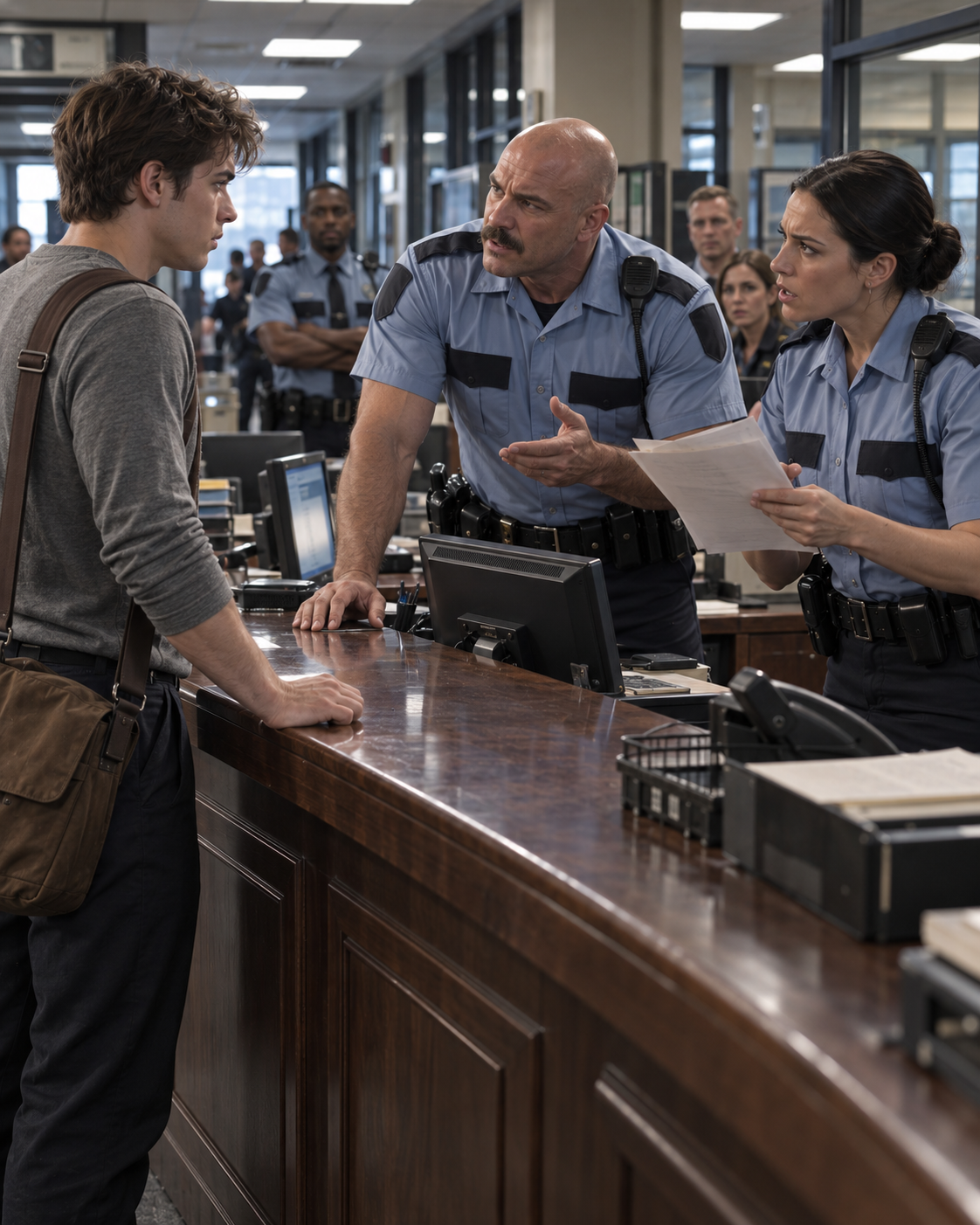
They laughed while tearing my stolen-property report into pieces at the police station, but as my eight-year-old son shivered outside
The chief’s words followed me all the way home.
Not because I suddenly felt important.
I didn’t.
I still felt like the same exhausted father who had spent half the night repairing a broken furnace and the morning trying to explain to his son why his mother’s photographs were gone.
What stayed with me was the way the officers had changed when Chief Sterling recognized me.
They hadn’t suddenly become kinder.
They had simply become afraid of being seen.
That distinction bothered me.
Toby was sitting on the couch when I opened the apartment door.
He looked up immediately.
“Did they find Mom’s ring?”
I took off my jacket.
“Not yet.”
His face fell.
I sat beside him.
“But they’re going to look.”
“Really?”
“Really.”
He leaned against me.
For a moment, I closed my eyes.
I could still smell smoke from years ago.
I could still hear children crying behind a bedroom door.
And strangely, I remembered something Emily had once told me.
“Courage doesn’t mean you aren’t scared, Arthur.”
She had smiled at me across our kitchen table.
“It means you decide what matters more than your fear.”
I hadn’t understood how deeply those words would stay with me.
That afternoon, two detectives arrived at our apartment.
Detective Maya Brooks was in her thirties, calm and observant, while her partner, Daniel Price, carried a notebook filled with questions.
Maya looked around the apartment carefully.
“Tell us exactly what happened.”
I showed them the broken window.
The bedroom.
The empty drawer.
Toby’s missing laptop.
Then I pointed toward the small wooden box that was supposed to hold Emily’s photographs.
“That’s where the ring was.”
Maya didn’t interrupt.
She simply listened.
When I finished, she asked, “Anything else missing?”
I thought about it.
“No.”
“Anything unusual?”
I hesitated.
“There was a smell.”
“What kind?”
“Gasoline.”
Daniel looked up.
“Inside?”
“Very faint.”
Maya wrote it down.
“Did you touch anything?”
“No.”
“Good.”
She walked toward the window.
Then she noticed something on the sill.
A tiny smear of blue paint.
I stared at it.
“I’ve never seen that before.”
Maya photographed it.
“Neither have I.”
The investigation changed immediately.
What first looked like a simple apartment burglary began to resemble something more deliberate.
The thieves had entered through the window without disturbing most of the valuable electronics.
They ignored my television.
They ignored my tools.
They ignored cash sitting in a kitchen drawer.
They took Toby’s school laptop.
They took Emily’s photographs.
They took her ring.
And nothing else.
That meant they hadn’t come for valuables.
They had come for memories.
Three days later, Maya called me.
“We found your laptop.”
I nearly dropped the phone.
“Where?”
“In a pawn shop.”
My heart jumped.
“Is the ring there?”
“No.”
“The photographs?”
“No.”
I closed my eyes.
“What did the person look like?”
“Male, probably late twenties or early thirties.”
“Did he give a name?”
“Fake one.”
Maya paused.
“But he left fingerprints.”
That afternoon, detectives arrested a man named Travis Cole.
He had a long record of burglary and theft.
At first, the case seemed solved.
Then Maya called again.
“Arthur, there’s a problem.”
I met her at the station.
She placed a photograph on the table.
It showed Travis standing outside the pawn shop.
“What about him?”
“He wasn’t alone.”
She showed me another image.
A second man stood beside him.
He wore a dark jacket and baseball cap.
His face was partially hidden.
But I recognized something.
The blue paint.
It was on his jacket sleeve.
I looked at Maya.
“That’s not a random burglar.”
“No.”
“Who is he?”
“We don’t know yet.”
The next morning, Toby’s laptop was returned.
He hugged it like a lost friend.
But he didn’t smile.
“Where are Mom’s pictures?”
I knelt beside him.
“We’re still looking.”
“What if they burned them?”
I felt something inside my chest crack.
“They didn’t.”
I said it too quickly.
He looked at me.
“How do you know?”
I didn’t.
But I couldn’t let him see that.
“Because your mom’s story isn’t finished.”
He held my hand.
“How do you know?”
I looked at the photograph of Emily on the wall.
“Because she taught me not to give up.”
That night, I received a call from Chief Sterling.
“Arthur, come to the station.”
His voice was serious.
When I arrived, Maya and Daniel were waiting.
Chief Sterling closed the door.
“We found something.”
He placed a small evidence bag on the table.
Inside was a photograph.
My wife’s photograph.
The corner was burned.
But Emily’s face was still visible.
My knees nearly gave out.
“Where did you find it?”
“In the trash behind an abandoned house.”
I picked it up carefully.
My thumb hovered over Emily’s face.
For three years, I had feared forgetting the exact curve of her smile.
Now I could see it again.
I whispered, “Thank you.”
Maya looked at me.
“We think the thieves were paid to take specific items.”
“By whom?”
“We’re still working on that.”
Then Daniel placed another object on the table.
Emily’s wedding ring.
I stared at it.
My hands began shaking.
“Where?”
“Inside a car belonging to Travis Cole.”
I reached for it, but stopped.
For some reason, I couldn’t touch it.
Chief Sterling slid it toward me.
“Arthur.”
I finally picked it up.
The metal was cold.
It felt impossibly heavy.
I remembered placing that ring on Emily’s finger.
I remembered her laughing because my hands were shaking so badly.
I remembered the way she had looked at me afterward.
Like I was the only person in the world.
I closed my fist around it.
Then I heard footsteps outside.
The door opened.
Toby ran inside.
“Dad!”
I turned.
He saw the ring in my hand.
His eyes widened.
“Mom?”
I crouched down and placed it in his palm.
He stared at it for several seconds.
Then he pressed it against his chest.
“Mom finally came home.”
I couldn’t speak.
I pulled him into my arms.
He cried against my shoulder.
And this time, I cried too.
Not because I was weak.
Because sometimes grief doesn’t disappear.
Sometimes it simply waits for permission to come out.
For a few minutes, nobody in that room moved.
Then Maya quietly said, “There’s still something you need to know.”
I looked up.
“The ring wasn’t the only thing we recovered.”
She placed a small envelope on the table.
Inside was a photograph I had never seen before.
Emily was standing beside a man I didn’t recognize.
On the back, in her handwriting, were six words.
“If anything happens, find him.”
My blood turned cold.
“Where did you get this?”
“It was hidden inside the stolen box.”
I stared at Emily’s handwriting.
She had never mentioned another man.
Not once.
Daniel looked at me.
“Arthur, do you know who that is?”
“No.”
My voice barely came out.
“But I intend to find out.”
The investigation took a darker turn after that.
Maya discovered that the man in the photograph was a former contractor named Evan Mercer.
He had worked for a private heating company that serviced several buildings in our neighborhood.
Three years earlier, he had been investigating a series of illegal gas-line modifications.
Then he disappeared.
The date of his disappearance was two weeks before Emily died.
I felt sick.
“Are you saying my wife’s death wasn’t natural?”
Maya didn’t answer immediately.
“We aren’t saying anything yet.”
But her eyes told me enough.
Emily had died after a sudden gas leak in our old apartment.
The official report had called it an accident.
I had believed it because I needed to.
I had a grieving child.
Bills.
A funeral.
A life that had suddenly become impossible.
I had never had the strength to question the details.
Now I did.
Detectives reopened the old case.
They examined the building records.
They interviewed former tenants.
They reviewed maintenance reports.
Then they found something.
The gas system had been altered illegally.
The modification had been made shortly before Emily’s death.
The person who signed the maintenance record was Evan Mercer.
But Evan had told investigators he had never entered our building that night.
His signature said otherwise.
Maya discovered another name buried beneath the paperwork.
A property manager named Victor Hale.
Hale had been investigated years earlier for falsifying safety inspections.
He had never been charged.
Now he was missing.
The pieces began connecting.
Someone had stolen Emily’s photographs because one of them contained Evan.
Someone had stolen the ring because the thieves had searched inside the box where Emily had hidden the photograph.
They weren’t interested in the jewelry.
They were looking for evidence.
And suddenly, I understood why the burglary had happened now.
Someone had discovered that Emily’s old belongings still existed.
Someone was afraid I might eventually look inside them.
For the first time in three years, I wondered whether my wife’s death had been an accident at all.
That realization hurt more than the burglary.
Because grief is painful.
But discovering that grief may have been built on a lie is something else entirely.
Weeks passed.
The investigation grew.
Victor Hale was eventually located in another state.
Evan Mercer was found living under a different name.
And what he told detectives changed everything.
Emily had discovered that a contractor was deliberately disabling safety systems in old apartment buildings to avoid expensive repairs.
When she confronted the property manager, she was threatened.
Evan had tried to help her.
He had collected evidence.
But someone found out.
Then came the gas leak.
Then Emily’s death.
Then Evan disappeared.
I sat alone in the interrogation room while he told me what happened.
“You need to understand something,” he said.
“I tried to warn her.”
I stared at him.
“Why didn’t you tell me?”
He lowered his eyes.
“Because I was afraid.”
I wanted to hate him.
Part of me did.
But another part understood.
Fear makes people choose silence.
I had spent years believing courage meant running toward danger.
Now I realized there was another kind.
Sometimes courage meant telling the truth after living with it for too long.
Victor Hale was eventually arrested.
So were several people connected to the fraudulent maintenance scheme.
The burglary suspects agreed to testify.
The stolen-property case became evidence in a much larger investigation.
And the truth about Emily finally came out.
She had not died because nobody cared.
She had died because people who cared about money had decided other people’s lives were worth less.
That truth broke me.
But it also freed me.
For years, I had blamed myself.
I had wondered whether I should have noticed something.
Whether I should have protected her.
Whether being a firefighter had made me arrogant enough to believe I could save everyone.
Now I understood.
I hadn’t failed Emily.
People had made choices that no husband could have controlled.
One evening, I took Toby to the cemetery.
The sky was turning gold behind the trees.
He carried the wooden box with both hands.
Inside were the recovered photographs and his mother’s ring.
He placed the box beside her grave.
“I brought Mom’s things back.”
I smiled through tears.
“She’d be proud of you.”
He looked at me.
“Are you proud of me?”
“Every day.”
He thought for a moment.
“Dad?”
“Yeah?”
“Why did those officers laugh at us?”
I didn’t know how to answer without teaching him bitterness.
So I told him the truth.
“Sometimes people forget how much a person’s pain matters.”
“Are they bad people?”
I looked at the flowers on Emily’s grave.
“People can do bad things without being bad forever.”
He nodded slowly.
“Then can they change?”
“I hope so.”
We sat together in silence.
Then Toby reached for my hand.
I squeezed it.
A week later, Chief Sterling asked me to speak at a community meeting about public service.
I almost refused.
I didn’t think my story mattered.
But when I walked into the room, I saw families, firefighters, police officers, teachers, and people who had never met me.
Chief Sterling introduced me simply.
“This is Arthur Vance.”
Nothing more.
I stepped toward the microphone.
I looked at the crowd.
“I used to think courage meant being the person who runs into the fire.”
I paused.
“Now I think courage also means refusing to become cruel after you’ve been hurt.”
The room was silent.
I told them about Toby.
About Emily.
About the stolen photographs.
About the officers who laughed.
I didn’t name them.
I didn’t need to.
Then I said something I wished someone had told me three years earlier.
“When someone comes to you carrying grief, don’t measure whether their problem seems important to you.”
I looked around the room.
“Measure how important it is to them.”
Chief Sterling stood near the back.
His eyes were wet.
Afterward, one of the two officers who had torn up my report approached me.
He looked different without the arrogance.
“I owe you an apology.”
I studied his face.
“You do.”
He swallowed.
“I was wrong.”
I nodded.
“I hope you never make someone else feel the way you made my son feel.”
He looked down.
“I won’t.”
I didn’t shake his hand.
Not yet.
Forgiveness, I had learned, wasn’t something you owed people because they finally felt guilty.
Sometimes forgiveness was simply deciding their cruelty would not live inside you forever.
Months later, Toby’s room had a new shelf.
On it sat the wooden box.
Inside were Emily’s photographs.
The ring was no longer there.
Toby wore it on a chain around his neck, just as he had asked.
One evening, he came into the kitchen while I was repairing a broken thermostat.
“Dad?”
“Yeah?”
“I think Mom would like our new place.”
I looked at him.
“Why?”
“Because the heat works.”
I laughed.
He laughed too.
For a few seconds, our apartment felt warm in a way that had nothing to do with the furnace.
Then Toby touched the ring beneath his shirt.
“She really came home.”
I stopped working.
“Yeah, buddy.”
I looked toward the photograph of Emily on the shelf.
“She did.”
The next morning, a letter arrived from the district attorney.
Inside was a copy of a final evidence report.
Most of it was ordinary legal language.
But one sentence stopped me.
Investigators had recovered a second photograph from the old apartment building.
It showed Emily standing beside Toby when he was only three.
On the back, she had written something I had never seen.
“Arthur, if you’re reading this, remember that our son needs the truth more than he needs a perfect story.”
I sat at the kitchen table for a long time.
Then I called Toby over.
I handed him the photograph.
He stared at his mother’s handwriting.
“What does it say?”
I smiled.
“It says she knew you’d grow up.”
He touched the picture gently.
“Did she know you’d be okay?”
I looked at him.
“No.”
I took his hand.
“But she knew I’d keep trying.”
Outside, the first snow of winter began falling.
I watched it through the window and realized that some memories aren’t meant to keep us trapped in the past.
They’re meant to remind us who we want to become.
I had once thought strength was the ability to carry people out of burning buildings.
Now I knew better.
Strength was carrying love through the years after the fire was gone.
It was standing up without becoming bitter.
It was protecting your child’s heart without teaching him to hate.
And sometimes, it was simply picking up the torn pieces someone had thrown away and refusing to believe they were worthless.
That night, Toby fell asleep with his mother’s photograph beside his pillow.
I stood in the doorway and watched him breathe.
For the first time in three years, the silence in our home didn’t feel empty.
It felt peaceful.
I turned off the light.
Then, just before closing the door, I heard Toby whisper in his sleep.
“Goodnight, Mom.”
I looked at the photograph on his pillow.
And for one brief second, I could almost imagine Emily smiling back.
The past had taken something from us that could never be returned.
But it had also taught us something no thief could ever steal.
Love leaves evidence.
Courage leaves evidence.
And even after the people who tried to destroy you are gone, the truth remains in the lives you chose to protect.
I closed Toby’s door softly.
Then I walked back toward the kitchen, where Emily’s photograph waited beneath the warm light.
I picked it up, held it against my chest, and finally allowed myself to believe that perhaps coming home was never about getting everything back.
Perhaps it was about learning how to live with what remained.
And somewhere beneath the grief, beneath the anger, beneath every unanswered question, I heard the quietest promise of all.
We were still here.
Together.
And this time, nobody was going to take that away.