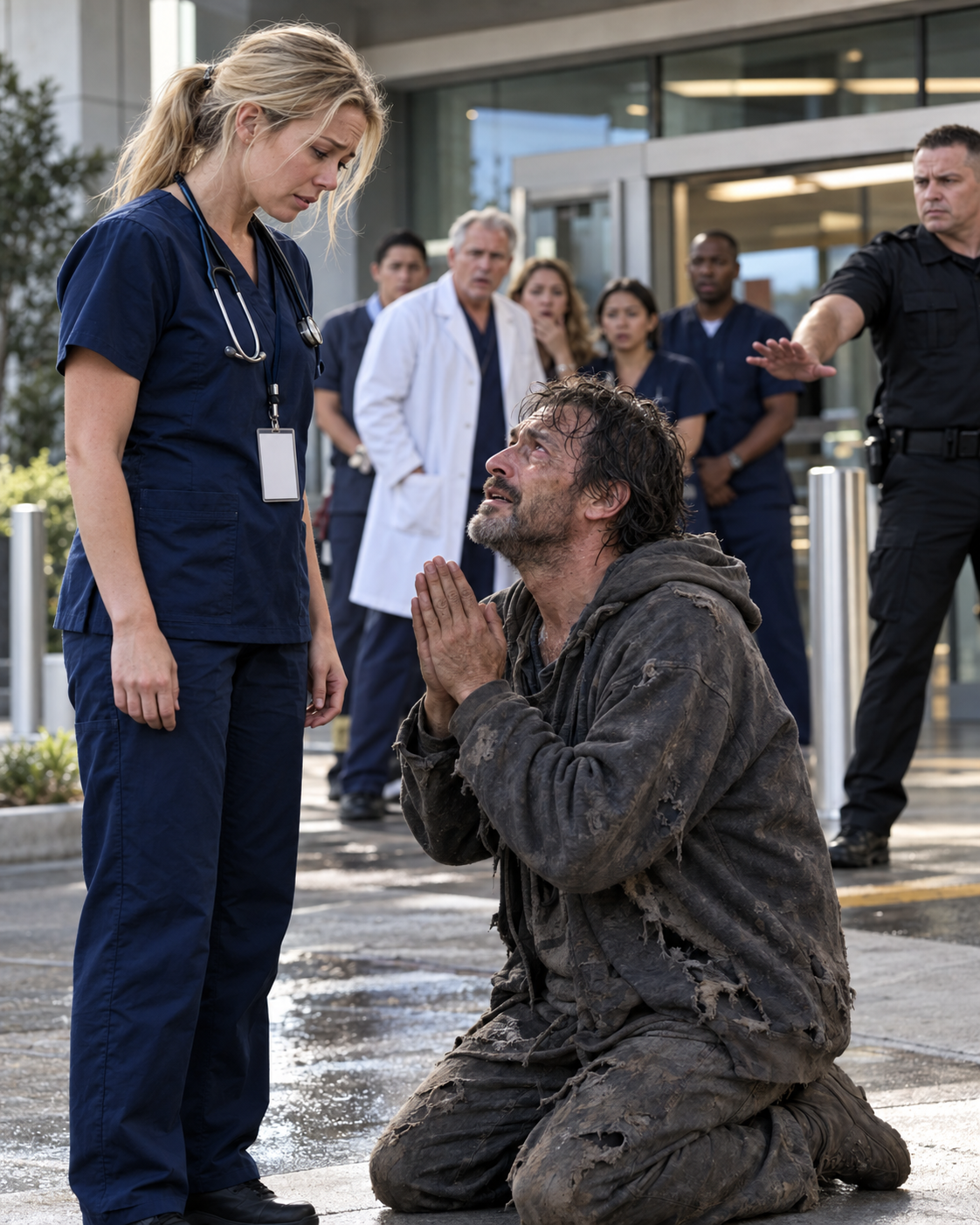
The worst thing you can hear in a hospital is not a monitor flatlining; it is a doctor saying, ‘Get him off my pavement,’
The doors to the emergency department opened before the helicopter blades had fully wound down.
Six people came through.
Not running.
They didn’t need to.
They moved with the kind of calm that made everyone else get out of the way.
The first man was tall, broad-shouldered, and younger than I expected. His dark hair was cut close, his uniform immaculate despite the weather.
He stopped when he saw me.
For a moment, neither of us spoke.
Then he said, very quietly, “Lifeline.”
Maya looked from him to me.
“Claire?”
I couldn’t take my eyes off the man.
“Lieutenant Commander Nathan Cross.”
His expression barely moved.
“You’re alive.”
It wasn’t a question.
I swallowed.
“So are you.”
He gave a humorless little breath.
“Apparently we’re both difficult to get rid of.”
Behind him, a hospital administrator hurried down the corridor.
Brenda Sterling was the kind of woman who could make a crisis feel like an inconvenience to her schedule. She wore a gray suit and carried a tablet in one hand.
“Commander, this is a civilian hospital. You cannot arrive with a tactical team and take over a clinical floor.”
Cross didn’t even turn.
“I need access to the patient in Twelve.”
“You don’t have authorization.”
“He is a protected military witness.”
“That doesn’t mean—”
“It means federal agents are already on their way.”
Sterling stopped.
Maya leaned toward me.
“Did he just say federal agents?”
“Yes.”
“Why?”
“I don’t know.”
That was a lie.
I knew enough to be afraid.
Six years earlier, I had been Corporal Claire Bennett, combat medic, call sign Lifeline.
There had been eight of us on that mountain.
By sunrise, there were five.
By the following week, there were four.
I had carried one brother until my arms stopped working.
Another died while I was holding pressure against his neck.
The third never made it out of the ravine.
Afterward, I stopped answering calls.
I left the service.
I became a nurse.
I learned how to speak calmly when somebody was bleeding.
I learned how to smile at families.
I learned how to go home without hearing rotor blades in my sleep.
Or at least I thought I had.
Cross stepped closer.
“Why are you here?”
I glanced toward Room 12.
“Because he was freezing to death outside.”
“That sounds like him.”
“What does?”
“Trying to disappear somewhere nobody would think to look.”
A federal agent entered behind him.
Then another.
Sterling’s face tightened.
“Commander, I need you to understand that hospital security procedures still apply.”
Cross finally looked at her.
“They applied when he was a patient. They apply now.”
It wasn’t an argument.
It was a boundary.
Sterling stepped back.
The first thing Nomad asked for when he woke was water.
The second was me.
I went into the room alone.
His beard was gray around the chin now. His face was thinner than I remembered. There was a scar near his temple that hadn’t been there before.
“You shouldn’t have said my name,” he whispered.
“I know.”
“You shouldn’t have recognized me.”
“I recognized the way you moved.”
He closed his eyes.
“You always did.”
I pulled a chair closer.
“What happened to you?”
He didn’t answer immediately.
Outside the room, footsteps passed.
A cart squeaked down the hall.
Somewhere nearby, a monitor alarmed and was silenced.
Finally he said, “I found out the deaths weren’t accidents.”
My stomach tightened.
He told me about a military logistics contractor called Meridian Strategic Supply.
The company had held contracts for specialized cold-weather equipment used by units operating in extreme environments.
For years, inspection reports had warned about material failures.
Those reports were altered.
Some were buried.
Some equipment was accepted despite failing specifications.
The mountain mission six years earlier had been one of several incidents tied to defective gear.
Nomad had found internal correspondence showing people knew.
“They didn’t just make mistakes,” he said. “They signed off on equipment they knew could fail.”
“Why didn’t you report it?”
“I did.”
“To whom?”
He gave me a tired smile.
“Everybody.”
“And?”
“Then people started dying.”
He had spent eleven months moving between shelters, abandoned buildings, churches, and streets because he believed the people watching him had access to government databases and private security networks.
“Why come here?”
“I didn’t choose the hospital.”
I frowned.
“What do you mean?”
“I was trying to get farther south. The rain got bad. I thought I could sleep under the loading dock.”
He looked toward the door.
“Then I saw the sign.”
“Naval Central?”
He nodded.
“I thought if I was going to die, maybe I’d at least die somewhere with people who knew what they were looking at.”
That sentence stayed with me.
Because I understood it.
Not the dying part.
The being seen part.
Before I could answer, the door opened.
Maya stood there.
Her expression was wrong.
“Claire.”
I rose.
“What?”
“We need you outside.”
Cross was waiting in the corridor.
So was Marcus.
And a man in a courier uniform stood against the wall with his hands restrained behind him.
My stomach dropped.
“What happened?”
Marcus spoke first.
“He came in through receiving.”
“Courier?”
“That’s what he said.”
Cross pointed toward the evidence bag on the counter.
Inside was a small black device.
“What is it?”
“A tracking beacon,” Cross said.
“Where was it?”
Marcus answered.
“Inside the replacement supply bin headed for Twelve.”
I looked at Nomad’s room.
“Did he know where the patient was?”
“He had the room number.”
The corridor seemed to narrow.
Sterling arrived, furious.
“This is unacceptable.”
Cross turned.
“Agreed.”
“You cannot lock down my hospital based on speculation.”
“It’s not speculation.”
“Then where are your warrants?”
“On their way.”
She looked at me.
“Claire, you brought this person into the hospital.”
I stared at her.
“He was dying outside.”
“That doesn’t change the security implications.”
“No,” I said. “It changes the medical implications.”
Maya stepped beside me.
“She’s right.”
Sterling glared at her.
Maya shrugged.
“You can be angry about it after you stop somebody from planting tracking devices on my floor.”
That was Maya.
Quick when frightened.
Sharper when angry.
The lockdown lasted three hours.
No visitors.
No deliveries.
No one entered or left without clearance.
The courier eventually admitted he had been paid to place the beacon.
He didn’t know who had hired him.
That part bothered me more than if he had confessed immediately.
There was always another layer.
Around midnight, Walter Haines rolled himself into the waiting area in a wheelchair.
Walter was seventy-eight and had been admitted two days earlier for complications after a fall.
He had served in the Navy decades ago.
He knew enough about hospital rules to ignore most of them.
“You look terrible,” he told me.
“Thank you.”
“Wasn’t a compliment.”
He handed me a cup of vending-machine coffee.
“Sit.”
“I have work.”
“You’ve had work all night.”
I sat.
Walter watched me for a while.
“You’re doing that thing.”
“What thing?”
“Pretending your hands aren’t shaking.”
I looked down.
They were.
He smiled.
“You don’t have to be brave in a hallway.”
I didn’t answer.
He looked toward Room 12.
“You know him?”
“Once.”
“That’s usually how trouble starts.”
I laughed softly.
Then the laugh caught in my throat.
“I lost three people with him.”
Walter’s face changed.
“Brothers?”
“Close enough.”
“You think surviving them means you owe them something.”
It wasn’t a question.
I stared at him.
“How do you know?”
“Because I did the same thing.”
The quiet between us was kinder than most conversations.
At four in the morning, the federal team began taking statements.
I gave mine.
Then I gave another.
Then another.
At sunrise, Cross came to the nurses’ station.
“He wants you in the debrief.”
I almost refused.
Maya squeezed my shoulder.
“Go.”
The conference room smelled like stale coffee and printer toner.
Nomad sat at one end.
Cross sat beside him.
Two federal investigators were there.
Sterling was not invited.
I placed my field medical records on the table.
They had been buried in a box for years.
Old casualty reports.
Equipment notes.
Temperature readings.
Handwritten observations.
One investigator opened the first folder.
“You recorded the gear failure?”
“Yes.”
“During the mountain mission?”
“Yes.”
“Did you report it?”
“Yes.”
“To command?”
“Yes.”
“Did anyone respond?”
I looked at Nomad.
He answered.
“They told us to stop documenting equipment concerns unless specifically requested.”
I felt something cold move through me.
That sentence had lived in my memory for six years.
I had thought it was ordinary bureaucracy.
Now it sounded like a warning.
The investigator spread copies of the records across the table.
The pattern became visible.
A failed insulation layer.
A malfunctioning heater.
A missing cold-weather component.
A report marked corrected.
Then another.
Then another.
None of the records alone proved criminal intent.
Together, they showed something worse.
People had known.
The case reopened within forty-eight hours.
Meridian denied wrongdoing.
Its attorneys issued statements saying the equipment had met contractual requirements and that previous incidents were unrelated.
The federal investigation continued.
For the first time, the families of the three men I had lost were contacted with new information.
I wasn’t ready for that.
The first call came from Aaron’s mother.
She cried.
I cried.
Neither of us knew what to say.
The second family asked me whether Aaron had suffered.
I told them the truth.
I stayed with him.
He wasn’t alone.
Sometimes truth is all you can give somebody.
And sometimes it is enough.
The third family didn’t call.
They sent a letter.
I kept it unopened for three days.
When I finally read it, his sister had written:
Thank you for remembering him as a person instead of a name on a report.
I had to leave work early that day.
I sat in my car for an hour.
For six years, I had believed I left the military because I couldn’t bear the memories.
Maybe that was partly true.
But there had been something else.
I had believed leaving meant I had failed them.
That was the lie I had been carrying.
Cross found me in the parking garage.
“You don’t have to go back in.”
“I have to.”
“No.”
He leaned against the concrete pillar.
“You’ve already done enough.”
I shook my head.
“No. I spent six years thinking I hadn’t.”
He nodded slowly.
“Then maybe stop measuring yourself by what you couldn’t prevent.”
I looked at him.
“You still talk like a commander.”
“You still listen like a medic.”
That almost made me smile.
The investigation eventually reached hospital administration.
Not because of Nomad.
Because Sterling had ordered security records altered after the tracking device was discovered.
She claimed she had done it to protect patient confidentiality.
The federal investigators disagreed.
The internal inquiry found multiple policy violations.
She resigned before the final disciplinary hearing.
Dr. Vance stayed.
For a while.
One afternoon he came to the nurses’ station.
He looked uncomfortable.
“I owe you an apology.”
I kept charting.
“For what?”
“The night in the rain.”
I stopped.
“You were right.”
“I know.”
He gave a short, embarrassed laugh.
“You’re supposed to say something gracious there.”
“I’ve been practicing.”
He smiled.
Then his expression softened.
“I was embarrassed that you caught something I missed.”
I looked at him.
“That happens.”
“It shouldn’t.”
“It happens to everyone.”
He shook his head.
“Maybe. But I don’t want to be the physician who stops seeing the person because the chart says nuisance.”
A month later, he transferred to community outreach.
He sent me a note.
No speech.
No apology tour.
Just two sentences.
I’m trying to notice people before I notice their paperwork.
I kept it.
Nomad recovered slowly.
He didn’t return to the military.
He didn’t want medals.
He didn’t want a press conference.
He wanted a small apartment, a driver’s license, and the freedom to walk into a grocery store without checking every reflection.
The federal case continued.
Meridian eventually faced criminal charges connected to falsified safety documentation and procurement fraud.
The families received formal briefings.
Compensation followed later.
Money didn’t restore anyone.
Nobody pretended it did.
But the records changed.
The names were no longer buried beneath phrases like operational loss.
They had context.
They had warnings.
They had people who had tried to speak.
Nomad stayed in town for a while.
Sometimes we’d drink coffee after my shift.
We didn’t talk about the mountain every time.
Sometimes we talked about baseball.
Sometimes the weather.
Once, he spent twenty minutes complaining about the price of eggs.
It was wonderful.
One evening, Nathan Cross found me in the cafeteria.
“I have a position for you.”
I laughed.
“You flew two helicopters to offer me a job?”
“Technically, the helicopters were unrelated.”
“That’s not what it looked like.”
He slid a folder across the table.
Military medical training.
Field trauma instruction.
A billet designed for someone who had lived both sides of the line.
“You’d be good at it.”
I closed the folder.
“I don’t think I want to go back.”
“You don’t have to.”
“I don’t want to be Lifeline all the time.”
Cross nodded.
“Maybe you don’t have to choose.”
That sentence followed me for weeks.
Because that was exactly what I had been doing.
Choosing.
Civilian nurse or combat medic.
Claire or Lifeline.
Past or present.
Grief or usefulness.
As if a person could only carry one identity without betraying the other.
I finally understood what Walter had been trying to tell me.
My worth had never depended on how much suffering I could survive.
It depended on what I did with the life that remained.
I stayed at Naval Central.
I helped rewrite the hospital’s cold-exposure triage protocols.
We changed how security staff were trained to recognize medical emergencies among unhoused people.
We added rapid temperature assessment to intake criteria for vulnerable patients during severe weather.
We created a direct pathway from the emergency entrance to social services so that people who came in soaked, frightened, intoxicated, or disoriented weren’t treated as nuisances before someone checked whether they were sick.
Maya joined the committee.
She complained through every meeting.
Then she caught every detail everyone else missed.
Walter insisted on reviewing the final draft.
He said the language sounded too much like lawyers.
He was right.
Nomad read the final version in my office.
“You know,” he said, “six years ago I thought the person who saved me was gone.”
I looked at him.
“She wasn’t.”
“No.”
He smiled.
“She just needed somewhere else to stand.”
I didn’t cry.
Not then.
I had cried enough.
Instead, I walked him to the door.
Outside, rain had started again.
Not a storm this time.
Just a steady spring rain tapping against the windows.
We stood beneath the awning.
“You hate rain now?” he asked.
“No.”
“You used to.”
“I used to hate a lot of things.”
He smiled.
“So did I.”
He walked away slowly.
I watched until he disappeared around the corner.
Then I went back inside.
A man in a torn coat was standing near the emergency entrance.
He looked uncertain.
A security guard was approaching him.
For one second, six years collapsed into one.
I stepped forward.
Not because I was afraid of what might happen.
Because I knew exactly what might happen.
I walked beside the guard.
“Let’s find out what’s wrong first.”
The guard nodded.
The man looked at me suspiciously.
I smiled.
“Come on. It’s warm inside.”
He followed.
And as the doors closed behind us, I understood something I had spent years avoiding: the battlefield had never been the only place where a life could depend on whether somebody was willing to kneel.