The woman who planned to buy my family’s restoration shop laughed in front of everyone when I said I could save the million-dollar car.
The folder was sitting beneath a stack of auction papers, almost hidden by a thick leather cover.
Claire pulled it free.
“Is this supposed to be here?” she asked.
I shook my head.
The document wasn’t related to the car’s engine, its service history, or its auction value. It was a property record.
And the address printed across the top belonged to the restoration shop.
My father’s shop.
I felt my hands go cold.
“Why would a property document be inside a vehicle consignment folder?” I asked.
Claire turned the first page.
“I don’t know. But I think we should read it before anyone else notices.”
The document described the buyer’s proposed plans for the property after the auction. There were sections about redevelopment, staffing changes, and the removal of certain specialized equipment.
One paragraph caught my attention.
The buyer intended to dismiss the entire technical team once the sale was completed.
Another described plans to convert the building into a private automotive showroom and luxury storage facility.
I read the paragraph twice.
My father had spent decades building that place. He had hired young mechanics who couldn’t afford formal training. He had taught them how to restore engines, repair damaged bodies, and recognize details that most people overlooked.
For many of them, the shop wasn’t just a workplace.
It was the reason they had a career.
Now someone was planning to erase all of it.
“She isn’t buying the shop to continue its work,” I said.
Claire closed the folder.
“No. She’s buying it to get rid of what made it special.”
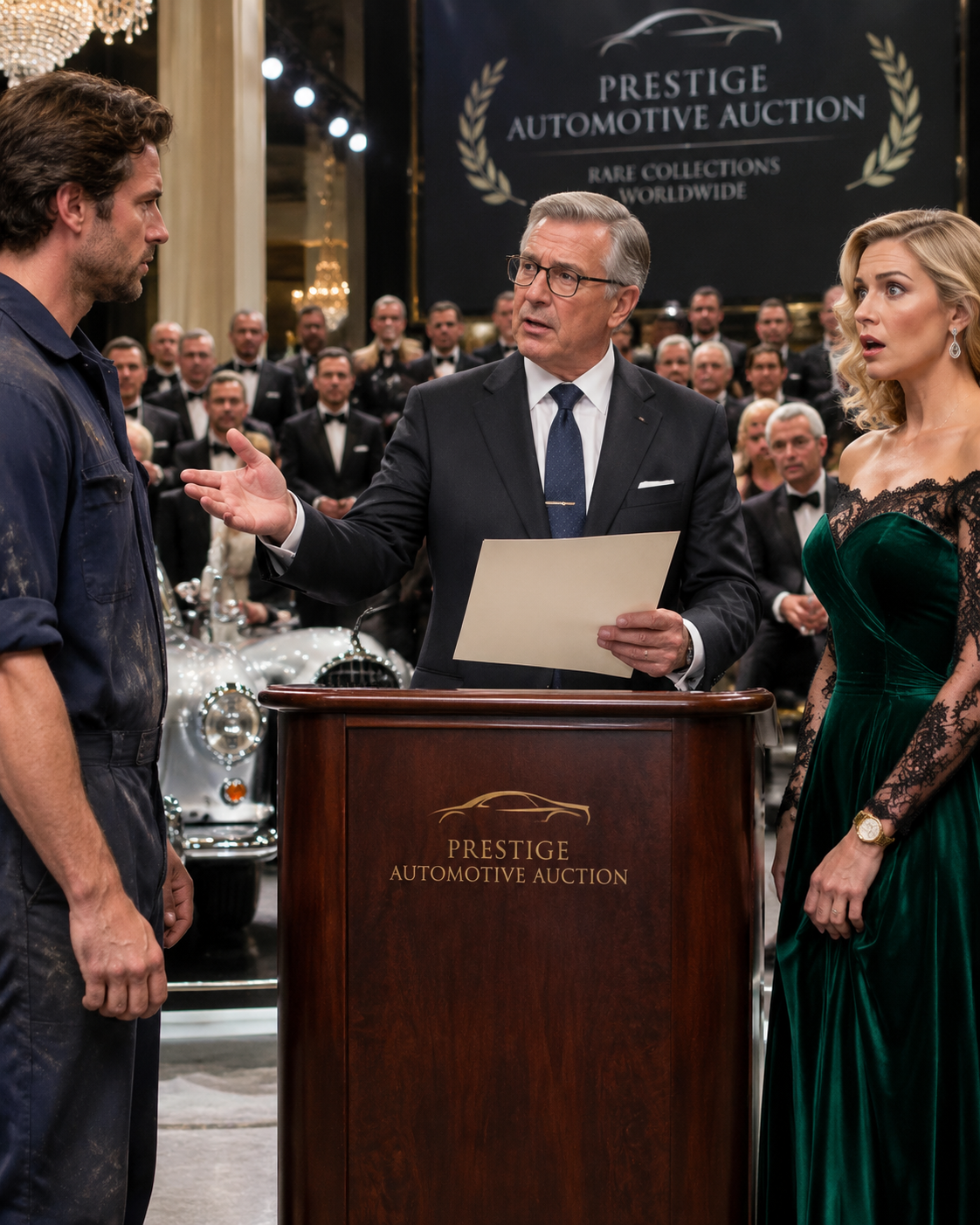
I looked toward the auction floor.
The woman in the white suit was standing near the stage, speaking with two investors. She appeared relaxed. She had already begun acting like the building belonged to her.
And maybe, if I hadn’t found that document, she would have gotten exactly what she wanted.
But there was something she didn’t know.
Neither did Claire.
Years earlier, my father had made a decision that I had never fully understood.
At the time, I thought it was just another attempt to protect a family business that was already struggling.
Now I wondered if he had been preparing for something much bigger.
I took out my phone and photographed every page.
Then I folded the document and placed it inside my jacket.
“Claire, I need to tell you something about this building.”
She looked at me.
“What?”
“My father never trusted a business deal that depended on someone’s good intentions.”
Before I could explain, a voice came from behind us.
“Put that folder down.”
The buyer was standing only a few feet away.
Her smile had disappeared.
She held out her hand.
“That’s private company property.”
I didn’t move.
“It’s a property document with the shop’s address on it. Why was it included in the car’s consignment file?”
“That’s not your concern.”
“It became my concern when I saw the plan to fire everyone who works here.”
Her expression hardened.
“You are an hourly employee. You have no authority to question my business decisions.”
Claire stepped forward.
“He has every right to ask why a property document was placed among the vehicle records.”
The buyer turned toward her.
“And who are you to tell me what I can do?”
“I’m the authentication specialist assigned to this vehicle.”
“Then authenticate the vehicle. Don’t interfere with the property transaction.”
She reached for the folder.
I pulled it away.
“Not until I have a copy.”
For a moment, nobody spoke.
Then she looked toward the two security guards standing near the entrance.
“Make sure nobody removes anything else from this building.”
The guards nodded.
She turned and walked away.
Claire waited until the woman was out of earshot.
“We need to find out what your father signed.”
I nodded.
But first, I had to finish the car.
The auction was approaching, and the vehicle was still sitting dead in the center of the restoration bay.
I returned to the engine compartment.
The damaged connector was still where I had left it. The replacement auxiliary component was also in place, and the hidden work order was folded in my pocket.
I checked the readings again.
The problem was more complicated than one loose connection.
Someone had disturbed a section of the control system, then attempted to make the failure look like a normal electrical problem.
If I simply replaced the damaged connector and started the engine, the underlying fault could remain.
I needed access to the original components.
Unfortunately, the buyer had already locked the special parts room.
I walked toward the service desk.
“Can I get access to the parts room?”
The clerk looked uncomfortable.
“Sorry. I was told not to let anyone in.”
“Even the technicians?”
“Especially the technicians.”
I glanced toward the buyer.
She was watching me from the other side of the room.
“That’s convenient,” I said.
She heard me.
“Excuse me?”
“The parts I need are in that room.”
“Then perhaps you should have checked before accepting the job.”
“I didn’t know someone had changed the parts.”
Her smile returned.
“Are you accusing my company of something?”
“I’m asking for the parts required to complete the repair.”
She stepped closer.
“Let me make this simple. You were given a chance to prove yourself. If you can’t do it, we’ll find someone else.”
I looked at the engine.
Then I looked at Claire.
She understood immediately.
“We can restore the original connector,” she said quietly.
I nodded.
The connector housing was damaged, but not beyond repair. The metal contacts could be cleaned and carefully restored. I had done similar work before, although never under this kind of pressure.
I brought my tools over.
For the next hour, I worked without looking at the audience.
I removed the damaged section, inspected the terminals, and measured each contact.
Claire recorded the part numbers and photographed the condition before and after each step.
We worked slowly.
The room was getting louder as more guests arrived.
Some watched from behind the barriers. Others whispered to one another.
The buyer occasionally glanced in our direction.
She seemed convinced that we would fail.
But I wasn’t thinking about her.
I was thinking about my father.
He used to stand beside me in this very workshop and tell me that a good mechanic never rushed a repair just because someone was watching.
“Machines don’t care how important a customer thinks he is,” he would say. “They only care whether you did the work right.”
I could almost hear him saying it again.
When the connector was ready, I tested it.
The readings were stable.
One problem solved.
But the control system still wasn’t communicating correctly.
I traced the remaining fault through the wiring diagram. The altered auxiliary component had changed the expected signal, and the control unit was responding exactly as it was designed to respond when it detected an abnormal input.
The car wasn’t refusing to start because it was broken beyond repair.
It was protecting itself.
I explained this to Claire.
She looked at the readings.
“So the person who changed the component knew the system would shut the engine down?”
“Yes.”
“Then this wasn’t careless work.”
“No.”
She glanced at the hidden work order.
“Someone wanted the car to fail.”
I nodded.
“And someone wanted me to be standing beside it when it did.”
That was the part I couldn’t stop thinking about.
The document wasn’t just an accusation.
It was evidence of a plan.
I placed the original auxiliary component back where it belonged, corrected the connection, and checked the system one more time.
The warning signal disappeared.
I took a breath.
“Claire, I think we’re ready.”
She looked toward the auction team.
“Should we tell them?”
“Not yet.”
I wanted to complete the final safety checks before anyone touched the ignition.
The buyer approached again.
“How much longer?”
“Five minutes.”
“You’ve been saying that for an hour.”
“Because I found problems that needed to be corrected.”
She looked at the engine.
“Well, I hope you know what you’re doing.”
I met her eyes.
“I do.”
She walked away.
I completed the final inspection, checked the fluid levels, and confirmed that the starting system was operating within the required range.
Then I stepped back.
Claire moved beside me.
“Ready?”
I nodded.
The moment felt strangely quiet.
The auction staff had begun gathering near the vehicle. A few collectors had stopped their conversations. Even the buyer had turned around.
I pressed the start control.
For one second, nothing happened.
Then the engine turned over.
A deep mechanical sound filled the restoration bay.
The engine caught.
It roared to life.
People stepped back in surprise.
A few applauded.
Claire smiled.
I didn’t.
I was too busy watching the readings.
The engine settled into a smooth idle. The control system remained stable. The warning lights stayed off.
I let it run through the required checks before shutting it down.
Then I removed my gloves.
The buyer stared at the car.
“How did you do that?”
I looked at her.
“I repaired it.”
She seemed unhappy with that answer.
“Who authorized the repair?”
“The auction team did.”
“Who is responsible if anything goes wrong?”
Claire stepped forward.
“We documented every stage. The original condition, the replacement component, the damaged connector, and the final test results.”
The buyer looked at her.
“You photographed everything?”
“Yes.”
“All of it?”
“Every step.”
For the first time that afternoon, the buyer looked genuinely concerned.
She turned toward the operations desk.
“Owen!”
He appeared from the hallway.
“Yes?”
“Come here.”
He walked over slowly.
She pointed at the car.
“Explain what happened.”
Owen glanced at the engine.
Then at me.
“It’s running?”
“Yes,” I answered.
He swallowed.
“That’s good.”
The buyer’s expression tightened.
“Good? That’s all you have to say?”
Owen didn’t answer.
I pulled the hidden work order from my pocket.
“Maybe you can explain this.”
His face changed immediately.
He recognized the paper.
The buyer reached for it.
“What’s that?”
“A work order,” I said. “One you approved.”
Owen looked toward the exit.
Claire moved closer.
“Don’t leave. We need to discuss the documentation.”
The buyer took the paper from my hand.
She read the first few lines.
Then she looked at Owen.
“Did you authorize this?”
He opened his mouth.
No words came out.
“Answer me.”
Owen finally spoke.
“I followed the instructions I was given.”
“Whose instructions?”
He looked at me.
I thought he might deny everything.
Instead, he lowered his voice.
“You don’t understand what happened.”
“Then explain it.”
He glanced at the security guards.
“I can’t do that here.”
The buyer folded the work order.
“This is ridiculous. The car is running. The repair is complete. I don’t want a scene.”
Claire shook her head.
“The vehicle’s condition and the records need to be reviewed before the auction proceeds.”
The buyer turned toward her.
“That is not your decision.”
“It is part of my responsibility.”
The argument continued for several minutes.
Eventually, the auction manager asked everyone to step away from the car.
I returned to the service desk and collected my notes.
But I couldn’t stop thinking about the property document.
Something about the buyer’s reaction had bothered me.
She had seemed much more frightened by that folder than by the discovery that someone had deliberately tampered with a million-dollar vehicle.
That meant the building was more important to her than the car.
I found Claire near the auction office.
“Did you get a copy of the property document?”
She nodded.
“I photographed every page.”
“Good. We need someone who can explain what it means.”
She looked at me.
“Do you have any idea?”
I hesitated.
“Maybe.”
I remembered my father’s old office.
He had kept several filing cabinets there, even after the business collapsed. Most of the documents had been moved when the ownership changed.
But there was one place he had always told me to leave alone.
A small locked cabinet behind his desk.
He used to say it contained family papers, not business records.
After he died, I never opened it.
I had assumed it was full of old photographs and personal documents.
Now I wasn’t so sure.
I told Claire.
She listened carefully.
“Can you get to it?”
“I don’t know. The office is still part of the building, but the new management controls the keys.”
“Then we need permission.”
Before we could continue, my phone rang.
It was my daughter.
“Hey, Dad.”
“Hey, sweetheart.”
“Did you fix the car?”
I looked back toward the restoration bay.
“Yes. It’s running.”
She cheered.
“I knew you could do it!”
I smiled for the first time in hours.
“Thanks.”
“Are you coming home soon?”
“I hope so.”
There was a short pause.
Then she asked, “Did you find anything about Grandpa’s shop?”
I looked at Claire.
“Maybe.”
My daughter lowered her voice.
“Mom always said Grandpa kept important papers because he didn’t trust people to keep their promises.”
I stopped walking.
My late wife had been right about many things.
She had also been the person who encouraged me to keep copies of every important document.
She used to tell me that memories were not enough when someone could change the story later.
“You’re right,” I told my daughter.
“Are you okay?”
I looked at the old workshop sign.
“I think I am.”
After the call, Claire and I returned to the office.
We found the auction manager and explained the situation.
He wasn’t happy about another delay, but he agreed to let us retrieve personal family documents from the old cabinet, provided everything was recorded.
A security guard accompanied us.
The office smelled like old paper and machine oil.
My father’s desk was still there.
So was the cabinet.
I stood in front of it for a moment.
I remembered him sitting behind that desk, reviewing invoices and drawing mechanical diagrams on scrap paper.
He had always looked older than he was during the final years of the business.
The financial collapse had taken a terrible toll on him.
We had lost control of the property, and the company had eventually been sold.
I had spent years believing there was nothing left to save.
I opened the cabinet.
Inside were envelopes, old photographs, insurance papers, and several folders tied together with string.
One folder had my name written on it.
I pulled it out.
The first document was a copy of a family trust agreement.
I read the first page.
Then the second.
My hands began to shake.
Claire noticed.
“What is it?”
I looked at the date.
My father had created the trust years before the business finally collapsed.
It contained a preservation covenant covering the restoration property.
The agreement stated that certain original features of the building and its historic restoration operations were to be protected.
If a future owner attempted to remove those features or convert the facility away from its intended purpose, specific protections could be triggered.
But the next page was even more important.
It described a priority repurchase provision.
Under certain conditions, the successor trustee would have the right to acquire the property before it could be permanently converted.
I read the paragraph again.
Then I saw the name.
Mine.
I looked at Claire.
“Can you read this?”
She took the document.
Her eyes moved across the page.
Then she looked up.
“You’re the successor trustee?”
“Apparently.”
“Did you know?”
“No.”
I pulled out the next folder.
It contained a letter from my father.
The envelope was addressed to me.
I opened it carefully.
His handwriting was familiar.
The first line made my throat tighten.
If you’re reading this, it means someone is trying to take the workshop away from the people who made it what it is.
I sat down.
Claire stepped back and gave me a moment.
I continued reading.
My father explained that the family had faced financial pressure for years. He had known that selling the business might become unavoidable.
But he had refused to let the property lose its identity.
He had worked with an attorney to establish the trust and create protections for the building.
He hadn’t expected me to need them immediately.
He had simply wanted the option to remain available.
The letter explained that the trust could preserve the original workshop and provide an opportunity for the family to reclaim ownership through an approved heritage preservation program.
There was also a grant reference.
The program offered funding to help preserve historic industrial properties and traditional skilled trades.
I looked at Claire.
“Does this mean what I think it means?”
She nodded slowly.
“It could. But the documents need to be verified, and the grant requirements need to be checked.”
I looked at the trust agreement again.
For the first time in years, I felt something other than regret when I thought about the building.
Hope.
But hope wasn’t ownership.
And I wasn’t going to make promises until I knew the documents were valid.
We contacted the attorney named in the original trust papers.
His office was still operating.
A staff member confirmed that the attorney was available for an urgent consultation.
I sent photographs of the documents.
Then we waited.
Outside, the auction was preparing to resume.
The buyer had apparently decided that the car’s successful repair was enough to continue with the event.
She was speaking to the auction manager and several investors.
Owen was nowhere to be seen.
Claire checked the time.
“We don’t have much longer.”
“I know.”
My phone rang again.
This time it was the attorney.
He had reviewed the initial documents.
“These appear to be genuine copies,” he said. “But I need to confirm the recorded covenant and the trust’s current status.”
“Can you do that today?”
“I’m already contacting the title office.”
I waited.
He continued.
“There is something else you should know. The repurchase provision may still be enforceable. But the timing matters. If the property transaction has already closed without the required notices, we may have grounds to challenge it.”
My stomach tightened.
“Has it closed?”
“I don’t know yet.”
I looked through the office window.
The buyer was standing near the auction stage, smiling again.
“Please find out,” I said.
“We will.”
The call ended.
Claire placed a hand on the folder.
“Whatever happens, at least we know your father didn’t leave this place unprotected.”
I nodded.
But I was afraid to get excited.
I had spent too many years watching things disappear.
The auction manager announced that the event would resume in ten minutes.
I returned to the floor.
The buyer saw me immediately.
“Finished playing detective?”
I didn’t answer.
She smiled at the investors.
“Some people find it difficult to accept that businesses change hands. It’s understandable, but sentimental attachment doesn’t determine ownership.”
A few people nodded.
I walked past her.
Then she called after me.
“By the way, your repair work was satisfactory. You should speak with Owen about collecting your payment.”
I turned around.
“Why Owen?”
“Because he managed the project.”
“Then he can explain why he approved the work order.”
Her smile disappeared.
The auctioneer stepped toward the microphone.
“Ladies and gentlemen, we will now continue with the scheduled proceedings.”
The buyer took her seat.
Claire stood near the authentication table.
I remained near the back of the room.
The auctioneer introduced the next item and explained the vehicle’s successful restoration.
The car was brought forward.
The bidding began.
The room became lively.
Collectors raised their paddles.
The price climbed.
I watched without much interest.
The car had been saved.
That mattered.
But the building still mattered more.
Then I saw Owen approaching the stage.
He was carrying an envelope.
The buyer noticed him and smiled.
She whispered something to him.
He nodded.
The auctioneer announced the final bid.
The room applauded.
The buyer stood and walked toward the stage.
“Before we move on,” she said, taking the microphone, “I would like to recognize the people responsible for making this sale possible.”
She gestured toward Owen.
“Owen coordinated the technical response and ensured the vehicle was ready for auction.”
I stared at her.
Claire looked furious.
The buyer continued.
“And as a token of appreciation, I have arranged a special reward.”
She took a check from the envelope.
It was made out to Owen.
She held it up for everyone to see.
A few people applauded.
Owen stepped forward.
But instead of accepting it, he looked at the check and then at the audience.
“I can’t take that.”
The buyer’s smile froze.
“What?”
“I said I can’t take it.”
The room became quiet.
She lowered the microphone.
“Don’t make this difficult.”
Owen shook his head.
“I didn’t restore that car.”
The buyer looked toward me.
“Security.”
Two guards began walking across the floor.
The auctioneer raised one hand.
“Please, let’s keep this professional.”
The buyer ignored him.
“That man has been interfering with company property all afternoon. I want him removed.”
I stood still.
Claire moved beside me.
Then the auctioneer looked down at a sealed envelope lying on his desk.
He picked it up.
“Before anyone leaves,” he said, “I have received an additional confirmation regarding the property associated with this event.”
The buyer turned toward him.
“What confirmation?”
He opened the envelope.
His expression changed as he read the first page.
Then he looked directly at me.
“Sir, I believe you should come forward.”
The guards stopped.
The buyer’s face had gone pale.
I walked toward the stage.
The auctioneer held up the document.
“According to the confirmation received by escrow, the transaction involving this property has been completed.”
The buyer took a step forward.
“That’s impossible.”
The auctioneer continued.
“The deed has been transferred to the family trust, under the management of its successor trustee.”
He looked at me.
“That would be you.”
For a moment, I couldn’t speak.
The room was completely silent.
The building my father had built, the building we had lost, the building I thought I would never see again…
It belonged to our family’s trust.
The auctioneer handed me the document.
I recognized the trust name immediately.
The attorney’s confirmation was attached.
The preservation covenant had been recorded, the required conditions had been met, and escrow had closed the transaction under the approved repurchase arrangement.
The buyer shook her head.
“That can’t be right. I had an agreement.”
The auctioneer looked at the paperwork.
“Your proposed purchase was subject to the existing property restrictions. The trust exercised its priority rights, and the transfer has been completed.”
She turned toward me.
“You can’t possibly have done this.”
I held the document carefully.
“I didn’t do it alone.”
Claire stepped forward.
“His father made sure the protections were in place.”
The buyer looked around the room.
For the first time all afternoon, she had no answer.
I looked toward the old workshop entrance.
The sign was still hanging above the doorway.
My father’s name was still on it.
And now it had a future.
But there was one more thing I needed to do.
I turned toward Owen.
He was standing near the stage, his hands empty.
“Why did you sign that work order?” I asked.
He looked down.
The room was still watching us.
He finally spoke.
“Because I was afraid.”
“Afraid of what?”
He glanced toward the buyer.
Then he looked at me.
“She told me the building was already hers. She said if I cooperated, I would keep my position after the sale.”
I waited.
He continued.
“She wanted the car to fail before the auction. She knew the engine was rare, and she knew a failed inspection would create a problem for the restoration team. She wanted someone to take responsibility.”
“Me?”
He nodded.
“Your name was already on the repair schedule. She said you would be the easiest person to blame.”
I felt a strange emptiness.
Owen and I had known each other for years.
We had worked on difficult projects together. We had shared late nights, broken tools, and countless cups of terrible coffee.
I had trusted him.
“Why didn’t you tell me?”
He looked ashamed.
“At first, I thought I could fix it before anyone noticed. Then she showed me the paperwork and told me what would happen if I spoke.”
“That doesn’t excuse what you did.”
“I know.”
He reached into his jacket.
There was another envelope.
“I kept this because I didn’t want to be the only person holding the evidence.”
He handed it to me.
Inside were copies of messages, revised work instructions, and an approval record connecting the executive office to the unauthorized changes.
Claire took photographs.
The auction manager requested that the documents be preserved for an official review.
The buyer tried to interrupt.
“These are internal business communications. You have no right to use them.”
The auctioneer looked at her.
“They are now part of an active dispute involving the property and the vehicle’s certification.”
She turned toward her assistant.
“Call the attorneys.”
But this time, nobody rushed to obey her.
The guards stepped away from me.
The auction manager asked everyone to remain calm while the documents were secured.
The buyer left the stage.
She didn’t look at me as she walked past.
I watched her disappear through the side entrance.
Then I looked at Owen.
“I don’t know if I can forgive you.”
He nodded.
“I understand.”
“But you can start by telling the truth to the investigators.”
He agreed.
That evening, I finally returned to the restoration bay.
The lights were still on.
The mechanics were cleaning their tools and preparing to leave.
Some had heard what happened.
Others were waiting for confirmation.
One of the older technicians approached me.
“Is it true?”
I held up the document.
He read the first page.
Then he looked at me.
“Does this mean we’re staying?”
I smiled.
“Yes.”
He let out a breath and shook his head.
“Your dad would be proud.”
I looked toward the office.
“I hope so.”
The next few weeks were not easy.
Owning a building and protecting it were two different things.
The trust needed legal administration. The heritage grant required a formal preservation plan. The property had outstanding maintenance needs, and the business needed a new operating structure.
I also had to decide what to do about the people involved in the attempted sabotage.
The vehicle’s records were submitted for independent review.
Claire remained involved as the authentication specialist.
The investigation confirmed that the auxiliary component had been changed without proper authorization and that the connector had been deliberately disturbed.
The work order and the additional communications helped establish the chain of responsibility.
Owen cooperated with the review.
He admitted that he had approved the work and had initially intended to let the fault remain hidden.
His cooperation did not erase his actions, but it helped uncover the full sequence of events.
The buyer’s proposed acquisition was no longer proceeding.
Her company disputed the trust’s rights, but the recorded covenant and escrow documentation supported the transfer.
The attorneys handled the legal issues.
I concentrated on the building.
The first thing I did was call a meeting with the technical staff.
I stood in the same restoration bay where my father had once gathered everyone before a difficult project.
“I know the last few weeks have been uncertain,” I began. “Some of you have worked here longer than I’ve been alive. Others came here because you wanted to learn a trade.”
Nobody spoke.
“I can’t promise that everything will be easy. We have repairs to make, bills to pay, and a lot of work ahead.”
I looked around the room.
“But I can promise that this place won’t be turned into a showroom while the people who built its reputation are pushed out the door.”
One of the younger mechanics raised his hand.
“What happens now?”
“We rebuild the business.”
A few people smiled.
“And we do it properly.”
That was the beginning.
We created a new operating plan that focused on restoration, technical training, and preservation.
The heritage grant covered part of the building’s preservation work and helped us restore several original features.
We repaired the roof, upgraded the electrical system, and reorganized the service areas.
The old sign above the entrance was cleaned and restored.
I also made a decision about the shop’s name.
It would remain exactly as my father had left it.
I didn’t want to erase his work just because I was now responsible for it.
Claire helped us establish a new authentication process.
Every vehicle received a complete inspection record. Every replacement component was documented. Every significant repair required photographs and independent verification.
We also created a rule that no executive could override a technical safety concern without written approval and a documented reason.
Some people called it excessive.
I called it necessary.
The supercar that had started the whole mess eventually passed its independent review.
Its buyer received the complete restoration records, and the sale proceeded with the vehicle’s history properly documented.
The auction house also revised its internal procedures.
For me, that mattered almost as much as the successful repair.
A rare car deserved honesty.
So did the people who worked on it.
One afternoon, several months after the auction, I was sitting in my father’s old office.
The room had been cleaned, but I had left his desk where it was.
His tools were displayed in a small cabinet.
His old mechanical drawings were framed along one wall.
My daughter came in carrying a cardboard box.
“What’s this?”
She placed it on the desk.
“Mom’s things.”
I looked at her.
“Where did you find those?”
“In the storage closet. I was looking for the old family photographs.”
I opened the box.
Inside were notebooks, envelopes, and several small folders.
My late wife had kept records of everything.
She had written down dates, conversations, and details from important family events.
I smiled when I saw her handwriting.
She had always been organized.
Sometimes I used to tease her about it.
She would just smile and say, “You’ll thank me someday.”
I opened one of the notebooks.
There were pages about the shop.
My father had apparently discussed the preservation agreement with her years earlier.
She had written down the attorney’s name, the date of the meeting, and the location of the original documents.
At the bottom of one page was a sentence that made my eyes fill.
He needs to know that losing something doesn’t mean it has to be gone forever.
I sat quietly.
My daughter moved closer.
“Is that Mom’s handwriting?”
I nodded.
She read the sentence.
Then she leaned against my shoulder.
“I think she knew you would save it.”
I shook my head.
“I don’t know about that.”
“She believed in you.”
I closed the notebook.
For a long time, I had thought my wife was simply trying to make me feel better whenever the business struggled.
Now I understood that she had been helping me preserve a history I didn’t know I would need.
She had kept the records.
My father had created the protections.
And somehow, both of them had left me the tools to continue.
The first official open house was held on a Saturday.
We invited former employees, customers, local mechanics, and families interested in learning about automotive restoration.
The building was full.
People walked through the workshop, looked at the old equipment, and listened to the technicians explain how different restoration projects worked.
A few older customers brought photographs of vehicles my father had restored decades earlier.
One man showed me a picture of his first car.
My father had worked on it when the man was still in high school.
“He charged me almost nothing,” the man said. “I didn’t have much money back then.”
I smiled.
“That sounds like him.”
“He told me that if I learned to take care of something, I wouldn’t always have to buy another one.”
I laughed.
“He used to say that to everyone.”
The man looked around the building.
“I’m glad you kept it.”
So was I.
Near the entrance, Claire was speaking with a group of visitors.
She had become an important part of the shop’s new technical program.
We were training younger mechanics to work with older vehicles, rare components, and complex restoration systems.
I approached her.
“How’s everything going?”
She smiled.
“Pretty well. The new inspection process is working.”
“Any problems?”
“Only the usual ones.”
She looked toward the engine bay.
“Although I think we need another set of diagnostic equipment.”
I laughed.
“We’ll put it on the list.”
She paused.
“Do you ever think about that day?”
“The auction?”
“Yes.”
I looked around the room.
“Sometimes.”
“What do you remember most?”
I thought about the buyer’s comments, the failed engine, the hidden work order, and the moment the auctioneer opened the sealed envelope.
But one memory stood out above the others.
“My daughter asking if I was going to let them take her grandfather’s shop.”
Claire nodded.
“That must have been difficult.”
“It was.”
I looked toward the old sign.
“But I think it was the question I needed.”
She smiled.
Then she returned to the visitors.
Later that afternoon, I stood alone in the restoration bay.
The building was quiet for the first time all day.
I walked over to the engine stand and ran my hand along its metal frame.
My father had built this place with tools, hard work, and a belief that skilled people deserved a place to do meaningful work.
Financial trouble had taken away our control.
It had taken years of confidence from me.
And after my wife died, there were days when I wasn’t sure I had enough strength to start again.
But the workshop was still standing.
The people were still here.
And the work was continuing.
My daughter appeared at the doorway.
“Dad?”
I turned.
“Yeah?”
“Can I ask you something?”
“Of course.”
“Do you think Grandpa would be happy with what you did?”
I looked at the sign.
Then at the people working in the next bay.
“Yes,” I said. “I think he would.”
She smiled.
“Mom would be happy, too.”
I nodded.
For the first time in a long while, I didn’t feel the need to argue with that thought.
I turned off the workbench light and walked toward the entrance.
The old sign above the door caught the afternoon sunlight.
It wasn’t the biggest restoration shop in the country.
It wasn’t the most expensive.
And it certainly wasn’t the most modern.
But it was ours.
Not because we had managed to hold on to every dollar, every contract, or every business decision.
Because someone had cared enough to protect what mattered.
My father had protected the building.
My wife had protected the records.
Claire had protected the truth.
And when I finally had the chance, I protected the people who had made the place worth saving.
I locked the front door and looked back one last time.
The workshop was quiet.
But it wasn’t finished.
The next morning, the lights would come on again.
The tools would be picked up.
The engines would turn.
And somewhere in that building, another young mechanic would learn what my father had taught me years earlier.
A good mechanic doesn’t abandon something just because it stops working.
He finds the problem.
He takes the time to understand it.
And if it’s worth saving, he does everything he can to bring it back to life.
That lesson had saved more than a million-dollar car.
It had saved my family’s legacy.