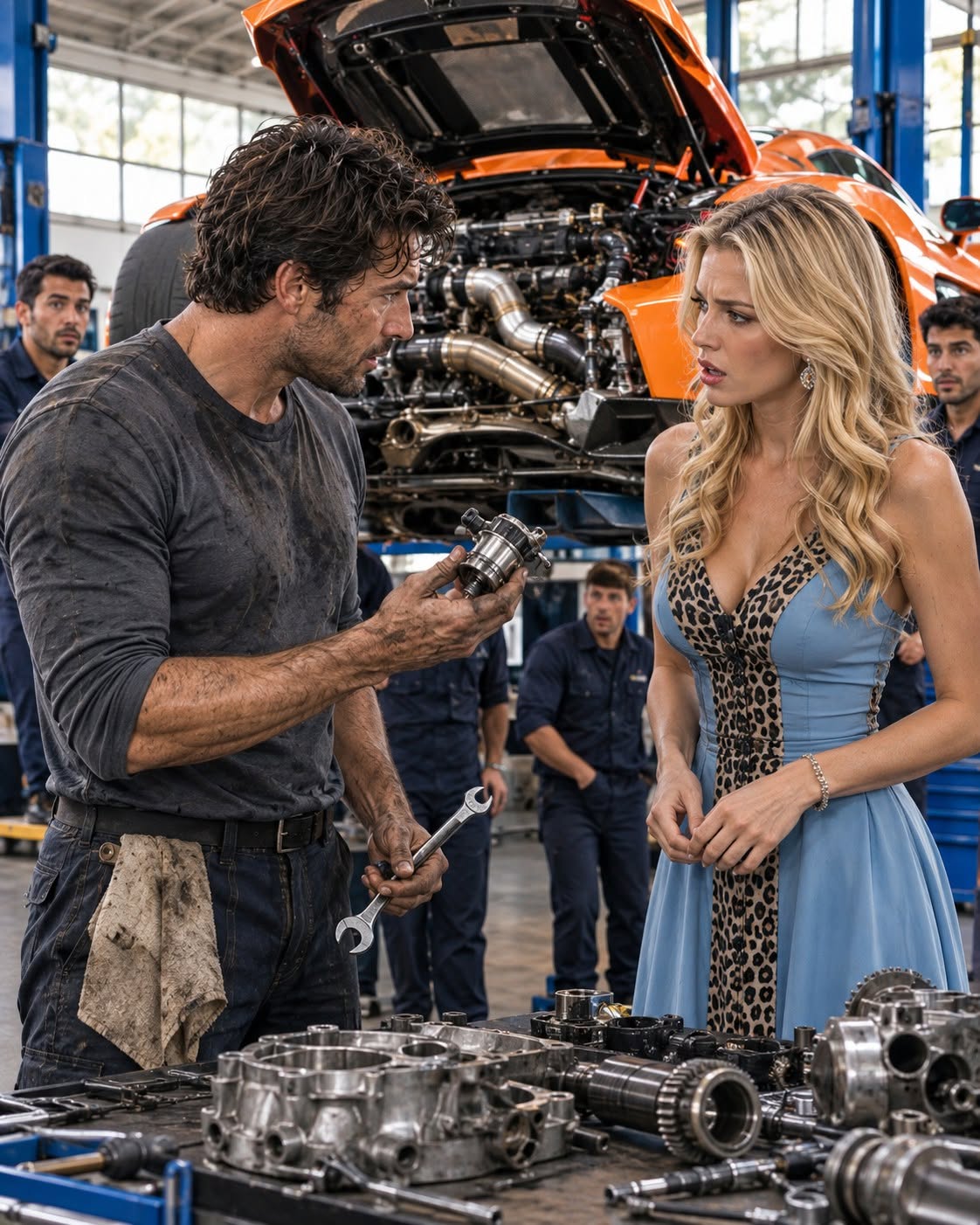
The woman laughed when I said I could fix her $3 million sports car. Three expert teams had already failed. She didn’t know who she was talking to.
THE NAME INSIDE THE FOLDER
I stared at the name printed across the top of the folder.
BLACKWOOD MOTORSPORTS.
For a moment, I couldn’t hear anything around me. The name seemed to pull me backward through time, into a world I had spent nearly a decade trying to forget.
I knew that company.
I knew its racing division, its engineering department, and the people who had once promised me the future.
Most importantly, I knew the man whose signature appeared at the bottom of the first page.
Richard Blackwood.
My former team director.
The man who had been there the night my wife died.
I slowly lifted my eyes toward the woman standing across the workbench.
“Where did you get this?” I asked.
She folded her arms.
“My father founded Blackwood Motors. He passed away four years ago. I’m Evelyn Blackwood, and I inherited the company.”
I looked down at the folder again.
Evelyn.
The name suddenly made sense. I had heard about Richard’s daughter years ago, but I had never met her. She had been studying overseas when I left the racing industry.
“What does this have to do with me?” I asked.
She pulled out a chair and sat down.
“Everything.”
She opened the folder and turned it toward me.
Inside were photographs of an unfinished prototype, engineering diagrams, financial reports, and several pages covered in handwritten notes.
I recognized the car immediately.
It was the Phoenix X1.
A revolutionary hybrid supercar project that Blackwood Motors had abandoned eight years earlier.
I had designed its original electrical architecture.
Before I left the company, I had spent almost three years developing the system. It was supposed to become the foundation of a new generation of racing vehicles.
But the project had collapsed after a series of unexplained electrical failures.
The company blamed my design.
I remembered the humiliation of that final meeting. My colleagues had stopped making eye contact. My name disappeared from the project documents. Within weeks, I had resigned.
And then my wife died.
Everything had happened so quickly that I never had the strength to fight back.
I closed the folder.
“I don’t understand. Why are you showing me this?”
Evelyn leaned forward.
“Because my father never believed the Phoenix project failed because of your engineering. He believed someone sabotaged it.”
I felt my stomach tighten.
“Someone?”
She nodded.
“Three months ago, my company acquired the damaged supercar you just repaired. It was built using the same electrical architecture as the Phoenix X1. We sent it to three engineering firms because we wanted to understand why its control system kept shutting down.”
“And?”
“They all found the same thing. The system wasn’t simply damaged. Someone had deliberately altered its communication architecture.”
I looked at the photographs again.
She continued.
“Every team told me the original design was too complicated to reconstruct. One of them even recommended replacing the entire electrical system. But I didn’t want another expensive experiment. I wanted to find the person who designed it.”
I slowly looked up.
“Your father knew where I was?”
“Yes.”
Her answer came so quietly that it frightened me more than a loud accusation would have.
I gripped the edge of the workbench.
“Then why didn’t he contact me?”
Evelyn looked down.
“Because he was afraid.”
I laughed bitterly.
“Afraid of what?”
“Afraid you would discover what he had been hiding.”
She removed another document from the folder.
It was an internal company report dated eight years earlier.
At the bottom was a list of names.
My name appeared first.
Below it was the name of Daniel Mercer, the former chief electrical engineer.
I remembered Daniel well.
He had been my closest colleague at Blackwood Motors. We had worked late nights together, argued over circuit designs, and celebrated when the first Phoenix prototype finally completed its initial tests.
He had also been the person who testified against me when the project failed.
I read his name twice.
“Daniel is still with the company?”
Evelyn nodded.
“He’s now the chief technology officer.”
I pushed the folder away.
“Then you should be talking to him, not me.”
“That’s exactly what I did.”
She paused.
“He told me your original design was fundamentally flawed. He said you were brilliant but emotionally unstable after your wife’s death. He also warned me that bringing you back could damage the company’s reputation.”
I felt a familiar bitterness rise inside my chest.
Eight years.
I had spent eight years believing I had left that world behind.
Yet the same people were still deciding what my name meant.
Evelyn stood.
“I know this is a lot to ask. But I need you to look at something.”
She placed a small black device on the workbench.
It was a damaged control module removed from the Phoenix X1.
“Can you tell me whether this was deliberately modified?”
I examined the casing.
The damage was obvious, but something beneath it caught my attention.
A tiny mark had been engraved beside the connector.
Three short lines forming a triangle.
My fingers went cold.
I had used that symbol in the earliest Phoenix prototypes.
It was my private engineering mark, something I added to distinguish my experimental components from production parts.
Nobody outside my original development team should have known about it.
I turned the module over.
“Where did you find this?”
“Inside the wrecked car.”
I stared at the device for several seconds.
Then I looked at Evelyn.
“I’ll need access to the original engineering files.”
She nodded.
“Whatever you need.”
“And I want to know who had access to this module.”
“I can arrange that.”
I closed the folder.
“But there’s one condition.”
She waited.
“I don’t want my daughter dragged into this. Whatever happened eight years ago, she has nothing to do with it.”
For the first time that evening, Evelyn smiled.
“I have a six-year-old daughter too. I understand.”
I glanced at her.
“You have a child?”
“A son. His name is Noah. He’s seven.”
Something about the way she said his name softened her expression.
“Then you understand why I can’t afford to make mistakes.”
She nodded.
“More than you know.”
That night, I went home later than usual.
My daughter, Lily, was already asleep.
I stood in the doorway of her bedroom, watching her breathe beneath a pink blanket. Her schoolbooks were scattered across the small desk, and a drawing of three people holding hands was taped to the wall.
Me.
Her.
And her mother.
I walked over and gently moved a strand of hair away from her face.
For years, I had convinced myself that leaving engineering had been the right decision.
I had given up the racing world to give Lily a stable childhood. I had traded expensive laboratories for a modest garage, international competitions for school pickups, and professional recognition for quiet evenings helping with homework.
I had never regretted choosing her.
But perhaps I had mistaken abandoning my past for protecting our future.
The next morning, I returned to Blackwood Motors.
The headquarters was a towering glass building overlooking the city. Nothing about it had changed. The same polished floors, the same expensive artwork, and the same atmosphere of people pretending they weren’t afraid of losing their positions.
Evelyn met me at the entrance.
She took me to a private laboratory on the fourth floor.
A dozen engineers were already waiting.
Some looked curious.
Others looked confused.
One man stood near the main workstation with his hands in his pockets.
Daniel Mercer.
His hair had turned gray at the temples, but his expression was exactly as I remembered.
When he saw me, his eyebrows lifted.
“Well, I’ll be damned.”
I said nothing.
He walked toward me with a smile that didn’t reach his eyes.
“I heard you were working in a garage these days.”
“I am.”
“Quite a change from the old days.”
“People change.”
Daniel chuckled.
“Apparently.”
Evelyn stepped between us.
“We’re here to examine the Phoenix control module. I’d like everyone to cooperate.”
Daniel glanced at the device.
“There’s no point wasting time. The architecture is obsolete.”
I picked up the module.
“Then examining it shouldn’t take long.”
A few engineers exchanged uncomfortable looks.
I connected the device to the diagnostic system.
Within minutes, lines of code appeared across the monitor.
At first, everything seemed normal.
Then I noticed a sequence of repeated commands.
My pulse quickened.
I zoomed in.
There it was.
A secondary signal was entering the system through a hidden maintenance channel. It was sending contradictory instructions to the power management controller, forcing the car’s safety systems into repeated shutdown cycles.
I recognized the structure.
It was based on my original design, but the command sequence had been modified.
Someone had inserted a deliberate failure into the system.
“Whoever wrote this understood the Phoenix architecture,” I said.
Daniel crossed his arms.
“Or perhaps your architecture was so poorly designed that anyone could exploit it.”
I ignored him.
I traced the command sequence backward.
The signal had been routed through an internal diagnostic account.
A privileged account that should have been disabled after the prototype testing phase.
I opened the access log.
The room became quiet.
One username appeared repeatedly.
D.MERCER.
I slowly turned toward Daniel.
He didn’t move.
“That’s an old account,” he said.
“Then why was it used to modify the system last month?”
His expression hardened.
Evelyn stepped closer to the monitor.
“Daniel, would you like to explain?”
He looked at the screen, then at me.
“Anyone could have used my credentials.”
“That’s possible,” I replied. “But there’s something else.”
I opened the next file.
A hidden authorization record appeared.
It showed that the altered software had been approved using a digital signature linked to Daniel’s personal security key.
Nobody spoke.
Daniel suddenly laughed.
“This is ridiculous. You’re going to accuse me based on a computer log?”
“No,” I said calmly. “I’m going to prove what happened.”
I returned to the diagnostic system.
The modified command sequence contained a small error that most engineers would have overlooked. The same error appeared in an old internal test file.
A file I had created eight years earlier.
But there was a difference.
The original file had never contained the dangerous command.
Someone had copied my code, changed three instructions, and inserted a false timestamp to make it appear that the modification came from my workstation.
I looked at Evelyn.
“Your father was right. Someone framed me.”
Daniel’s face changed.
Only for a second.
But I saw it.
Evelyn saw it too.
She asked everyone to leave the laboratory except the three of us.
When the door closed, Daniel’s polite expression disappeared.
“You have no idea what you’re doing,” he said.
“Then explain it to me.”
He looked at Evelyn.
“Your father knew the Phoenix project was failing. He wanted to shut it down. He was going to sell the entire engineering division.”
Evelyn frowned.
“That’s not what the records say.”
“Your father was not a saint.”
“I never said he was.”
Daniel paced around the workstation.
“Do you know what that project cost? Millions. Investors were threatening to pull out. The company was drowning. We needed a successful demonstration, and your design wasn’t ready.”
I shook my head.
“The original system worked.”
“Not well enough.”
“So you altered it?”
Daniel stopped.
For several seconds, he stared at me.
Then he said something I had never expected to hear.
“I was trying to save the company.”
I felt something inside me go cold.
“You destroyed my career to save the company?”
“I needed someone to take responsibility. You were already talking about leaving. Your wife was sick, and you weren’t around enough to manage the project. It was convenient.”
I stepped toward him.
“My wife had nothing to do with your decisions.”
“I know.”
Those two words were enough.
He knew exactly what he had done.
Evelyn’s face had gone pale.
“You let me spend millions trying to repair a car you knew had been sabotaged?”
Daniel turned toward her.
“I was protecting the company.”
“No,” she said. “You were protecting yourself.”
He reached for the folder on the workbench.
Evelyn stepped back.
“Don’t touch that.”
Daniel looked between us, then walked toward the door.
“You’ll regret this.”
The door closed behind him.
For a moment, neither of us moved.
Then Evelyn sat down.
“My father suspected him,” she whispered. “But he never had enough evidence.”
I looked at the monitor.
“Why didn’t he tell me?”
She took a deep breath.
“Because he knew the damage he’d caused by letting you take the blame. He wanted to find a way to make things right before he died.”
She opened the folder again and removed a sealed envelope.
“My father left this for you.”
My name was written across the front.
I recognized his handwriting immediately.
My hands trembled as I opened it.
The letter was short.
You were the best engineer I ever worked with. I knew your design was sound, but I allowed fear to make me silent. I told myself that protecting the company was more important than protecting the truth. I was wrong.
You lost your career because I failed to stand beside you. I cannot return those years, and I cannot ask you to forgive me.
But if there is still a chance for you to build something meaningful, I hope you will take it.
Richard.
I read the letter twice.
Then I folded it carefully.
I didn’t cry.
Perhaps I had already cried enough during the years when nobody believed me.
Evelyn stood beside me.
“I want to offer you a position.”
I looked at her.
“What kind?”
“Director of Advanced Vehicle Engineering.”
I almost laughed.
“That’s a big title.”
“It’s an important job.”
“I have a daughter. I can’t travel constantly or spend every night in a laboratory.”
“Then we build the position around the work, not the other way around.”
I shook my head.
“You don’t understand. I’m not the man I was eight years ago.”
Evelyn looked directly at me.
“That’s exactly why I want you.”
She explained that Blackwood Motors was preparing to launch a new electric racing division. The company had already invested heavily in a vehicle called the Phoenix Revival.
They needed someone who understood the original system and could redesign it safely.
But there was another problem.
The company’s largest investor had given Evelyn thirty days to demonstrate a working prototype. If she failed, the investor planned to withdraw funding and sell the engineering division.
Daniel had known about the deadline.
He had been manipulating the project to ensure that it failed.
Now that he had been exposed, Evelyn needed someone capable of taking control.
I looked at the Phoenix drawings.
Then at the letter.
Finally, I thought about Lily.
“I’ll consider it,” I said.
Evelyn smiled.
“That’s all I can ask.”
I went home that evening and told Lily about my day.
She was sitting at the kitchen table, coloring a picture of a red sports car.
When I finished explaining, she looked up.
“Does that mean you’ll make cars again?”
“Maybe.”
“Will you be happy?”
The question caught me off guard.
I sat beside her.
“I think I might be.”
She considered this for a moment.
“Then you should do it, Daddy.”
I smiled.
“But I still need to pick you up from school.”
She shrugged.
“That’s okay. You can build cars during the day, and then you can help me with my homework.”
I pulled her into a hug.
“Deal.”
The following Monday, I accepted the position.
My first decision was to change the way the engineering team worked.
I didn’t want a laboratory full of brilliant people afraid to admit mistakes. I wanted people who could question assumptions, challenge designs, and speak honestly when something wasn’t working.
I also insisted that the company create a small scholarship program for young engineers from ordinary backgrounds.
Evelyn approved it immediately.
Then the real work began.
The Phoenix Revival was unlike anything I had built before.
Its power system combined an advanced electric drivetrain with a compact hybrid energy unit. The challenge wasn’t simply making it fast. It had to remain stable under extreme temperature changes, high electrical loads, and the vibrations of racing conditions.
For the first two weeks, everything seemed to go wrong.
A battery management unit overheated during testing.
The regenerative braking system produced inconsistent signals.
A cooling valve failed during a high-speed simulation.
One afternoon, the prototype shut down completely.
A young engineer named Marcus threw his notebook onto the table.
“We’re never going to finish this.”
Nobody answered.
I looked at the failed test report.
Then I looked at the team.
“Do you know what the biggest mistake I ever made was?”
They turned toward me.
“Believing that being a good engineer meant never being wrong.”
I picked up the notebook.
“We’re going to find the problem. And when we find it, we’re going to learn from it.”
We worked late that evening.
By midnight, we had discovered that the cooling system was responding to outdated temperature data. The problem wasn’t in the valve itself. It was in the communication timing between two controllers.
We corrected it.
The next morning, the system passed its first complete stress test.
For the first time, the team celebrated together.
I found myself smiling in a way I hadn’t in years.
But our progress attracted unwanted attention.
Three days later, I received an anonymous email.
There was no greeting.
No signature.
Just one sentence.
You should have stayed in your garage.
Attached was a photograph of Lily outside her school.
My blood turned cold.
I immediately called the school and asked them to keep her inside until I arrived.
When I reached the building, I found her sitting in the principal’s office, holding her backpack.
She looked frightened.
“Daddy, did I do something wrong?”
I knelt in front of her.
“No, sweetheart. You did nothing wrong.”
I hugged her tightly.
That evening, I showed Evelyn the photograph.
Her expression hardened.
“Daniel?”
“I don’t know.”
She immediately contacted the company’s security department and reported the incident to the police.
An investigation revealed that someone had accessed restricted company files using an account belonging to Daniel’s former assistant.
The security team also discovered that several prototype documents had been copied and sent to an external engineering firm.
Someone was trying to steal our work.
The next morning, Evelyn called an emergency board meeting.
Daniel was placed under investigation, his access credentials were revoked, and the company formally reported the suspected sabotage and unauthorized data transfer.
But the situation became worse when we discovered that the rival engineering firm was preparing to unveil a competing vehicle using almost identical technology.
Our investor demanded an explanation.
He gave Evelyn forty-eight hours to prove that our prototype was genuinely operational.
If she couldn’t, the funding agreement would be terminated.
Evelyn came to my office that afternoon.
“They’re forcing us into a public demonstration.”
I looked at the calendar.
“How long do we have?”
“Two days.”
I leaned back.
“Then we’d better make sure the car is ready.”
She studied me.
“Are you sure?”
I looked at the Phoenix Revival through the glass wall.
“No. But I know how to prepare.”
The next forty-eight hours were the hardest of my career.
We ran simulation after simulation.
We checked every connection, every sensor, every safety protocol.
I personally inspected the electrical architecture from beginning to end.
On the second night, just as we were preparing for the final test, the main power controller failed.
A warning flashed across the diagnostic screen.
The entire laboratory went silent.
Marcus stared at the reading.
“That’s impossible. We replaced that unit yesterday.”
I approached the workstation.
The failure pattern looked familiar.
Too familiar.
I opened the controller logs and compared them with the original design.
There was an unauthorized instruction embedded in the startup sequence.
Someone had inserted a command that would disable the controller under maximum load.
I looked at Marcus.
“Who had access to the system?”
“Only our authorized engineering team.”
“Then we have a problem.”
We traced the modification to a maintenance terminal that had been left active during a software update.
The security team isolated the terminal and preserved the logs.
The evidence pointed to an outside access attempt using credentials linked to Daniel’s former assistant.
The police were already investigating.
I could have replaced the controller and rushed the demonstration.
But that would have been reckless.
Instead, I redesigned the startup verification process and added an independent safety layer. It took almost eight hours.
When the system finally passed its checks, the sun was rising.
I went to the restroom, washed my face, and looked at myself in the mirror.
My eyes were red.
My hands were trembling.
For a moment, I saw the younger engineer I had once been.
Then I remembered the man who had spent years working quietly so his daughter could have a better life.
I wasn’t trying to reclaim my old identity anymore.
I was building a new one.
At nine in the morning, the demonstration began.
The investor, several board members, and representatives from the automotive industry gathered around the testing track.
Evelyn stood beside me.
She looked nervous.
“Whatever happens,” she said, “thank you for trying.”
I nodded.
Then I noticed someone standing near the back of the crowd.
Daniel.
He had been permitted to attend under the company’s investigation procedures, but he looked uncomfortable.
Our eyes met.
He gave me a faint, almost mocking smile.
I turned away.
The Phoenix Revival rolled onto the track.
Its dark metallic body reflected the morning sunlight.
A technician entered the cockpit.
The engine started.
A low electronic hum spread across the track.
The car moved forward.
At first, slowly.
Then faster.
The driver completed the first lap without incident.
On the second lap, the vehicle accelerated through the straightaway.
The energy recovery system engaged perfectly.
The temperature remained stable.
The car crossed the finish line.
The engineers applauded.
But I wasn’t celebrating yet.
I watched the diagnostic screen.
Everything was normal.
Then the car began its third lap.
Suddenly, a red warning flashed.
The main controller detected an unexpected signal.
The driver immediately slowed down.
The car entered safety mode and stopped at the designated section of the track.
The crowd murmured.
Evelyn looked at me.
“What happened?”
I studied the display.
For several seconds, I couldn’t understand it.
Then I noticed something.
The warning wasn’t coming from the power system.
It was coming from the external telemetry connection.
Someone was attempting to inject a command into the car while it was running.
I grabbed the microphone.
“Driver, stay in safety mode. Do not restart the vehicle.”
I turned toward the security team.
“Disconnect the external telemetry network. Now.”
The connection was severed.
The warning disappeared.
The car remained stable.
The investor stepped forward.
“Are you telling me someone interfered with the demonstration?”
I looked at Evelyn.
She nodded.
The security team had preserved the incoming signal.
It contained the same unauthorized command pattern found in the earlier sabotage attempts.
This time, however, the attack had been captured in real time.
The investigation had finally found something it could trace.
Daniel suddenly started moving toward the exit.
Two security officers approached him.
“Mr. Mercer, we need you to remain here.”
He turned angrily.
“Get out of my way.”
Evelyn stepped forward.
“Daniel, don’t make this worse.”
He looked at her with a mixture of anger and disbelief.
“You think you can run this company without me?”
“No,” she replied. “I think I can run it without someone destroying it.”
The officers escorted him away for questioning.
The demonstration was paused while the vehicle underwent a complete inspection.
For another hour, the crowd waited.
I stood beside the Phoenix Revival, listening to the technicians report each safety check.
Finally, Marcus approached me.
“Everything is clear. The vehicle is safe.”
I nodded.
“Let’s finish what we started.”
The car returned to the track.
This time, the telemetry connection remained isolated, and every critical control system operated independently.
The driver accelerated.
One lap.
Two laps.
Three laps.
Four laps.
The Phoenix Revival completed the full demonstration without another fault.
When it returned to the pit lane, the crowd erupted into applause.
Evelyn closed her eyes and exhaled.
The investor approached us.
He shook my hand.
“I’ve seen many engineers promise results. Very few know how to handle a failure without making it worse.”
I smiled faintly.
“Sometimes the most important part of engineering is knowing when to stop and investigate.”
He nodded.
Then he turned to Evelyn.
“Your funding remains in place. And I want this project moving forward.”
For the first time in months, Evelyn looked genuinely relieved.
But the biggest surprise came several weeks later.
The police investigation uncovered evidence that Daniel had deliberately sabotaged the original Phoenix project eight years earlier. He had falsified engineering reports, manipulated diagnostic records, and used my absence during my wife’s illness to make it appear that I had neglected my responsibilities.
He had also attempted to steal the new vehicle’s intellectual property and sell it to a competitor.
The evidence was enough for the company to terminate his employment and pursue legal action. The criminal investigation continued, and several other employees were questioned about their involvement.
Blackwood Motors publicly corrected its old engineering records.
My name was officially cleared.
The company issued a statement acknowledging that I had been wrongly blamed for the Phoenix project’s original failure.
I received several calls from former colleagues.
Some apologized.
Others simply said they had always known I was innocent.
I listened politely.
But I didn’t feel the triumph I had imagined during all those years.
Because an apology couldn’t give me back the nights I had spent wondering whether I had failed my family.
It couldn’t restore the opportunities I had lost.
And it certainly couldn’t bring my wife back.
What it could do was allow me to stop carrying a burden that had never belonged to me.
Three months after the demonstration, the Phoenix Revival was officially unveiled at an international automotive exhibition.
The car stood beneath a spotlight, surrounded by photographers and journalists.
Evelyn invited me to stand beside her onstage.
I hesitated.
“I don’t need to be in front of the cameras.”
She smiled.
“You designed the system. You earned the right to stand here.”
I looked toward the crowd.
Then I noticed a familiar little face near the front.
Lily.
She was holding a handmade sign.
It read:
THAT’S MY DADDY! HE FIXES EVERYTHING!
I laughed.
For the first time in a long while, I didn’t care who was watching.
After the presentation, I carried her around the exhibition hall.
She pointed at the Phoenix Revival.
“Is that the car you fixed?”
“It’s the car we built.”
“Can I sit inside?”
I looked at the safety attendant.
He smiled and opened the door.
I lifted Lily into the passenger seat.
She placed both hands on the steering wheel and stared at the dashboard.
“Wow.”
“Do you like it?”
She nodded enthusiastically.
“Can we make one for Mom?”
The question came unexpectedly.
My smile softened.
I sat beside her.
“Maybe one day we’ll build something special in her memory.”
Lily looked at the photograph of her mother that I kept in my wallet.
“She would be proud of you.”
I swallowed.
“I hope so, sweetheart.”
She reached over and held my hand.
“She would.”
That evening, after the exhibition, Evelyn invited us to dinner.
Her son Noah was there too.
The children quickly became friends, arguing over which car was faster and laughing about who would become a racing driver.
At one point, Noah asked me if I could teach him how engines worked.
I smiled.
“Of course.”
Lily immediately protested.
“Me too! I want to learn first!”
Evelyn laughed.
“Looks like you’ve got two students.”
I looked at the children.
Then I looked at the woman who had unknowingly opened a door I had spent eight years trying to close.
“Maybe I should start a little engineering class.”
Evelyn put down her glass.
“Actually, that gives me an idea.”
She told me that the company had recently acquired an unused training facility. She wanted to turn it into an engineering academy for young people who couldn’t afford expensive technical schools.
The academy would offer scholarships, practical training, and mentorship from experienced engineers.
She wanted me to lead it.
I looked at her.
“Why me?”
“Because you’ve learned something most people in this industry never understand.”
“What’s that?”
“Talent doesn’t always come from the people who can afford the best opportunities. Sometimes it comes from the people nobody bothers to notice.”
I thought about the years I had spent in my garage.
The customers who had looked past me.
The colleagues who had dismissed me.
The young mechanics who worked hard but rarely received the chance to prove themselves.
I knew exactly what she meant.
I accepted.
Six months later, the Blackwood Technical Academy opened its doors.
The first class had twenty students.
Some were recent graduates.
Others were young mechanics who had spent years working in small repair shops.
One student was a seventeen-year-old boy who had traveled three hours by bus because he wanted to learn about electric vehicle systems.
Another was a young woman whose family had told her that engineering wasn’t a suitable career for her.
I welcomed every one of them.
On the first day, I stood in front of the class and wrote three words on the board.
NEVER STOP LEARNING.
Then I turned toward them.
“Some of you are here because you love cars. Some of you are here because you want a better future. And some of you might still be wondering whether you’re good enough to belong here.”
I paused.
“Let me tell you something. Eight years ago, I was one of the most promising engineers in professional racing. Then I lost my wife, left my career, and spent years working in a garage. People looked at my uniform and assumed they knew everything about me.”
The students listened quietly.
“They were wrong. But I was wrong too. I thought my value depended on the title printed on my business card. It doesn’t.”
I picked up a marker.
“Your skills matter. Your character matters. And what you do when nobody is watching matters more than you think.”
I wrote another sentence beneath the first.
YOUR PAST DOES NOT HAVE TO DECIDE YOUR FUTURE.
Then I smiled.
“All right. Let’s build something.”
The students began working.
And for the first time in years, I felt that familiar excitement of discovering something new.
Not because I was chasing a championship.
Not because I wanted to prove Daniel wrong.
But because I was helping someone else discover what they were capable of.
A year later, the Phoenix Revival won its first major endurance competition.
The victory brought Blackwood Motors international recognition, but the most meaningful moment happened after the race.
A young mechanic from our academy approached me.
His name was Ethan.
He had been one of the quietest students in the first class, often staying behind to ask questions about complicated electrical systems.
Now he was part of the race engineering crew.
He handed me a photograph.
It showed the Phoenix Revival crossing the finish line.
On the back, he had written:
Thank you for giving someone like me a chance.
I folded the photograph carefully and placed it inside my jacket.
That evening, I returned home to find Lily waiting at the door.
She was seven now.
Her hair was longer, and she had developed the habit of asking a hundred questions before breakfast.
“Daddy!”
She ran toward me.
I lifted her into my arms.
“How was school?”
“Good! I got the highest score in science.”
“Really?”
She nodded proudly.
“And I told my teacher I want to be an engineer.”
I smiled.
“That’s wonderful.”
She looked at me seriously.
“Do you think I can be one?”
I kissed her forehead.
“I think you can become anything you work hard to become.”
She wrapped her arms around my neck.
“Then when I’m older, I’ll help you build cars.”
I laughed.
“I’ll be waiting.”
Later that night, after she had gone to bed, I sat alone in the garage.
My old grease-covered uniform still hung on a hook near the door.
I had kept it.
Not because I missed those days, but because it reminded me of something important.
The day Evelyn first saw me, she had looked at my uniform and assumed I was an ordinary mechanic.
She hadn’t known about my engineering career.
She hadn’t known about the racing championships.
She hadn’t known about the years of sacrifice, the sleepless nights, or the promise I had made to my wife.
But perhaps she didn’t need to know any of that.
Because the man standing in front of her that night was already enough.
He was a father who had kept his promise.
A mechanic who had never stopped learning.
And an engineer who had finally found a reason to build again.
I took my wife’s photograph from the toolbox.
For a long moment, I simply looked at her smile.
“I think we’re doing all right,” I whispered.
Then I placed the photograph beside Lily’s latest drawing.
Three people holding hands.
The same drawing she had made years earlier.
Only this time, there was a small red racing car beside us.
I turned off the garage lights and walked upstairs.
Tomorrow, there would be new problems to solve, new students to teach, and new challenges waiting.
But I wasn’t afraid of them anymore.
Because I had finally understood something that eight years of silence had taught me.
Sometimes life doesn’t take away your purpose. Sometimes it takes away the life you thought you were supposed to have so you can discover the purpose you never knew you needed.
And sometimes, the person everyone overlooks is the very person who can make the impossible happen.
Not because he needs to prove he’s better than anyone else.
But because he never forgot who he was, even when the world did.
And if there was one thing I wanted Lily to remember when she grew up, it was this:
Never judge a person’s worth by the clothes they wear, the job they do, or the place where you find them. You never know what battles they’ve survived, what dreams they’ve sacrificed, or what extraordinary things they’re still capable of achieving.
That night, I finally slept peacefully.
For the first time in eight years, I wasn’t looking backward.
I was looking forward.