The waiter had already cleared my place setting when my father raised his glass and announced, with a proud smile
The total at the bottom of the photograph was $2,812.46.
I stared at it in the parking garage beneath the hotel until the screen dimmed.
Then I laughed.
Not because it was funny.
Because if I didn’t laugh, I was afraid I would finally say everything I had been swallowing for years.
I drove home separately from my parents. Nathan was already there when I arrived, pacing through the living room with his jacket still on.
“You embarrassed me.”
I put my keys on the counter.
“I wasn’t invited to sit down.”
“That doesn’t mean you take my gift away.”
“You’ll get it tomorrow.”
“Tomorrow?”
He laughed bitterly.
“You’re unbelievable.”
Mom came out of the kitchen carrying a glass of water for him.
Not for me.
She handed it to Nathan.
“Sweetheart, sit down.”
He did.
Dad walked in behind her.
He didn’t look at me.
“Fourteen hundred,” he said.
I blinked.
“What?”
“Half the dinner.”
“You’re joking.”
“You caused the disruption.”
“I didn’t choose the seating chart.”
“You made a scene.”
“I redirected a computer I bought with my own money.”
Dad’s jaw tightened.
“You’ve always been selfish when you don’t get your way.”
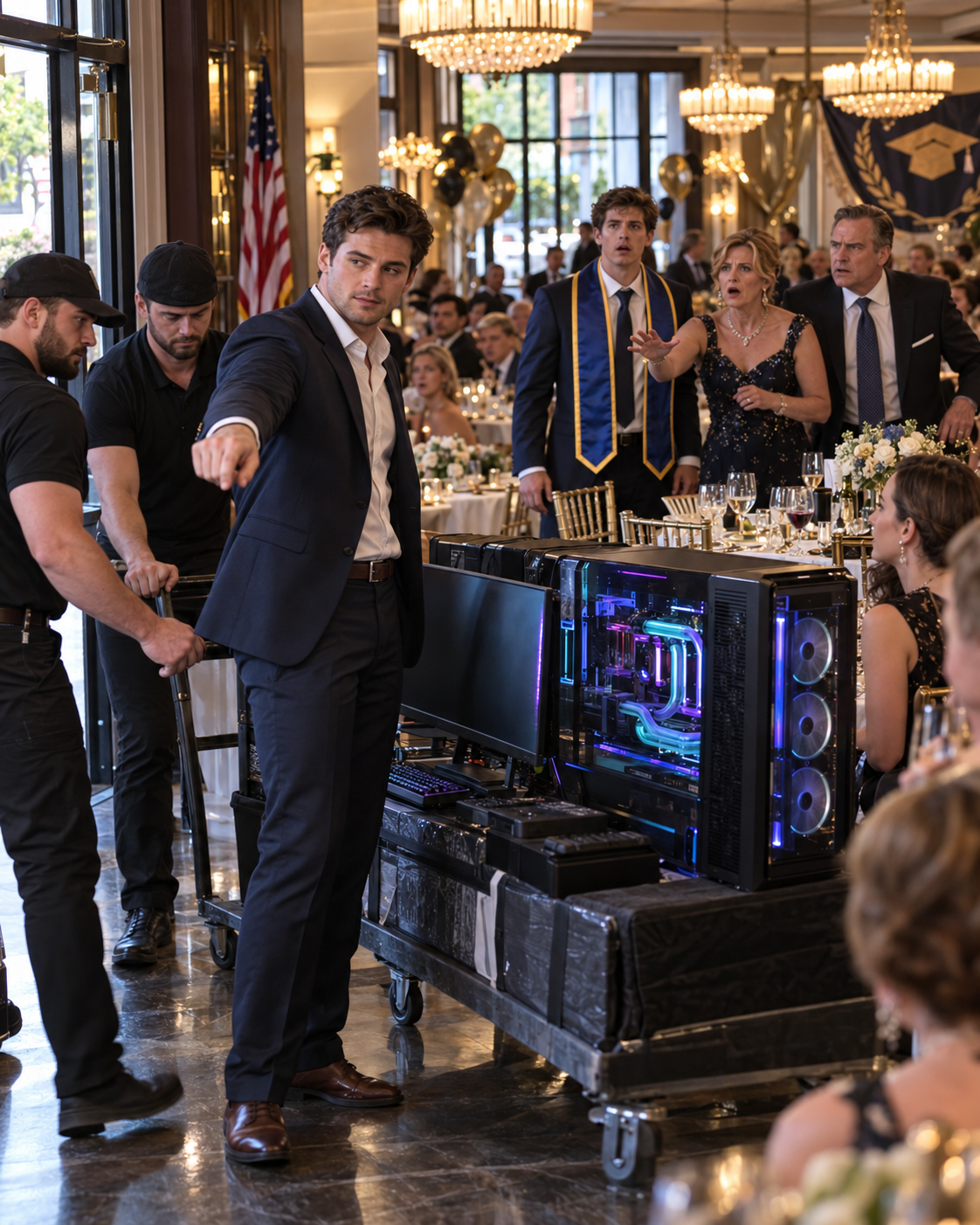
That sentence hit differently than the others.
Maybe because I had spent so many years trying to prove the opposite.
I had paid rent while living in their house.
I had covered my own tuition shortfall.
I had lent Nathan money twice and never asked for it back.
I had driven Mom to medical appointments, picked Dad up from the airport, handled paperwork, ordered birthday gifts, and once spent an entire Saturday repairing the broken fence because Dad said he was too busy.
Selfish.
I looked at my mother.
“Do you really think I owe you fourteen hundred dollars?”
She hesitated.
That hesitation hurt more than Dad’s accusation.
“I think,” she said carefully, “that you should help your brother celebrate.”
“Nathan is twenty-two.”
“He’s your brother.”
“So am I.”
Nobody answered.
That night, I sat on the edge of my bed and opened my banking app.
Eight hundred dollars.
Every month.
I stared at the transfer history.
Then I opened a spreadsheet I’d made years earlier to track expenses.
Rent to parents.
Utilities.
Groceries.
Nathan’s loan.
Family dinners.
Holiday travel.
Repairs.
I scrolled until I reached a number I had never totaled before.
Thirty-one thousand, four hundred and sixty dollars.
That was how much I had given my family in four years beyond my ordinary share of household expenses.
I sat there for a long time.
Then I closed the spreadsheet.
The next morning, Dad knocked on my bedroom door.
He didn’t apologize.
He didn’t mention the dinner.
He said, “Give Nathan your car.”
I actually thought I had misheard him.
“My car?”
“He needs it.”
“My car is paid off.”
“Exactly.”
I stared at him.
“You want me to give him my car?”
“It’s a family resource.”
I laughed once.
“Then Nathan can buy it.”
Dad’s face hardened.
“You know he’s trying to get started.”
“So am I.”
“You have a good job.”
“So does Nathan.”
“He needs more help.”
“And I need my car.”
That was when the conversation stopped being about a vehicle.
It became about permission.
My father had spent years believing my willingness to sacrifice was an unlimited family resource.
Now he was discovering there was a limit.
“You’re leaving,” he said.
I thought he meant the room.
He pointed toward the hallway.
“No. You’re leaving this house.”
Mom appeared behind him.
“Please don’t do this.”
I looked at her.
“Do what?”
“Make everything final.”
I almost asked her when it had ever been temporary for me.
Instead, I went upstairs.
I packed two suitcases.
Not boxes.
Not sentimental keepsakes.
Just clothes, my laptop, toiletries, climbing shoes I’d barely used, and the framed photograph of Nathan and me when we were kids.
I left the photograph on the dresser.
That was harder than leaving the house.
My friend Maya let me take the second bedroom in her apartment for three weeks while I found a place.
Eventually I rented a small one-bedroom on the fourth floor of a brick building near the river.
The kitchen was narrow.
The bedroom barely fit my queen mattress.
The radiator clanged at night.
I loved it.
Nobody knocked on my door asking for money.
Nobody compared me to my brother.
Nobody treated competence as permission.
For the first time, I began learning what peace sounded like.
It sounded like coffee brewing before sunrise.
It sounded like my climbing shoes scraping against indoor holds on Thursday nights.
It sounded like the hum of the computer I had bought for Nathan, sitting on my desk because I had eventually asked my friend to let me pick it up.
I had decided I was keeping it.
Not as revenge.
As a reminder that generosity without boundaries eventually becomes resentment.
Six months passed.
My relationship with my parents became almost nonexistent.
My mother sent occasional messages.
“How are you?”
“Hope you’re doing okay.”
Nothing about the car.
Nothing about the dinner.
Nothing about being thrown out.
Then, on a Tuesday afternoon, she called.
I nearly ignored it.
Instead, I answered.
“Hi, Mom.”
“Can you meet me?”
“About what?”
“I just need to talk to you.”
She gave me the name of a downtown café.
When I arrived, she was sitting at a corner table.
Dad was there.
So was Nathan.
I stopped before reaching them.
“This is an ambush.”
Dad stood.
“Sit down.”
I almost left.
Then Nathan said, “Please.”
There was something different in his voice.
Not entitlement.
Fear.
I sat.
My mother folded her hands.
“We’re in a difficult situation.”
I waited.
Nathan swallowed.
“I have an opportunity.”
Dad looked at him.
“A real one.”
“What kind of opportunity?”
“A coffee shop.”
I stared at him.
Nathan slid a folder across the table.
He had found a storefront.
He had a logo.
A menu.
A projected customer count.
He had even hired someone to design an industrial-style interior.
“How much?”
“Thirty thousand.”
I laughed under my breath.
Dad leaned forward.
“We need a loan.”
“We?”
“We’re helping him.”
I opened the folder.
The numbers were optimistic to the point of fantasy.
Projected revenue doubled by month four.
Rent was understated.
Labor costs were almost laughable.
There was no contingency fund.
No realistic estimate for equipment maintenance.
No allowance for the first months of low traffic.
I looked at Nathan.
“Did you make this?”
“Yes.”
“Who checked it?”
Silence.
My mother reached for my hand.
“We wouldn’t ask if we had another option.”
That sentence stayed with me.
Not because it was persuasive.
Because I suddenly understood what they had come to ask for.
Not thirty thousand dollars.
Trust.
Again.
They wanted me to put my name behind Nathan’s dream after years of teaching me that family obligations ran only in one direction.
I closed the folder.
“I’ll give you the money.”
Dad exhaled.
Nathan’s shoulders dropped.
My mother smiled.
“But there’s one condition.”
Dad’s smile vanished.
“The loan needs a formal agreement.”
“Of course.”
“Interest.”
He shifted in his seat.
“And collateral.”
Nathan frowned.
“What collateral?”
“The house.”
My mother went still.
Dad’s face changed completely.
“You can’t be serious.”
“You asked me for thirty thousand dollars.”
“That’s family.”
“Then a contract shouldn’t scare you.”
“It isn’t the same.”
“Why?”
Nobody answered.
I continued.
“Your house has equity. If the business succeeds, you repay me. If it fails, I have a secured asset.”
Dad pushed the folder away.
“You think you’re a bank now?”
“No.”
I looked at him.
“I think you want me to be family when you need money and a stranger when I ask for accountability.”
Nathan stared at the table.
My mother whispered, “Please.”
I felt something crack inside me.
Not anger.
Grief.
Because I had spent half my life waiting for them to understand what I needed from them, and now, sitting in that café, I finally knew they did understand.
They simply didn’t want to give it.
Dad stood.
“You’re really going to put a lien on your parents’ home?”
“If I’m lending thirty thousand dollars, yes.”
“You’ve become cruel.”
“No.”
I pushed the folder toward him.
“I’ve become careful.”
He stared at me for several seconds.
Then he said the sentence that ended our relationship.
“Then you’re not my daughter anymore.”
My mother began crying.
Nathan looked up.
“Dad—”
“No.”
He pointed at the folder.
“She wants us to sign a contract like we’re strangers.”
I stood.
“You made me a stranger long before I asked for paperwork.”
I walked out.
My mother followed me onto the sidewalk.
“Please don’t leave.”
I turned.
She was crying so hard her mascara had started to run.
“Mom, I can’t keep doing this.”
“You’re all I have.”
I wanted to believe that.
I really did.
But I had heard that sentence before, in different forms, every time I tried to establish a boundary.
You’re the responsible one.
You’re the strong one.
You’re the one we can count on.
I finally understood that sometimes being the dependable person in a family means everyone quietly agrees you can be depended upon forever.
I went home.
I blocked Dad.
I blocked Nathan.
I didn’t block Mom.
Not yet.
Three months later, my cousin Elena called me.
She had always been the only relative willing to speak plainly.
“You sitting down?”
I was at my desk.
“Why?”
“Because I don’t want you hearing this from someone else.”
My stomach tightened.
“What happened?”
Nathan’s coffee shop had opened.
Ninety days later, it was gone.
The business had collapsed faster than anyone expected.
The rent had increased.
The espresso equipment had been financed at a terrible rate.
The first three months were nowhere near the projections.
Nathan had borrowed money from several people.
My parents had covered some of it.
Then more.
Then they had refinanced the house.
I sat silently while Elena explained.
“They’re selling the house.”
I closed my eyes.
“How much debt?”
She told me.
It was worse than I expected.
“What about Nathan?”
“He moved in with a friend.”
“And Mom?”
“She blames herself.”
I stared at the wall.
For a moment, I felt something I didn’t expect.
Pity.
Not satisfaction.
Not triumph.
Pity.
I had wanted my parents to understand what they had done to me.
I had never wanted them ruined.
Elena sighed.
“Your mom asked about you.”
“What did you say?”
“That you were okay.”
I smiled faintly.
“I am.”
And I was.
That was the strangest part.
My life hadn’t become spectacular.
I wasn’t suddenly rich.
I still had meetings that ran too long and emails that irritated me and laundry I forgot in the dryer.
But I had started climbing regularly.
I had been promoted.
I had moved into my own office.
On Friday afternoons, sunlight came through the glass wall and landed across the little chalk bag hanging beside my desk.
My gaming rig hummed quietly in the corner.
The apartment was mine.
My money was mine.
My decisions were mine.
I had stopped waiting for permission to be an adult.
Then, almost a year after the graduation dinner, an envelope arrived.
No return address.
I recognized my mother’s handwriting immediately.
Inside was a birthday card.
Blank.
No message.
No apology.
Just a little watercolor of wildflowers on the front.
I held it for several minutes.
Then I placed it unopened in the recycling bin.
My phone buzzed.
A message from Nathan.
I stared at his name.
I almost deleted it without reading.
Instead, I opened it.
“I failed.”
Three words.
Then another message.
“I thought if I could make the shop work, Dad would finally be proud of me.”
I sat back.
There it was.
The truth I had spent years missing.
Nathan hadn’t simply been spoiled.
He had been trained to measure his worth through my parents’ approval, just as I had been trained to measure mine through usefulness.
We had been given opposite cages.
His had padded walls.
Mine had bars.
Neither of us had known how to leave.
Another message appeared.
“I know you hate me.”
I typed a response.
Deleted it.
Typed again.
Deleted that too.
Finally, I wrote:
“I don’t hate you.”
I stopped there.
My finger hovered over the screen.
I could have added, “I forgive you.”
I wasn’t ready.
Forgiveness had become another word people used when they wanted access to me without accountability.
So I didn’t send anything else.
Nathan responded almost immediately.
“Can we talk?”
I looked around my office.
At the framed photo from my first climbing trip.
At the shelves I’d filled one book at a time.
At the computer glowing softly on my desk.
At the quiet I had fought so hard to create.
Then I answered.
“Not yet.”
I expected guilt.
Instead, I felt relief.
Not the triumphant kind.
The quiet kind.
The kind that comes when you finally stop arguing with a door that was never going to open.
I didn’t know whether I would ever speak to Nathan again.
Maybe someday.
Maybe not.
What I knew was that I no longer needed my parents to call me good, responsible, generous, successful, or worthy.
I had spent years confusing love with access.
Now I understood the difference.
My family could share my blood without owning my time.
They could remember my childhood without controlling my future.
And they could need me without being entitled to me.
That night, I took the unopened birthday card from the recycling bin and tore it in half.
Not because I was angry.
Because it was empty.
For the first time, I didn’t feel compelled to fill it in for them.