The venue coordinator crossed my name off the wedding list in front of three hundred guests while my father watched
Harrison tried to ignore the phone.
He couldn’t.
It vibrated again as the organist began the wedding procession, and then again when the first bridesmaid stepped into the chapel.
His CFO called for the fourth time.
Harrison finally answered.
“What?”
The voice on the other end was frantic.
“Sir, the bank has frozen the operating account.”
Harrison’s face changed.
“What do you mean frozen?”
“The Vance collateral is under an emergency court order.”
Harrison glanced toward the chapel doors.
Guests were turning their heads.
Khloe was waiting to enter.
His daughter had spent months dreaming about this moment, and he had spent even longer making sure everyone in Nashville knew how much the wedding cost.
He lowered his voice.
“How much is accessible?”
“Nothing.”
Harrison’s hand tightened around the phone.
“Nothing?”
“Not until the court reviews the injunction.”
He ended the call.
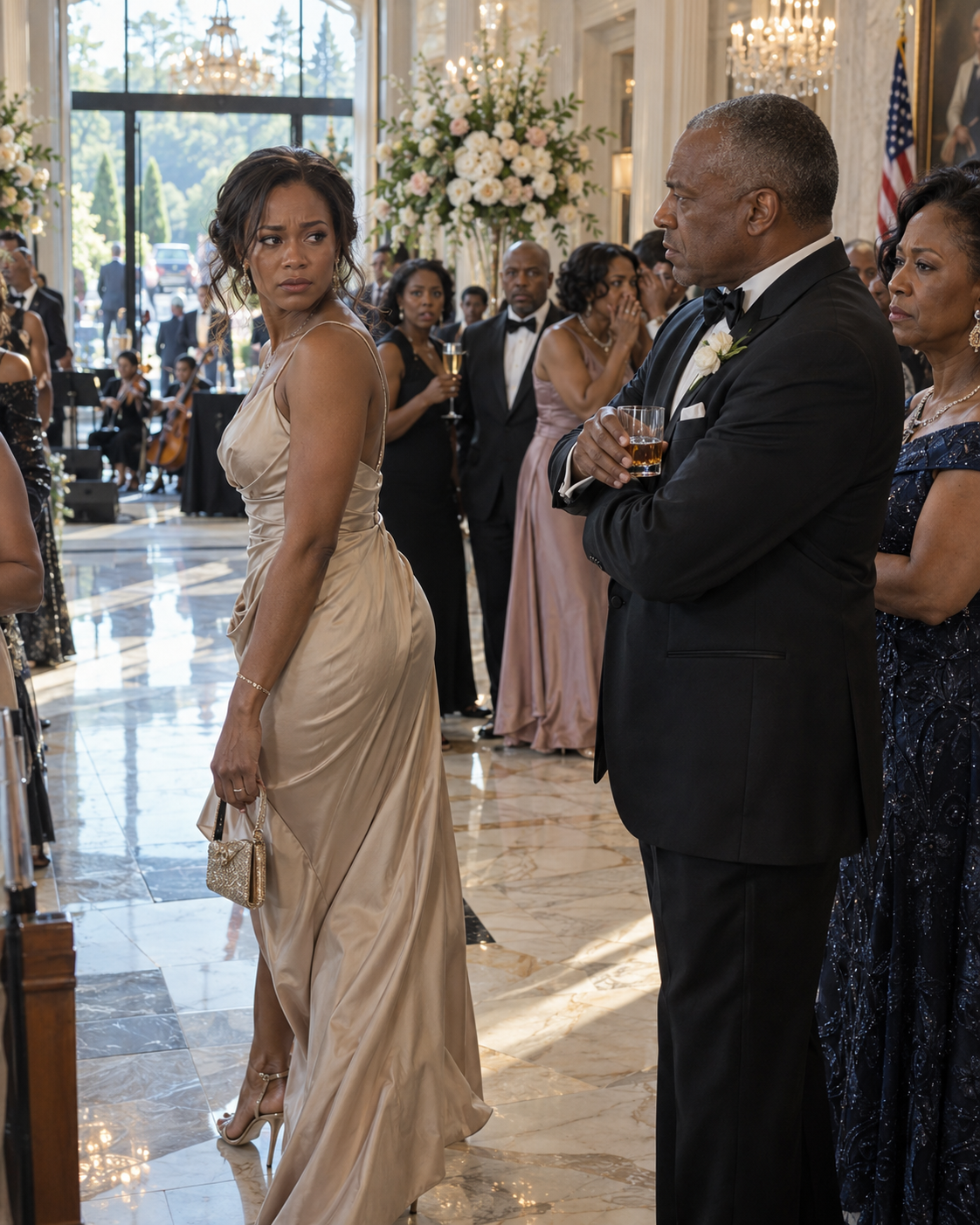
For several seconds, he simply stood there.
Then another call came through.
The Grand Manor manager.
Harrison answered.
“Mr. Wolf, we have a problem with your payment.”
“I’ll handle it Monday.”
“I’m afraid that’s not possible.”
Harrison looked toward the chapel.
“My daughter is getting married.”
“I understand, sir, but the reception balance has been declined.”
His jaw tightened.
“Put it through again.”
“We already did.”
“Use another corporate account.”
“We have been instructed that all accounts associated with Wolf Commercial Properties are subject to the hold.”
Harrison went silent.
The manager lowered his voice.
“If you cannot provide certified funds, the reception services cannot continue.”
Harrison looked around at the marble walls, the floral arrangements, and the hundreds of people he had invited to witness his family’s prosperity.
He suddenly understood how fragile his image had always been.
It was expensive.
It was polished.
And it was built on borrowed ground.
The ceremony continued.
Harrison walked Khloe down the aisle with a face so pale that several guests whispered about whether he was ill.
Khloe noticed.
“What happened?”
“Nothing.”
“Dad, you’re shaking.”
“I’m fine.”
He wasn’t.
By the time the vows ended, his phone contained dozens of messages.
The bank wanted answers.
His CFO wanted instructions.
His attorneys wanted emergency authorization.
The venue wanted money.
And somewhere outside that estate, I was sitting quietly in my car, waiting for Marcus to call.
He did.
“It’s moving.”
I looked through the windshield.
“How bad?”
“Bad enough that the bank has started reviewing every loan tied to those parcels.”
I closed my eyes.
“Then let them.”
Marcus paused.
“You understand what happens next?”
“Yes.”
“Your father could lose the company.”
I looked at the wedding mansion behind me.
“He chose this.”
Marcus sighed.
“I know.”
But I didn’t feel victorious.
That surprised me.
I had imagined this moment for years without realizing it.
I thought reclaiming my inheritance would feel like revenge.
Instead, it felt like grief.
Because Harrison had not always been cruel.
When I was six, he had been the man who carried me through a hospital hallway after my parents died.
He had promised me I would never be alone.
I had spent twenty years believing that promise meant something.
Maybe that was why his betrayal hurt more than the money.
He hadn’t simply misused an inheritance.
He had taken a child’s trust and quietly turned it into collateral.
By Monday morning, the bank had begun a formal review.
By the end of the week, Harrison’s attorneys were demanding negotiations.
Marcus refused to negotiate away my legal rights.
Within days, the court records revealed that Wolf Commercial Properties had repeatedly relied on the Vance parcels to secure financing.
The issue was not merely that Harrison had used the properties.
The problem was that the documentation showed he had continued using them after the conditions governing his authority had expired.
The bank froze additional transactions while its lawyers reviewed the collateral.
Harrison’s carefully maintained world began shrinking.
He stopped returning calls from business associates.
Then his partners stopped returning his.
Investors who had once crowded around him at charity dinners suddenly became unavailable.
People who had called him “Harrison” with admiration began calling his attorneys instead.
That was the cruelest part of watching a powerful man fall.
The people who had praised him never actually belonged to him.
They belonged to his position.
And when the position disappeared, so did they.
Khloe’s marriage began cracking almost immediately.
Her new husband had entered the relationship believing she came from one of Nashville’s strongest commercial families.
Now creditors were asking questions, the wedding scandal was circulating through private circles, and Harrison could no longer provide the lifestyle everyone had expected.
Khloe blamed him.
Harrison blamed me.
Victoria blamed everyone.
I stopped listening.
I returned to work.
My office became the only place where the world still made sense.
Numbers didn’t care who had embarrassed me.
Contracts didn’t care whether I was adopted.
A balance sheet did not ask whether I belonged.
It only told the truth.
And I began rebuilding my life around that truth.
I took control of the Vance properties.
The Broadway parcels were valuable, but I didn’t want to become another Harrison.
I didn’t want glass towers bearing my name simply because I could afford them.
I wanted to build something that would outlast a surname.
So I created Vance Infrastructure and Real Estate Group.
My first major project was a mixed-use development that combined affordable housing, small-business retail space, and public green areas.
The project took eighteen months.
It nearly failed twice.
There were zoning disputes.
Financing problems.
Contractors who underestimated me.
Investors who assumed a young woman couldn’t negotiate as aggressively as a man twice her age.
Every obstacle reminded me of Harrison.
But I didn’t become him.
When someone challenged me, I brought the documents.
When someone underestimated me, I learned more.
When someone tried to intimidate me, I stayed calm.
I discovered that strength did not require cruelty.
It required clarity.
A year after the wedding, I stood on the top floor of my new headquarters overlooking downtown Nashville.
Marcus walked into my office carrying a folder.
“Final title documents.”
I took them from him.
He smiled.
“Everything is settled.”
I opened the folder.
For years, I had imagined seeing my name attached to those properties.
When I finally did, I didn’t feel rich.
I felt free.
“How is Harrison?”
Marcus hesitated.
“His company is finished.”
I looked out the window.
“And him?”
“He sold the house.”
I nodded.
“Victoria?”
“Renting outside Davidson County.”
“And Khloe?”
“Divorced.”
The silence afterward felt strangely peaceful.
I expected satisfaction.
Instead, I felt sadness.
Not because I wanted them back.
Because I finally understood that losing people who never truly valued you can still hurt.
Healing doesn’t erase history.
It simply stops history from controlling the future.
A few months later, I received a letter.
There was no return address.
Inside was a single photograph.
It showed me at six years old, standing between Harrison and Victoria on the day they adopted me.
I stared at the little girl in the picture.
She was smiling.
She had no idea what was coming.
Behind the photograph was a handwritten note.
“I should have protected you.”
I knew the handwriting immediately.
Harrison.
For several minutes, I couldn’t move.
Then I read the second line.
“I used what belonged to you because I was terrified that without it, nobody would respect me.”
I folded the note.
There was no apology strong enough to erase twenty years.
But for the first time, I understood something important.
His failure had never been proof that I wasn’t worthy.
It had been proof that he was incapable of loving something without trying to possess it.
I placed the photograph inside a drawer.
Not as a reminder of him.
As a reminder of me.
The six-year-old girl who had lost everything had survived.
She had grown into a woman who understood contracts, money, boundaries, and most importantly, herself.
That realization changed the direction of my work.
I began mentoring young women who had inherited businesses, trusts, properties, or complicated family financial structures.
I told them what I wished someone had told me earlier.
“Read everything.”
“Ask questions.”
“Know what is legally yours.”
“Never confuse gratitude with permanent debt.”
And most importantly:
“Love people without surrendering your ability to stand without them.”
One evening, after a mentoring session, I returned to my office and found another envelope waiting on my desk.
There was no name on it.
No return address.
Inside was a photocopy of an old trust document.
I recognized the signature at the bottom.
My biological father’s.
But there was something I had never seen before.
A handwritten notation beside one of the original property descriptions.
I called Marcus immediately.
“Where did this come from?”
“I don’t know.”
He studied it carefully.
Then his expression changed.
“Francis, this isn’t part of the final trust file.”
My heart began beating faster.
“What does that mean?”
“It means someone removed a document.”
I looked at the photocopy.
“From my father’s estate?”
“Possibly.”
“Who?”
Marcus didn’t answer.
The room seemed suddenly colder.
For twenty years, I had believed Harrison’s secret was the biggest secret surrounding my inheritance.
Now I wasn’t sure.
The notation on the document pointed toward another parcel.
A property my parents had owned before their deaths.
A property that had never appeared in the final trust inventory.
“Where is it?” I asked.
Marcus looked at the address.
His face went still.
“Francis, that property doesn’t belong to Harrison.”
“Who owns it?”
He hesitated.
“According to this document, it was transferred into a private entity shortly before your parents died.”
I stared at him.
“My parents died in an industrial accident.”
“I know.”
“Then who transferred it?”
Marcus placed the paper on the desk.
“That’s what we need to find out.”
For twenty years, I had thought my story was about an adopted daughter fighting for an inheritance that had been stolen from her.
Now I wondered if the inheritance itself had been only one piece of something much larger.
I looked out over Nashville.
The city lights stretched endlessly into the darkness.
For the first time since the wedding, I felt that old uncertainty return.
Not fear.
Something sharper.
The feeling that a door had opened somewhere behind me.
And whoever had been standing on the other side had been waiting a very long time.
I picked up the document.
At the bottom of the page was one final handwritten sentence.
“Your father knew they were coming.”
I read it twice.
Then a third time.
Marcus looked at me.
“Francis…”
I folded the document slowly.
“My father knew someone was coming?”
Marcus nodded.
“Apparently.”
I looked toward the city.
The life I had rebuilt was real.
The company was mine.
The properties were mine.
My future was mine.
But suddenly, I understood that reclaiming my inheritance might never have been the real ending.
Maybe it was the beginning.
Because somewhere in Nashville was an answer to a question my parents had taken to their graves.
And now that I knew the question existed, I couldn’t pretend I didn’t want the answer.
I slipped the document into my bag.
“Tomorrow,” I said, “we find that property.”
Marcus nodded.
As I turned off the office lights, my phone buzzed.
An unknown number.
One message.
“You should have left the past buried.”
I stared at the screen.
Then another message appeared.
“But your father didn’t.”
And for the first time in my life, I realized that walking away from the people who rejected me had not ended the story.
It had only given me the freedom to finally uncover the truth they had spent twenty years trying to hide.