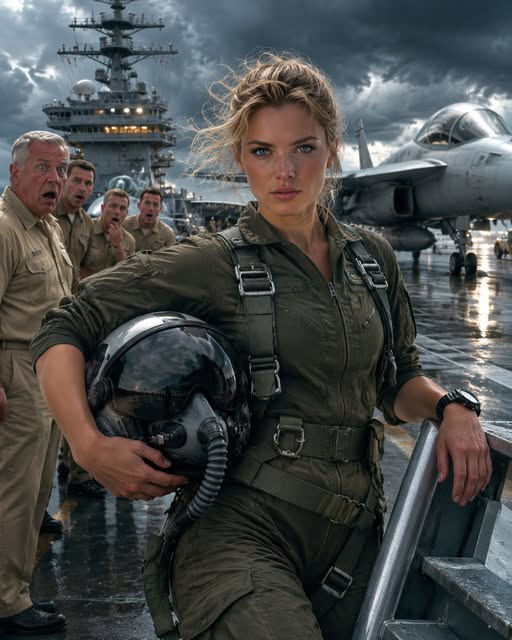
The typhoon was throwing waves over the flight deck of the USS Eisenhower when an Air Force A-10 Warthog came screaming toward the carrier with almost no control left.
The first sign that something was wrong came at 3:17 in the morning.
I was lying in the carrier’s medical bay, staring at the ceiling, when the ship’s general alarm sounded.
A voice crackled over the announcement system.
“Damage control personnel, report to your assigned stations. Engineering casualty. This is not a drill.”
I tried to sit up.
Pain shot through my ribs.
Dr. Arthur Thorne appeared beside my bed almost immediately.
“Don’t even think about it, Major.”
I looked at him.
“What’s happening?”
“Something you aren’t going to fix by getting out of bed.”
He checked the monitor beside me.
“Your blood pressure is still unstable, and you’ve got two cracked ribs. Stay put.”
But I could hear boots pounding through the passageway.
Something serious was happening.
Then the lights flickered.
Once.
Twice.
And went out.
Emergency lighting washed the medical bay in a dim red glow.
Thorne stopped moving.
For the first time since he’d examined me, I saw concern in his eyes.
“What was that?” I asked.
He didn’t answer.
A moment later, the door opened.
Chief Petty Officer Pete Vance stepped inside, soaked to the skin.
“Doctor, we need to move two patients from the forward compartment.”
Thorne hurried toward him.
I caught Pete’s sleeve.
“Chief, what’s going on?”
He hesitated.
“Electrical fault. Flooding in one of the lower compartments. Engineering’s handling it.”
“Is the ship in danger?”
Pete gave me a look.
“Major, this ship has survived worse.”
Then he added something that made my stomach tighten.
“But your airplane may have just become our biggest problem.”
I swung my legs over the side of the bed.
Thorne turned.
“Absolutely not.”
“What’s wrong with the Warthog?”
Pete sighed.
“The elevator move isn’t finished. The storm damaged part of the elevator’s electrical system, and the aircraft is still in a temporary secured position.”
I stared at him.
“On the elevator?”
“Close enough to make everyone nervous.”
I reached for my flight suit.
Thorne stepped between me and the door.
“Major, you’re injured.”
“That’s my aircraft.”
“And this is my medical bay.”
He folded his arms.
“You’re not going anywhere until I clear you.”
I wanted to argue.
Instead, I sat back down.
Because for the first time that night, I realized something uncomfortable.
I wasn’t the person in control anymore.
The Navy had saved my life.
Now I had to trust them to do their jobs.
Twenty minutes later, Commander Holt appeared.
His face was pale beneath the fluorescent emergency lights.
He pulled up a chair beside my bed.
“Major, we need to talk.”
I felt my stomach drop.
“How bad?”
“The aircraft is secure for the moment. The elevator crew is waiting for engineering to restore the necessary systems.”
I exhaled.
“Then what’s the problem?”
Holt studied me.
“Your maintenance records.”
I frowned.
“What about them?”
“We contacted your unit to verify the aircraft’s configuration and damage history.”
“And?”
“There’s a discrepancy.”
He handed me a printed maintenance summary.
I recognized the aircraft number immediately.
A-10C, tail number 81-0976.
My Warthog.
The airplane I’d flown for almost three years.
The airplane I’d trusted through combat training, deployment exercises, and more bad-weather missions than I could count.
Holt pointed to a line near the bottom.
“Your aircraft underwent a major hydraulic inspection eleven days ago.”
“That’s right.”
“According to this report, the emergency flight-control system was tested and certified.”
I nodded.
“It was.”
Holt’s expression darkened.
“Then why did your emergency controls fail?”
I looked at him.
“Because the storm damaged the aircraft.”
“Maybe.”
He leaned closer.
“But our technicians found evidence of a problem that appears to have existed before tonight.”
For a moment, I couldn’t speak.
“What kind of problem?”
“A component that may have been improperly installed.”
I stared at the paper.
“That’s impossible.”
Holt didn’t blink.
“That’s what we’re trying to determine.”
The room seemed to tilt.
I’d blamed the storm.
The violent turbulence.
The enormous wave I’d barely cleared.
But what if the aircraft had already been compromised?
What if the thing that nearly killed me had been waiting inside the Warthog before I ever left the runway?
I thought about my wingman.
About the four sailors.
About the carrier crew who’d risked their lives helping me land.
And suddenly, the question wasn’t whether my airplane could be saved.
It was whether someone else might be flying with the same hidden danger.
“Commander,” I said quietly, “you need to contact my squadron.”
“We already have.”
“No. I mean immediately. Every aircraft that went through that maintenance cycle needs to be checked.”
Holt nodded.
“That recommendation has been passed along.”
He stood.
“Get some rest, Major.”
But I knew sleep wasn’t coming.
By sunrise, the worst of the typhoon had moved north.
The sea was still rough, but the wind had weakened enough for the crew to resume work on the aircraft.
From the medical bay, I received updates through Pete.
The damaged Warthog had been secured, its remaining weapons made safe by qualified ordnance personnel, and the elevator systems checked.
The crew was finally able to lower the aircraft into the hangar bay.
Pete returned just before noon.
“She’s downstairs.”
I sat up.
“Really?”
“All seventy feet of ugly Air Force stubbornness.”
I laughed, then immediately regretted it as pain stabbed through my ribs.
Pete grinned.
“Careful, Major. Laughing’s not covered under your medical clearance.”
“How’s she look?”
He scratched his chin.
“Like somebody tried to fold a refrigerator in half.”
I shook my head.
“She’s prettier than that.”
“That’s a matter of opinion.”
Then his smile faded.
“But she’s intact enough for the investigators to examine.”
I looked down at my bandaged hands.
“Can I see her?”
“Doctor says no.”
“Pete.”
“Major.”
I sighed.
He leaned closer.
“Give it another day. The airplane isn’t going anywhere.”
He was wrong about one thing.
The airplane was about to take me somewhere I never expected.
Three days later, the Eisenhower reached calmer waters.
I was finally cleared to walk short distances with assistance.
Pete escorted me into the hangar bay.
The moment I saw the Warthog, I stopped.
I’d known she was damaged.
I’d felt every violent shudder during the approach.
But seeing her under the bright hangar lights was different.
The left wing was twisted.
The landing gear had absorbed punishment that seemed impossible for any machine to survive.
The tail was visibly distorted.
Hydraulic fluid stains marked the fuselage.
And the paint around the cockpit was scarred by saltwater and flying debris.
I stood there, unable to speak.
Pete watched me.
“Rough sight?”
I nodded.
“Yeah.”
He folded his arms.
“She got you here.”
I stepped closer.
“She did.”
Then I noticed something written in white grease pencil beneath the cockpit.
WELCOME ABOARD, AIR FORCE.
I laughed.
“Who wrote that?”
Pete looked innocent.
“No idea.”
Below it, in smaller letters, someone had added:
PARKING FEE: FOUR SAILORS.
My smile disappeared.
I reached out and touched the fuselage.
Four sailors.
Four lives.
For the first time, the aircraft didn’t look like a wreck.
It looked like a witness.
A reminder of what had happened out there.
And what had almost been lost.
“Major?”
I turned.
A Navy lieutenant stood beside a man in civilian clothes.
“I’m Lieutenant Sarah Keene, Naval Safety Center. This is Dr. Michael Reyes, an aerospace systems investigator.”
Reyes extended his hand.
“We’d like to ask you some questions.”
I shook it carefully.
“About the landing?”
“About everything.”
We moved into a small briefing room.
For the next four hours, they walked me through the mission.
The weather.
The rescue.
The first sign of vibration.
The hydraulic failure.
The control response.
The emergency procedures.
The carrier approach.
They asked the same questions in different ways.
I understood why.
In aviation, memory can be unreliable after extreme stress.
What feels like ten seconds might have been two.
What sounds like an explosion might have been a mechanical failure.
And a pilot who survives something extraordinary isn’t automatically a reliable narrator of every technical detail.
Finally, Reyes opened a photograph.
It showed a damaged section of the flight-control assembly.
“Do you recognize this?”
I leaned forward.
“That’s part of the emergency control linkage.”
“Correct.”
He placed another photograph beside it.
The second showed a similar component from an undamaged aircraft.
Even I could see the difference.
A retaining assembly appeared misaligned.
Reyes tapped the photograph.
“We’ve found indications that the installation may not have met the required maintenance standard.”
I felt cold.
“How long had it been like that?”
“We don’t know yet.”
“Could that have caused the failure?”
“It’s one possibility. We’re not making conclusions until the analysis is complete.”
I stared at the pictures.
Then I asked the question I’d been afraid to ask.
“Are other aircraft affected?”
Keene answered.
“Your squadron has initiated precautionary inspections.”
“Have they found anything?”
She hesitated.
“Two aircraft have been temporarily grounded pending further checks.”
I sat back.
Two more.
Two pilots who might have experienced the same failure.
Maybe in clear weather.
Maybe during training.
Maybe somewhere without a carrier beneath them.
The thought made my hands shake harder than the landing had.
That evening, I called my wingman.
Captain Marcus Reed answered on the second ring.
“Well, look who decided not to die.”
I laughed.
“Missed you too.”
His voice changed.
“Seriously, brother. How are you?”
“Bruised. Tired. Still ugly.”
“Good. Means you’re normal.”
We were quiet for a moment.
Then I said, “Marcus, did they inspect your aircraft?”
“Yeah.”
“And?”
He hesitated.
“They found something.”
My stomach tightened.
“What?”
“A questionable installation in the same maintenance area. They’re checking whether it’s related.”
I closed my eyes.
“Jesus.”
“Listen,” Marcus said. “You didn’t know.”
“I should’ve noticed something.”
“How?”
“I don’t know.”
“Exactly.”
His voice grew firm.
“You followed your checks. You trusted the maintenance release. That’s what pilots are supposed to do.”
I rubbed my forehead.
“But if I’d turned back with you—”
“Then those four sailors might still be in the water.”
I didn’t answer.
Marcus sighed.
“You’re doing that thing again.”
“What thing?”
“Trying to take responsibility for every bad thing that happens within a hundred miles of you.”
I almost smiled.
He continued.
“You saved four people. You survived a nightmare. And now your damaged airplane may help prevent another accident.”
I looked toward the hangar.
“Doesn’t feel like enough.”
“That’s because you’re an idiot.”
I laughed despite myself.
“Thanks.”
“Anytime.”
Before hanging up, Marcus said something that stayed with me.
“Sometimes surviving is the mission, too.”
I thought about those words long after the call ended.
Because I’d spent my entire military career measuring myself by what I could accomplish.
The missions completed.
The people protected.
The emergencies handled.
I’d never been particularly good at accepting help.
And I was about to learn just how difficult that could be.
Two days later, Rear Admiral Sterling summoned me to his office.
I arrived wearing a borrowed Navy uniform shirt because my flight suit was still being cleaned and inspected.
Sterling stood beside a large window overlooking the ocean.
Commander Holt was already there.
“Major,” the admiral said. “Have a seat.”
I sat.
Sterling studied me.
“How are your injuries?”
“Improving, sir.”
“Good.”
He placed a folder on the desk.
“Your chain of command has requested your return for a formal investigation.”
I nodded.
“Understood.”
“Before you leave, there’s something you should know.”
He opened the folder.
Inside was a preliminary report.
The rescue mission had been successful.
All four sailors had survived.
But one of them was still hospitalized.
His name was Seaman First Class Andrew Collins.
Twenty-two years old.
Married.
Father of a six-month-old daughter.
He had suffered severe hypothermia and complications from prolonged exposure.
I stared at the photograph attached to his medical report.
He looked impossibly young.
“Is he going to make it?”
Sterling nodded.
“His doctors are optimistic.”
I exhaled.
Then the admiral said, “He asked to speak with you.”
I looked up.
“Me?”
“Apparently, he remembers hearing your aircraft overhead.”
I swallowed.
“He was conscious?”
“Intermittently.”
Sterling leaned back.
“He told the rescue team that when he heard the engines, he knew someone was still looking.”
I stared at the floor.
The admiral continued.
“Major, I’ve spent thirty-four years in the Navy. I’ve seen people do extraordinary things. I’ve also seen people take unnecessary risks because they couldn’t accept failure.”
I looked at him.
“Sir?”
“Your decision to remain in that weather will be reviewed. The technical failures will be reviewed. Every part of this incident will be examined.”
He paused.
“But I want you to understand something.”
I waited.
“The purpose of an investigation isn’t to decide whether you’re a hero. It’s to learn what happened so the next crew has a better chance of coming home.”
I nodded slowly.
“Yes, sir.”
He closed the folder.
“And as for that airplane…”
I held my breath.
Sterling glanced at Holt.
“The Air Force wants it returned for examination.”
My chest tightened.
“Will they repair it?”
“We don’t know.”
Holt stepped forward.
“Major, the damage is extensive. There may not be a practical way to return it to flight.”
I looked away.
I knew he was right.
But knowing something and accepting it are different things.
Sterling continued.
“However, we’re arranging to preserve the aircraft until the investigation is complete.”
I looked up.
“Thank you, sir.”
The admiral gave a small nod.
“Don’t thank me yet. We still have to figure out how to get your flying junk off my ship.”
Holt grinned.
“Sir, I believe the preferred term is ‘historic aircraft.'”
Sterling rolled his eyes.
“Get out of my office, both of you.”
For the first time since the storm, I laughed without feeling guilty.
A week later, I was transferred ashore for further medical evaluation.
Before leaving the Eisenhower, I asked permission to visit the flight deck one last time.
Pete accompanied me.
The weather was beautiful.
Blue sky.
Calm ocean.
Sunlight reflecting off the steel deck.
It was difficult to believe this was the same place where I’d nearly died.
We walked toward the landing area.
Pete pointed to a spot near the arresting wires.
“Right about there.”
I stared.
“That’s where she stopped?”
“Yep.”
I looked toward the deck edge.
It seemed impossibly close.
“How far?”
Pete shrugged.
“Close enough.”
I shook my head.
He grinned.
“Major, I’ve worked flight decks for twenty-one years. I’ve seen some ugly landings.”
“And?”
“Yours was special.”
“Thanks, Chief.”
“Didn’t say it was a compliment.”
We laughed.
Then he reached into his pocket.
He handed me a small piece of metal mounted on a wooden plaque.
It was a section of damaged aircraft skin removed during the safety inspection.
Beneath it was an engraved message.
FROM THE CREW OF USS EISENHOWER.
YOU LANDED WITH US.
YOU LEFT AS ONE OF US.
I stared at it.
My throat tightened.
“Pete…”
He looked away.
“Don’t get sentimental, Major. Navy doesn’t do that.”
I laughed softly.
“Of course not.”
He extended his hand.
I shook it.
Then, without warning, he pulled me into a brief hug.
“Glad you made it, brother.”
I couldn’t answer.
Because suddenly, I wasn’t thinking about the airplane.
I was thinking about every sailor who’d stood on that deck in the storm.
The people who’d guided me.
The crew who’d secured the weapon.
The firefighters.
The medical team.
The engineers.
The men and women who’d risked their lives to help a stranger wearing a different uniform.
I had come aboard alone.
But I hadn’t survived alone.
Three months later, the investigation reached a major turning point.
I was back at my home station, still grounded while recovering from my injuries.
My squadron commander called me into his office.
“Major, we’ve received the preliminary engineering findings.”
I sat across from him.
He handed me a report.
The investigation had identified a maintenance process failure involving a particular flight-control component.
Several aircraft had undergone the same procedure.
The faulty installation had not been detected during routine verification.
My Warthog’s extreme flight conditions had likely accelerated the failure.
I read the report twice.
Then I looked up.
“So it wasn’t just the storm.”
“No.”
“Was anyone hurt in the other aircraft?”
“No. The inspections caught the problems before those jets returned to service.”
I exhaled slowly.
My commander continued.
“The maintenance unit is reviewing its procedures. Additional inspection requirements are being developed.”
I looked down at the report.
“What’s going to happen to the technicians?”
“That depends on the investigation. We’re examining supervision, training, documentation, and quality-control failures. We’re not assuming one person caused everything.”
I nodded.
That mattered.
I’d known too many good mechanics who worked long hours under enormous pressure.
They deserved a fair investigation, not a convenient scapegoat.
Then my commander said, “There’s another matter.”
I looked up.
“Your aircraft.”
My chest tightened.
“The structural damage is beyond economical repair.”
I stared at him.
“So she’s done?”
He nodded.
“I’m afraid so.”
For a long moment, I couldn’t speak.
I knew it was just a machine.
Metal.
Wiring.
Hydraulics.
Engines.
But pilots develop relationships with their aircraft that are difficult to explain.
You learn every vibration.
Every sound.
Every small imperfection.
You trust a machine with your life, and eventually it begins to feel like something more than equipment.
My commander leaned forward.
“There’s a proposal to preserve the aircraft as a training and historical display.”
I looked up.
“Where?”
“That’s still being discussed.”
I thought about the carrier.
About Pete.
About the four sailors.
And suddenly, I knew what I wanted.
“Sir, may I make a suggestion?”
He smiled.
“I had a feeling you would.”
Six months later, I stood inside a large aircraft restoration facility.
My Warthog sat beneath bright lights, supported by maintenance stands.
Technicians had stabilized the damaged structure and cleaned away the saltwater corrosion.
The aircraft would never fly again.
But it would survive.
Beside me stood Commander Holt, Pete Vance, and Lieutenant Derek Pike.
Pike was younger than I’d imagined.
I’d only known him as a voice in the storm.
A calm voice telling me to hold my line when everything in my body wanted to panic.
I shook his hand.
“Lieutenant, I owe you my life.”
He looked embarrassed.
“Just doing my job, sir.”
I smiled.
“That’s what everyone keeps telling me.”
He laughed.
Then Holt stepped closer.
“We have a surprise for you.”
I frowned.
“What kind?”
He gestured toward the hangar entrance.
Four men stood there.
Three were wearing Navy uniforms.
The fourth wore civilian clothes and walked with a cane.
Andrew Collins.
The youngest sailor from the rescue.
He looked healthier than in the hospital photograph, though he moved carefully.
I froze.
He approached slowly.
“Major?”
I nodded.
“Andrew.”
He smiled.
“I’ve been wanting to meet you.”
I shook his hand.
Then he surprised me by pulling me into a hug.
“Thank you for coming back for us.”
My eyes burned.
“You don’t owe me anything.”
He stepped back.
“Actually, I do.”
He reached into his pocket and removed a photograph.
It showed a baby girl sitting on a blanket, smiling at the camera.
“My daughter, Lily.”
I stared at the picture.
“She’s beautiful.”
He nodded.
“She took her first steps last month.”
I smiled.
“That’s wonderful.”
Andrew swallowed.
“I almost missed that.”
The room went quiet.
He looked directly at me.
“When we were in the water, I thought I was going to die.”
I didn’t speak.
“The waves were so high we couldn’t see the rescue aircraft. We kept losing sight of each other.”
His voice trembled.
“Then I heard your engines.”
I felt something tighten in my chest.
“I couldn’t see you,” he continued. “But I heard you circling.”
He paused.
“And I remember thinking, somebody knows we’re still here.”
I looked away.
Andrew reached for my shoulder.
“You didn’t give up on us.”
I swallowed.
“Neither did your rescue team.”
He nodded.
“I know. I’ve thanked them too.”
Then he smiled through his tears.
“But I wanted you to know what it meant.”
I looked at the photograph again.
A little girl.
A father who had come home.
A future that had almost disappeared beneath the Pacific.
For months, I’d mourned the loss of my aircraft.
In that moment, I understood what the airplane had really been worth.
Not its replacement cost.
Not its service record.
Not the hours I’d spent flying it.
Its greatest value was that it had helped bring people home.
The restoration project took another year.
The Air Force and Navy worked together to preserve the aircraft for a joint aviation safety exhibit.
The display would explain the rescue mission, the emergency landing, and the engineering lessons learned from the incident.
It would also recognize the carrier crew, the rescue personnel, and the maintenance investigators whose work helped identify the underlying problem.
I was asked to speak at the dedication ceremony.
At first, I refused.
I didn’t want another speech about bravery.
I didn’t want to stand beside a damaged airplane while people called me a hero.
But then Andrew called.
“You have to do it.”
I laughed.
“Why?”
“Because my daughter wants to meet the man who helped bring her daddy home.”
I was quiet for a moment.
“She’s too young to understand.”
“Maybe.”
He paused.
“But one day she won’t be.”
So I agreed.
The ceremony took place on a clear October morning.
The Warthog stood inside a spacious exhibition hangar.
Its damaged sections had been carefully preserved.
The left wing still showed the scars of the storm.
The landing gear remained bent.
And beneath the cockpit, the crew had recreated the words Pete’s sailors had written in grease pencil.
WELCOME ABOARD, AIR FORCE.
PARKING FEE: FOUR SAILORS.
I laughed when I saw them.
Pete stood beside me, grinning.
“Had to keep the important historical details.”
I shook my head.
“Naturally.”
The audience included pilots, sailors, mechanics, veterans, families, and students.
Admiral Sterling attended.
So did Commander Holt and Lieutenant Pike.
My wingman Marcus sat in the front row.
And Andrew Collins stood beside his wife, holding little Lily’s hand.
When my name was called, I walked to the podium.
For a moment, I couldn’t speak.
I looked at the aircraft.
Then at the people who’d made it possible for me to stand there.
“I’ve spent a lot of time thinking about that night,” I began.
The room grew quiet.
“People have asked me what it felt like to land an A-10 on an aircraft carrier during a typhoon.”
A few people smiled.
“The truth is, I was terrified.”
The audience laughed softly.
“I was exhausted. My aircraft was damaged. My fuel was running low. And I knew I was running out of options.”
I glanced toward Pike.
“Then a voice came over the radio.”
I paused.
“Hold your line. Keep coming. I’ve got you.”
Pike lowered his head.
“Those words mattered more than I can explain.”
I looked toward Pete.
“And when I finally stopped on that deck, there were people waiting who didn’t care what uniform I wore.”
My voice tightened.
“They cared that I was alive.”
I took a breath.
“For a long time, I thought the story was about one pilot and one airplane surviving impossible conditions.”
I shook my head.
“But I was wrong.”
I looked at Andrew and his family.
“This story is about four sailors who refused to give up in the water. A rescue team that kept searching. A carrier crew that made room for someone who had nowhere else to go.”
I glanced at the aircraft.
“And a damaged machine that helped investigators find a problem before someone else got hurt.”
The room was silent.
“I used to think courage meant never being afraid.”
I paused.
“Now I think courage sometimes means admitting you’re afraid and trusting someone else to help you.”
My eyes found Marcus.
“Sometimes it means turning back when that’s the right decision.”
Then I looked at Andrew.
“And sometimes it means staying just long enough to make sure someone else gets home.”
I stepped away from the podium.
The applause began slowly.
Then people stood.
I saw Pete wiping his eyes.
He noticed me looking and immediately pretended to adjust his collar.
I smiled.
Some things never change.
After the ceremony, Andrew approached with Lily.
She was holding a small toy airplane.
“Say hello,” he encouraged.
Lily looked up at me.
“Are you the airplane man?”
I laughed.
“I guess I am.”
She held out the toy.
“Can you make it fly?”
I knelt carefully.
“Well, this one looks pretty fast.”
I moved it through the air with a soft engine noise.
She giggled.
Then she pointed toward the enormous Warthog.
“Did you fly that?”
I nodded.
“Yes, ma’am.”
She studied the damaged aircraft.
“Why is it broken?”
I looked at Andrew.
He smiled gently.
I turned back to Lily.
“Because it worked very hard one night.”
She frowned.
“Can you fix it?”
I considered the question.
“Not enough to make it fly again.”
She looked disappointed.
Then she asked something that stopped me cold.
“Is it sad?”
I stared at her.
A three-year-old girl asking whether an airplane was sad.
I thought about the storm.
The landing.
The investigation.
The long months of recovery.
And the grief I’d felt when I learned the aircraft would never fly again.
Then I smiled.
“No, sweetheart.”
“Why not?”
“Because it did what it needed to do.”
She looked toward the Warthog.
“Did it help my daddy?”
I felt my throat tighten.
“Yes.”
She smiled.
“Then it’s a good airplane.”
I couldn’t answer.
Andrew placed a hand on my shoulder.
And for the first time, I realized that a little girl had just explained something I’d spent two years trying to understand.
The aircraft didn’t need to fly again to have value.
Its mission hadn’t ended when its engines stopped.
Its mission had changed.
It was no longer carrying weapons or flying rescue support.
Now it was carrying a story.
A story about courage.
About teamwork.
About mistakes that needed to be understood.
About the responsibility to learn from failure.
And about the extraordinary things ordinary people can accomplish when they refuse to abandon one another.
Years later, I returned to the exhibit with my own son.
He was twelve.
He’d heard the story many times, but he’d never seen the airplane in person.
We stood beneath its enormous wings.
He studied the bent landing gear.
The damaged tail.
The scars along the fuselage.
Then he looked at me.
“Dad, were you really scared?”
I smiled.
“More than I’ve ever been.”
He nodded thoughtfully.
“Then why didn’t you quit?”
I looked at the aircraft.
“Because there were people counting on me.”
He was quiet.
Then he asked, “What if you hadn’t made it?”
I took a slow breath.
“That’s a question I’ve asked myself a lot.”
He looked worried.
I knelt beside him.
“Listen to me. I want you to understand something important.”
He nodded.
“Being brave doesn’t mean taking every risk. Sometimes the bravest thing you can do is ask for help, turn around, or admit something is too dangerous.”
He looked at the airplane.
“But you didn’t turn around.”
“No.”
“Why?”
“Because that night, with the information I had, I believed staying a little longer gave those sailors their best chance.”
I paused.
“But that doesn’t mean every decision I made was perfect. That’s why we investigated everything afterward.”
He considered that.
“So heroes can make mistakes?”
I smiled.
“Especially heroes.”
He laughed.
Then he reached for my hand.
“I’m glad you came home.”
I looked down at him.
“So am I, buddy.”
We stood together beneath the Warthog.
For a long time, neither of us spoke.
Then I noticed a small brass plaque near the aircraft’s nose.
I’d read it dozens of times.
But that day, the words felt different.
It listed the names of the four rescued sailors.
The rescue crew.
The carrier personnel who’d coordinated the emergency recovery.
And the investigators who’d helped prevent another accident.
At the bottom was a simple sentence.
NO ONE COMES HOME ALONE.
I read it twice.
Then I looked at my son.
“Ready to go?”
He nodded.
As we walked toward the exit, I glanced back one last time.
The Warthog stood beneath the hangar lights, silent and motionless.
Its engines would never roar again.
Its wheels would never leave the ground.
Its wings would never cut through another storm.
But I no longer felt sadness when I looked at it.
I felt gratitude.
For the sailors who survived.
For the Navy crew who saved me.
For the mechanics who worked to understand what had failed.
For the commanders who chose caution over pride.
And for the aircraft that carried me through the darkest night of my life.
I’d once believed that the greatest achievement of a pilot was completing the mission.
Now I understood something more important.
The mission matters.
But so do the people who carry it out.
And no victory is worth forgetting the lives that make it possible.
That night, after my son went to bed, I took the small wooden plaque Pete had given me from my desk drawer.
The piece of damaged aircraft skin still rested beneath the engraved words.
YOU LANDED WITH US.
YOU LEFT AS ONE OF US.
I ran my thumb across the metal.
Then I placed it beside a photograph of Andrew Collins holding his daughter.
Two reminders.
One of the people who saved me.
One of the people we’d saved.
I turned off the light.
And as I walked down the hallway, I thought about the voice that had guided me through the storm.
“Hold your line. Keep coming. I’ve got you.”
I finally understood why those words had stayed with me.
They weren’t just instructions for landing an aircraft.
They were a promise.
A promise that when someone is struggling, frightened, or running out of options, another person can step forward and say, “You’re not alone.”
And sometimes, that promise is enough to carry someone through the worst night of their life.
Because the greatest measure of courage isn’t how far you’re willing to go alone. It’s how many people you’re willing to help bring home—and whether you’re wise enough to let others bring you home, too.