The smell of burning oil hit me just as two pilots collapsed inside the cockpit. Within seconds, hundreds of passengers were sitting on a plane with no one capable of flying it.
“Wait a minute. Are you the same pilot who flew through that terrible storm years ago?”
I stared through the cockpit window at the fighter jet holding position beside us. Its wings were barely visible through the clouds, and its navigation lights blinked against the gray sky.
For a moment, I couldn’t answer.
There are memories a man can bury for decades, but all it takes is one familiar voice to bring them back.
“Yes,” I finally replied. “That was me.”
The fighter pilot went silent.
Then he said something I never expected to hear.
“Sir, I’m sorry. I don’t think you remember me, but my father was the man who never made it home that night.”
My fingers tightened around the controls.
Suddenly, the cockpit felt smaller. The warning alarms, the smell of burning oil, and the hundreds of terrified passengers behind me seemed to fade into the background.
I knew exactly which night he meant.
And I knew exactly why his father had never come home.
But before I could respond, another warning light began flashing.
The aircraft was developing a problem that could turn an emergency into a catastrophe.
“Sir,” the fighter pilot said urgently, “we need to talk. But first, we need to get you on the ground.”
I took a breath.
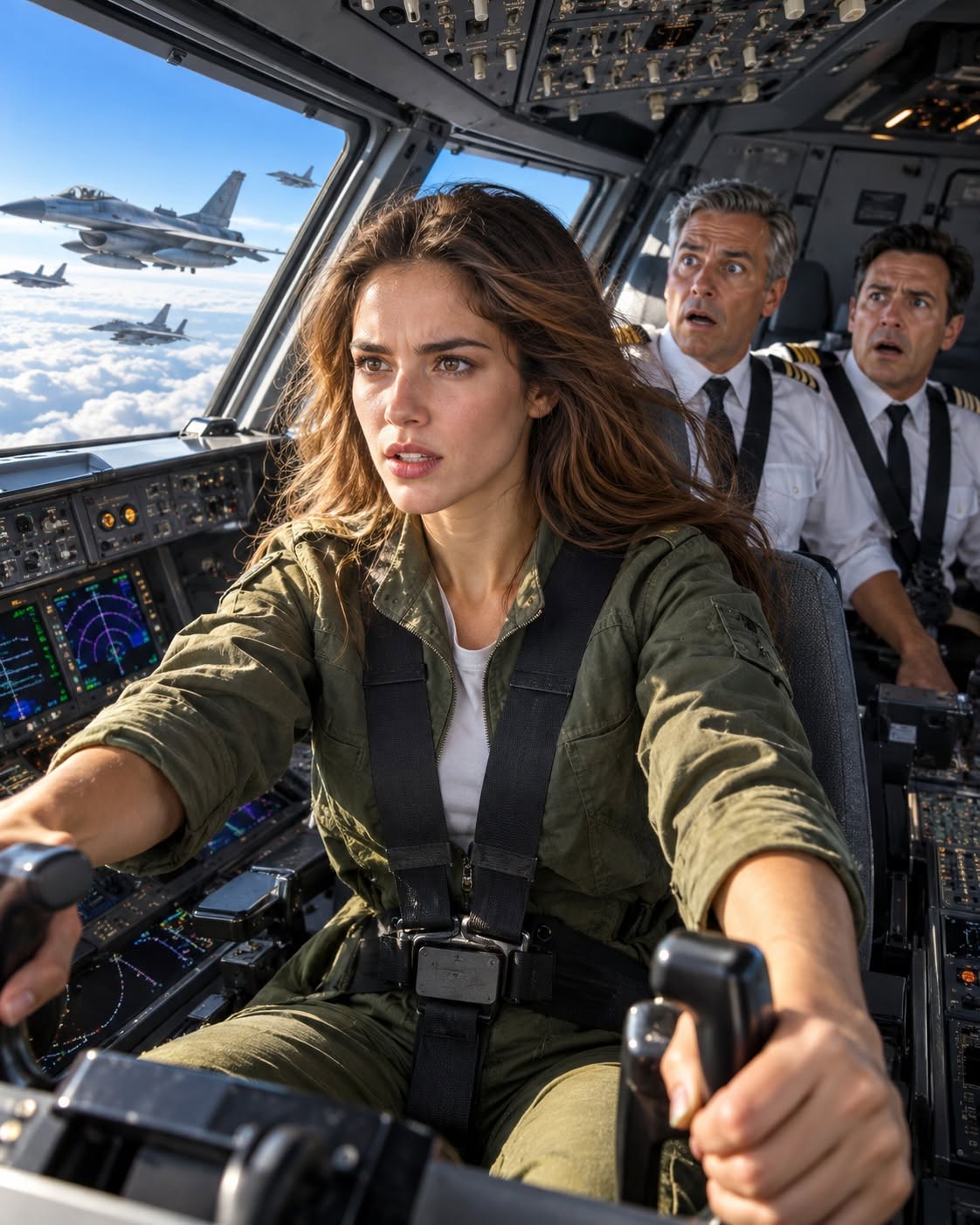
“Agreed. Let’s bring everyone home.”
What happened next would test everything I had learned in more than forty years of flying.
And it would force me to face a promise I had made to a grieving family long before any of these passengers knew my name.
FORTY YEARS EARLIER
My name is Daniel Mercer.
I was sixty-eight years old when I boarded that commercial flight, but most people would have guessed I was older.
My hair had turned completely white. My hands were marked with age, and my knees complained whenever I climbed stairs.
I was wearing an old straw hat, a light blue shirt, sandals, and a pair of trousers that had seen better days.
I had never been particularly interested in looking impressive.
For most of my adult life, I had worn uniforms.
First, as a military pilot.
Later, as an instructor responsible for teaching younger pilots how to stay alive when everything went wrong.
I had flown transport aircraft, military tankers, and several other aircraft during my career. I had also spent years teaching emergency procedures in flight simulators.
I had retired after a long career and moved to a quiet coastal town.
My wife, Margaret, had passed away three years earlier.
Since then, I had developed a habit of traveling without much luggage, visiting places we had once dreamed of seeing together.
That particular flight was taking me to visit my granddaughter, Emily.
She had recently graduated from nursing school and had invited me to spend a few days with her.
I was looking forward to seeing her.
I had no idea that I would soon become responsible for the lives of more than two hundred strangers.
But the fighter pilot’s words had taken me somewhere I had spent forty years trying not to visit.
Back to the winter of 1986.
Back to the night of the storm.
Back to the man named Captain Robert Hayes.
Robert had been my closest friend during my early military career.
He was the kind of man who could make an entire room laugh without telling a single joke.
He was also one of the finest pilots I had ever known.
We had flown together on several dangerous missions, and I trusted him more than I trusted anyone.
One winter night, we were assigned to escort a military transport aircraft carrying emergency medical supplies through a severe storm.
The weather deteriorated much faster than expected.
Lightning illuminated the clouds, turbulence shook our aircraft, and radio communication became increasingly difficult.
During the mission, Robert’s aircraft developed a serious mechanical problem.
His engines were losing power.
I heard his voice over the radio.
“Daniel, I’ve got a problem. I’m losing thrust.”
I immediately requested permission to assist him.
The storm was so violent that even maintaining formation became difficult.
Then the radio crackled again.
“Daniel, you need to get clear. I don’t want you going down with me.”
“Negative, Robert. We’re getting you home.”
He laughed.
Even then, he found time to laugh.
“You always were too stubborn to follow instructions.”
I tried to guide him toward a safer route, but the weather was closing in.
His aircraft began losing altitude.
I could hear his breathing through the radio.
Then came the words I would remember for the rest of my life.
“Daniel, if anything happens to me, tell my boy that his father wasn’t afraid.”
I shouted at him to keep talking.
But there was no answer.
A moment later, his aircraft disappeared from my radar.
Search teams found the wreckage two days later.
Robert had not survived.
His son, Michael, was only six years old.
At his funeral, I stood beside the boy and promised him something.
I promised that I would always tell him the truth about his father.
I promised that Robert had been brave, that he had fought until the very end, and that he had tried to protect everyone around him.
But life moved on.
Military assignments took me to different countries.
Michael’s family moved away.
Eventually, our paths separated.
I never forgot the promise.
I simply never got the chance to fulfill it properly.
And now, forty years later, his son was flying beside me in a fighter jet.
BACK TO THE PRESENT
“Daniel? Are you still with us?”
The fighter pilot’s voice pulled me back into the cockpit.
“Yes. I’m here.”
“My name is Michael Hayes. I’m Captain Robert Hayes’s son.”
I closed my eyes briefly.
“Michael,” I whispered.
“You remember my father?”
“I remember him every day.”
There was a pause.
Then Michael spoke again.
“I’ve heard your name my entire life. My mother told me you were the last person to speak to my father.”
I swallowed.
“I wish I could have brought him home.”
“You tried,” Michael replied. “I know that.”
There was something in his voice that surprised me.
It wasn’t anger.
It was something closer to grief that had finally found somewhere to rest.
But we had no time to discuss the past.
A loud alarm sounded inside the cockpit.
One of the aircraft’s electrical systems was malfunctioning, and the instruments were displaying conflicting information.
I glanced at the flight controls.
The commercial aircraft was still responding, but the situation was becoming increasingly complicated.
“Michael, I need you to do something for me.”
“Anything, sir.”
“Ask your controller to coordinate with the airline’s technical operations team. I need the aircraft type, its emergency procedures, and any available information about this particular malfunction. I also need the nearest suitable airport with the appropriate emergency services.”
“Understood.”
I turned toward the senior flight attendant, who was standing behind me.
Her name was Laura.
She had been working for the airline for seventeen years, and although her face was pale, she was doing everything possible to remain composed.
“Laura, I need you to contact the cabin crew. Tell them to keep everyone seated, fastened in, and away from the aisles. Make sure they follow the airline’s emergency procedures.”
She nodded.
“Is there anything else?”
“Yes. I need you to find out whether anyone on board has medical training. We may need help with the passengers and the pilots.”
She immediately left.
I returned my attention to the aircraft.
I had to remind myself of something I had taught hundreds of young pilots.
Panic does not make a problem disappear.
It only makes it harder to solve.
I was not a commercial airline pilot, and I knew better than to pretend that military experience automatically made me qualified to operate every civilian aircraft.
I needed information, coordination, and support.
Most importantly, I needed to keep everyone alive.
THE FIRST SURPRISE
A few minutes later, Michael returned on the radio.
“Daniel, we’ve received the aircraft information. The airline’s operations center is joining the emergency coordination. An experienced commercial pilot is also being connected to the frequency.”
“Good. Let’s use every resource available.”
Then Michael said something else.
“There is another problem.”
I looked at the fighter jet beside us.
“What is it?”
“The weather at the nearest airport is deteriorating. The runway is available, but the crosswinds are increasing.”
I looked at the weather information being relayed from air traffic control.
The situation was not ideal.
However, there was another airport farther away with better conditions.
The problem was that the aircraft might not have enough time to reach it safely.
“What’s the estimated weather window at the closer airport?” I asked.
The controller provided an update.
We discussed the available options, and the airline’s ground team began coordinating with the airport.
Then Michael spoke again.
“Daniel, my commander wants to know whether you’re comfortable continuing toward that airport.”
I looked at the instruments.
“I want the commercial aviation team to confirm the aircraft’s limitations and the appropriate approach. I won’t gamble with two hundred lives to protect my pride.”
There was a short silence.
Then Michael answered.
“Understood, sir.”
I almost smiled.
Robert would have been proud of the way his son spoke.
A VOICE FROM THE CABIN
While the ground teams worked, Laura returned to the cockpit.
She looked exhausted.
“Sir, we’ve identified a doctor and two nurses among the passengers. They’re helping monitor the cabin.”
“Good. What about the passengers?”
“Most are frightened, but they’re cooperating.”
She hesitated.
“There’s something else.”
“What is it?”
“One of the passengers has been asking about you.”
I frowned.
“Me?”
“Yes. An older gentleman in seat 18C. He says he recognizes your name.”
I looked at her.
“What is his name?”
“Arthur Collins.”
The name meant nothing to me.
Laura continued.
“He says he was an air traffic controller many years ago. He heard your military call sign over the radio during an incident in the 1980s.”
My heart began beating faster.
“What incident?”
“He didn’t explain. He just said he needs to speak to you.”
I looked toward the cockpit door.
“Can he communicate through the cabin intercom?”
Laura shook her head.
“He’s helping the other passengers. But he wrote something on a piece of paper and asked me to give it to you.”
She handed me a folded note.
I opened it.
There were only two sentences.
Daniel Mercer. If you are the man I think you are, tell Michael Hayes that his father did not die because you abandoned him.
I read the words twice.
Then a third time.
My throat tightened.
I looked at Laura.
“Did he say anything else?”
“He said you would understand.”
I folded the paper carefully and placed it in my pocket.
For forty years, I had carried a burden that I had never fully discussed with anyone.
I had always wondered whether I could have done more that night.
Whether I should have taken a different route.
Whether one more attempt to reach Robert might have changed the outcome.
And now a stranger was telling me something I had never heard before.
THE SECRET OF THAT NIGHT
I asked Laura to arrange a brief communication with Arthur through the cabin intercom, provided it did not interfere with emergency operations.
A few minutes later, I heard an elderly man’s voice.
“Daniel Mercer?”
“Yes. This is Daniel.”
“My name is Arthur Collins. I was working at the regional air traffic control center on the night Robert Hayes disappeared.”
I gripped the side of the console.
“Do you remember that mission?”
“I remember every minute of it.”
“Why did you write that note?”
Arthur took a breath.
“Because I was the controller who handled your emergency calls that night. And there is something I should have told you a long time ago.”
I said nothing.
He continued.
“Robert’s aircraft had suffered a mechanical failure. We lost reliable contact with him, but his aircraft did not disappear immediately. We received a final transmission.”
My chest tightened.
“What did he say?”
Arthur hesitated.
“He said you had done everything possible. He specifically asked that nobody blame you.”
I looked down.
The cockpit suddenly seemed very quiet.
Arthur continued.
“But there was more. Before the transmission ended, he gave us his last known position and reported that he had directed his aircraft away from a populated area.”
I closed my eyes.
That was something I had never known.
Robert had made a final decision to protect people on the ground.
Arthur’s voice became softer.
“He saved lives that night, Daniel. More lives than you ever knew.”
For a moment, I couldn’t speak.
Then I heard Michael’s voice over the military frequency.
“Daniel? What happened?”
I looked toward the fighter jet.
“Michael, your father was a good man.”
“I know.”
“No. I mean you need to know something. Your father made a decision that night that saved people he would never meet. He didn’t abandon his aircraft, and he didn’t stop fighting.”
Michael did not answer immediately.
Then his voice came back, quieter than before.
“My mother always said that.”
I looked at the folded note in my pocket.
“Your father asked that nobody blame me. I wish I’d known that forty years ago.”
Michael’s voice cracked.
“I wish he’d come home.”
“So do I, son.”
For the first time since the emergency began, I felt something inside me loosen.
But the aircraft was still in danger.
And the hardest part was still ahead.
THE PASSENGER NOBODY EXPECTED
The airline’s operations center finally connected us with a senior commercial captain who had extensive experience with the aircraft type.
He was on the ground, reviewing the information and coordinating with air traffic control.
We discussed the aircraft’s condition, the available options, and the emergency landing preparations.
I listened carefully.
The situation was deteriorating, but there was still a chance.
Then Laura returned with another message.
“Sir, there’s a young woman in the cabin who says she can help.”
“Help how?”
“She works for the aircraft manufacturer. She’s an engineer specializing in flight-control systems.”
I looked at Laura.
“Is she familiar with this aircraft?”
“She says she’s worked on its electrical systems and knows the relevant technical documentation.”
“Bring her information to the airline’s operations team. Have them verify her credentials and coordinate with the commercial captain.”
Laura nodded.
Before she left, I asked another question.
“How are the pilots?”
Her expression changed.
“One is still unconscious. The other has started responding, but the doctor says he needs immediate medical attention.”
I looked at her.
“Keep the medical team ready. We need to get them both safely onto the ground.”
She nodded again.
Then she hesitated.
“Sir?”
“Yes?”
“People are asking who you are.”
I glanced at my reflection in the dark cockpit window.
A tired old man with white hair, a straw hat, and a shirt that had become damp with sweat.
“Tell them I’m just another passenger doing what I can.”
Laura gave me a small smile.
“I don’t think anyone believes that anymore.”
THE DESCENT
The next twenty minutes felt longer than the previous forty years.
The weather continued changing.
The aircraft’s systems were behaving unpredictably, and the technical team was working to help us understand what the warning indications meant.
The commercial captain remained connected through the emergency communication channel.
He was calm, precise, and professional.
Michael and his fellow fighter pilot maintained visual contact when conditions allowed.
Air traffic control cleared the airport for an emergency arrival and arranged for fire crews, ambulances, and emergency medical personnel.
Meanwhile, Laura kept the cabin informed.
I could hear her voice over the intercom.
“Ladies and gentlemen, I know this is frightening. Our flight crew and emergency support teams are working together. Please remain seated, keep your seat belts fastened, and follow the crew’s instructions.”
There were still cries from the cabin.
A little girl was asking her mother whether they were going to die.
I heard the mother trying to comfort her.
Then another voice spoke.
It was Arthur Collins.
“Sweetheart, look at me. My name is Arthur. I’ve been around airplanes most of my life. I want you to know that everyone up here is working very hard to get you home.”
The little girl stopped crying for a moment.
“Are you a pilot?”
Arthur chuckled softly.
“No, sweetheart. I was the man who helped pilots find their way home.”
I smiled despite myself.
Even at his age, Arthur still knew how to calm frightened people.
Then Michael’s voice returned.
“Daniel, we have a clear visual on the runway area. Weather is changing, but the airport remains available.”
“Understood.”
“There’s something I want to tell you.”
“Go ahead.”
“My father kept a photograph of you in his locker. My mother gave it to me after he died.”
I looked at the controls.
“I didn’t know that.”
“He wrote something on the back.”
“What?”
“Two stubborn men. One aircraft. And enough courage to get us home.”
I closed my eyes briefly.
That sounded exactly like Robert.
Michael continued.
“I used to hate that photograph. I thought it meant you had somehow taken his place.”
I said nothing.
“But when I joined the military, I learned about the incident. I understood what happened. I wanted to meet you one day, but I never imagined it would happen like this.”
I gave a quiet laugh.
“Life has a strange sense of humor.”
“Yes, sir. It does.”
Then Michael said something that stayed with me.
“Whatever happens today, I want you to know that I don’t blame you.”
I felt my eyes grow wet.
“Thank you, Michael.”
“Now let’s get those people on the ground.”
THE MOMENT EVERYTHING CHANGED
We were approaching the airport when the cabin crew reported another medical emergency.
A passenger had collapsed.
A doctor was treating him, but the man was not responding normally.
Laura came back to the cockpit.
“Sir, the doctor believes he may be having a serious cardiac event. He needs emergency medical attention as soon as possible.”
I looked at the airport information.
“Tell the controller. Make sure medical personnel are ready to receive him.”
She nodded.
Then she looked at me with an expression I would never forget.
“Sir, there are children on this plane. There’s a pregnant woman. There’s an elderly couple celebrating their fiftieth anniversary.”
She paused.
“Everyone has someone waiting for them.”
I looked at her.
“I know.”
“No,” she whispered. “I don’t think you do.”
She pointed toward the cockpit door.
“People were laughing at your clothes when you stood up. Some thought you were crazy. But now they’re all praying that you’ll get them home.”
I took a slow breath.
“Laura, I don’t need them to believe in me. I need them to follow your instructions and give us the best possible chance.”
She nodded.
Then she returned to the cabin.
I looked at the runway through the windshield.
The airport lights were visible through the clouds.
For the first time, I could see the ground clearly.
But the aircraft was still unstable, and the approach required every bit of concentration available.
The commercial captain continued advising us through the emergency channel.
Air traffic control provided updated conditions.
Michael maintained his position outside.
And I followed the coordinated emergency plan, one decision at a time.
Then the fighter pilot spoke.
“Daniel, my aircraft is experiencing turbulence. I’m moving slightly ahead of you to maintain a safe visual reference.”
“Understood.”
He paused.
“Sir?”
“Yes?”
“My father would be proud.”
I couldn’t answer.
I simply nodded, even though he couldn’t see me.
THE LANDING
The runway was getting closer.
The warning alarms continued sounding.
The aircraft shook as it passed through a patch of rough air.
I heard someone in the cabin scream.
Then Laura’s voice came through.
“Cabin secured. Passengers seated. Crew ready.”
I acknowledged her.
The commercial captain continued providing guidance.
The controller confirmed the runway was clear.
Michael’s fighter jet moved into a safe position.
For one brief moment, I remembered Robert’s voice.
Daniel, you need to get clear.
I remembered the storm.
The lightning.
The final transmission.
And the promise I had made to a six-year-old boy.
I had spent forty years wondering whether I had failed my friend.
Now his son was beside me, helping bring a damaged passenger aircraft safely home.
I felt a strange sense of peace.
Not because I knew what would happen.
But because I knew I had done everything I could.
The aircraft crossed the runway threshold.
The ground rushed toward us.
I followed the landing plan that had been coordinated with the commercial aviation team.
A few seconds later, the wheels touched the runway.
There was a tremendous vibration.
The aircraft bounced slightly.
Then it settled.
For a moment, everything seemed to happen at once.
The cabin erupted in screams.
The engines roared.
The emergency vehicles raced toward us.
Then the aircraft slowed.
And finally, it stopped.
Completely.
Silence.
For three seconds, nobody moved.
Then the cabin erupted in applause.
People were crying, hugging one another, and thanking God.
A flight attendant began sobbing.
Laura rushed into the cockpit.
“Sir… we made it.”
I took off my headset.
“Are the passengers okay?”
“Everyone is being accounted for. The medical team is coming aboard.”
“What about the pilots?”
“They’re alive. They’re being taken to the hospital.”
I closed my eyes.
“Good.”
Laura looked at me.
Then she did something I hadn’t expected.
She took my hand and kissed it.
“Thank you.”
I gently pulled my hand away.
“Don’t thank me alone. You kept those passengers together when they needed you most.”
She shook her head.
“You don’t understand what you did.”
I looked at her.
“I think I do.”
She began crying again.
Then I heard a voice over the radio.
“Commercial aircraft, this is your escort. Confirm safe landing.”
I picked up the microphone.
“Confirmed. We’re on the ground.”
Michael responded immediately.
“Thank God.”
I smiled.
“Your father would have liked that landing.”
There was a long silence.
Then Michael said:
“I think he would have liked the pilot, too.”
THE MAN IN THE STRAW HAT
When the aircraft finally came to a complete stop and emergency personnel secured the scene, the passengers began disembarking under the direction of the airport teams.
Medical personnel rushed to the pilots.
The unconscious captain was taken directly to the hospital.
The first officer was conscious but needed further evaluation.
The passenger who had suffered the cardiac emergency was also transported for treatment.
Later, we learned that he had survived.
The airline’s management team arrived at the airport.
So did several military officers.
I was sitting in a quiet room near the terminal when the airline’s chief operations officer approached me.
He was a tall man wearing an expensive suit.
“Mr. Mercer?”
I stood up.
“Yes.”
He extended his hand.
“My name is Thomas Reed. On behalf of the airline, I want to thank you for your extraordinary assistance.”
I shook his hand.
“Your people did their jobs. The controller, the commercial captain, the flight attendants, the medical team, and the military escort all contributed.”
He nodded.
“We’re aware of that. But without you, things could have ended very differently.”
I didn’t respond.
He continued.
“We would like to issue a public statement recognizing your actions.”
I looked at him.
“Please recognize the crew and the emergency teams, too.”
“Of course.”
He smiled.
“And we’d like to offer you lifetime complimentary travel with our airline.”
I almost laughed.
“That’s generous, but I don’t need it.”
He looked surprised.
“Is there anything we can do for you?”
I thought about it.
Then I asked him a question.
“Have you checked on the families of the two pilots?”
He nodded.
“Our medical and passenger support teams are contacting everyone involved.”
“Good. And make sure the flight attendants receive proper support. They went through something terrible.”
He promised he would.
Then I added:
“One more thing. Don’t let the story become about an old man saving a plane. That isn’t what happened.”
He listened carefully.
“What should it be about?”
I looked through the window toward the aircraft.
“It’s about people doing their jobs, trusting one another, and refusing to give up when things become difficult.”
He nodded.
“I understand.”
But the biggest surprise of the day was still waiting for me.
THE SON OF MY OLD FRIEND
I was walking toward the airport’s medical center when I saw Michael Hayes standing near the entrance.
He had removed his flight helmet and was carrying it under one arm.
He looked younger than I remembered Robert.
But his eyes were unmistakably his father’s.
When he saw me, he walked forward.
For a moment, neither of us spoke.
Then he extended his hand.
“Daniel Mercer.”
I shook it.
“Captain Hayes.”
He smiled.
“You can call me Michael.”
We stood there for several seconds.
Then he looked down at my clothes.
“You really did fly that whole emergency dressed like that?”
I laughed.
“Would you have preferred a uniform?”
“No. I think the straw hat makes the story better.”
We both laughed.
Then his expression became serious.
“My mother passed away last year.”
I lowered my head.
“I’m sorry, Michael.”
“She kept my father’s things until the end. His medals, his letters, and that photograph.”
He reached into a pocket and removed a small, faded picture.
It showed two young men standing beside a military aircraft.
One was Robert.
The other was me.
I hadn’t seen it in decades.
Michael turned the photograph over.
There was Robert’s handwriting.
Two stubborn men. One aircraft. And enough courage to get us home.
I stared at the words.
Then I noticed something beneath them.
A second sentence had been written in smaller letters.
If I ever have a son, I hope he learns that being brave doesn’t mean being fearless. It means doing the right thing even when you’re afraid.
My eyes filled with tears.
Michael handed me the photograph.
“My mother told me that my father wanted you to have this one day.”
I shook my head.
“No. It belongs with you.”
Michael gently closed my fingers around it.
“He wanted you to keep it.”
I looked at him.
“Are you sure?”
He nodded.
“I have the original. My mother kept another copy.”
I held the photograph against my chest.
Then Michael surprised me again.
“There’s something else.”
“What is it?”
“I’d like you to come to the military academy next month. I’m giving a presentation to the new pilots about responsibility and emergency decision-making.”
I smiled.
“I’m retired, Michael.”
“I know.”
“I don’t think young pilots want to listen to an old man telling stories.”
Michael laughed.
“Trust me. They will after they hear what happened today.”
I considered his invitation.
Then I nodded.
“All right. But only if you let me tell them about your father.”
Michael’s eyes became wet.
“That’s exactly why I’m asking.”
THREE DAYS LATER
The story spread quickly.
By the following morning, television stations were reporting that an elderly former military pilot had helped bring a passenger aircraft safely to the ground after both pilots became incapacitated.
Some headlines called me a hero.
Others described me as a mysterious military veteran who had saved more than two hundred lives.
A photograph of me wearing my straw hat was shared thousands of times.
People began sending messages.
Some thanked me.
Some wanted to know where I had learned to fly.
Others asked whether I had been frightened.
The truth was simple.
I had been terrified.
I was terrified for the passengers.
I was terrified for the crew.
And I was terrified that one wrong decision could cost lives.
But fear was not something I needed to defeat.
It was something I needed to recognize and control.
One television reporter asked me whether I considered myself a hero.
I thought about the question for a moment.
Then I answered:
“No. Heroes are not always the people standing at the front. Sometimes they’re the flight attendant holding a frightened child’s hand. Sometimes they’re the air traffic controller who stays at his desk when everyone else has gone home. Sometimes they’re the engineer working through the night to understand a problem. Sometimes they’re the stranger sitting beside you who refuses to let you give up.”
The reporter nodded.
“Then what would you call yourself?”
I smiled.
“A man who happened to be in the right seat at the wrong time.”
The interview ended.
But something unexpected happened afterward.
I received a letter from the wife of the captain who had collapsed.
Her name was Susan.
She wrote that her husband had survived but was still recovering.
She also told me that he had asked to speak with me as soon as he was able.
I called her that evening.
She began crying when she heard my voice.
“He keeps saying he wants to thank you.”
I told her there was no need.
But she insisted.
“He says you gave him another chance to see his children.”
I sat quietly for a moment.
Then I said:
“Please tell him to get well. He still has plenty of flying stories to tell.”
THE PROMISE
A month later, I traveled to the military academy.
I wore the same straw hat.
I wore the same sandals.
And I wore the same simple shirt.
When I entered the auditorium, hundreds of young pilots were waiting.
Michael stood near the stage.
He introduced me as a former military pilot and instructor who had recently helped an emergency commercial flight.
The students applauded.
I waited until they were quiet.
Then I placed an old photograph on the table.
It showed Robert Hayes and me standing beside an aircraft.
I told them about the storm in 1986.
I told them about the radio transmission.
I told them about the promise I had made to a little boy.
And I told them about the passenger aircraft.
But I did not describe the landing as a miraculous achievement.
I described it as a series of decisions made by people who understood their responsibilities.
I told them that the most dangerous words a pilot could ever say were:
“I know everything. I don’t need anyone’s help.”
A few students smiled.
I continued.
“Experience is valuable. Confidence is valuable. Training is essential. But none of those things makes you invincible.”
I looked across the room.
“Sometimes the bravest thing you can do is admit that you need help. Sometimes the smartest decision is to listen to someone with more experience in a particular situation. And sometimes your greatest responsibility is to remain calm enough to let other people do their jobs.”
Then I held up Robert’s photograph.
“This man taught me something I carried throughout my entire career. He taught me that courage is not measured by how little fear you feel. It is measured by what you do when fear is the only thing you can feel.”
The room was silent.
I looked at Michael.
He was standing at the back, his eyes fixed on the photograph.
I knew then that the promise I had made forty years earlier had finally been fulfilled.
Not because I had told him his father was brave.
But because he had grown into a man who understood what bravery meant.
AN UNEXPECTED VISITOR
After the presentation, several young pilots approached me.
They asked questions about my military career, my training, and the emergency flight.
One young woman asked:
“Sir, if you could go back and change one thing about your life, what would it be?”
I thought about Margaret.
I thought about Robert.
I thought about the years I had spent wondering whether I could have done more.
Then I answered honestly.
“I would spend less time believing that silence is the same thing as strength.”
She frowned slightly.
I explained.
“For years, I carried the guilt of losing my friend. I thought talking about it would make me weak. I thought I had to keep moving forward without looking back.”
I paused.
“But sometimes the things we refuse to discuss become heavier than the things we actually have to face.”
The young woman nodded.
Then an older man approached me.
He was wearing a dark jacket and walking with a slight limp.
I recognized him immediately.
It was Arthur Collins.
The retired air traffic controller from the passenger flight.
I hadn’t known he would be there.
“Daniel,” he said.
I smiled.
“Arthur. What are you doing here?”
He chuckled.
“Michael invited me.”
He extended his hand.
“I thought it was about time we finished that conversation from the airplane.”
We sat together near the back of the auditorium.
Arthur told me that after the incident in 1986, he had attempted several times to contact me.
But military transfers and changes in assignments made it difficult.
He had eventually retired without ever getting the opportunity.
“I should have found you,” he said.
I shook my head.
“You were doing your job. None of us knew where life would take us.”
He looked at the photograph on the table.
“Robert was a remarkable man.”
“Yes,” I replied. “He was.”
Arthur smiled.
“Do you know what I remember most about that night?”
“What?”
“You never stopped asking about the other aircraft. Every time I gave you an update, you asked whether Robert was safe.”
I lowered my head.
Arthur continued.
“You weren’t trying to be a hero. You were trying to bring your friend home.”
I looked at the photograph again.
For the first time in forty years, remembering that night did not feel like reopening a wound.
It felt like honoring someone I loved.
THE LAST FLIGHT
Six months later, I received an invitation from the airline.
They were organizing a small reunion for the passengers and crew who had been aboard the emergency flight.
The captain had recovered sufficiently to attend.
The first officer was also there.
So were Laura, Arthur, Michael, and several members of the ground emergency teams.
When I entered the room, everyone stood up.
I felt embarrassed.
I had never liked being the center of attention.
Laura approached me first.
She was wearing a simple black dress.
“Mr. Mercer.”
“Laura.”
She hugged me.
Then she introduced me to the captain.
His name was James Peterson.
He was still recovering, but he looked much healthier than the last time I had seen him.
He extended his hand.
“Sir, I owe you my life.”
I shook my head.
“You owe your life to the people who treated you and the medical team that helped you recover.”
He smiled.
“Perhaps. But I wanted to say something.”
I waited.
“When I woke up in the hospital, the first thing I asked was whether the passengers were safe. The second thing I asked was who had helped bring the aircraft down.”
He laughed softly.
“When they told me an old man in sandals had stepped forward, I thought they were joking.”
Everyone laughed.
Then he became serious.
“I’ve spent my career teaching young pilots that the cockpit is a place of responsibility. That day, you reminded me that responsibility doesn’t disappear just because someone is no longer wearing a uniform.”
I looked at him.
“I’m glad you’re here.”
He nodded.
“Me too.”
Later, the airline presented me with a small wooden plaque.
It had a photograph of the aircraft and the names of the crew and emergency teams.
Beneath it was a sentence:
No one brings an aircraft home alone.
I read it twice.
Then I smiled.
That was exactly right.
The plaque did not carry my name alone.
It carried the names of everyone who had helped.
And that made it worth keeping.
THE LETTER FROM MARGARET
That evening, after the reunion, I returned to my hotel room.
I placed the plaque on the desk and removed the old photograph of Robert from my pocket.
Then I opened my suitcase.
Inside was a small envelope I had carried for years.
It contained a letter Margaret had written to me shortly before she died.
I had read it many times, but never without tears.
She knew how much Robert’s death had affected me.
She had watched me wake up in the middle of the night, remembering the storm.
She had listened to me wonder whether I should have done more.
In the letter, she had written:
Daniel, you have spent your whole life trying to bring people home. But I want you to understand something. You cannot save everyone. You cannot control every storm, repair every broken machine, or change every ending. What you can do is love people while you have them, help when you are able, and never let yesterday’s sorrow steal tomorrow’s happiness.
I read those words slowly.
Then I looked at Robert’s photograph.
I thought about Michael.
I thought about the passengers.
I thought about the little girl who had asked Arthur whether she was going to die.
And I realized something.
For years, I had believed that my story was about a friend I had lost.
But perhaps it had always been about the people who remained.
The people who needed someone to show up.
The people who needed reassurance.
The people who needed to know that even when life became frightening, they were not alone.
I folded Margaret’s letter and placed it beside the photograph.
Then I went to the window.
Outside, an aircraft was climbing into the evening sky.
Its lights disappeared slowly into the clouds.
I smiled.
For the first time in many years, I felt no need to follow it with my eyes.
ONE FINAL PROMISE
The following spring, Michael invited me to visit his mother’s grave.
He had arranged for us to meet at a small cemetery overlooking the ocean.
The day was bright, and the wind carried the smell of salt through the trees.
We stood beside the headstone for a long time.
Michael placed a photograph of his father beneath the flowers.
Then he looked at me.
“Daniel, do you think he knew he wouldn’t make it home?”
I considered the question.
“I don’t know. But I know he never stopped trying.”
Michael nodded.
“Sometimes I wonder what he would have been like if he’d lived.”
I smiled sadly.
“He would have been proud of you.”
“How can you know?”
“Because I knew the man who raised the standard you’re trying to live up to.”
Michael looked toward the ocean.
“I spent so many years thinking I needed to become a pilot to understand him.”
“And now?”
“Now I think I understand him because of what he taught me about people.”
I nodded.
“That’s a better lesson.”
We stood together for another moment.
Then Michael turned toward me.
“There’s one thing I’ve wanted to ask you.”
“Go ahead.”
“When you stood up on that aircraft and offered to help, weren’t you afraid that everyone would blame you if something went wrong?”
I laughed quietly.
“Of course I was.”
“Then why did you stand up?”
I looked at the headstone.
Then I looked at the photograph in Michael’s hand.
“Because I knew what it felt like to be the person waiting for help. And I knew that if I stayed in my seat without even offering what I could, I would regret it for the rest of my life.”
Michael nodded slowly.
I continued.
“But remember something. Standing up doesn’t always mean taking control. Sometimes it means asking for help, giving someone else a chance, or simply refusing to abandon the people who need you.”
He smiled.
“I’ll remember that.”
Before we left, I placed my hand on Robert’s headstone.
“I kept my promise, old friend,” I whispered.
The wind moved gently through the trees.
For a moment, I could almost hear his laugh.
And I finally understood that some promises do not end when the people who made them are gone.
They live on in the people who remember.
THE REAL MEANING OF COURAGE
A year after the emergency, the airline invited me to speak at a safety conference.
I was asked to talk about the incident and what I had learned from it.
I stood before a room filled with pilots, engineers, flight attendants, and aviation professionals.
I looked at the audience and began with a simple question.
“How many of you have ever been afraid?”
Nearly every hand went up.
I smiled.
“Good. That means you’re human.”
The room laughed.
Then I became serious.
“Fear is not the enemy. Arrogance is. Silence is. The belief that we are too important to ask for help is.”
I told them about Robert.
I told them about the storm.
I told them about the commercial flight and the people who worked together to bring it safely to the ground.
Then I said something I had never said publicly before.
“For forty years, I believed that the greatest failure of my life was not bringing my friend home. But I was wrong. My greatest failure was allowing that guilt to convince me that his life should only be remembered through the way it ended.”
The room was silent.
“Robert was more than a pilot who died in a storm. He was a father. A friend. A man who made people laugh. A man who loved his family. A man who chose to protect strangers when he had very little time left.”
I paused.
“And every one of us has the power to leave that kind of legacy. Not necessarily through extraordinary acts, but through ordinary decisions made with courage, honesty, and compassion.”
When I finished, the audience stood and applauded.
But I wasn’t thinking about the applause.
I was thinking about a little boy who had lost his father.
A flight attendant who had refused to give up.
A retired controller who had finally told the truth.
And a young fighter pilot who had discovered that his father’s legacy was still alive.
As I walked out of the conference hall, Michael was waiting near the door.
He handed me a small package.
“What’s this?”
“Something my mother wanted you to have.”
I opened it carefully.
Inside was a silver military aviation pin that had belonged to Robert.
On the back was a tiny engraving.
For the man who never stopped trying.
I looked at Michael.
He smiled.
“She always said you deserved it.”
I held the pin in my palm.
Then I did something I had not done in decades.
I cried without trying to hide it.
Michael put his hand on my shoulder.
And for the first time, I understood that the boy whose father I had once promised to remember had become the person helping me put the past to rest.
EPILOGUE: THE OLD MAN IN SEAT 18A
People still ask me about the day I helped bring that passenger aircraft safely to the ground.
Some want to know whether I was a hero.
Others want to know whether I would do it again.
My answer is always the same.
I was not a hero.
I was simply a man who had spent his life learning that when trouble comes, the most important thing is not who receives the credit.
It is whether everyone gets the chance to go home.
I still travel.
I still wear my straw hat.
I still prefer simple shirts and comfortable sandals.
And whenever I board a plane, I look around at the passengers.
I see families traveling together.
Grandparents visiting grandchildren.
Young people beginning new lives.
Businessmen returning home.
Children looking out the windows, amazed by the clouds.
Every one of them carries a story.
Every one of them has someone waiting at the other end.
Sometimes, a passenger recognizes me.
They approach quietly and say:
“Are you the old pilot from that emergency flight?”
I usually smile.
“Yes. That was me.”
Then they ask:
“Were you scared?”
And I tell them the truth.
“Yes. Very scared.”
They often look surprised.
So I explain.
“Courage isn’t the absence of fear. It’s deciding that someone else’s life matters more than your fear.”
A few months ago, I received a photograph from Michael.
He was standing beside a group of young pilots at the academy.
Behind them was a framed picture of his father.
Underneath it was a sentence:
The greatest pilots aren’t remembered only for the aircraft they flew, but for the lives they protected.
I placed the photograph beside Margaret’s letter and Robert’s old picture.
Three reminders of the people who had shaped my life.
And sometimes, late at night, when the world is quiet, I think about that commercial flight.
I remember the smell of burning oil.
The oxygen masks falling.
The frightened passengers.
The flight attendant who asked whether I was a pilot.
And the question that changed everything:
“What kind of aircraft have you flown?”
I remember how uncertain everyone was when I first stood up.
I remember how quickly strangers became a team.
And I remember the moment the wheels touched the runway and two hundred people realized they were going to see their families again.
But most of all, I remember something Robert once told me during a long flight many years ago.
He said that a pilot’s greatest achievement wasn’t how high he could fly or how far he could travel.
It was how many people he could help get home.
He was right.
Because life is not measured by the number of people who know your name.
It is measured by the difference you make in the lives of people who may never remember your face.
And if there is one thing I hope people take from my story, it is this:
Never judge a person by their appearance.
The man sitting quietly beside you may have lived a lifetime of experiences you know nothing about.
The person who seems ordinary may carry extraordinary courage.
And the person you overlook today may be the one who stands beside you when your world begins to fall apart.
Sometimes, all it takes to change an ending is one person willing to stand up and say:
“I can help.”
THE END