The senior cadet wrapped his arm around my throat while his classmates laughed. I tapped his arm seven times before everything went black.
THE SEVEN TAPS: THE DAY THE SUPPLY OFFICER SHOWED THEM WHAT COURAGE REALLY MEANT
Master Chief Victor Delgado studied the gold Trident above my pocket.
“Imogen Hart,” he murmured. “I knew there was something familiar about you.”
I smiled faintly.
“Been a while, Master Chief.”
He tried to laugh, but the pain in his leg stopped him.
“Last time I saw you, you were pulling three sailors out of a flooded compartment aboard the USS Mason. You were twenty-three years old.”
“Twenty-four, actually.”
He shook his head.
“Still correcting people. Some things never change.”
Before I could answer, a distant siren cut through the noise.
An ambulance had finally reached the eastern entrance.
I turned back toward Clara.
“How many critical?”
“Four confirmed so far. Two children, one elderly woman, and a man with severe chest trauma. We’re still assessing.”
I glanced toward the wreckage.
“Then we keep moving.”
Victor caught my wrist again.
“Imogen.”
I looked down.
“That boy. The one who had you in the chokehold yesterday. Is he here?”
I followed his gaze.
Brock Halvorsen was running toward the supply annex with Kenji close behind him.
“Yes,” I answered.
Victor’s expression hardened.
“Then watch him carefully.”
I didn’t have time to ask what he meant.
A loud crash came from the direction of Bleacher C.
Someone screamed.
The center section had collapsed completely, trapping several people beneath the wooden platform.
“Clara!”
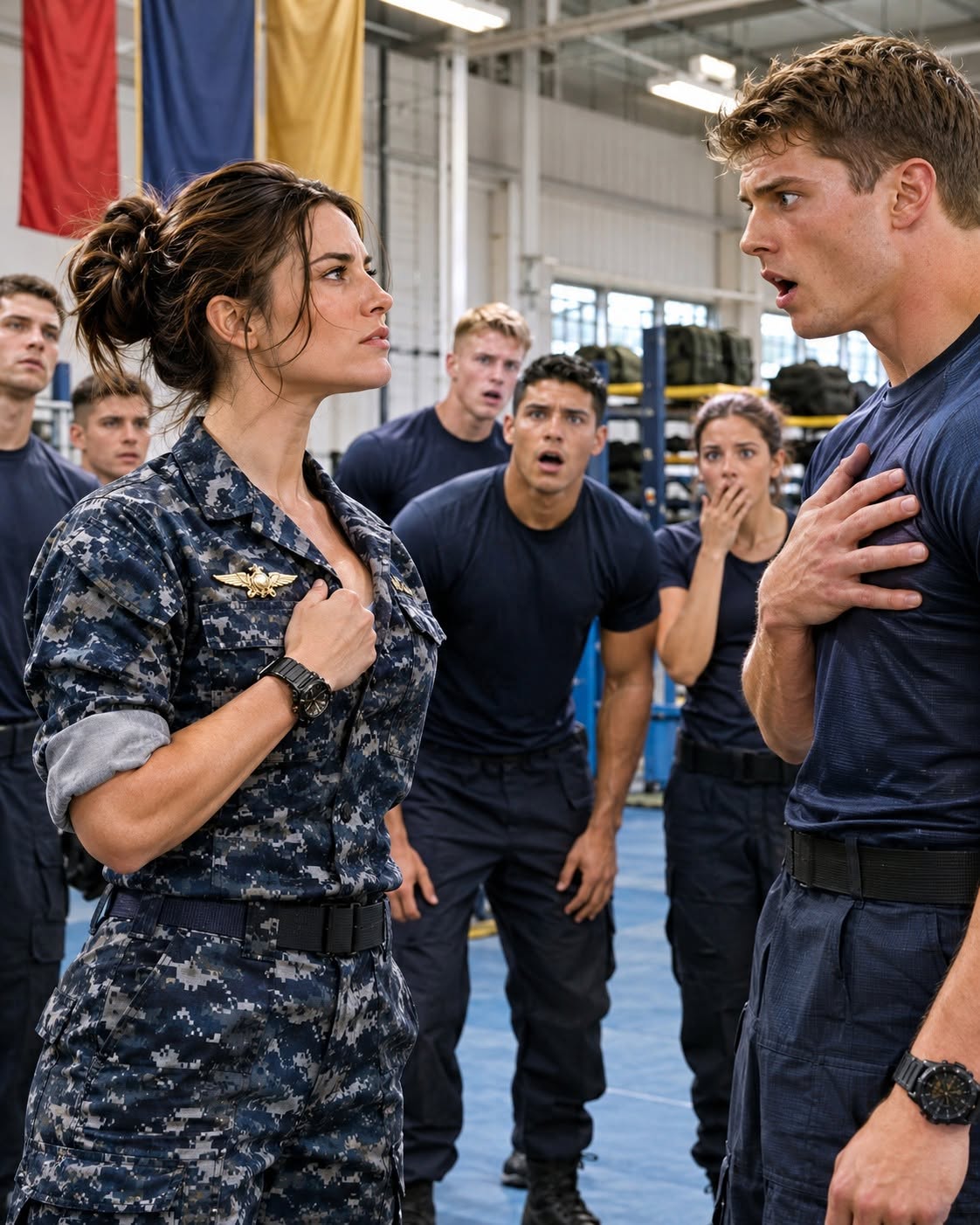
“I see them!”
We ran toward the wreckage.
Three cadets were already trying to lift a heavy support beam.
“Stop!” I shouted. “Nobody lifts that until we know what’s underneath!”
One of the cadets turned.
“There’s a woman under there!”
“And if you shift that beam without stabilizing it, you’ll crush her.”
I scanned the structure.
Two steel supports had snapped. A third was bent but still holding part of the upper platform.
We needed equipment.
“Where are the rescue straps?”
Clara pointed toward an emergency vehicle.
“Inside the trauma kit.”
“Get them.”
I turned toward the cadets.
“Find two intact wooden supports. Nothing rotten, nothing cracked. We need to brace the remaining structure.”
They scattered.
Then I heard a familiar voice.
“Ma’am!”
Kenji appeared, breathing hard.
He was carrying two backboards.
Behind him, Brock struggled with another one.
“Supply annex was locked,” Brock said. “We had to get the spare key from the maintenance office.”
I looked at the backboards.
“Good. Put them here.”
Brock placed his down.
For a moment, our eyes met.
There was no grin this time.
No joke.
Just a frightened young man who had suddenly discovered that the world could become serious without warning.
“Cadet Halvorsen,” I said.
“Yes, ma’am?”
“You’re going to help me stabilize this section.”
He blinked.
“Me?”
“Unless you have somewhere more important to be.”
He swallowed.
“No, ma’am.”
I pointed to the support beam.
“Hold that brace exactly where it is. Do not move until I tell you.”
He obeyed.
Kenji joined two other cadets, helping Clara prepare the backboards.
We worked for nearly twenty minutes.
The woman trapped beneath the platform was conscious but bleeding heavily from a wound above her forehead. Her name was Margaret Ellis, a seventy-two-year-old former history teacher whose grandson was one of the freshmen at Corbett Ridge.
When we finally reached her, she was crying.
“Is my grandson okay?”
I took her hand.
“We’re going to find him. But first, we’re getting you out.”
She squeezed my fingers.
“Please don’t let him see me like this.”
I smiled.
“I’ll do my best.”
The rescue team arrived just as we secured the last support.
They carefully lifted the beam while Clara and I guided Margaret onto the backboard.
When the paramedics carried her away, I noticed Brock standing several feet behind us.
His uniform was covered in dust.
His hands were shaking.
“Good work, Cadet,” I said.
He looked at me as though he hadn’t expected those words.
“Thank you, ma’am.”
I nodded and turned away.
But the worst part of the disaster was still ahead.
At approximately 10:40 a.m., Colonel Vance received a radio transmission that changed everything.
The eastern bleacher section had partially collapsed, but the western section was also structurally compromised.
Worse, a maintenance worker had reported hearing someone calling for help beneath the lower access platform.
The rescue team couldn’t reach that area without entering a narrow maintenance corridor.
Colonel Vance approached me.
“Hart, I need your assessment.”
I studied the structural layout on his tablet.
“There’s an access tunnel beneath the western bleachers. It connects to the equipment storage room.”
“Can we get through?”
“Possibly. But the corridor is narrow, and the ventilation system may be damaged.”
He looked at the rescue commander.
“Your recommendation?”
The commander shook his head.
“We’re waiting for structural engineers. Entering now would be dangerous.”
I understood his position.
Nobody wanted another casualty.
But then a small voice came over the radio.
“Help! Somebody, please!”
Everyone went quiet.
A child.
The voice came again.
“Mommy?”
I closed my eyes for half a second.
Then I opened them.
“How long until the engineers arrive?”
“Fifteen minutes,” the commander answered.
“That’s too long.”
“Hart, we cannot send personnel into an unstable structure.”
“I’m not asking you to send anyone.”
Colonel Vance stared at me.
“What are you suggesting?”
I pointed to the maintenance map.
“The old drainage corridor runs parallel to the access tunnel. It’s narrower, but it has independent support beams. If the entrance is intact, we might reach the trapped section from the side.”
The commander studied the drawing.
“That corridor hasn’t been inspected in years.”
“I know. I used to maintain the emergency equipment stored down there.”
Colonel Vance hesitated.
Then he looked at me.
“You’re not going in alone.”
“I wasn’t planning to.”
I turned toward the cadets.
“Kenji Takahashi!”
He immediately stepped forward.
“Yes, ma’am!”
“You’re staying here.”
His face fell slightly.
“Ma’am, I can help.”
“I know. That’s why you’re staying. I need someone who can follow instructions, communicate with the rescue team, and keep track of everyone entering and leaving.”
He straightened.
“Understood.”
I looked at Brock.
“Halvorsen.”
He stepped forward.
“Yes, ma’am.”
“You’re coming with me.”
His face went pale.
“Me?”
“You’re strong, you know the gym layout, and you’ve already demonstrated that you can follow directions under pressure.”
He glanced at the corridor.
“Ma’am, I…”
I waited.
He looked toward the collapsed bleachers.
Then he nodded.
“Yes, ma’am.”
We collected helmets, flashlights, protective gloves, and a portable radio.
Before entering, I looked at Brock.
“One rule.”
“Yes?”
“If I tell you to stop, you stop. If I tell you to move, you move. No improvising. No showing off. No trying to be a hero.”
He nodded.
“Understood.”
We entered the maintenance corridor.
The air was damp and smelled of rust.
Our flashlights illuminated old pipes, electrical conduits, and patches of concrete that had cracked over time.
Brock walked behind me.
For several minutes, neither of us spoke.
Then he finally broke the silence.
“Ma’am?”
“Yes?”
“Yesterday…”
“Not now, Cadet.”
He fell silent.
We reached the first junction.
I checked the map.
“The storage room should be another thirty feet.”
A metallic groan echoed overhead.
Brock froze.
I raised my hand.
“Don’t move.”
A few seconds passed.
Dust drifted from the ceiling.
Then the noise stopped.
I examined the nearest support.
One bolt had shifted, but the structure remained stable.
“Keep low. Stay close to the left wall.”
We continued.
At the next turn, I spotted something on the floor.
A small red backpack.
I picked it up.
A name tag was attached to the zipper.
DANNY ELLIS.
My stomach tightened.
The little boy I’d rescued earlier.
The same child who had been trapped beneath the bench.
I turned toward Brock.
“Have you seen this boy?”
He nodded.
“He was with his grandmother during the ceremony.”
“Then we find him.”
A faint banging sound came from beyond the storage room.
Three knocks.
A pause.
Three more.
I raised my flashlight.
“Hello! Can anyone hear me?”
A weak voice answered.
“Here!”
Brock moved forward instinctively.
I grabbed his shoulder.
“Slowly.”
We found a narrow opening between a fallen storage cabinet and a section of collapsed ceiling.
A small hand appeared through the gap.
“Help!”
Danny.
He was alive.
But there was something else.
A second voice came from behind him.
“Please! My leg is stuck!”
An adult.
I lowered myself carefully and looked through the opening.
A maintenance worker was trapped beneath a steel shelving unit. Danny was beside him, frightened but apparently uninjured.
The worker introduced himself as Samuel Price.
“That cabinet fell when the bleachers shifted,” he explained. “I was checking the electrical panel when everything came down.”
I studied the obstruction.
The shelving unit was resting on the man’s lower leg.
We couldn’t simply pull him out.
“Can you feel your toes?”
“Some of them.”
“Good. Don’t move.”
I looked at Brock.
“We need the lifting strap.”
He handed it over.
I secured it around the shelving frame while Brock positioned himself beside the support.
“On three,” I instructed. “We lift just enough to release his leg. Nothing more.”
Brock nodded.
“One. Two. Three!”
We pulled.
The metal frame rose a few inches.
Samuel cried out.
“Hold it!”
Brock’s arms trembled.
His face turned red.
“Ma’am, I can’t hold this much longer.”
“Five more seconds!”
I reached through the gap and helped Samuel slide his leg free.
“Now!”
We lowered the frame carefully.
Brock collapsed onto one knee.
I checked Samuel’s leg.
There was significant swelling, but no obvious major bleeding.
“He’s alive,” Brock whispered.
“So is Danny.”
I turned toward the boy.
“Come here, sweetheart.”
Danny crawled into my arms.
He was shaking.
“Is Grandma okay?”
I hugged him.
“She’s at the medical station. She’s waiting for you.”
He began to cry.
Brock looked away.
Then he quietly removed his helmet and offered it to Danny.
“Here. You can wear mine.”
Danny took it.
“Thank you.”
Brock gave a small nod.
For a moment, the three of us simply sat there in the dust.
Then the radio crackled.
“Hart, this is Vance. Report!”
I pressed the button.
“Colonel, we have two survivors. One child and one maintenance worker with a lower-leg injury. We need extraction assistance.”
The response came immediately.
“Understood. Rescue team is approaching from the eastern entrance.”
I looked at Brock.
“Good work.”
He didn’t smile.
Instead, he stared at his hands.
“Ma’am, I need to tell you something.”
I waited.
“Yesterday, when I put you in that hold…”
His voice broke.
“I knew you were tapping.”
I said nothing.
“I thought you were exaggerating. Everyone was laughing, and I wanted them to think I was tough. I heard you tapping, but I didn’t let go.”
The corridor seemed to become even quieter.
He swallowed.
“I knew you wanted me to stop.”
I studied him.
“Why?”
He looked down.
“Because I wanted to impress them.”
There it was.
Not an excuse.
Not a misunderstanding.
A choice.
“You could have killed me, Cadet.”
His eyes filled with tears.
“I know.”
“No. I don’t think you understood that yesterday. You understand it now because today you saw how quickly someone can die.”
He nodded.
“I am sorry, ma’am.”
I held his gaze.
“An apology is a beginning, Brock. It is not the end.”
He wiped his face.
“I understand.”
The rescue team reached us minutes later.
They extracted Danny first, then Samuel.
Brock and I followed.
When we emerged into daylight, the parade ground looked like a battlefield.
Ambulances lined the entrance.
Medical personnel moved between injured families.
Cadets carried water, blankets, and emergency supplies.
Colonel Vance approached us.
His eyes went immediately to Danny.
“Are you hurt, young man?”
Danny shook his head.
Then he pointed toward Brock.
“He gave me his helmet.”
The colonel looked at Brock.
“Good work.”
Brock nodded.
But I could tell he wasn’t thinking about the praise.
He was thinking about something much older than the disaster.
Something that had happened yesterday.
And something he could never undo.
By late afternoon, the rescue operation was complete.
The final count was twenty-three injured, including six children. Four people had been transported to the regional hospital with serious injuries.
Miraculously, there were no fatalities.
The college closed its campus to visitors.
The parents’ weekend ceremony was canceled.
And the investigation began.
At 6:15 p.m., Colonel Vance summoned me to his office.
I arrived still wearing my uniform.
My sleeves were dusty, and a small tear ran along the side of my trousers.
He stood beside the window.
“Sit down, Commander.”
I paused.
He gestured toward the chair.
“Please.”
I sat.
He placed a folder on the desk.
Inside were photographs from the gym security camera.
One showed Brock holding me in the chokehold.
Another showed me tapping his arm.
A third showed the exact moment my body went limp.
I looked away.
“Where did you get these?”
“Security recovered the footage this afternoon. It was recorded from three different angles.”
He turned another page.
“Cadet Takahashi filed a written statement this morning. He reported that you tapped seven times and that Halvorsen continued applying pressure.”
I nodded.
“That is correct.”
“Three other cadets initially claimed they didn’t see anything.”
He paused.
“Then we showed them the footage.”
I closed the folder.
“What happens now?”
“Halvorsen has been suspended from leadership duties pending a disciplinary hearing. The other cadets are being interviewed.”
I looked at him.
“Good.”
Vance leaned back.
“There’s something else.”
He removed a document from another folder.
It was a formal letter.
The college had been considering me for a permanent position as director of logistics and emergency preparedness.
I hadn’t known.
“We reviewed your service record today,” he said. “Your twelve years in the Navy, your operational experience, your training credentials. Frankly, Hart, you’ve been working below your qualifications for quite some time.”
I gave a small smile.
“I’ve never been particularly concerned about titles.”
“I know. That’s part of why I want you in this position.”
He slid the document across the desk.
“The college needs someone who understands that preparedness isn’t a collection of equipment. It’s a responsibility toward the people who depend on it.”
I looked at the letter.
Then I looked at him.
“I’ll consider it.”
He nodded.
“Take your time.”
I stood.
Before I reached the door, he spoke again.
“Hart?”
“Yes, sir?”
“Master Chief Delgado asked me to tell you something.”
I turned.
“He said that the Navy never really loses its best people. Sometimes they simply end up serving somewhere unexpected.”
For the first time that day, I laughed.
“That sounds like Victor.”
The disciplinary hearing took place four days later.
I wasn’t required to attend.
But I chose to.
The room was filled with senior instructors, college administrators, and representatives from the cadet leadership board.
Brock sat at the end of the table.
His parents were there.
His father wore an expensive suit and spoke quietly with the attorney seated beside him.
His mother kept her hands folded in her lap.
Brock looked smaller than I remembered.
When the hearing began, the security footage was played.
Nobody laughed.
Not when he grabbed me.
Not when I tapped.
Not when I lost consciousness.
The room remained silent.
Then Kenji was called to testify.
He stood before the board, his hands trembling.
“Please state what you witnessed,” the chairwoman instructed.
Kenji took a breath.
“Cadet Halvorsen put his arm around Commander Hart’s neck. She tapped his arm repeatedly. I counted seven times.”
“Did Cadet Halvorsen release her?”
“No.”
“Did you believe she was in distress?”
Kenji swallowed.
“Yes.”
“Why didn’t you intervene?”
His eyes dropped.
“I was afraid.”
The answer hung in the room.
He continued.
“I was a freshman. Halvorsen was senior cadet leader. Everyone followed him. I thought someone else would stop him.”
He looked toward Brock.
“But nobody did.”
The chairwoman nodded.
“Thank you, Cadet.”
Then Brock was asked to speak.
He stood.
His voice was quiet.
“I don’t have an excuse.”
His father shifted in his seat.
Brock continued.
“I knew Commander Hart was tapping. I knew she wanted me to stop. I thought it was funny. I wanted everyone to think I was strong.”
He looked at me.
“I was wrong.”
The chairwoman asked whether he regretted his actions.
“Yes, ma’am.”
“Because you nearly injured a member of staff?”
Brock hesitated.
“Because I nearly killed someone.”
For a moment, nobody spoke.
Then his father stood.
“My son made a stupid mistake. He’s eighteen years old. Surely this doesn’t need to destroy his future.”
The chairwoman looked at him.
“Mr. Halvorsen, this hearing is not about destroying anyone’s future. It is about determining whether your son is fit to hold a position of responsibility.”
His father sat down.
The board deliberated for nearly an hour.
The decision was severe.
Brock was stripped of his senior cadet leadership rank.
He was removed from the college’s leadership development program and placed on disciplinary probation. He would also have to complete extensive safety training and participate in a supervised accountability program before he could return to any position of authority.
His conduct would remain part of his official disciplinary record.
The other cadets who had laughed were also disciplined according to their individual involvement.
Kenji, meanwhile, received a formal commendation for reporting the incident and providing an accurate statement.
When the hearing ended, Brock approached me.
“Commander?”
I turned.
“Yes?”
He looked nervous.
“I know I don’t deserve forgiveness.”
I didn’t answer immediately.
He continued.
“But I wanted to thank you.”
“For what?”
“For not leaving me behind in that tunnel.”
I studied him.
“Would you have left me behind?”
His face fell.
“I don’t know.”
“Then you have something important to think about.”
He nodded.
I stepped closer.
“Listen carefully, Brock. I didn’t help you because you deserved it. I helped you because there was a person in danger, and I had the ability to help.”
He looked at me.
“That’s what leadership means.”
He lowered his eyes.
“I’ll remember that.”
“I hope you do.”
Three weeks passed.
The investigation into the bleacher collapse revealed something far more disturbing than anyone expected.
The structure had failed because several critical support brackets had corroded beyond acceptable limits.
The college had received two maintenance warnings during the previous year.
Both had been marked as low priority.
Worse, the maintenance budget had been redirected to cosmetic improvements for the parents’ weekend ceremony.
The decision had been approved by a former facilities administrator who had since resigned.
The news caused an uproar.
Families demanded answers.
The regional education authority launched an independent investigation.
Colonel Vance addressed the cadets during morning assembly.
He didn’t mention the ceremony.
He didn’t talk about the embarrassment or the damage to the college’s reputation.
Instead, he spoke about responsibility.
“Twenty-three people were injured because a structure failed. That failure did not happen in a single moment. It happened through dozens of small decisions, each one made by someone who believed the problem could wait.”
He paused.
“Leadership is not simply giving orders. It is recognizing responsibility before someone gets hurt.”
Then he announced the creation of a new safety oversight program.
I had been appointed its director.
My official title was Director of Logistics and Emergency Preparedness.
I was also given authority to review equipment inventories, inspect training facilities, and report safety violations directly to the colonel.
The supply annex was getting a complete renovation.
The maintenance budget was being reviewed.
And every cadet would receive updated emergency response training.
I accepted the position the following Monday.
My first decision was simple.
I removed the old sign above the supply office.
It read:
SUPPLY ROOM — AUTHORIZED PERSONNEL ONLY.
I replaced it with a new one.
EVERY LIFE DEPENDS ON PREPARATION.
Kenji was the first person to notice.
He stood in the doorway, reading the words.
“That’s better, ma’am.”
I smiled.
“I think so.”
He looked down at the clipboard in his hands.
“Commander, may I ask you something?”
“Of course.”
“Why didn’t you tell anyone you were a Navy SEAL?”
I considered the question.
“Because I didn’t need everyone to know what I’d done before. I needed them to see what I could do now.”
He nodded slowly.
“People treated you differently after they saw your uniform.”
“Yes.”
“Doesn’t that make you angry?”
I leaned against the desk.
“Sometimes.”
He waited.
“But the uniform didn’t make me capable, Kenji. It only made people notice.”
He looked at the new sign again.
“Do you think people can change?”
“Some can.”
“Even Brock?”
I was quiet for a moment.
“Changing isn’t something you announce. It’s something you demonstrate, one decision at a time.”
Kenji nodded.
“I think I understand.”
Then he smiled.
“By the way, ma’am, I still remember the number.”
I raised an eyebrow.
“Which number?”
“Seven.”
I laughed softly.
“Good. Never forget it.”
Two months later, I was inspecting the renovated combatives gym when I noticed Brock standing near the entrance.
He was no longer wearing his senior cadet insignia.
His uniform was clean, and he carried a stack of training mats.
He approached cautiously.
“Commander Hart?”
“Cadet.”
“I’ve been assigned to assist with the new safety training program.”
I looked at the mats.
“Then you should know the first rule.”
“Never apply a restraint without proper training and consent.”
“Good.”
He shifted his weight.
“There’s something else I wanted to ask.”
I waited.
“Would you consider letting me help with the anti-bullying program?”
I studied him.
“Why?”
He looked uncomfortable.
“Because I know what it feels like to want people to admire you so badly that you stop caring what happens to someone else.”
I folded my arms.
“That’s an honest answer.”
“I’d like to make sure nobody else does what I did.”
I considered it.
“You’re not going to stand in front of a group and tell everyone you’ve become a better person.”
He nodded.
“Understood.”
“You’re going to help set up the equipment, attend the training, listen to the cadets who speak about their experiences, and follow the same rules as everyone else.”
“Yes, ma’am.”
“And if someone tells you to stop?”
He looked directly at me.
“You stop.”
I nodded.
“Then you can start Monday.”
He let out a breath.
“Thank you.”
He turned to leave.
“Brock.”
He stopped.
“One more thing.”
“Yes?”
“Don’t confuse being forgiven with being trusted. Trust takes longer.”
He nodded.
“I know.”
This time, he didn’t ask for anything more.
The following spring, Corbett Ridge held its first memorial and safety ceremony since the collapse.
The damaged bleachers had been replaced with a new structure.
Every support had been inspected and certified.
The maintenance reports were publicly available.
The emergency response team had grown from twelve volunteers to forty trained cadets.
And the college had established a scholarship in honor of the maintenance worker, Samuel Price, who had returned to work after months of rehabilitation.
Margaret Ellis and her grandson Danny attended the ceremony.
Danny was wearing a small blue jacket and carrying a toy helicopter.
When he spotted me, he ran across the grass.
“Commander Hart!”
I crouched to greet him.
“Hello, Danny.”
He held out the toy.
“I want you to have this.”
I blinked.
“For me?”
He nodded.
“My grandma said you helped save us.”
I accepted it carefully.
“Your grandmother is very kind.”
Danny leaned closer.
“She also said you’re a hero.”
I smiled.
“Your grandmother is exaggerating.”
He giggled.
Then he whispered something that made me stop.
“I want to be brave like you when I grow up.”
I looked at him for a moment.
“Then remember something important, Danny.”
“What?”
“Being brave doesn’t mean you’re never afraid. It means you try to do the right thing even when you are.”
He nodded solemnly.
Behind him, Margaret watched with tears in her eyes.
The ceremony began.
Colonel Vance stepped onto the reviewing platform.
He spoke about the people who had been injured, the lessons learned, and the responsibility of every person who wore the college uniform.
Then he called me forward.
“Commander Imogen Hart.”
I stepped onto the platform.
The crowd applauded.
I recognized many faces.
The paramedics.
The maintenance workers.
The instructors.
The cadets.
Victor Delgado, sitting in the front row with a cane beside his chair.
Kenji stood near the formation, now wearing the insignia of a junior cadet leader.
And Brock stood several rows behind him.
He was no longer the loudest person in the room.
He no longer seemed interested in making everyone look at him.
He simply stood at attention.
Colonel Vance handed me a framed certificate recognizing my service during the disaster and my work rebuilding the college’s safety program.
I accepted it.
Then I was given the opportunity to speak.
I stepped toward the microphone.
For a few seconds, I looked across the crowd.
“I want to tell you something about leadership.”
The parade ground grew quiet.
“Many people think leadership begins when someone gives you a title, a uniform, or a position of authority.”
I glanced toward the cadets.
“It doesn’t.”
I paused.
“Leadership begins when you understand that another person’s safety matters more than your pride.”
I looked toward Kenji.
“Sometimes it means speaking up when everyone else is laughing.”
Then toward Brock.
“Sometimes it means admitting you were wrong, accepting the consequences, and choosing to behave differently tomorrow.”
Finally, I looked toward the parents and families.
“And sometimes it means remembering that the person standing beside you, regardless of their job title, deserves the same dignity and respect you expect for yourself.”
The applause began slowly.
Then it spread across the entire parade ground.
I stepped away from the microphone.
Victor Delgado rose carefully from his seat and saluted.
I returned the salute.
For a moment, I was twenty-four again, standing on the deck of a Navy ship with salt water in my hair and three exhausted sailors behind me.
Then I was thirty-six, standing on a college parade ground with a different kind of responsibility.
The uniform had changed.
The mission had not.
After the ceremony, I found Kenji waiting beside the supply annex.
He handed me a small envelope.
“What’s this?”
“A letter, ma’am.”
I opened it.
Inside was a handwritten note.
It was from the cadets who had participated in the rescue operation.
There were thirty-seven signatures.
At the bottom, one sentence had been written in bold letters.
WE WILL NOT LOOK AWAY AGAIN.
I read it twice.
Then I folded the letter carefully.
“Thank you, Cadet.”
Kenji smiled.
“You’re welcome, Commander.”
He hesitated.
“Can I ask one last question?”
“Go ahead.”
“If that day happened again, would you still choose to help Brock?”
I looked across the courtyard.
Brock was helping Danny retrieve a toy helicopter that had landed beneath a bench.
He was patient with the boy, listening carefully as Danny explained how the toy worked.
Then Brock stood and returned it to him.
I watched for a moment.
“Yes,” I answered.
Kenji seemed surprised.
“Even after what he did?”
“Especially because of what he did. If we only help people who have never made mistakes, we’re not teaching them anything about responsibility.”
I paused.
“But that doesn’t mean we forget what happened.”
Kenji nodded.
“I understand.”
I looked at him.
“And you, Kenji?”
“Me?”
“You counted seven taps when everyone else laughed. That took courage.”
He looked embarrassed.
“I was scared.”
“I know.”
“Then was it still courage?”
I smiled.
“That’s usually when courage matters most.”
He looked down at his boots, trying to hide his smile.
Then he straightened and saluted.
I returned it.
That evening, after the last cadet had left, I walked through the empty gym.
The mats were stacked neatly.
The emergency equipment was in its designated place.
The new safety procedures were posted beside the entrance.
I stopped near the spot where I had fallen two months earlier.
For a long moment, I stood completely still.
I could almost hear the laughter again.
I could almost feel Brock’s arm tightening around my throat.
Seven taps.
Seven chances to stop.
Seven moments when someone could have chosen to do the right thing.
I remembered the fear.
I remembered the silence.
And I remembered the little freshman who had counted when nobody else cared enough to look.
My radio crackled.
“Commander Hart?”
It was Kenji.
“Go ahead.”
“Just confirming the emergency equipment inventory is complete. Everything is accounted for.”
I glanced around the room.
“Excellent work.”
There was a short pause.
Then he added, “And Commander?”
“Yes?”
“Thank you for teaching us that being strong isn’t the same as making someone afraid.”
I looked at the empty gym.
A quiet smile crossed my face.
“You’re welcome, Cadet.”
I switched off the radio and headed toward the exit.
People at Corbett Ridge had once called me the supply girl.
They had mistaken my quietness for weakness, my ordinary clothes for an ordinary life, and my job title for the measure of my worth.
Brock had learned that strength without restraint was dangerous.
Kenji had learned that silence could be a choice, and that speaking up could change someone’s life.
The college had learned that ignoring small warnings could lead to enormous consequences.
And I had learned something too.
You don’t wear a uniform to become worthy of respect.
You don’t need a rank to protect someone.
And you don’t need an audience to do the right thing.
Sometimes the most important person in a room is the one nobody notices.
Sometimes the bravest voice belongs to the youngest person there.
And sometimes seven quiet taps are enough to reveal everything about the people standing around you.
I had spent twelve years in the Navy learning how to protect lives.
I never imagined that one day, my greatest mission would begin in a college supply room.
But if there was one thing I wanted every cadet at Corbett Ridge to remember, it was this:
The true measure of a leader is not how many people obey when they give an order. It is how many people remain safe because they were willing to listen.
And from that day forward, whenever a new cadet walked into my office and asked why the sign above the door said EVERY LIFE DEPENDS ON PREPARATION, I told them the same thing.
“Because the person you overlook today might be the person who saves you tomorrow.”
And I made sure they understood that it wasn’t just a lesson.
It was a promise.