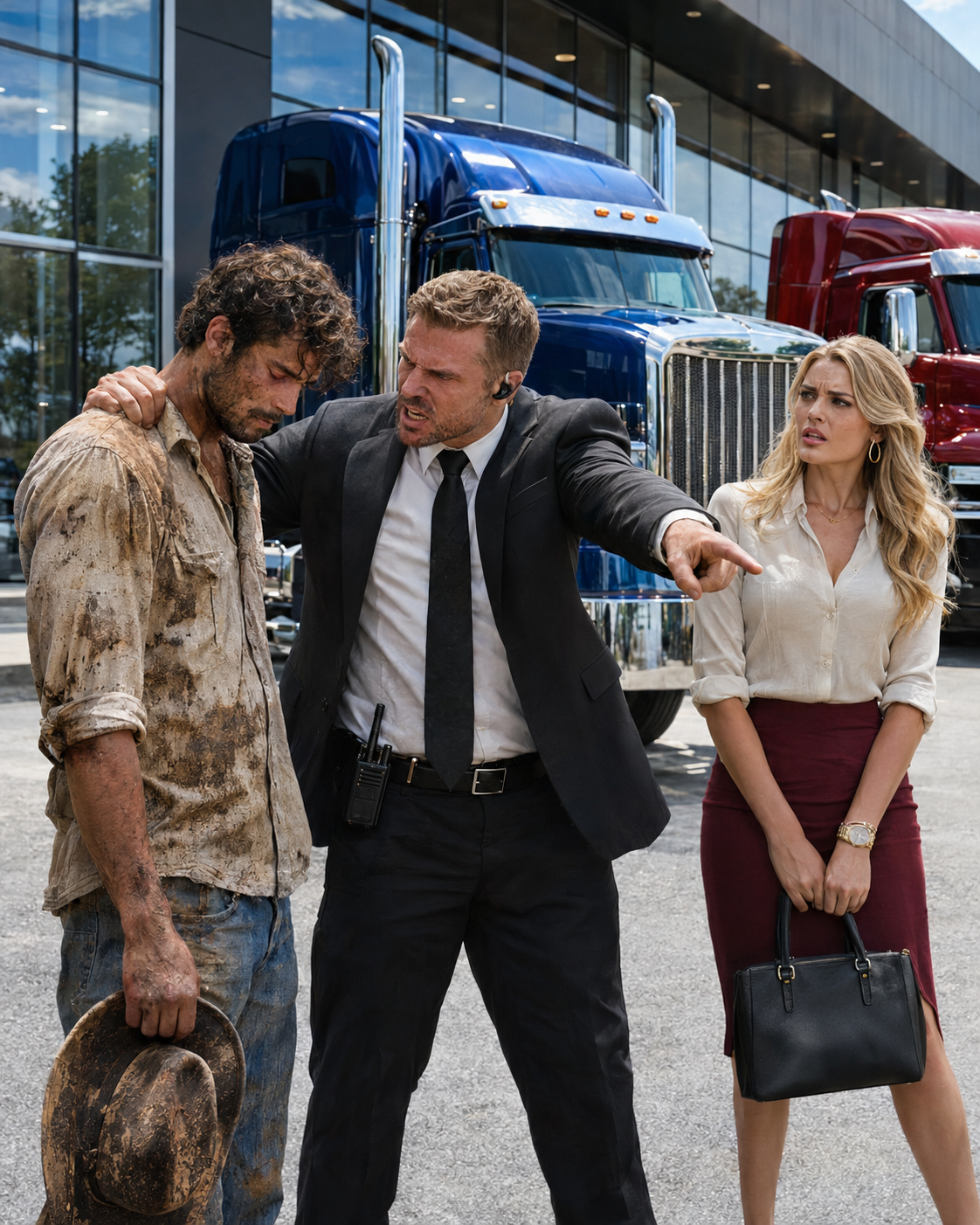
The salesman had his hand on my shoulder and was pushing me toward the dealership door when a woman in a cream blazer stepped between us.
On Monday morning, I called Hannah.
“I’ll give it a month,” I told her. “But I need to keep my mobile repair business, and when I say I’ve got to pick up my daughter, I’ve got to pick up my daughter.”
“Understood.”
“And if a truck isn’t ready to sell, it isn’t ready to sell.”
“That’s exactly why I’m hiring you.”
We put everything in writing before I started.
My first morning at the dealership was awkward. A few employees recognized me from the incident in the showroom. Others seemed to think I’d been brought in to catch them making mistakes.
One of the mechanics, a guy named Trevor, was particularly quiet around me.
He’d been working there for nearly nine years. He knew the shop, knew the equipment, and could diagnose problems faster than most mechanics I’d met.
I wasn’t interested in telling him how to do his job.
During our first inspection together, I noticed that a vehicle had been marked ready even though a replacement part hadn’t arrived.
Trevor rubbed his forehead.
“I told sales that thing was still waiting on a part.”
“Did anybody update the inspection record?”
He shook his head.
We found the original work order. Sure enough, he’d documented the problem correctly. Somewhere between his toolbox and the showroom, that information had stopped following the vehicle.
Trevor wasn’t the problem. Neither was the mechanic working in the next bay.
The system made it too easy for unfinished work to look finished.
Hannah introduced a new approval process. Every vehicle needed a verified inspection, unresolved repairs had to be clearly documented, and anything affecting safety had to be addressed before the vehicle could be offered for sale.
It wasn’t a popular change with everyone.
Salespeople had to wait longer for certain vehicles. Service employees had to spend more time documenting their work. Occasionally, someone would come into the shop asking whether we could hurry things along because a customer was waiting.
Trevor started answering those questions before I could.
“It’ll be ready when it’s ready.”
A couple of weeks into my trial month, an older farmer named Arthur came in looking for a truck.
He wore a canvas jacket with a torn pocket and carried a folded piece of paper listing the things he needed in a vehicle. He wanted something that could handle gravel roads, haul supplies, and start reliably on cold mornings.
He wasn’t particularly concerned about the color.
During the inspection of a truck he liked, Trevor and I discovered excessive play in a steering component.
Arthur had already arranged for his brother to drive him home after the purchase. When we explained that the truck needed additional work, he looked disappointed.
“Is it something I could take care of later?”
“You could,” I said, “but I’d rather you didn’t have to.”
He studied my face.
“How much is that going to cost me?”
Hannah had already approved the necessary repair as part of preparing the truck for sale.
“Nothing extra.”
Arthur folded his piece of paper and put it back in his jacket.
“Well, I suppose I can wait.”
After the repair, Trevor and I checked the steering again and took the truck out for another drive. Arthur returned, looked through the updated inspection paperwork, and completed his purchase.
Before leaving, he shook my hand.
“Appreciate you telling me something you didn’t have to.”
That bothered me a little.
We absolutely had to tell him. The fact that he considered it a favor said something about what customers had come to expect.
I started writing short inspection guides in plain English.
Instead of simply listing technical terms, I explained what certain problems meant for the person driving the vehicle. I included questions customers could ask, things they might notice during a test drive, and reasons to request an independent inspection.
Hannah had copies printed for the showroom.
Some customers took them home. Others stood beside the vehicles, reading through the pages while talking to salespeople.
The guides didn’t make everyone an expert, but they gave people enough information to participate in decisions that affected their money and their families.
Then, one afternoon, Chad approached me while I was putting away some equipment.
“Got a minute?”
I closed my toolbox.
He told me Hannah had issued him a formal warning over the way he’d treated me. He’d also been required to review the dealership’s customer service expectations with management.
At first, he talked about having a stressful morning and feeling pressured to meet sales targets.
Then he stopped.
“That’s not really an excuse, is it?”
“No,” I said.
He looked down at the concrete floor.
“I judged you before you even sat down. I saw your clothes and figured you weren’t going to buy anything. I shouldn’t have done that.”
I appreciated that he didn’t try to pretend it had been a misunderstanding.
But I wasn’t ready to tell him everything was fine.
“You know what bothered me most?” I asked. “It wasn’t that you thought I couldn’t afford the truck. It was that you didn’t think I deserved a conversation.”
He nodded slowly.
“I get that.”
“I hope you do. Because the next guy who walks through that door might not have somebody like Hannah standing nearby.”
He promised he’d treat people differently.
I accepted his apology, but I knew the promise would mean more if he kept it when nobody was watching.
Over the following weeks, I saw him spend time with customers he might previously have dismissed. He still had sales targets, and he was still learning how to balance those expectations with the dealership’s new standards.
People don’t become entirely different overnight.
But he was making an effort.
When my trial month ended, Hannah asked whether I wanted to stay.
I agreed to continue part-time under the same terms. My mobile repair business was still important to me, and I didn’t want Maya growing up with a father who was always too busy to be home.
Hannah respected that.
Meanwhile, I still needed a truck.
She offered to help me find one through the dealership, but I eventually came across a blue pickup being sold elsewhere. It wasn’t especially impressive. There were a few scratches along the bed, and the interior had clearly seen years of ordinary use.
The maintenance records were good, though.
I asked a mechanic I trusted to inspect it. Even after years of repairing vehicles myself, I wanted another set of eyes on something I was spending my own money on.
He gave it a thorough check.
We discussed the minor repairs it would eventually need, and I negotiated a price that left enough money in my savings account for emergencies.
When I brought it home, Maya ran outside without her shoes.
“Is this ours?”
“Sure is.”
She climbed into the passenger seat and immediately started investigating the cup holders.
“Can we go see the horses again?”
I laughed.
“That’s the plan.”
There wasn’t a giant bow on the hood. Nobody took a picture of me holding an oversized key. It was simply a dependable truck that I could afford.
For us, that was plenty.
Several months later, Hannah organized a community vehicle inspection event at the dealership. Local residents could bring their vehicles in for basic checks, ask maintenance questions, and learn what warning signs they shouldn’t ignore.
Maya came along with me.
She helped arrange the inspection guides on a folding table and handed them to visitors. She took her little job so seriously that she straightened the stack every time somebody removed a sheet.
Trevor showed a few teenagers how to check their tire pressure. Arthur stopped by to say hello. Even Chad spent part of the morning helping people find the right service bay without trying to sell them anything.
Near lunchtime, a man pulled into the parking lot in an aging pickup.
He stepped out wearing dusty work boots and a shirt with his employer’s name stitched above the pocket. A little boy climbed out after him.
The man stood near the entrance, looking uncertain.
“I’m not buying anything today,” he told me. “Just wanted to see if somebody could answer a couple of questions.”
I recognized the careful way he said it.
He was trying to establish that he wasn’t going to waste anyone’s time before anyone could accuse him of doing exactly that.
I walked over and shook his hand.
“Of course. What can we help you with?”
His shoulders relaxed.
He explained that his truck had been making a noise whenever he turned sharply. He depended on it for work and was worried about how much a repair might cost.
We talked through the symptoms and arranged for someone to take a look.
Maya brought him one of our inspection guides.
“Here you go,” she said. “My dad helped make these.”
The man thanked her, and she returned to her table with a smile.
I watched her for a moment.
I’d originally walked into that dealership because I needed a truck. I hadn’t been looking for another job, a confrontation, or an opportunity to change anybody’s business.
I certainly hadn’t been looking to become wealthy.
I wanted to pay my bills, do work I could stand behind, and get my daughter wherever she needed to go without wondering whether we’d make it.
Those were still my priorities.
The dealership wasn’t perfect. There were still disagreements, mistakes, and days when doing things properly took longer than anyone wanted.
But now, when something went wrong, there were people willing to acknowledge it and put it right.
That afternoon, Maya helped me pack up the remaining inspection guides. We climbed into our blue pickup, and she asked whether we could stop for ice cream on the way home.
I checked the time.
We had nowhere else we needed to be.
“Absolutely.”
The truck started without hesitation. Maya buckled her seat belt, and I pulled out of the parking lot.
There was nothing particularly remarkable about that drive home.
And after everything we’d been through, I was grateful for exactly that.