The regional manager dropped a clipboard onto my garage counter and told me I was being investigated
Kate stopped a few feet from me.
For a moment, neither of us spoke.
The rain had started again, soft against the metal roof, and suddenly I could smell the same mixture of motor oil and wet concrete from the night she first walked through my door.
“You knew who I was,” I said.
She shook her head.
“I wanted to know who you were before you knew who I was.”
I looked at the man with the clipboard.
“So I’m in trouble?”
A small smile touched her face.
“Quite the opposite.”
She asked the compliance officer to leave us alone.
He handed me a folder and walked back toward the SUV.
I watched him go.
“What’s in there?”
“Everything we found.”
I opened the folder.
There were photographs of my handwritten repair notes, a copy of the service record from the dealership, and a report showing that the dealership had marked several inspections as completed even though they had not actually been performed.
My throat tightened.
“You pulled my records?”
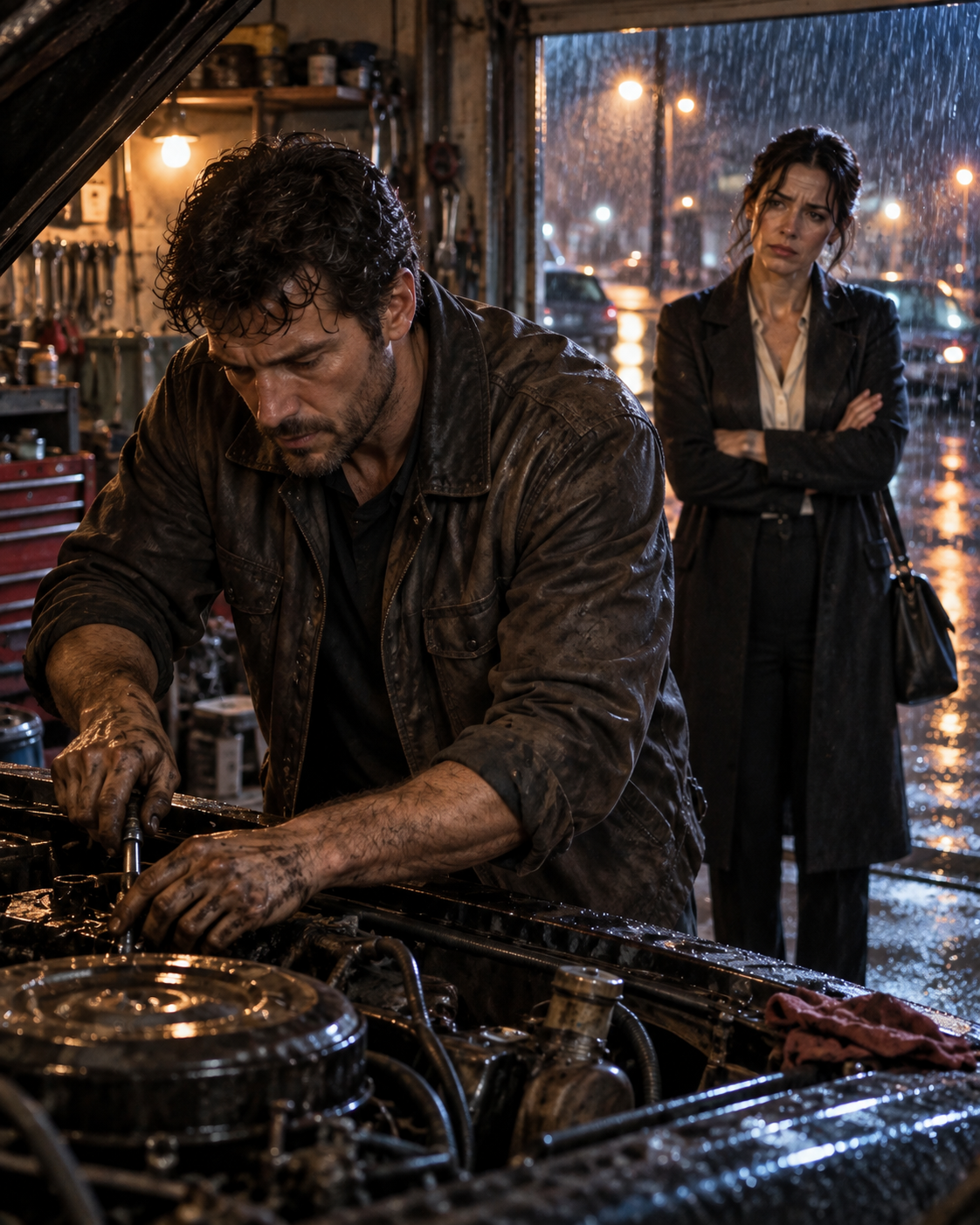
“We needed to verify what happened.”
“And?”
“You were right about the car.”
She turned the pages slowly.
“The battery terminal was neglected, the fluids were low, and the inspection was signed off by a technician who later admitted he had been told to rush through certain jobs.”
I stared at the paperwork.
“Why?”
“Because the store was measured almost entirely by revenue.”
She looked toward the rain.
“Repair hours, upsells, warranty conversions, customer retention numbers, all of it.”
She paused.
“Safety was somewhere underneath those numbers.”
I felt a cold anger rise in my chest.
“You knew?”
“I suspected.”
She looked directly at me.
“That’s why I came alone.”
I remembered the night she had checked her phone every few seconds.
“You were testing them.”
“Not just them.”
Her voice lowered.
“I was testing myself.”
She told me her father had built Voss Auto Group from one used-car lot into eleven dealerships, and after his death she had spent years trying to prove she deserved the company he left behind.
She had learned to read spreadsheets, contracts, sales reports, and executive summaries until she could tell exactly where money was leaking.
What she could not read was what happened between a customer and a technician when nobody important was watching.
“So every few months, I go somewhere unannounced,” she said.
“I drive an ordinary car, wear something people won’t remember, and see what happens.”
I looked at her.
“And this time?”
“This time I almost found out the worst thing about my own company.”
She reached into the folder and showed me a photograph of the dealership employee who had signed her inspection.
“He wasn’t the worst one.”
I studied the picture.
“Who was?”
“The man who taught him.”
Her words sat between us.
A week later, the investigation widened.
Three technicians came forward.
Then five.
One service advisor admitted he had been told to recommend unnecessary work whenever a customer looked wealthy enough to afford it.
Another said managers would punish technicians who took too long explaining repairs.
A woman in accounting showed auditors stacks of altered paperwork.
The pattern had been there for years.
No single person had created it.
People had simply learned what got rewarded.
Fast repairs.
Big invoices.
Few complaints.
Keep the line moving.
I sat in the small office while Kate spoke with the investigators.
She looked different now.
Not like the woman in the expensive coat.
Not like the CEO on magazine covers.
Just tired.
At one point she came out and closed the door behind her.
“Do you think I should shut the dealership down?”
The question surprised me.
“That’s not my call.”
“I know.”
She looked at my hands.
“You know what I kept thinking after I left your shop?”
I waited.
“If a man with eleven dollars in his wallet can find the time to check a stranger’s alternator after closing, why did I build a company where people with six-figure salaries were afraid to spend five extra minutes with a customer?”
I didn’t know what to say.
So I told her the truth.
“People become what a place rewards.”
She nodded.
“Exactly.”
For the next month, investigators interviewed employees across the company.
Some were defensive.
Some were ashamed.
A few quit before anyone could question them.
The service director at the dealership was eventually fired.
So were two managers who had falsified inspection records.
But Kate did something that surprised everyone.
She did not replace them with another layer of corporate people.
She started spending mornings in service bays.
She watched technicians work.
She listened when customers described problems badly.
She sat beside receptionists when angry people called.
She asked questions nobody had asked in years.
“How much time do you actually have with each customer?”
“Which jobs are you pressured to upsell?”
“What happens when you tell a manager a repair is unsafe?”
“How many minutes do you get to explain an invoice?”
The answers were uncomfortable.
Then one afternoon, Kate came to my garage carrying two coffees.
She set one on my workbench.
“I want to offer you something.”
I laughed.
“You already tried.”
“This isn’t the same thing.”
She pulled a chair over.
“I want you to train our service teams.”
I nearly dropped the wrench in my hand.
“I’m not a corporate trainer.”
“No.”
She smiled.
“You’re a mechanic.”
She slid a document toward me.
“That’s why I want you.”
The proposal was simple.
One day a week.
Visit different dealerships.
Talk to technicians.
Teach them how to explain repairs honestly.
Teach managers how to build time into schedules for human conversations.
And create a policy that any technician could stop a repair process when they believed a customer was being put at risk without fear of punishment for losing revenue.
I looked at the compensation number.
It was more money than I had made in several months.
“I can’t leave my shop.”
“I don’t want you to.”
She leaned back.
“Keep fixing cars.”
She pointed at the paper.
“Just teach us how to remember who is sitting on the other side of the hood.”
I took the job.
Not because I suddenly trusted corporations.
Not because I wanted a bigger title.
I took it because I knew exactly what it felt like to choose between doing the right thing and paying your own bills.
The first dealership I visited was forty miles away.
The service manager shook my hand without knowing why I was there.
He assumed I was another consultant.
Then he saw me watching the technicians.
“You’ve got a checklist,” he said.
“No.”
I handed him a grease-stained notepad.
“I’ve got questions.”
He looked confused.
I smiled.
“What do your people get in trouble for?”
That changed the room.
We talked for almost two hours.
By the end, three technicians had told me things they had never told their manager.
One was being pressured to sell unnecessary transmission flushes.
Another was discouraged from writing detailed notes because managers wanted shorter job times.
The youngest technician admitted he had stopped asking customers questions because he was afraid every additional minute would hurt his numbers.
I asked him why he became a mechanic.
He shrugged.
“My dad.”
“Why?”
“He fixed everybody’s cars for free when I was a kid.”
I looked at him.
“Sounds like a good man.”
He smiled.
“He was.”
I realized then that this was bigger than Voss Auto Group.
It was about memory.
The reason people entered trades.
The people who taught them.
The kindness somebody showed before a business taught them to count everything.
When I came home that evening, Lily was sitting at the kitchen table with a math worksheet.
She looked up.
“Did the rich lady make you wear a suit?”
“No.”
“Did she give you a company car?”
“No.”
“Did she give you a helicopter?”
I laughed.
“Definitely no.”
She went back to her worksheet.
“Then what does she pay you for?”
I sat beside her.
“I help her company remember how to treat people.”
Lily thought about that.
“Like you helped her?”
“Yeah.”
She nodded.
“Because she didn’t know you were nice?”
I smiled.
“She didn’t know she could trust me.”
Lily tapped her pencil against the paper.
“That’s different.”
“How?”
“Being nice is what you do.”
She looked at me seriously.
“Trust is what people learn after.”
Her words caught me off guard.
Kids sometimes walk straight through complicated things adults spend years avoiding.
I kissed the top of her head.
“Where did you learn that?”
She shrugged.
“School.”
I laughed.
But that sentence stayed with me.
Months passed.
The changes at Voss Auto Group became visible.
Service complaints dropped.
Technicians stayed longer.
Managers began including customer explanations in performance reviews instead of only sales numbers.
The company created a policy called the Safe Stop Rule.
Any employee could pause a repair when something looked unsafe, even if it meant losing money.
There was another change that mattered even more to me.
Every dealership received a small emergency fund for stranded customers who could not afford immediate repairs.
It was not unlimited.
It was not a marketing campaign.
It was a quiet pool of money managers could use when someone was genuinely stuck.
Kate called me the first time she approved it.
“What made you think of that?”
I asked.
She laughed.
“You did.”
“No.”
“The rainy Tuesday did.”
I smiled.
“You don’t have to tell everyone about that.”
“I don’t.”
She paused.
“But I do tell new managers about a mechanic named Mark Wilson who had eleven dollars in his wallet and still found twenty minutes for a stranger.”
I looked down at the shop floor.
“I had four dollars in the register.”
“That makes the story better.”
I laughed.
For the first time since my wife died, I found myself talking about the worst years of my life without feeling like I had to hide them.
That was another unexpected gift of the whole strange journey.
My wife had been the person who taught me generosity before I ever had anything worth giving.
When money was tight, she would still bring groceries to the elderly couple down the street.
When my daughter was born, she told me something I had forgotten until that winter.
“Never let being broke convince you that you’re powerless.”
She was gone two years later.
Sometimes I thought grief had made me smaller.
But maybe it had simply made me notice need faster.
A year after Kate first entered my garage, we held a training session for all eleven Voss dealerships.
There were technicians in the front row, service advisors behind them, and executives along the walls.
Kate stood beside me at the beginning.
She handed me the microphone.
I looked at the room.
“I don’t have a business degree.”
A few people laughed.
“I don’t know your quarterly targets.”
More laughter.
“And I don’t know how to make a spreadsheet impress a board.”
The room went quiet.
“But I know what it feels like to sit in a broken car in the rain.”
I told them about the woman who had walked into my shop at 6:47 p.m.
I did not mention her name.
I did not mention the money.
I did not tell the room she owned the company.
I told them what mattered.
She was stranded.
She was tired.
She was scared.
And for twenty minutes, she needed someone to care more about getting her home than getting paid.
When I finished, nobody clapped immediately.
For a second, the room was completely still.
Then one technician in the back stood up.
Everyone followed.
I looked at Kate.
She was crying.
She whispered, “That’s what I wanted.”
I shook my head.
“No.”
She smiled through the tears.
“Then what?”
I looked at the people standing in front of me.
“You wanted them to remember who they were before they became numbers.”
She nodded.
“Yes.”
After the meeting, an older technician approached me.
He introduced himself as Ray.
“I heard about the new policy,” he said.
“I did too.”
He smiled.
“My grandson just started at one of the stores.”
He shook my hand.
“I almost told him not to.”
I waited.
“Now I think maybe he can change it from the inside.”
That sentence followed me for weeks.
Not because I thought one company could be fixed forever.
It couldn’t.
No system stays good without people watching it.
No promise stays meaningful without people keeping it.
And no act of kindness magically guarantees a reward.
Sometimes you fix somebody’s car and never see them again.
Sometimes you give what you have and nobody notices.
Sometimes doing the right thing costs you more than doing the wrong thing.
But once in a while, a small choice travels farther than you ever know.
One rainy evening, almost two years after Kate first came through my door, I was closing the garage when I noticed headlights stopped across the street.
A teenage boy got out of an old sedan.
He hesitated before walking toward me.
“Sir?”
I turned.
“Need some help?”
He looked embarrassed.
“My mom’s car won’t start.”
I glanced at the clock.
6:49.
For a second, I thought about the old version of myself.
The man with eleven dollars.
The unpaid invoices.
The little girl waiting with a math worksheet.
Then I looked at the boy standing in the rain.
“Bring it around back.”
His shoulders dropped with relief.
“Thank you.”
He drove the car into the bay.
While I lifted the hood, he stood nearby.
“How much is this going to cost?”
I looked at him.
“Let’s figure out what’s wrong first.”
He nodded.
A few minutes later, I found the problem.
Loose battery cable.
Nothing serious.
I tightened it and started the engine.
The boy smiled.
I reached for my wallet.
He looked confused.
“Why are you giving me that?”
I pulled out the eleven-dollar bill I had kept folded behind my driver’s license all these years.
“I keep this as a reminder.”
“Of what?”
I looked through the open garage door at the rain.
“That having very little doesn’t mean you have nothing to give.”
He stared at the bill.
Then his eyes filled unexpectedly.
“My mom used to say that.”
I stopped.
“What was your mom’s name?”
He looked at me.
“Katherine.”
My hand froze on the hood.
He laughed nervously.
“Kate. She says everybody calls her Kate.”
For a moment, the entire garage seemed to disappear.
The rain.
The compressor.
The ticking engine.
Everything.
I looked at the boy.
“How do you know me?”
He smiled.
“My mom talks about you.”
I swallowed.
“What does she say?”
He shrugged.
“She says you’re the reason she changed the company.”
I looked toward the office where Lily had once spun in her chair doing homework.
The lights were off now.
The little girl who used to make me calculate what I could afford had grown into a teenager who no longer needed me to check her math.
Life had kept moving.
Loss had kept moving.
Love had kept moving.
And somehow, one rainy Tuesday had kept moving too.
The boy thanked me and climbed into the driver’s seat.
Before he closed the door, he looked back.
“Do you really do this for everybody?”
I smiled.
“Not everybody.”
He seemed disappointed.
I pointed toward the street.
“Just whoever needs help while I’m the one standing here.”
He laughed.
Then he drove away.
I watched the taillights disappear into the rain.
A few seconds later, my phone buzzed.
It was a message from Kate.
“Did you meet him?”
I stared at the screen.
I had never told her I would.
I typed, “Yes.”
Her reply came immediately.
“Then you finally know why I came back.”
I frowned.
Before I could answer, another message appeared.
“There’s something I never told you about that night.”
I stopped breathing for a second.
Then the typing bubble appeared.
And disappeared.
Appeared again.
Whatever Kate had been carrying all this time, I suddenly knew it had never been about a battery terminal.
I stood alone in the dark garage, listening to the rain hit the roof, wondering what kind of secret could still be waiting after everything we had already survived.
Then my phone buzzed one more time.
“Mark, I didn’t choose your shop by accident.”
The lights above me flickered.
And for the first time since that rainy Tuesday, I wondered who had really sent Kate to my door.