The pilot was unconscious, the plane was falling toward the freezing Atlantic Ocean, and nobody on board knew I had once flown fighter jets for the military.
THE LAST LANDING: A FIGHTER PILOT’S FINAL TEST
Nathan’s face went completely white.
“Sir… there’s something wrong. The gear isn’t locking into position.”
I glanced at the landing gear indicator. Three lights should have been glowing green. Instead, two were red, and the third was flashing amber.
For a moment, nobody spoke.
The runway lights were getting closer. The aircraft was shaking violently, and the storm was pushing us from side to side like a giant invisible hand.
“How much time do we have?” I asked.
Nathan checked the instruments.
“Less than three minutes. Maybe two.”
I took a slow breath.
“All right. Then we stop worrying about what might happen and focus on what we can still control.”
I had flown combat missions in some of the most dangerous conditions imaginable. I had experienced engine failures, mechanical malfunctions, and emergencies that left no room for hesitation.
But this was different.
Behind us were 214 passengers, including children, elderly people, and families who had no idea how close they were to disaster.
I wasn’t just fighting to save an aircraft.
I was fighting to bring every single one of them home.
“Chloe!” I shouted over the alarms.
She appeared in the cockpit doorway, gripping the frame to keep herself upright.
“Yes?”
“Get on the cabin intercom. Tell everyone to brace for an emergency landing. Heads down, feet flat, and follow the crew’s instructions. Tell them we are doing everything possible to get them safely on the ground.”
Her eyes searched mine.
“Are we going to make it?”
I wanted to tell her yes.
I wanted to give her the certainty she desperately needed.
But I had learned something during my years in the military: a pilot’s job wasn’t to promise things he couldn’t guarantee.
It was to make the best possible decisions when everything was falling apart.
“Tell them we’re not giving up,” I said.
She nodded and disappeared.
I turned back to Nathan.
“Show me the landing gear system.”
He pointed toward the warning panel.
“The left main gear is showing an unsafe indication. The right main gear appears down, but it isn’t locked. The nose gear indicator is unreliable.”
I studied the readings.
“Have you tried the alternate extension?”
“Twice. Nothing.”
“Hydraulic pressure?”
“Almost gone.”
I stared at the panel.
Something about the readings bothered me.
The warning wasn’t consistent with a simple mechanical failure. The hydraulic pressure was fluctuating, but the electrical indicators were behaving strangely.
Then I remembered the earlier problem.
The computer had been overriding Nathan’s commands before the engine failure.
What if the landing gear problem wasn’t an isolated malfunction?
“What happened to the flight control computer?” I asked.
Nathan hesitated.
“Before the captain collapsed, he reported a system fault. He said the aircraft had switched into an abnormal control mode. Then the autopilot disconnected, and the captain started feeling dizzy.”
“Did he mention smoke?”
Nathan looked at me.
“Actually, yes. There was a strange electrical smell.”
My stomach tightened.
I glanced at the electrical systems display.
One section was flashing red.
“Something is wrong with the electrical bus,” I muttered.
Nathan looked confused.
“What does that mean?”
“It means we may have more than one problem caused by the same failure.”
I needed a way to get the landing gear down without relying on the normal electrical system.
But before I could investigate further, the aircraft lurched violently.
A warning tone sounded.
ENGINE FIRE. LEFT ENGINE.
Nathan grabbed the radio.
“Mayday, mayday, mayday! We have an engine fire and an unsafe landing gear indication. Request immediate emergency assistance!”
The tower responded almost instantly.
“Mayday aircraft, emergency services are standing by. Wind conditions are worsening. You are cleared to land on runway zero-nine. Repeat, cleared to land runway zero-nine.”
I looked outside.
The runway was visible now, but it seemed impossibly small beneath the dark clouds.
“Nathan, give me the latest engine readings.”
“Fire warning is active. Fuel pressure is falling.”
“All right. We’ll deal with that after we get the aircraft on the ground.”
I knew the next decision could determine whether everyone survived.
I could attempt a normal landing with uncertain landing gear, or I could look for another option.
Neither was safe.
Then Nathan noticed something.
“Wait. Sir, look at this.”
He pointed toward the systems display.
A small maintenance message was appearing and disappearing beneath the warnings.
ALTERNATE GEAR EXTENSION AVAILABLE.
“Why didn’t you mention that earlier?”
“I thought the system was completely disabled.”
“Can you access it?”
He reached toward the controls.
“I can try.”
“Don’t guess. Read the procedure.”
He opened the emergency checklist while I kept the aircraft stable.
His hands were shaking so badly that he struggled to turn the page.
I placed one hand briefly on his shoulder.
“Listen to me, Nathan. You’re not alone in this cockpit. We’ve got time to do this properly.”
He swallowed and began reading.
We followed the aircraft’s emergency procedure step by step, isolating the affected electrical system and attempting the independent mechanical extension.
For several seconds, nothing happened.
Then we heard a heavy metallic clunk from beneath the aircraft.
Nathan looked at the indicator.
One green light appeared.
Then another.
Then the third.
His mouth fell open.
“Sir… all three landing gear indicators are green.”
I almost smiled.
“Good. Now let’s not celebrate before we’re safely on the ground.”
The tower came back over the radio.
“Emergency aircraft, confirm landing gear status.”
“Three green indications. Preparing for final approach.”
“Understood. Be advised, we have reports of severe crosswinds near the runway threshold. Emergency vehicles are positioned on both sides.”
I looked at Nathan.
“What’s our fuel?”
“Critical. We cannot go around if this approach fails.”
That was the moment the reality of our situation hit me.
There would be no second attempt.
No opportunity to circle around and try again.
We had one runway, one engine that might fail at any moment, and a storm that seemed determined to throw us into the ocean.
I adjusted my grip.
“Let’s bring them home.”
In the passenger cabin, Chloe was moving between the rows, checking seatbelts and helping frightened travelers.
A little girl, perhaps seven years old, was crying uncontrollably.
Her mother held her tightly.
“Are we going to die?” the child whispered.
Chloe knelt beside them.
“No, sweetheart. There are very good people working very hard to get us safely down.”
The girl looked at her.
“Is the pilot okay?”
Chloe hesitated.
She couldn’t tell them the captain was unconscious or that the person flying their aircraft wasn’t even a member of the airline crew.
Instead, she gently squeezed the girl’s hand.
“Someone is helping him. And we’re all going to do our part.”
Further back, a businessman was frantically trying to call his wife.
An elderly passenger was praying with his eyes closed.
A young couple held hands without saying a word.
Everywhere Chloe looked, she saw the same expression.
Fear.
And she knew that once the wheels touched the ground, none of those people would ever look at an ordinary flight the same way again.
Then the intercom crackled.
“Cabin crew, prepare for impact.”
Chloe grabbed the nearest seat.
The announcement was followed by another sentence from the cockpit.
“Brace. Brace. Brace.”
The aircraft began descending through the clouds.
I could barely see the runway.
The windshield was covered in ice, and the rain was hitting it so hard that the wipers seemed almost useless.
“Altitude?” I asked.
“Five hundred feet.”
“Speed?”
Nathan gave me the reading.
I made a small correction.
The aircraft drifted left.
I corrected again.
Then a violent gust hit the tail.
The nose swung toward the right side of the runway.
“Crosswind!” Nathan shouted.
“I see it!”
The aircraft was moving sideways, and I could feel the resistance through the controls.
I had experienced crosswinds before, but never quite like this.
A fighter jet was designed to respond quickly. A commercial airliner was a different machine entirely. It carried hundreds of people, had enormous wings, and required patience rather than aggression.
My military experience gave me confidence, but it didn’t make me an expert on every system aboard this aircraft.
That was why I listened to Nathan.
He knew this airplane.
I knew how to remain calm when the world was trying to kill me.
Together, we had a chance.
“Three hundred feet!” Nathan called.
The runway lights suddenly disappeared.
“Where did they go?”
“Visibility just dropped!”
For one terrible second, I was flying almost entirely by instruments.
Then a red light flashed.
WINDSHEAR WARNING.
Nathan shouted, “We’re losing control!”
I felt the aircraft sink.
The ocean was behind us, and the runway was directly ahead.
My instincts screamed at me to pull harder.
But I knew that reacting violently could make things worse.
I made the necessary corrections, following the aircraft’s approved emergency procedures as closely as possible.
“Come on,” I whispered.
The warning continued.
Two hundred feet.
One hundred and fifty.
One hundred.
Then Nathan yelled something I will never forget.
“THE RUNWAY IS TOO FAR LEFT!”
I looked through the windshield.
He was right.
The aircraft had drifted dangerously off the centerline.
I pushed the controls gently, fighting the crosswind.
For a moment, the aircraft seemed to respond.
Then the left engine made a terrible grinding sound.
A flash of orange appeared outside the window.
The engine fire had returned.
“Engine fire still active!” Nathan shouted.
“Keep your eyes on the runway!”
The aircraft dropped another few feet.
Fifty feet.
Thirty.
I could finally see the wet surface beneath us.
“Brace!” Nathan screamed.
The first wheels struck the runway.
A deafening bang echoed through the aircraft.
The plane bounced.
For a split second, we were airborne again.
My heart stopped.
Then the right landing gear hit.
The aircraft slammed onto the runway so hard that I felt the impact all the way through my chest.
A shower of sparks erupted outside.
Something was dragging beneath the fuselage.
Nathan shouted, “We’re down! We’re down!”
But we were far from safe.
The aircraft began pulling sharply toward the left.
I fought to keep it straight.
The left engine was burning, and the braking system wasn’t responding normally.
The runway seemed to rush toward us.
“Slow down!” Nathan yelled.
“I’m trying!”
A moment later, another warning sounded.
BRAKE SYSTEM FAILURE.
I stared at the remaining runway.
There was barely enough space.
At the far end, beyond the runway lights, stood a line of emergency vehicles.
If we couldn’t stop, we would crash directly into them.
I remembered something from my training.
In an emergency, the best solution wasn’t always the most powerful one.
Sometimes it was the simplest.
I looked at Nathan.
“Tell the tower we need the emergency stopping area cleared immediately.”
He grabbed the radio.
“Tower, aircraft unable to stop normally! Request maximum emergency response!”
The controller answered.
“Understood. We are clearing the area. Continue straight ahead. Emergency crews are responding.”
I kept the aircraft centered as best I could.
The speed began dropping.
Slowly.
Painfully slowly.
The runway end was approaching.
Then, from somewhere ahead, I saw a line of bright red lights.
The airport emergency crews had activated their specialized aircraft arresting system.
I had never expected to see one used for a passenger airliner.
The tower’s voice came through again.
“Emergency aircraft, continue straight. The stopping system is active. Do not attempt to turn.”
Nathan looked at me.
“Is that safe?”
“Right now, it’s our best chance.”
We continued forward.
The aircraft crossed the final runway markings.
Then came a tremendous impact.
A violent jolt threw me against my harness.
The entire fuselage shook.
A strange grinding sound filled the cockpit.
And then, slowly, unbelievably, the aircraft began to stop.
I watched the speed indicator.
One hundred miles per hour.
Seventy.
Forty.
Twenty.
Five.
Zero.
Silence.
For a few seconds, neither Nathan nor I moved.
The engine fire warning was still sounding.
Smoke was drifting past the windshield.
But the aircraft was no longer moving.
I looked at Nathan.
“Are you hurt?”
He shook his head.
Then his face crumpled.
“We made it.”
I closed my eyes for a moment.
“No,” I said quietly. “We got them here. Now we have to get them out.”
The emergency crews reached us within seconds.
Firefighters surrounded the burning engine while airport rescue teams approached the aircraft.
I shut down the remaining systems according to the emergency checklist and helped Nathan coordinate the evacuation.
The cabin crew opened the emergency exits that were safe to use.
Passengers began sliding down the evacuation chutes.
Some were crying.
Others were screaming.
A few simply sat on the runway afterward, unable to believe they were alive.
Chloe was among the last people to leave the aircraft.
She had helped an elderly couple and carried a small child toward the nearest exit.
When she reached the runway, she looked back at the cockpit.
Then she saw me standing beside Nathan.
Her eyes filled with tears.
“We did it,” she whispered.
I nodded.
But something was bothering me.
The captain.
I had almost forgotten about him in the chaos.
“Where is the captain?”
Chloe pointed toward an ambulance.
“They got him out. The paramedics are treating him now.”
I looked toward the ambulance.
A medical team was working around a stretcher.
The captain was still unconscious, but I could see movement.
That was enough to make me breathe again.
Nathan approached me.
“Sir, I don’t know how to thank you.”
I shook my head.
“Don’t thank me yet. You helped save this flight too.”
He looked surprised.
“I almost lost control.”
“And you didn’t give up. You knew the aircraft better than I did, and you kept communicating. That matters.”
He lowered his head.
Then he began crying.
Not loudly.
Not dramatically.
Just the quiet tears of someone who had spent the last hour believing he might never see another sunrise.
I placed a hand on his shoulder.
“You’re going to be all right.”
About forty minutes later, I was sitting inside the airport medical center.
My clothes were soaked.
My hands were still trembling.
A nurse had checked me for injuries and told me I was lucky to have escaped without anything serious.
Across the room, several passengers were being treated for minor injuries.
One woman had a fractured wrist.
A man had a cut above his eyebrow.
The little girl Chloe had comforted was sitting beside her mother, wrapped in a silver emergency blanket.
When she noticed me, she stood up.
Her mother gently encouraged her to approach.
“Excuse me, mister?”
I looked down.
“Yes?”
The girl held out a small piece of paper.
“I drew this for you.”
It was a picture of an airplane with a huge smile and dozens of little people inside.
Above it, in uneven handwriting, were the words:
THANK YOU FOR BRINGING US HOME.
I stared at the drawing.
I had received medals during my military career.
I had been praised by commanders and congratulated by people whose opinions mattered.
But nothing had ever affected me quite like those seven words.
I knelt and smiled.
“That’s the best award I’ve ever received.”
The girl smiled back.
Then she ran to her mother.
I folded the picture carefully and placed it inside my jacket.
I intended to keep it forever.
A few hours later, an airport investigator approached me.
He introduced himself as Daniel Reeves, a senior aviation safety investigator.
“Sir, we need to understand exactly what happened in that cockpit.”
I nodded.
“I’ll tell you everything I remember.”
He opened his notebook.
“First, how did you recognize the flight control problem?”
I explained the unusual computer behavior, the electrical warnings, and the fluctuating hydraulic pressure.
He listened carefully.
Then he asked something unexpected.
“Did you notice any unusual smell before the captain became unconscious?”
I looked at him.
“Electrical smoke. Nathan said the captain had mentioned it.”
Daniel exchanged a glance with another investigator.
“That’s important.”
“Why?”
He hesitated.
“We’re still investigating, but the preliminary evidence suggests an electrical fault may have affected several interconnected systems. We also found signs of a serious problem with one of the aircraft’s electronic control units.”
I frowned.
“Could that explain the conflicting commands?”
“Possibly. But we need the flight data recorder before we can establish exactly what happened.”
I leaned back.
There was something deeply unsettling about that explanation.
We had been flying above the Atlantic in a machine that might have been suffering from a dangerous technical failure long before anyone noticed.
“Was the aircraft safe to fly?” I asked.
Daniel didn’t answer immediately.
“That’s precisely what we’re trying to determine.”
He closed his notebook.
“One more thing. We checked your background. You were a military fighter pilot?”
“I was.”
“Why didn’t you tell the airline when you boarded?”
I gave a tired smile.
“Because I was a passenger. I wasn’t looking for another emergency.”
He nodded.
“Well, today you became part of one.”
The next morning, I was preparing to leave the medical center when Chloe came looking for me.
She was holding two cups of coffee.
“I thought you might need this.”
I accepted one.
“Thank you.”
She sat beside me.
For a while, neither of us spoke.
Then she asked a question.
“Can I ask you something personal?”
“Of course.”
“When you stood up yesterday, were you afraid?”
I looked at her.
“Terrified.”
She seemed surprised.
“But you looked completely calm.”
I smiled.
“Being calm doesn’t mean you’re not afraid. It means you’ve decided that fear isn’t going to make your decisions for you.”
She stared into her coffee.
“I thought I was going to die.”
“I know.”
“I kept thinking about my family. About all the things I hadn’t done yet.”
I nodded.
“That’s what moments like yesterday do. They remind you how little control we sometimes have over tomorrow.”
She looked at me.
“Why did you leave the military?”
I hadn’t expected that question.
For a moment, I considered giving her the simple answer.
I wanted a quieter life.
I wanted to spend more time with my family.
I wanted to stop living in a world where every mistake could cost someone their life.
But the real answer was more complicated.
Years earlier, I had lost a close friend during a training exercise.
His name was Michael.
He had been one of the finest pilots I had ever known.
After his death, I began questioning everything.
I wondered whether I could continue flying without becoming emotionally detached from the people around me.
Eventually, I decided to leave.
I had spent years trying to find peace away from the cockpit.
Yesterday had reminded me that some responsibilities never truly disappear.
“I left because I wanted to live a different kind of life,” I finally said.
Chloe nodded.
“Do you regret it?”
I looked out the window.
“No. But I sometimes miss the feeling of knowing exactly what I was meant to do.”
She smiled.
“Yesterday, I think you found that feeling again.”
I didn’t answer.
Because I knew she was right.
Three days later, the airline arranged a private meeting with several passengers, crew members, and investigators.
The captain had regained consciousness.
He was recovering in the hospital after suffering a serious medical episode, though doctors expected him to survive.
When I entered the conference room, the passengers stood up.
I wasn’t prepared for that.
A woman began clapping.
Then another.
Within seconds, the entire room was applauding.
I stood awkwardly near the doorway.
“Please, sit down. I didn’t do anything extraordinary.”
An older gentleman approached me.
“Sir, my wife and I have been flying for forty years. We’ve never experienced anything like that. You gave us a second chance.”
I shook his hand.
“I’m glad you’re both safe.”
Then a young man stepped forward.
“My daughter hasn’t stopped talking about you.”
I recognized him immediately.
He was the father of the little girl who had drawn the airplane.
He handed me a photograph.
It showed his daughter holding the drawing.
On the back, she had written another message:
WHEN I GROW UP, I WANT TO HELP PEOPLE LIKE YOU.
I smiled.
“Tell her she can do anything she sets her mind to.”
Then the airline’s operations director stood up.
“We would like to offer you our sincere gratitude. The company also wants to recognize the courage and professionalism demonstrated by everyone involved.”
He looked directly at me.
“We would be honored if you accepted a formal commendation.”
I thanked him.
But before he could continue, I raised my hand.
“There’s something I’d like to say.”
The room became quiet.
“I appreciate the recognition. But I don’t want anyone to walk away from this believing that one person saved this aircraft.”
I looked at Nathan, who was sitting near the front.
“The first officer stayed at his post when everything was going wrong. He communicated, followed procedures, and helped me understand a machine I had never flown before.”
Then I looked toward Chloe.
“The cabin crew kept passengers calm when they had every reason to be frightened. They helped people who were injured, secured the cabin, and guided everyone to safety.”
I paused.
“And the emergency crews on the ground gave us somewhere to stop when our brakes failed.”
I glanced around the room.
“Yesterday wasn’t about one hero. It was about a group of people refusing to give up on one another.”
Nobody spoke.
Then Nathan stood up.
He walked toward me and extended his hand.
I shook it.
But instead of letting go, he pulled me into a hug.
“Thank you,” he whispered.
I patted his back.
“You did well, son.”
I thought that would be the end of it.
I was wrong.
Two weeks later, I received a phone call from the airline’s chief safety officer.
He wanted to meet privately.
When I arrived, he was waiting with Daniel Reeves, the investigator.
There were several documents on the table.
The safety officer looked serious.
“We’ve completed the initial analysis of the incident.”
I sat down.
“What did you find?”
He slid a report toward me.
“The aircraft experienced a cascading electrical malfunction. Several automated systems began behaving unpredictably. The initial fault affected components that should have remained isolated.”
I read through the summary.
The problem had been more serious than we had realized.
But one section caught my attention.
The captain’s medical emergency.
“Was his collapse connected to the electrical fault?”
Daniel answered.
“The medical findings are still being reviewed. We cannot establish that the electrical issue caused his collapse. However, the unusual smell and the symptoms reported by the crew were important clues.”
I nodded slowly.
Then the safety officer continued.
“We also discovered that an earlier maintenance report had mentioned intermittent electrical irregularities on this aircraft.”
My eyes moved back to the document.
“Was that report resolved?”
He looked uncomfortable.
“It was marked as corrected.”
“Was it actually corrected?”
A long silence followed.
Daniel folded his hands.
“That’s part of the investigation.”
I felt anger rising inside me.
Not because someone had failed to give me credit.
Not because I wanted an apology.
But because 214 people had been placed in danger, and the warning signs might have existed long before that flight.
“How many other aircraft have experienced similar faults?” I asked.
The safety officer glanced at Daniel.
“We’re reviewing the entire fleet.”
I closed the report.
“Then don’t just review it. Fix it.”
The room went quiet.
“I’ve spent enough years watching people make decisions based on schedules, budgets, and convenience. An aircraft doesn’t care about any of those things. When something is wrong, you fix it before someone dies.”
The safety officer nodded.
“You’re right.”
I wasn’t sure whether he was agreeing because he meant it or because he knew the conversation was being documented.
But I hoped he understood.
Because surviving an accident should never become an excuse to ignore what caused it.
A month later, I returned home.
My wife was waiting at the front door.
The moment she saw me, she wrapped her arms around me and held on tightly.
“I heard everything,” she whispered.
I rested my forehead against hers.
“I’m okay.”
She stepped back and looked into my eyes.
“Don’t ever scare me like that again.”
I laughed softly.
“I’ll try to avoid falling out of the sky.”
She hit my arm gently.
Then she noticed the folded paper sticking out of my jacket.
“What’s that?”
I carefully removed the little girl’s drawing.
My wife studied it.
For a long moment, she said nothing.
Then she smiled.
“That’s beautiful.”
I nodded.
“It is.”
She placed it on the kitchen table, and I watched her smooth out the creases.
That evening, I told her everything.
Not just the technical details.
I told her about the fear, the alarms, the storm, and the moment the aircraft finally stopped.
I also told her about Nathan and Chloe.
And about the little girl who had drawn an airplane with a smile.
When I finished, my wife took my hand.
“Do you think you’ll ever fly again?”
I looked toward the window.
For years, I had believed my flying days were behind me.
But something had changed.
I didn’t suddenly want to return to military aviation.
I didn’t want medals or attention.
I wanted to use what I knew to help others become better prepared for the moments they hoped would never come.
“I don’t know about flying,” I said.
“But I think I know what I want to do next.”
Six months later, I was standing inside a flight training center.
In front of me were twenty young pilots, cabin crew members, and aviation students.
Nathan was sitting in the second row.
He had recovered fully and returned to flying after completing additional training.
Chloe had also returned to work, although she admitted that she still felt nervous whenever an aircraft encountered turbulence.
The little girl who had drawn the airplane was not there.
But her picture was hanging on the wall behind me.
I had been invited to help establish a new emergency preparedness program for airline crews.
It focused on communication, decision-making, teamwork, and recognizing unusual system failures.
I wasn’t there to teach commercial pilots how to fly their aircraft.
That was their responsibility, and their training mattered.
My role was to help them understand something I had learned over decades in aviation.
An emergency doesn’t wait until you’re ready.
I stood in front of the class.
“Let me ask you something,” I began.
“What is the most important thing a pilot can have during an emergency?”
A young man raised his hand.
“Experience?”
I nodded.
“Experience helps.”
Another student answered.
“Confidence?”
“Confidence helps too.”
Nathan smiled.
Then a young woman near the back raised her hand.
“Good judgment?”
I smiled.
“That’s closer.”
I walked toward the front row.
“The most important thing is knowing how to think clearly when everything around you is telling you to panic.”
I paused.
“You can have the best aircraft, the most advanced computer systems, and thousands of hours of experience. But none of those things guarantee that everything will go according to plan.”
I pointed toward the picture on the wall.
“Sometimes, the person who helps save a life isn’t the person you expected. Sometimes it’s a young first officer who refuses to give up. Sometimes it’s a flight attendant who keeps a frightened child calm. Sometimes it’s an emergency worker who arrives at exactly the right moment.”
Then I looked around the room.
“And sometimes it’s a stranger sitting quietly in first class who never expected to touch an aircraft’s controls again.”
Nobody moved.
I continued.
“Never underestimate the person beside you. Never assume that someone has nothing to contribute. And never let pride stop you from asking for help.”
I looked at Nathan.
He nodded.
Then I turned back toward the students.
“Because when the worst moment of your life arrives, you won’t be remembered for how confident you looked. You’ll be remembered for what you did when other people were depending on you.”
After the class ended, Nathan approached me.
“Sir, can I ask you something?”
“Of course.”
He hesitated.
“Do you ever think about that landing?”
I smiled faintly.
“Every day.”
“Do you think we were lucky?”
I considered his question.
There had certainly been luck involved.
The weather could have been worse.
The runway could have been unavailable.
The aircraft could have suffered another failure.
But luck wasn’t the whole story.
“We were lucky to have survived,” I said. “But we also had people who prepared, people who communicated, and people who kept doing their jobs even when they were terrified.”
Nathan looked down.
“I used to think being a good pilot meant never making mistakes.”
I shook my head.
“No. Being a good pilot means recognizing when something is going wrong, admitting when you need help, and making the best decision you can with the information you have.”
He smiled.
“I wish someone had told me that before my first emergency.”
“That’s why we’re here.”
We walked toward the exit together.
Outside, an aircraft was climbing into the evening sky.
Its lights disappeared slowly into the clouds.
I watched it for a moment.
Then I thought about that terrible afternoon over the Atlantic.
The unconscious captain.
The flashing warnings.
The freezing rain.
The little girl holding her mother’s hand.
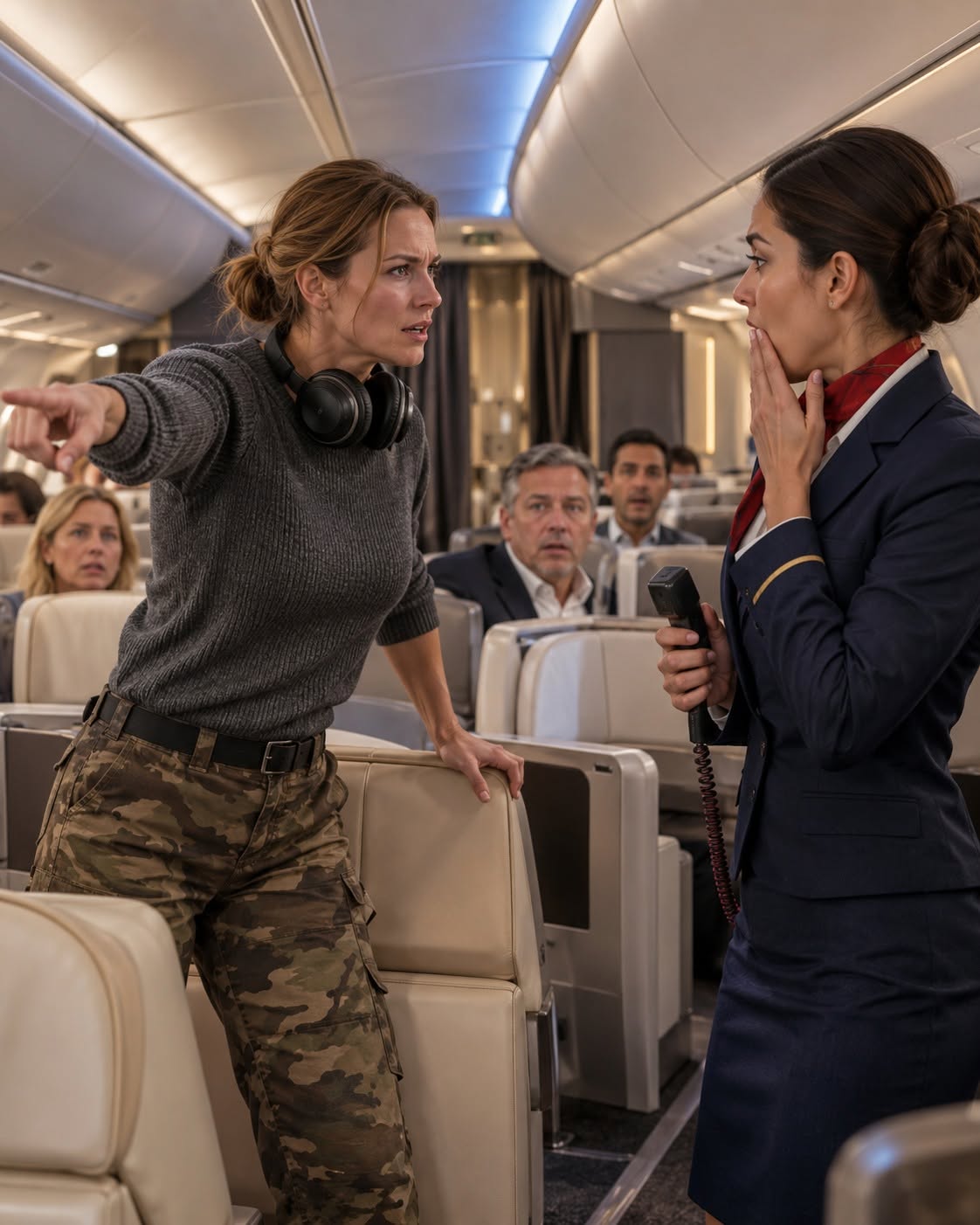
And the moment I had stood up in first class when a flight attendant asked whether anyone knew how to fly.
I had spent years believing that leaving the military meant leaving that part of myself behind.
But I had been wrong.
The uniform was gone.
The fighter jet was gone.
The missions were over.
Yet the responsibility to help others had never disappeared.
I reached into my jacket and touched the folded drawing.
The paper was beginning to show signs of wear, but I still carried it everywhere.
Because it reminded me of something far more important than surviving a dangerous flight.
It reminded me that courage isn’t always loud.
It isn’t always dramatic.
And it certainly isn’t about being fearless.
Sometimes courage is simply standing up when everyone else is afraid to move.
Sometimes it’s admitting that you don’t have all the answers.
And sometimes it’s trusting another person enough to let them help you.
That day, 214 passengers boarded an aircraft expecting an ordinary journey across the Atlantic.
They landed with a story they would tell for the rest of their lives.
But I came away with something even more valuable.
I finally understood that the greatest thing I had ever done as a pilot wasn’t flying a fighter jet, earning a medal, or surviving a dangerous landing.
It was helping 214 strangers get another chance to live the lives waiting for them.
And if I had to do it all over again, knowing exactly how terrifying those moments would be, I would still stand up.
Without hesitation.
Because sometimes, when the world is falling apart, all it takes is one person willing to say:
“I’m here. Tell me what needs to be done.”