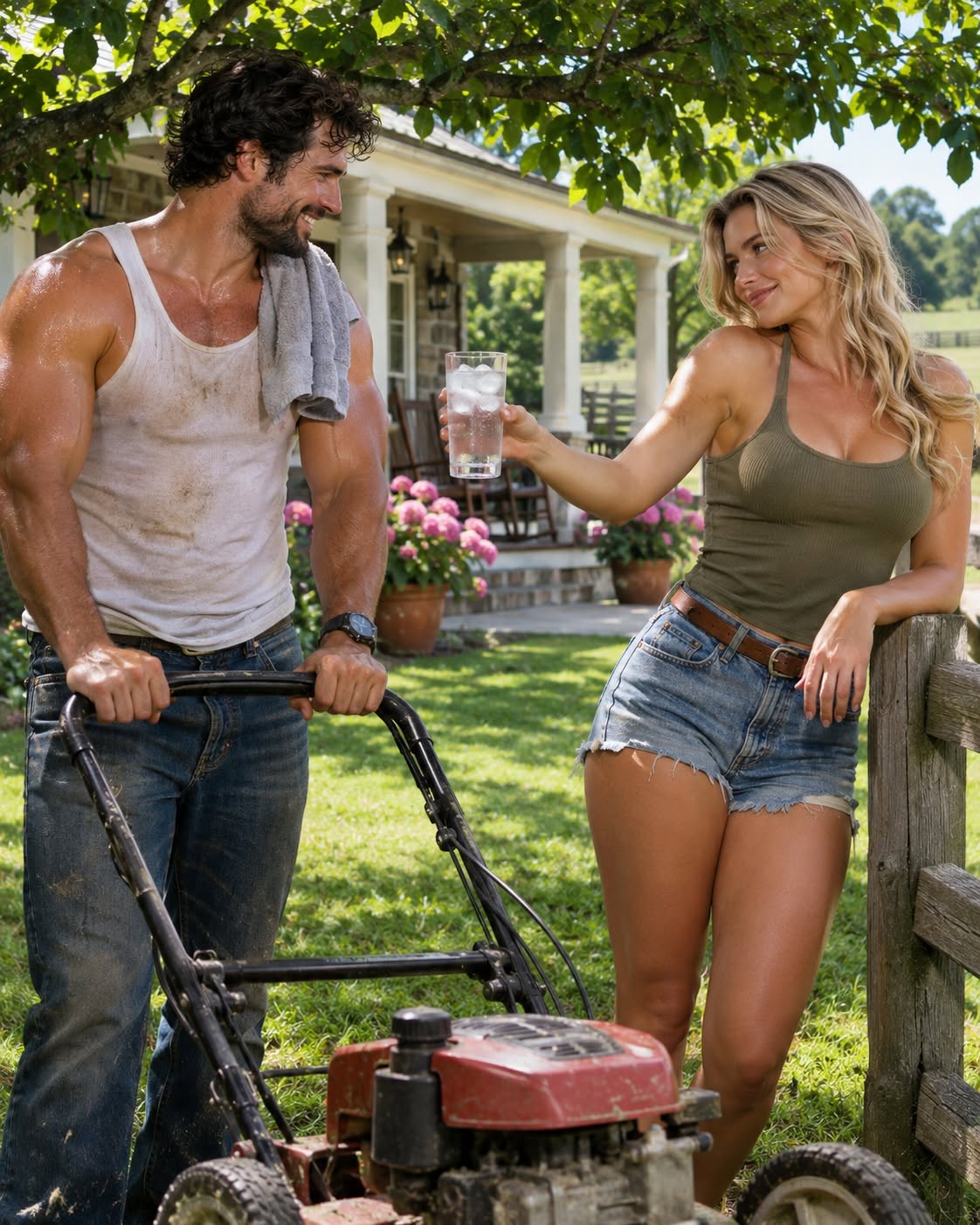
The owner of the biggest ranch I’d ever worked on walked across her front lawn carrying two bottles of water.
The figures Tessa handed me were spread across the desk in three separate columns.
One was labeled EXPANSION.
Another said DEBT REDUCTION.
The third simply read REMAINING CASH.
I studied them for several minutes before looking up.
“If we expand the irrigation system the way the contractor recommends, we’ll spend almost everything we have,” I said.
Tessa nodded.
“And if we put the money toward the debt?”
“We’ll breathe a little easier financially. But we’ll still have an inefficient system, and another dry summer could put us right back where we started.”
She leaned back in her chair.
“That’s why I asked you.”
I looked at the figures again.
The ranch had approximately ninety-six thousand dollars available after payroll and operating expenses. The proposed irrigation expansion would cost more than a hundred and forty thousand. The outstanding debt was still substantial, and the bank had made it clear that another year of poor cash flow would make negotiations difficult.
It wasn’t a choice between spending money and saving money.
It was a choice between solving tomorrow’s problem and making sure there was a tomorrow.
“I wouldn’t do either one completely,” I finally said.
Tessa raised an eyebrow.
“Go on.”
“I’d spend enough to make the existing system efficient before building anything new. Replace the worst sections of pipe, install proper pressure regulators, put meters on the major lines, and upgrade the pump controls. We could also monitor soil moisture instead of watering on a fixed schedule.”
“How much?”
“About thirty-one thousand, based on these estimates.”
She looked at the remaining figures.
“That leaves sixty-five.”
“Put twenty-four toward the principal. Keep the other forty-one as a reserve.”
“That’s a lot of money sitting in an account.”
“It’s money keeping us from borrowing at the worst possible time. If a pump fails, we can repair it. If we get another emergency, we won’t have to sell something just to survive.”
Tessa didn’t answer immediately.
I continued.
“Once we’ve tracked the savings through a full growing season, we’ll know whether expanding the system makes sense. Maybe we won’t need the expansion at all. Maybe we’ll only need a smaller version.”
She tapped her pencil against the desk.
“So you’re recommending that we move slower.”
“I’m recommending that we stop paying to fix problems we haven’t properly understood.”
For the first time that evening, she smiled.
“My father would have hated that answer.”
“Why?”
“He believed in building big enough that nobody could ever question whether we were serious.”
“Maybe that’s why the ranch has so many expensive things that don’t work.”
She laughed.
It was the kind of laugh I hadn’t heard from her during our first months working together.
Then her expression became thoughtful.
“All right. Let’s do it your way.”
I didn’t realize how much trust was contained in those five words until much later.
The following week, we brought Ray and our irrigation specialist into the meeting. Ray studied the proposed repairs, then disappeared into his truck and returned with his old notebook.
He opened it to a page filled with measurements and sketches.
“Your father installed this section in 1998,” he told Tessa, pointing to a drawing. “He intended to add another line here, but never finished it.”
Tessa stared at the page.
“I’ve never seen this.”
“Your father didn’t like paperwork. He liked drawing things on whatever he could find.”
Ray turned another page.
There were measurements, notes about water pressure, dates of repairs, and little reminders written in the margins.
For years, everyone had treated that notebook as an old ranch hand’s collection of memories.
Now it was helping us save thousands of dollars.
We made a final list, approved the repairs, and began the first stage.
For a while, everything went according to plan.
Then Wade Barlow showed up.
He represented the development company that had offered to buy the stream frontage. I’d seen him once before, standing beside a black SUV near the entrance.
He wore an expensive watch and carried the kind of confidence that comes from believing every problem has a price.
He asked Tessa to reconsider the offer.
“We’ve increased the amount,” he said. “You could eliminate most of your financial obligations immediately.”
Tessa didn’t invite him into the house.
“How much?”
He named a figure that made even me stop moving.
It was considerably more than the original offer.
Wade continued.
“We’re prepared to move quickly. You wouldn’t have to spend another summer worrying about water restrictions or equipment expenses.”
Tessa folded her arms.
“And what happens to the stream?”
“We’d develop the surrounding property.”
“That wasn’t my question.”
He glanced at me before answering.
“There would be access improvements and some changes to the existing drainage.”
I noticed a thick document tucked under his arm.
Tessa asked to see the proposed agreement.
He handed it over.
After he left, she asked me to look through the technical sections.
I wasn’t a lawyer, and I wasn’t going to pretend to understand every clause. But one section caught my attention.
The agreement included a permanent access and drainage easement.
I read it twice.
“Tessa, you need an attorney to explain this.”
“I know.”
“But I think you should pay particular attention to what they want to do with the water.”
She looked at the page.
“Why?”
“Because they’re not just buying seventeen acres. They’re asking for rights that could affect how the land around the stream is used in the future.”
She sat down slowly.
For a moment, neither of us spoke.
“My father spent his entire life protecting that stretch of land,” she said. “And I was ready to sell it because I couldn’t figure out how to keep the bills paid.”
“There’s nothing shameful about considering an offer.”
“It feels like I’m betraying him.”
“Your father left you a ranch, not an obligation to destroy yourself keeping it exactly as he left it.”
She looked at me.
“That’s a surprisingly thoughtful thing to say for someone who once tried to repair a water pump with a hammer.”
“It was a very specific problem.”
She laughed again.
But she didn’t sign the agreement.
Instead, she hired an attorney to review it and gave Wade a deadline for a response.
For the next month, we concentrated on the irrigation work.
Clara also became a regular visitor.
She had decided that the strip of ground beside the old equipment shed would make a perfect garden.
Tessa gave her permission, provided she didn’t plant anything where the underground lines ran.
That led to an afternoon of Clara marking the ground with little wooden stakes while Ray patiently explained where the pipes were buried.
I came home one evening to find a handwritten list on the kitchen counter.
TOMATOES.
SUNFLOWERS.
GREEN BEANS.
AND SOMETHING PRETTY FOR TESSA.
I smiled at the last line.
Clara caught me looking.
“Don’t tell her.”
“I won’t.”
“She works too much.”
“She owns a ranch. That’s practically part of the job.”
Clara frowned.
“That’s not a very good excuse.”
I had no argument.
By late July, the heat had become relentless.
The grass turned brown, the creek dropped, and the cattle began gathering around the shaded troughs earlier each afternoon.
Our new monitoring system had been running for several weeks when something unusual appeared.
One of the meters showed water moving through the main line long after the irrigation schedule had ended.
At first, I thought the sensor was faulty.
I checked the readings again.
The numbers were real.
“Ray!” I called.
He walked over carrying his notebook.
“What have you found?”
“Either we’ve got a serious leak or somebody’s watering the pasture at midnight.”
He studied the readings.
“There’s a section beneath the old road crossing that I never trusted.”
We followed the line toward the lower pasture.
The ground looked normal from above, but when I stepped near the edge of the crossing, my boot sank into unusually soft soil.
I pushed a metal rod into the ground.
It went down much farther than it should have.
“Shut the pump off,” I told Ray.
We did.
Within minutes, the pressure readings changed.
The leak was somewhere beneath the road.
Tessa arrived just as we were setting up the equipment.
“How bad?”
“Bad enough that we’ve probably been losing water for days.”
She looked toward the pasture.
“Can we fix it?”
“Yes. But we need to find exactly where the pipe broke. If the ground underneath that crossing is washing away, we could lose the road, too.”
Tessa called the specialist.
He arrived that afternoon and confirmed our concern.
A section of old main pipe had cracked beneath the crossing. Water had been escaping into the soil, slowly undermining the road.
The repair wasn’t going to be cheap.
Worse, shutting down the line would leave the lower pasture without its normal water supply.
We had livestock to consider.
Tessa stood beside the road, staring at the muddy ground.
“How much will this cost?”
The specialist gave her an estimate.
She closed her eyes.
For a moment, I saw the same fear I’d seen in her office months earlier.
The fear of another problem arriving just when she thought things were getting better.
“Use the reserve,” I said quietly.
She looked at me.
“That’s exactly what we saved it for.”
She nodded.
Then she turned toward Ray.
“Let’s move the cattle to the upper pasture. Get the portable tanks ready. I want the road secured before anyone starts digging.”
There was no panic in her voice.
Just decisions.
That evening, the crew worked beneath portable lights.
The damaged pipe was worse than we’d expected. A large section had split, and the surrounding soil had become almost like wet sand.
Ray found the original installation sketch in his notebook.
“Look here,” he said, pointing to a small drawing. “There’s an old bypass line running around this crossing.”
The specialist examined it.
“If it’s still intact, we can use it temporarily while we replace the damaged section.”
We spent nearly an hour locating the connection.
It was buried beneath years of dirt and gravel, but eventually my shovel struck metal.
There it was.
An old valve, almost completely hidden.
We cleared it, tested the connection, and managed to restore water to the temporary supply.
The crew cheered.
Tessa stood beside me, wiping dirt from her forehead.
“You realize that notebook might be worth more than the entire equipment shed.”
“Don’t tell Ray. He’ll start charging us for consulting.”
She laughed.
Then she looked at the road.
“Thank you.”
“For what?”
“For not making me feel stupid every time something goes wrong.”
I put down my shovel.
“Things break. That’s why people learn how to repair them.”
She looked at me for a long moment.
“I wish I had learned that earlier.”
I wanted to tell her that I wished I had learned it earlier, too.
After my wife died, I’d spent years believing that every failure was proof I wasn’t doing enough. If Clara needed something, I worked longer. If the truck broke down, I found another job. If money ran short, I simply stopped buying things for myself.
I thought that was what being a father meant.
I hadn’t understood that constantly trying to be strong could make it impossible for anyone else to help.
The pipe repair took two days.
During that time, the weather forecast changed.
A powerful storm system was moving toward the county.
We had been waiting for rain for weeks, but now the forecast warned of heavy rainfall in a short period.
The specialist advised us to check the drainage channels and make sure the temporary bypass was protected.
We spent the next morning clearing debris.
Ray inspected the lower pasture.
I checked the equipment.
Tessa reviewed the emergency plan with the crew.
For once, everyone knew exactly what needed to happen.
Then the storm arrived.
It began shortly after sunset.
Rain struck the roof of the barn so hard that conversation became impossible. Within an hour, the creek had risen several inches.
I was checking the drainage gate when my phone rang.
It was Ray.
“Get down here. The lower channel is backing up.”
I climbed into the truck and drove toward the pasture.
Tessa was already there.
Water was rushing toward the road, carrying branches and debris.
The newly repaired crossing was holding, but the drainage channel had become blocked near an old fence line.
“If that backs up any higher, it’ll run across the road,” Ray shouted.
We needed to clear the obstruction.
The three of us worked with the crew, using ropes and equipment to remove the larger branches.
At one point, the current knocked a heavy piece of timber against the gate.
The metal frame bent.
Tessa stepped forward.
“Stay back!” I yelled.
She stopped just as the timber broke loose and swept past.
For several seconds, nobody moved.
Then Ray called out that the secondary drainage route was open.
Water began moving away from the road.
We watched the level drop.
The crossing held.
The pasture held.
And the ranch was still standing.
By midnight, the worst of the storm had passed.
We stood beneath the barn awning, soaked and exhausted.
Tessa looked at the crew.
“Everyone accounted for?”
Ray nodded.
“All of us.”
She turned to me.
“How’s the road?”
“Ugly. But it’ll survive.”
She smiled.
“That’s a pretty good description of this ranch.”
I laughed.
Then she became quiet.
“My father used to stand right there during storms,” she said, pointing toward the old barn. “He’d walk outside every hour to check the drainage. He never trusted a weather report.”
“Sounds like a stubborn man.”
“He was.”
She looked across the dark pasture.
“I spent so much time trying to become the person he wanted me to be that I forgot to figure out what kind of person I wanted to be.”
I didn’t know what to say.
She continued.
“I thought owning this place meant I had to know everything. I couldn’t let the workers see me worried. I couldn’t admit when I didn’t understand something.”
“Nobody knows everything.”
“Apparently, even the man who can fix a broken irrigation system with a hammer.”
“That happened once.”
“Twice.”
We laughed.
Then she reached for my hand.
It was a small gesture.
But neither of us pulled away.
The next few weeks brought a different kind of challenge.
The county scheduled a follow-up inspection to review our water records and verify that the repairs were reducing consumption.
We had done the work, but the inspector would need to see actual results.
Our irrigation specialist prepared the technical report.
Ray organized the historical records.
I gathered the pressure readings, repair receipts, and maintenance logs.
Tessa handled the financial documents.
The night before the inspection, she came into the equipment office carrying two cups of coffee.
“You look like you’re preparing for a trial,” she said.
“I’d rather repair ten pumps than explain one spreadsheet.”
She placed a cup beside me.
“Good thing you have me.”
I looked up.
“Good thing.”
She sat on the edge of the desk.
“Do you ever wonder what would have happened if you hadn’t stopped here that first morning?”
“Probably would have found another lawn to mow.”
“And Clara?”
“Would still be telling me I need to buy a better truck.”
Tessa smiled.
“I’m serious.”
I considered the question.
“I don’t know. I was doing what I had to do. I wasn’t really thinking about what came next.”
“Neither was I.”
She looked down at her coffee.
“I thought I needed someone to fix the ranch. I didn’t realize I needed people who would tell me when I was making the wrong decisions.”
I smiled.
“Sometimes that’s the hardest repair.”
The inspection began at nine the next morning.
The county reviewers examined the pump records, checked the meters, and walked the irrigation lines.
They asked difficult questions.
We answered honestly.
There were still sections that needed improvement. We didn’t pretend otherwise.
But the measurements showed that the repaired system was using significantly less water than before.
The specialist explained how the new controls prevented unnecessary pumping.
Ray showed them the historical drawings.
I walked them through the damaged crossing and explained how the temporary bypass had allowed us to maintain livestock water while completing the repair.
One of the reviewers studied the figures.
“Your water consumption is down considerably,” he said.
Tessa nodded.
“We’re not finished. But we know what needs to be done next.”
He looked at the maintenance records.
“That’s important. A conservation plan only works if someone continues monitoring it.”
Tessa glanced toward me and Ray.
“We have people doing that now.”
The reviewers left with copies of the documents.
We waited nearly two weeks for the decision.
When the letter finally arrived, Tessa called everyone into the office.
The county had approved the next phase of our permit, with continued monitoring and periodic reporting.
It wasn’t unlimited access.
It wasn’t a guarantee that the ranch would never face another restriction.
But it was a clear path forward.
Ray opened a bottle of soda.
“Well, I’ll be.”
Tessa laughed and wiped her eyes.
For the first time since I’d met her, she didn’t look like someone carrying the entire ranch on her shoulders.
She looked like someone who had finally learned to share the weight.
That afternoon, Clara ran into the office holding a small green plant.
“Dad! Look!”
She had grown the first sunflower from her garden.
It was barely taller than her hand.
Tessa crouched beside her.
“That’s a beautiful one.”
“There’s another one coming.”
“Then we’d better make sure we give it enough room.”
Clara considered that.
“Can I plant more?”
Tessa looked at me.
I shrugged.
“Apparently, we’ve started a farming operation.”
Clara grinned.
And just like that, the garden became another project for the ranch.
The financial situation improved slowly.
The repairs reduced operating costs. We continued paying down the debt, and the reserve account gave us room to handle unexpected expenses without taking on another emergency loan.
By the following spring, we had enough information to reconsider the irrigation expansion.
This time, we didn’t rely on a contractor’s promises or a single estimate.
We had a year of measurements.
We knew which pastures needed additional water and which ones could manage with better scheduling and soil management.
The expansion we eventually approved was smaller than the original proposal.
It cost less, used less water, and addressed the actual needs of the ranch.
Tessa also made another decision.
She established a paid training position for a young local worker who wanted to learn equipment maintenance and irrigation management.
Ray volunteered to teach him.
“You’ll have to be patient,” I warned Ray.
He shook his head.
“I was patient with you.”
“That’s not what I remember.”
“Exactly.”
The ranch was becoming something neither Tessa nor I had expected.
Not just a place that employed people.
A place where people could learn, contribute, and build a future.
But the biggest change happened away from the equipment shed.
One Saturday evening, Tessa came to my house for dinner.
Clara had insisted on cooking.
The menu consisted of grilled chicken, potatoes, and a salad made mostly from vegetables she had grown herself.
Tessa complimented every dish.
Clara looked pleased.
After dinner, she disappeared into her bedroom and returned carrying a folded piece of paper.
“I made something.”
She handed it to Tessa.
It was a drawing of the ranch.
There was a barn, a truck, several cows, a garden, and three people standing beside a large sunflower.
Tessa studied it carefully.
“Who’s this?”
“That’s Dad.”
“And this?”
“Me.”
She pointed to the third figure.
Tessa smiled.
“Is that supposed to be me?”
Clara nodded.
“I put you in the picture because you belong there.”
Tessa’s expression changed.
She looked at Clara, then at me.
“Thank you,” she whispered.
Clara shrugged as though it were the most ordinary thing in the world.
Then she asked whether Tessa wanted to help her plant more flowers next weekend.
Tessa said yes.
After Clara went to bed, we sat on the porch.
The evening was quiet.
Tessa held the drawing in her hands.
“I’ve never been very good at letting people get close,” she said.
“Neither have I.”
“Your wife…”
She stopped, uncertain whether she should continue.
I looked toward the yard.
“She was a wonderful person. Clara still talks about her. I don’t expect anyone to replace her.”
“I wouldn’t want to.”
I nodded.
“But I think there’s room in our lives for good things we didn’t expect.”
Tessa looked at me.
“Is that what you think this is?”
I took a breath.
“I think I’ve started looking forward to seeing you even on days when nothing is broken.”
She smiled.
“That’s unfortunate. I was hoping you’d keep coming around for the broken equipment.”
We laughed softly.
Then she moved closer and rested her head against my shoulder.
It wasn’t a dramatic beginning.
No promises were made.
No one suddenly forgot the past.
But something had changed.
We were no longer just two people trying to keep a ranch operating.
We were two people who had discovered that life could become easier when you stopped insisting on carrying everything alone.
The following summer brought another difficult season.
Rainfall was below average, and several neighboring properties struggled with dry wells and declining pasture conditions.
The Ward Ranch wasn’t immune.
We had to reduce irrigation hours, adjust grazing schedules, and monitor every major water line.
But we were prepared.
The reserve covered an unexpected pump repair.
The conservation system helped us stay within the county limits.
And the crew knew how to respond before a small problem became an expensive emergency.
One afternoon, a neighboring rancher named Mr. Ellis stopped by.
His livestock water supply had become unreliable, and he asked whether we could help him understand some problems with his old pumping system.
Tessa listened.
Then she looked at me.
I understood what she was thinking.
We couldn’t simply give away water. Our permit had clear restrictions, and we weren’t going to jeopardize the ranch by ignoring them.
But we could help him inspect his equipment and identify the problem.
Ray volunteered to go.
A week later, Mr. Ellis returned with a repaired pump and a basket of peaches.
He insisted we take them.
Tessa accepted.
“Seems like we’re making friends,” I said.
“Don’t get used to it,” she replied. “I still don’t like people.”
“That’s strange. You seem to tolerate me.”
“You’re useful.”
I pretended to be offended.
She laughed and kissed my cheek.
That evening, I found Clara sitting in the garden beside the sunflowers.
She was writing something in a small notebook.
“What are you working on?”
“My school assignment.”
“What is it about?”
“People who make a difference in their community.”
I sat beside her.
“Who’s your subject?”
She pointed toward the ranch.
“Everyone here.”
I looked at her notebook.
She had written about Ray, the workers, the irrigation specialist, Tessa, and even the county employees who had helped us understand the requirements.
At the bottom of the page, she had written one sentence.
Sometimes saving something doesn’t mean doing everything yourself. It means finding people who care enough to help you save it.
I read it twice.
“That’s pretty good.”
Clara smiled.
“I learned it from watching you.”
I looked at her.
For a moment, I couldn’t speak.
I had spent so many years worrying that I wasn’t giving her enough.
Enough money.
Enough time.
Enough opportunities.
Yet she had been watching the way I worked, the way I struggled, and the way I slowly learned to accept help.
Maybe children don’t need to see their parents become invincible.
Maybe they need to see them become human.
Several months later, Tessa and I stood near the stream frontage at sunset.
The developer’s offer had expired.
The land was still part of the ranch.
The water still moved through the same narrow channel her father had walked beside for decades.
She looked toward the trees.
“I used to think keeping this place meant preserving everything exactly as it was.”
“And now?”
“Now I think keeping it means making sure it can still be here for the next generation.”
She turned toward me.
“I’ve been thinking about something.”
“Should I be worried?”
“Probably.”
She smiled.
“I want to put Clara’s garden on a permanent plan. Maybe build a small greenhouse and let local children visit during the spring open house.”
“That sounds expensive.”
“We’ll start small.”
I nodded.
“That’s usually how the best things start.”
She took my hand.
“And there’s something else.”
I waited.
“I don’t want you to feel like your future depends on this ranch. If something changes here, I don’t want you to believe you have nowhere else to go.”
I understood what she was saying.
She wasn’t asking me to stay because I needed the paycheck.
She was telling me I could stay because I wanted to.
“Then let me say something, too,” I replied.
“What’s that?”
“I’m not here because I need somewhere to hide from the world. I’m here because I’ve found something worth building.”
Her eyes softened.
“Us?”
“Us. The ranch. The life we’re making. All of it.”
She squeezed my hand.
And for the first time in a long time, I didn’t feel afraid of what tomorrow might bring.
The ranch wasn’t suddenly wealthy.
There were still debts to pay, equipment to maintain, and difficult decisions ahead.
The stream still had to be protected.
The county still required reports.
And the weather still refused to follow anyone’s plans.
But the ranch had something it hadn’t had when I first arrived.
A future that didn’t depend on one person pretending to have all the answers.
Ray had become the keeper of the old records and the teacher of the new crew.
Tessa had learned to ask questions before making decisions.
I had a dependable job, a healthier work schedule, and the ability to pick Clara up from school every afternoon.
And Clara had a garden that seemed to grow a little bigger every season.
One Sunday, nearly two years after that first morning, I was repairing a gate when Tessa walked across the lawn carrying two bottles of water.
I looked up and started laughing.
She stopped.
“What?”
“Nothing. Just remembering the first time you walked toward me with those.”
“Back then, I was worried you hadn’t finished mowing.”
“And instead, you asked me to fix an irrigation system.”
“Which you did.”
“Eventually.”
She handed me a bottle.
We stood together looking across the pasture.
The grass wasn’t perfect. The fence needed work. A tractor was making an unpleasant noise near the barn.
But the water was running where it was supposed to run.
The cattle had shade.
The garden was blooming.
And somewhere near the house, Clara was laughing with Ray as they argued about whether sunflowers needed more room.
Tessa leaned against my shoulder.
“Do you ever think about that night when I gave you the contract?”
“Sometimes.”
“What would you have done if you hadn’t signed it?”
I looked toward the old road crossing.
“I probably would have kept taking whatever jobs came along. I would have told myself I was doing the responsible thing.”
“Would you have been happy?”
I considered that.
“I would have been getting by.”
She nodded.
“There’s a difference.”
“Yes. There is.”
A few minutes later, Clara came running toward us.
“Dad! Tessa! You have to see the garden!”
We followed her.
The sunflowers had grown taller than she was. The tomatoes were beginning to ripen, and green beans climbed the wooden frames Ray had helped her build.
Clara pointed to a small wooden sign beside the entrance.
She had painted it herself.
It read:
WARD RANCH COMMUNITY GARDEN.
Beneath it, in smaller letters, she had written:
GOOD THINGS GROW WHEN PEOPLE TAKE CARE OF EACH OTHER.
Tessa read the words quietly.
Then she looked at me.
I thought about the man I’d been when I first drove through the ranch gates.
A widowed father with an old pickup, a toolbox, and a daughter who needed him.
I had believed my only responsibility was to keep the bills paid and make sure Clara never saw how frightened I was.
But that ranch had taught me something I hadn’t expected.
Being responsible didn’t mean refusing every opportunity that involved uncertainty.
It meant knowing what mattered enough to protect, what needed to change, and when to let someone stand beside you.
Tessa had once feared losing the land her family had spent generations building.
I had feared losing the little stability I’d managed to give my daughter.
Neither of us had understood that protecting something didn’t always mean holding on tighter.
Sometimes it meant making room for other people.
Sometimes it meant changing the plan.
And sometimes it meant accepting that the future would never be completely safe, no matter how carefully you prepared for it.
Clara reached for my hand.
“Are we staying here for a long time?”
I looked at Tessa.
She was smiling.
“That’s the plan,” I told her.
Clara nodded, apparently satisfied.
Then she ran back toward the sunflowers.
Tessa slipped her hand into mine.
For years, I’d measured success by what I could provide without asking anyone for help.
A paycheck.
A repaired truck.
A full refrigerator.
A roof over my daughter’s head.
Those things still mattered.
But now I understood that a good life was measured by something more.
It was measured by whether the people you loved had room to grow.
Whether your work left something better behind.
Whether you could face a difficult season without believing you had to face it alone.
And whether, when someone offered you a place beside them, you were brave enough to accept.
The ranch had needed someone to repair its irrigation system.
I had needed a steady job.
Neither of us had known that the most important thing we would build together had very little to do with water, pipes, or pasture.
It was a life.
And this time, I wasn’t afraid to let it grow.