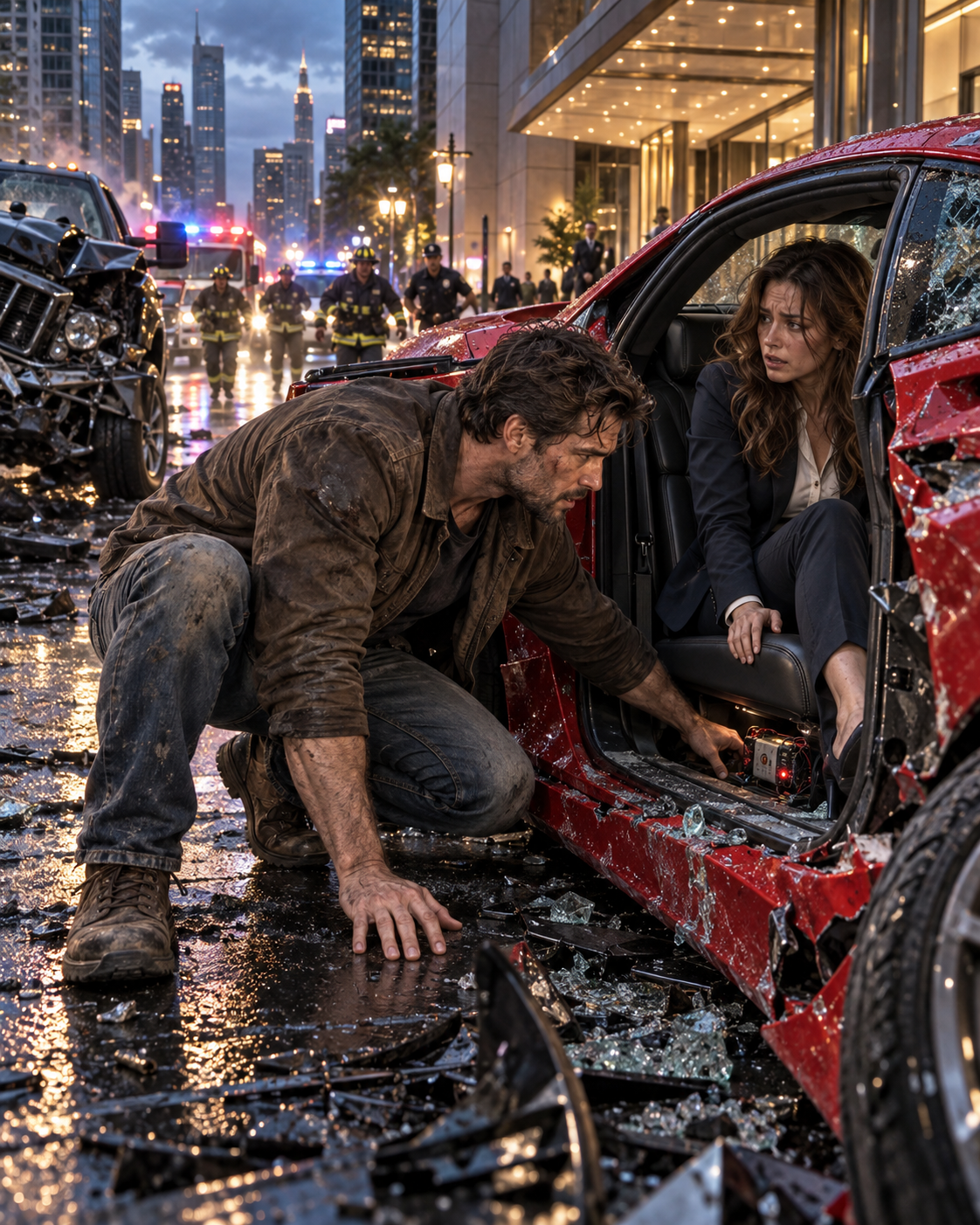
“The moment my battered pickup slammed into Vivian Lockwood’s red Ferrari outside the Chicago hotel
Part 2
Vivian stared at the photograph until the paper began to bend beneath her fingers.
Preston Carlyle had joined Lockwood Technologies fourteen months after her father’s death.
He had told her repeatedly that he had never met Alexander.
He had said he regretted arriving too late to know the man who built the company.
Now his face was sitting inside a photograph taken eighty yards from Alexander’s body.
I showed Vivian my old field notebook.
I had written down the name of the private security consultancy that man represented that night.
The company had disappeared five months after Alexander’s death.
Its records were gone.
Its principals had moved into other businesses.
But Vivian had access to something I didn’t.
Her company’s historical financial records.
We searched for three hours.
Then we found it.
The consultancy had received payments through a private investment fund.
The fund had received money through two intermediaries.
And at the end of the chain was one name.
Graham Kingsley.
The payments had continued for seven months.
The largest payment had cleared eleven days after Alexander’s funeral.
Vivian pressed both hands against the workbench.
“That’s not proof.”
“No,” I said.
“But it’s a trail.”
She knew what would happen if she accused Kingsley too early.
He would deny everything.
He would hire lawyers.
He would call her traumatized.
And if he knew what she had discovered, every record would disappear.
So we decided to make him believe he had won.
At 11:40 that night, Vivian called him.
She told him she had made a mistake.
She said I had manipulated her.
She apologized for doubting him.
Then she said she wanted to return to the tower.
Kingsley’s voice became warm again.
Almost paternal.
He sounded relieved.
Too relieved.
He made two requests.
First, he wanted an emergency board meeting the next morning.
Second, he wanted every piece of evidence transferred to Carlyle’s security division.
Vivian agreed.
After the call ended, she looked at me.
“He thinks I’m scared.”
I shook my head.
“He thinks you’re alone.”
We spent the night building a plan with Detective Bennett.
Nobody moved until the evidence was secure.
Nobody trusted the security chain.
And nobody mentioned my daughter.
By sunrise, the story had already changed.
A short security video of my pickup hitting Vivian’s Ferrari had gone viral.
It showed the crash.
It showed Vivian screaming.
It showed me standing beside the wreck.
It showed nothing underneath the seat.
The internet didn’t need the truth.
It only needed eleven seconds.
By eight that morning, Graham Kingsley stood before the Lockwood board.
He looked calm.
Concerned.
Almost fatherly.
He described me as a former investigator who had never accepted Alexander’s death.
He never called me a murderer.
He didn’t need to.
He repeated the word “obsession” until the room began thinking it for him.
Then he played another camera angle.
It showed me standing beside Vivian’s Ferrari before the crash.
My hand was out of frame.
Kingsley asked what I had been doing.
Nobody answered.
Then he suggested Vivian take temporary medical leave.
He said she had been through too much.
He said the company needed stability.
He recommended that Carlyle control the investigation.
Fourteen people turned toward Vivian.
She stood.
Through the glass wall behind Kingsley, she could see me being held by two of Carlyle’s men.
She looked directly at me.
Then she said the words we had rehearsed.
“Remove him from the building.”
I stared at her.
For one second, even I felt the weight of it.
Then I understood she was doing exactly what we had planned.
Carlyle’s men took me toward the service elevator.
That was the part they hadn’t planned for.
I slipped away at the loading bay.
I found an internal security room two corridors from the executive floor.
The door was open.
A shredder was still warm.
A rack that should have held eleven drives had eleven empty spaces.
Someone was destroying evidence.
I pulled the last remaining drive from the rack.
Then the door closed behind me.
Preston Carlyle stood there.
He didn’t look surprised.
He didn’t look angry.
He simply looked tired.
He said one sentence.
“You should have let that Ferrari leave the garage.”
Then he came for the drive.
We fought through the concrete corridor.
There were no guns.
No dramatic speeches.
Just two men crashing into doors, knocking over equipment and running through the parking deck.
I escaped with the drive.
Carlyle disappeared through a pedestrian exit.
The drive contained everything.
Credential theft.
Vehicle surveillance.
False traffic alerts.
Procurement records.
Names.
Dates.
Payments.
Then we found something worse.
The operation had started seven months before Vivian announced her audit.
That meant the audit hadn’t caused the attempt on her life.
It had only accelerated something already in motion.
Then we found a folder from nine years earlier.
Three words were written across it.
“A. Lockwood contingency.”
We opened it that night in the back room of a body shop.
Detective Bennett stood beside Vivian.
I connected the drive to a laptop.
The truth appeared piece by piece.
Alexander Lockwood had been investigating his own chairman.
He had discovered shell companies billing Lockwood Technologies for engineering work that had never happened.
The money moved through the same intermediaries Vivian had found.
Alexander had prepared a resolution to remove Graham Kingsley from the board.
He planned to refer the matter to prosecutors.
The board meeting was scheduled for June.
Alexander died in April.
Dry road.
No traffic.
No meaningful skid marks.
A supposedly ordinary accident.
Except it wasn’t.
Kingsley had not saved the company after Alexander’s death.
He had inherited the crime Alexander was about to expose.
For nine years, he had built himself into the company’s foundation.
He became the dependable chairman.
The adviser.
The family friend.
The man Vivian trusted.
And when Vivian’s audit began touching the same financial structure her father had discovered, Kingsley realized history was repeating itself.
So he needed a perfect story.
A former investigator with a grudge.
A stolen company credential.
A recovery job.
A bomb.
A Ferrari crash.
A frightened executive.
A convenient suspect.
Me.
If Vivian died, the story would be simple.
If I survived, I would be the villain.
Either way, Kingsley would inherit control.
Then the phone rang.
It was Vivian’s prepaid phone.
The number was supposed to be known only to us.
She answered.
Graham Kingsley was on the other end.
He said he had found something her father had left behind.
He told her to meet him at the old executive garage beneath the original Lockwood headquarters.
He knew we had the drive.
This wasn’t about Vivian anymore.
It was about destroying the last evidence that could put him away.
Vivian looked at me.
“We go.”
I nodded.
“But we decide how.”
Part 3
The old garage was almost completely dark.
Only six of the original forty lights still worked.
Concrete pillars stood like broken teeth beneath the building Alexander Lockwood had once owned.
Vivian walked in first.
Detective Bennett had officers waiting four blocks away.
I carried the drive.
We had backup.
But we both knew backup only mattered if the people inside the garage could be trusted.
Graham Kingsley stood beside a support column.
He wore a dark coat.
His hands were empty.
There was no folder.
No evidence.
No secret document from Alexander.
Vivian stopped ten feet away.
“You said you found something.”
Kingsley smiled.
“There was never anything.”
The warmth was gone from his voice.
He didn’t need it anymore.
He told Vivian her father had been a dreamer.
A romantic.
A man who believed a company should be built around principles.
Kingsley said somebody had to do the unpleasant arithmetic.
He spoke about shell companies.
About money.
About Alexander’s planned board resolution.
About the attorney who had buried the crash investigation.
About the security consultancy.
About Carlyle.
He never said, “I killed your father.”
He didn’t need to.
Every sentence confirmed what the drive already contained.
Then he placed a document on the hood of a parked car.
It transferred temporary operational authority to the chairman’s office.
He held out a pen.
“After everything you’ve been through, Vivian, the board will understand.”
She looked at the document.
Then she looked at him.
“No.”
Kingsley’s expression changed.
Just slightly.
Then a figure stepped out of the shadows behind him.
Preston Carlyle.
He hadn’t fled Chicago.
He had been waiting for Kingsley.
The arrangement was still alive.
Kingsley would finish the job.
Carlyle would get him out.
Vivian would disappear from the company.
And the evidence would disappear with her.
Kingsley sighed.
“You’re making this harder than it needs to be.”
A door slammed behind him.
I stepped into the light.
The drive was in my hand.
Kingsley looked at me.
For the first time, his composure cracked.
“You were supposed to be a name in a news story.”
I shook my head.
“You picked the wrong man to blame.”
Carlyle moved first.
Kingsley moved toward Vivian.
Vivian pressed the transmitter hidden in her palm.
Three doors opened simultaneously.
Detective Bennett entered from the north stairwell.
Officers came through the south ramp.
Another team blocked the pedestrian exit.
Carlyle ran.
He made it almost to the gate.
Then two officers slammed him against a parked van.
Nobody fired.
Nobody died.
Graham Kingsley didn’t fight.
He straightened his cuffs.
“You’re making a serious mistake,” he told Bennett.
“My attorneys will contact you within the hour.”
Bennett didn’t answer.
Kingsley had spent forty years buying his way out of rooms.
Then Vivian stepped closer.
“There is one thing you forgot.”
He looked at her.
“Everything you said in this garage was transmitted live.”
Kingsley froze.
“To whom?”
“To the investigators.”
She paused.
“And to four independent members of the board.”
For the first time, he looked around.
There was nobody left in the building who belonged to him.
No loyal security officer.
No frightened employee.
No attorney waiting behind a door.
No one to rewrite what had just happened.
They walked him out through the lobby of the original Lockwood headquarters.
For twenty years, he had entered that building like a king.
That morning, he left between two officers whose names he had never bothered to learn.
Vivian watched him disappear through the glass doors.
She didn’t cry.
Not yet.
Some wounds are too deep for tears.
The weeks afterward were quieter.
And somehow, that made them harder.
The financial investigation expanded.
More shell companies were uncovered.
More people were questioned.
More names appeared.
The case surrounding Alexander Lockwood’s death was reopened.
My missing report was placed back into the official record.
The allegations against me were withdrawn.
Then Vivian stood before the business press.
She didn’t give them a polished corporate statement.
She told them the truth.
She said the man they had called the Ferrari attacker had saved her life.
She said she had doubted him.
She said she had been wrong.
And she said she would never again confuse power with truth.
Afterward, she offered me a position at Lockwood Technologies.
Head of risk and security.
A large salary.
My own team.
A floor in the tower.
I turned it down.
She looked surprised.
I smiled.
“I’ve already spent eleven years being the honest man inside somebody else’s institution.”
She understood.
Instead, we created an independent consulting agreement.
My garage would review Lockwood’s physical security and vehicle operations.
Nobody could edit my findings.
Nobody could bury my reports.
Nobody could remove a sentence because it made the company uncomfortable.
The board received everything directly.
Months later, Vivian came to my garage.
The Ferrari was still sitting beneath a tarp.
Its body was scarred where my pickup had hit it.
She lifted the cover and studied the damage.
“You still owe me a car,” she said.
I laughed.
“I saved the driver.”
“You destroyed the Ferrari.”
“The Ferrari wasn’t part of the rescue plan.”
She laughed.
It was the first real laugh I had heard from her.
Then she placed a key on my workbench.
I recognized it immediately.
It was the key to my old pickup.
The truck had disappeared from the impound lot weeks earlier.
Now it was parked outside.
The frame had been straightened.
The front end rebuilt.
The windshield replaced.
The bumper fixed.
But the odometer still read 290,000 miles.
I looked at her.
“You fixed my truck?”
“You fixed my life,” she said.
Then she smiled.
“So I figured we were even.”
I held the key in my palm.
For nine years, I had carried the weight of a dead man nobody believed I had the right to remember.
That night outside the hotel, I thought I was only stopping a car.
I didn’t know I was reopening a grave.
I didn’t know a woman who had everything could still be surrounded by people she couldn’t trust.
And I didn’t know an old report buried in a forgotten file could survive long enough to speak when its author no longer had a badge.
Sometimes the truth doesn’t arrive like thunder.
Sometimes it sits quietly beneath a seat.
Sometimes it waits inside a photograph.
Sometimes it survives in a report somebody tried to destroy.
And sometimes, when everyone powerful in the room has decided what the truth is supposed to be, all it takes is one ordinary person refusing to look away.
Vivian picked up her keys.
“Next time you want to save my life,” she said, “try calling first.”
I smiled.
“Next time, answer your phone.”
She laughed again.
Outside, the old pickup waited beneath the gray Chicago sky.
Inside the garage, the Ferrari remained under its tarp.
One was worth two hundred thousand dollars.
The other was worth almost nothing.
But that night, I understood something I hadn’t understood nine years earlier.
A person’s value isn’t measured by what they own.
It’s measured by what they refuse to abandon when abandoning it would be easier.
And sometimes the person everyone calls the problem is the only person brave enough to stand between you and the truth.