The moment Chief Surgeon Gregory Whitlock ordered armed security to drag me away from a bleeding Navy SEAL
I stared at the envelope until the letters blurred.
THEY LIED ABOUT TITAN SIX.
For eight years, I had convinced myself that the past was finished, that the men I couldn’t save had been given the dignity of being remembered, and that leaving the military was the only way to stop losing pieces of myself.
Now a wounded SEAL was fighting for his life behind a pair of operating-room doors, and the man who had once promised me that our mission would never be forgotten had sent me a warning from the edge of death.
I slipped the envelope into my pocket.
Not here, I told myself.
Not while Cole was still bleeding.
Through the narrow window, I watched the surgical team move around his body. Dr. Whitlock stood at the operating table, his hands steady despite the sweat gathering along his forehead, while the anesthesiologist called out vital signs.
“Pressure is dropping,” someone announced.
“Clamp that vessel,” Whitlock ordered.
I couldn’t enter the sterile field without being assigned, so I remained outside, listening to the monitor’s frantic rhythm and forcing myself not to return to a place eight years old.
At 3:06 a.m., the monitor settled into a more stable pattern.
The surgeon emerged nearly two hours later, his shoulders sagging with exhaustion.
“We found the source of the bleeding and controlled it,” he said. “He’s not out of danger, but he has a chance.”
My knees almost gave way.
I turned toward the wall and pressed my fingers against my eyes.
I had spent eight years learning how to survive the deaths of people I loved, but I had never learned how to stop being afraid when someone I couldn’t bear to lose was still alive.
Behind me, Whitlock cleared his throat.
“Hollis.”
I lowered my hands.
He looked older than he had an hour earlier.
“I owe you an apology.”
I said nothing.
“I treated you as though you were incompetent because you never challenged me,” he continued. “I assumed your silence meant you had nothing to contribute.”
“No,” I replied. “You assumed silence meant you didn’t have to listen.”
The words landed harder than I expected.
Whitlock looked away.
“You’re right.”
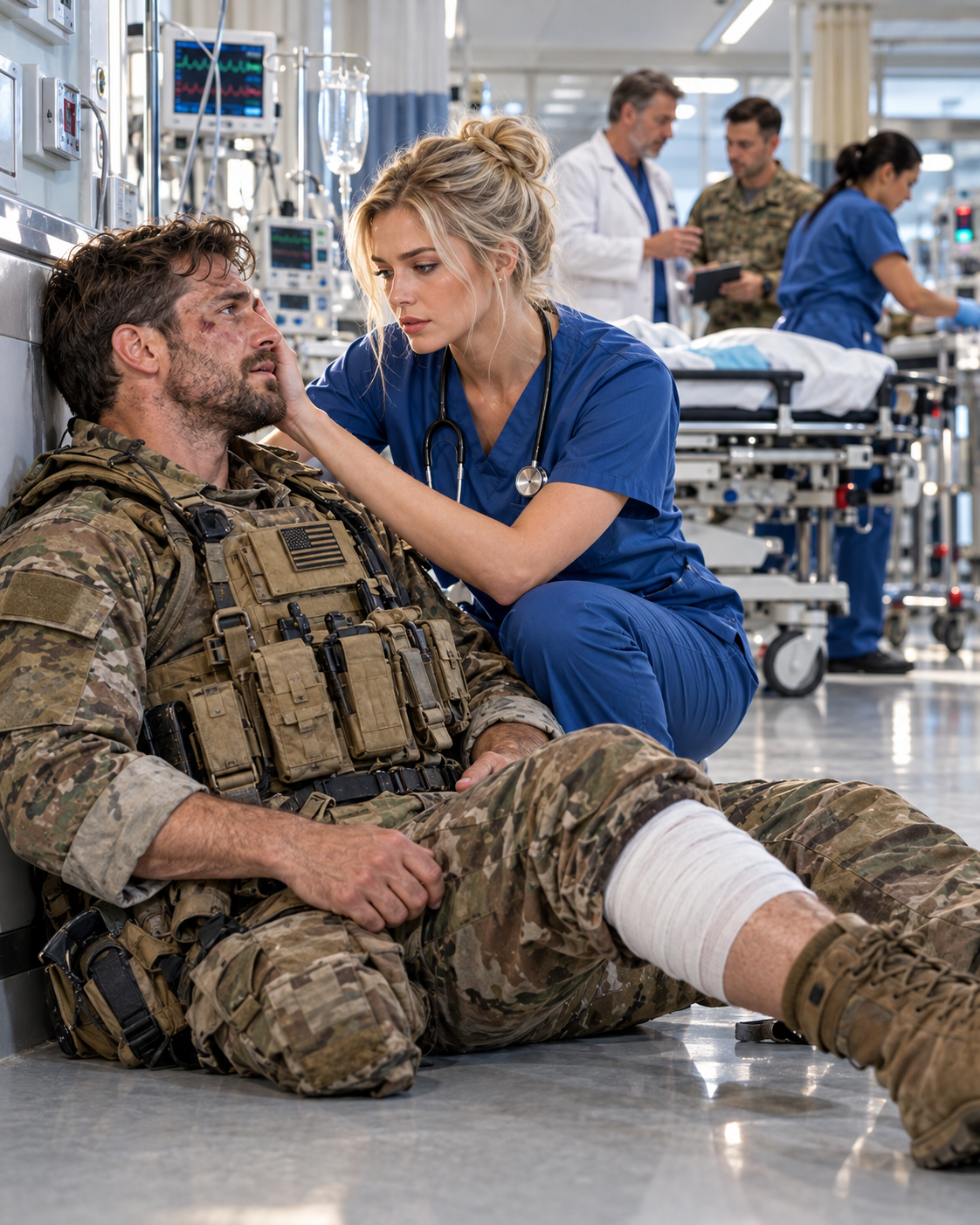
I had imagined that hearing him admit his mistake would feel satisfying. Instead, I felt tired, because no apology could return the eleven months I had spent shrinking myself to make other people comfortable.
“I don’t need you to feel embarrassed,” I told him. “I need you to remember what happened tonight the next time someone speaks quietly in a room full of people who think they’re important.”
He nodded slowly.
Then Admiral Pierce approached us.
“Commander, I need to speak with you privately.”
The title sounded strange in that corridor, as though it belonged to a woman I had once known but no longer recognized.
I followed him into an empty consultation room and closed the door.
He waited until we were alone before speaking.
“Did Brennan give you something?”
I went still.
“How did you know?”
“Because I’ve spent eight years hoping that envelope would never reach you.”
The room seemed to tilt.
“You knew about the message?”
Pierce removed his cover and set it on the table.
“I knew there were unanswered questions about Operation Titan Six. I did not know Brennan would survive long enough to bring them to you.”
“Then tell me what happened.”
He rubbed a hand over his face.
“Eight years ago, your team was sent to extract an intelligence officer from a remote mountain pass. The operation was compromised before you reached the objective. Your unit took heavy fire, your communications failed, and command ordered an immediate withdrawal.”
“I remember.”
I remembered the snow turning black beneath our boots. I remembered carrying a wounded operator whose blood soaked through my gloves. I remembered Cole Brennan firing until his rifle clicked empty.
And I remembered Sergeant Daniel Mercer, the youngest member of our team, disappearing behind a ridge while I screamed for someone to go back.
Pierce continued.
“Your official report stated that the intelligence officer was never recovered and that Mercer died during the engagement.”
“He didn’t die in the engagement,” I whispered. “We never found his body.”
“The report was closed anyway.”
“Why?”
Pierce’s jaw tightened.
“Because someone altered the mission record after the team returned.”
I felt the old anger rise, sharp and familiar.
“Who?”
“I don’t have proof of the individual’s identity yet.”
“Then why did you come here?”
“Because three weeks ago, a classified review reopened the operation after Brennan submitted a statement alleging that the extraction coordinates had been deliberately changed.”
For a moment, I couldn’t breathe.
The coordinates.
Our team had been directed into a narrow pass where the surrounding ridgelines gave enemy fighters an overwhelming advantage. I had spent years blaming myself for not recognizing the trap sooner.
“You’re saying we were sent there deliberately?”
“I’m saying someone may have known the route was compromised.”
I took the envelope from my pocket and placed it on the table.
“Then we start with what Cole knows.”
Pierce nodded.
“But we do this carefully. If the allegations are true, the person responsible may still have access to classified records.”
I opened the envelope.
Inside was a folded letter and a small photograph, its edges softened by years of handling.
The photograph showed six soldiers standing beneath a rocky ridge, their faces streaked with dust and exhaustion.
I recognized every one of them.
Cole stood at the far left, grinning beneath a helmet that was too large for him. Daniel Mercer was beside him, one arm draped over my shoulders.
I looked younger in the photograph.
I was smiling.
I had forgotten what that felt like.
On the back, Cole had written a single sentence.
Mercer made it off the mountain.
My fingers tightened around the photograph.
I read the words again.
Then a third time.
“That’s impossible,” I whispered.
Pierce leaned forward.
“Why?”
“Because Mercer was listed as killed in action.”
“Listed,” Pierce repeated. “Not recovered.”
I sat down.
For eight years, I had carried the memory of that mountain like a stone inside my chest. I had replayed every decision, every second, every moment when I could have turned back.
Now someone was telling me that Daniel Mercer might have survived.
And if he had, someone had spent eight years making sure we believed otherwise.
Before I could ask another question, a nurse knocked on the door.
“Admiral, Chief Brennan is awake.”
I was already standing.
Cole lay in the intensive care unit beneath a thin blanket, pale and exhausted, with monitoring leads crossing his chest. His eyes opened when I approached.
“Lantern,” he murmured.
I pulled a chair beside his bed.
“I’m here.”
He tried to smile, but the movement became a grimace.
“Still giving orders?”
“Only when people need them.”
“That sounds like you.”
For several seconds, we simply looked at each other.
There were a thousand things I wanted to ask him, but the first words that escaped my mouth were the ones I had been afraid to say for eight years.
“Why didn’t you tell me Mercer might be alive?”
Cole closed his eyes.
“Because I wasn’t sure.”
“Cole.”
“I saw him after the ridge fell,” he whispered. “He was alive. An enemy patrol dragged him away, and I couldn’t reach him. I tried, Tessa. I swear I tried.”
His voice broke.
“I watched them take him, and I had to choose between chasing them and getting the rest of the team out. I chose the team.”
I reached for his hand.
“You made the only decision you could make with what you knew.”
“I should have told you sooner.”
“Yes,” I said, because love without honesty could become another kind of wound. “You should have.”
He nodded, tears slipping toward his temples.
“Three weeks ago, I received an encrypted message from an old intelligence contact. It included a photograph of Mercer, taken six months ago.”
“Where?”
“I don’t know. The image had no location data. But the message said he was being held under an assumed identity, and that the people responsible for the original ambush had spent years keeping him hidden.”
“Who sent it?”
“Someone who signed the message Lantern.”
The word chilled me.
“That’s my callsign.”
“I know.”
He swallowed painfully.
“They wanted me to come looking for you. I think they knew you’d be the only person I’d trust.”
I stared at him.
Someone had used my old identity as bait, drawing Cole toward me while keeping Mercer somewhere beyond our reach.
“Did the message include anything else?”
Cole turned his head toward the bedside table.
“There’s a number. Memorize it. Don’t write it down.”
He recited eleven digits, pausing between each group.
I repeated them silently until I was certain I could remember them.
Then he caught my wrist.
“Tessa, there’s something else.”
His eyes moved toward the door.
“Before the operation, someone on our own side called off the original extraction. The order came through an authorization channel assigned to Rear Admiral Pierce.”
I looked at the man standing behind me.
Pierce had entered so quietly that neither of us had heard him.
For a moment, no one spoke.
Then the admiral stepped into the room and shut the door.
“I knew this might come up,” he said.
Cole tried to sit upright.
“You knew Mercer was alive?”
“No,” Pierce answered. “But I knew the withdrawal order was changed after the operation began.”
My heart hammered.
“By whom?”
Pierce reached inside his uniform and withdrew a thin folder.
“An officer named Captain Elias Voss controlled the operational coordination desk that night. He claimed the change was necessary because your extraction route had been compromised.”
“Voss,” I repeated.
I remembered the name from a briefing room eight years earlier, a man with polished boots, a perfect smile, and a habit of speaking about casualties as though he were discussing numbers on a spreadsheet.
“What happened to him?”
“He retired from active service two years ago and now works as a security consultant for a private defense contractor.”
“Does he know the review has reopened?”
Pierce looked at the folder in his hands.
“Someone has been accessing the investigation files without authorization.”
The hospital room suddenly felt too small.
We had a possible survivor, a suspicious withdrawal order, and an unknown person who knew Cole was coming to find me.
I thought of the envelope’s warning.
They lied about Titan Six.
Now I understood that the lie might have been larger than a falsified death report.
It might have been the foundation of eight years of carefully protected careers.
Pierce placed the folder beside Cole’s bed.
“I’ve arranged for a military investigative team to review the evidence. Until then, neither of you should contact Voss.”
I looked at him.
“With respect, Admiral, we’re already involved.”
“Commander, I am trying to keep you alive.”
“So was everyone who told me to stop asking questions eight years ago.”
His expression tightened, but he didn’t argue.
That afternoon, I left the hospital only long enough to shower and change clothes. When I returned, I found an unfamiliar man standing outside Cole’s room, pretending to read a notice posted on the wall.
He wore civilian clothes and an identification badge that looked legitimate at first glance.
When he noticed me, he smiled.
“Lieutenant Commander Hollis?”
I didn’t answer immediately.
“I’m with the team reviewing the Titan Six incident,” he said. “Admiral Pierce asked me to collect Brennan’s original statement.”
“What’s your name?”
“Special Agent Miller.”
“Which office?”
His smile faltered for less than a second.
“Joint investigations.”
It was the wrong answer.
I had worked with enough investigators to know that people carrying legitimate authority rarely needed to invent vague descriptions of it.
I stepped between him and Cole’s door.
“Show me your credentials.”
He reached inside his jacket.
My entire body went still.
“Slowly,” I said.
He withdrew a wallet and held it open.
The photograph matched his face, but the credential number was partially obscured by his thumb.
“Move your hand.”
His eyes hardened.
“Commander, you’re making this difficult.”
“No,” I replied. “I’m making it safe.”
A security officer approached from the nurses’ station, alerted by the tension in my voice.
The stranger took one step backward, then turned and walked briskly toward the elevators.
“Stop!” the officer shouted.
The man broke into a run.
Security caught him before he reached the lobby.
The credential turned out to be counterfeit.
Inside his jacket, investigators later found a phone containing photographs of Cole’s hospital room, copies of our old mission roster, and a recent image of me entering the medical center.
Someone had been watching us.
And they were desperate enough to impersonate a federal investigator inside a military hospital.
That evening, Admiral Pierce returned with two genuine investigators and a secure communications team.
The evidence recovered from the counterfeit agent’s phone led them to a private security company with ties to Elias Voss.
But the trail ended at a network of shell corporations and encrypted accounts.
“We need something he can’t explain away,” one investigator told me.
I looked at the photograph Cole had given me.
Daniel Mercer stood beside me, smiling as though the world had not yet taught us how cruel it could be.
Then I noticed something I had missed before.
Mercer was holding a folded map, its corner marked with a small symbol drawn in black ink: a lantern inside a circle.
I had created that mark during the mission as a way to identify safe rally points when radio communications failed.
It wasn’t visible on the original copy of our mission plan.
Someone had added it later.
I turned the photograph over, studying the handwriting beneath the image.
“Mercer knew he might be taken,” I whispered.
Pierce leaned closer.
“What makes you think that?”
“Because he was our communications specialist. If he survived, he would have understood how to leave a message without using a radio.”
I remembered a phrase Mercer used whenever we needed to find a route home.
“When the lights go out, follow the water.”
The investigators exchanged glances.
One of them opened a map of the mountain region where Titan Six had operated.
A narrow river cut through the valley below the pass, flowing toward an abandoned military listening station that had once served as a temporary intelligence relay.
The station had been decommissioned years earlier.
But its old access records showed that a private contractor had paid for maintenance on the property as recently as six months ago.
The contractor was linked to Voss.
For the first time, the pieces began to fit.
Mercer might have survived the ambush, been moved through a covert detention site, and remained hidden because he possessed information that could destroy the people who had abandoned us.
The investigators moved quickly, obtaining authorization to search the property and coordinating with military personnel familiar with the region.
I wanted to go with them.
Pierce refused.
“You’ve been awake for nearly two days,” he said. “You are not going into a potentially hostile situation because your past is calling your name.”
“It’s not my past,” I answered. “It’s my teammate.”
He studied me for a long moment.
Then he softened.
“I know what he means to you.”
“No,” I said. “You know what the report says he means to me. That’s not the same thing.”
The admiral had no answer.
I remained at the hospital while the team departed, pacing between Cole’s room and the windows overlooking the darkened grounds.
Just before dawn, my secure phone rang.
An unfamiliar number appeared on the screen.
I answered without speaking.
For several seconds, there was only static.
Then a voice emerged, thin and rough with disuse.
“Tessa?”
My knees weakened.
I knew that voice.
I had heard it through radio interference, beneath gunfire, and in the last message Mercer sent before the ridge collapsed.
“Daniel?”
A shaky breath came through the speaker.
“You took your time, Lantern.”
I covered my mouth.
Eight years of grief rose inside me so violently that I couldn’t speak.
“I thought you were dead,” I finally whispered.
“I know.”
“Why didn’t you come home?”
The silence that followed was worse than any answer.
“Because the people who left us on that mountain told me they would kill the others if I escaped.”
I gripped the phone.
“Where are you?”
“Somewhere the search team won’t find me.”
“Daniel, they’re looking for you now.”
“I know. That’s why I’m calling.”
His voice lowered.
“Voss isn’t the only person involved, Tessa. The order that trapped us was approved at a higher level. And the person who signed the original authorization is still serving.”
Before I could ask who, a sharp noise sounded behind him.
He inhaled.
“They found me.”
“Daniel, listen to me. Stay on the line.”
“I can’t.”
“I’m coming for you.”
“No,” he said, and for the first time his voice carried the authority I remembered from the mountain. “You already came for us once. This time, you have to make sure the truth survives.”
The call ended.
I stood motionless beneath the fluorescent lights, the phone pressed against my ear.
Then a message arrived from the investigative team.
They had reached the abandoned listening station.
The property was empty.
A single room contained a metal chair, restraints bolted to the floor, and fresh blood on the concrete.
On the wall, someone had painted a lantern inside a circle.
Beneath it were four words.
THE ADMIRAL KNOWS EVERYTHING.
I looked up.
Rear Admiral Pierce stood at the far end of the corridor, his face unreadable.
For the first time since he had saluted me, I wondered whether that gesture had been an apology, an act of respect, or an attempt to keep me from asking the wrong questions.
He approached slowly.
“Tessa,” he said, “there’s something I should have told you eight years ago.”
I felt the old mountain cold spreading through my chest.
“Then tell me now.”
He glanced toward Cole’s room, where my teammate was finally sleeping without the nightmares tearing him awake.
Then he looked back at me.
“The order that changed your extraction route was issued under my authorization,” he admitted. “But I didn’t issue it.”
My breath caught.
“Someone used your credentials?”
“Yes.”
“Who?”
Pierce reached into his pocket and removed a folded document bearing a signature I had never expected to see.
It belonged to a man whose name appeared in every official record of Titan Six, a man who had attended the memorial service, shaken my hand, and told me that some losses could never be explained.
A man I had trusted.
Pierce placed the document in my hand.
“I’ve spent eight years trying to prove who forged that order,” he said. “And now I believe he’s preparing to silence everyone who can expose him.”
I unfolded the paper.
The signature stared back at me.
My heart stopped.
Because the name at the bottom was not Elias Voss’s.
It was the name of the senior officer who had personally recommended me for the special operations medical program, the man who had taught me that a medic’s first duty was to preserve life, and the man who had stood beside me when I resigned.
General Nathaniel Cross.
Outside the window, the first light of morning spread across the hospital grounds.
For eight years, I had believed the worst thing that happened on that mountain was losing Daniel Mercer.
Now I understood that someone had taken more than a teammate from me.
They had taken my trust, rewritten our sacrifice, and turned our silence into protection for a lie.
I folded the document and slipped it into my pocket beside the photograph.
“Admiral,” I said, my voice quiet but steady, “we’re going to find Daniel.”
Pierce nodded.
“And then?”
I looked through the glass at Cole, whose fingers rested against the blanket as if he were holding on to a memory he refused to surrender.
“Then we’re going to tell the truth.”
My phone vibrated once more.
A new message appeared from an unknown number.
There was no greeting, no explanation, only a photograph of General Cross stepping into a black SUV outside the Pentagon.
Beneath the image was a final warning.
IF YOU WANT MERCER ALIVE, STOP DIGGING.
I stared at the screen until the words blurred.
Then I called the investigative team and asked them to preserve every file, every recording, and every trace of the operation before anyone could erase them.
Eight years ago, I had learned that courage wasn’t the absence of fear.
It was the decision to keep moving while fear tried to convince you that silence was safer.
I had spent eleven months hiding from the woman I used to be.
I would not spend another day hiding from the truth.
And somewhere beyond the hospital walls, Daniel Mercer was still alive, still hunted, and still waiting for the one person he had trusted to bring him home.
This time, I would not let the mountain take him from me.
But as I watched the morning sun rise over San Diego, I knew the most dangerous battle of my life had only just begun.