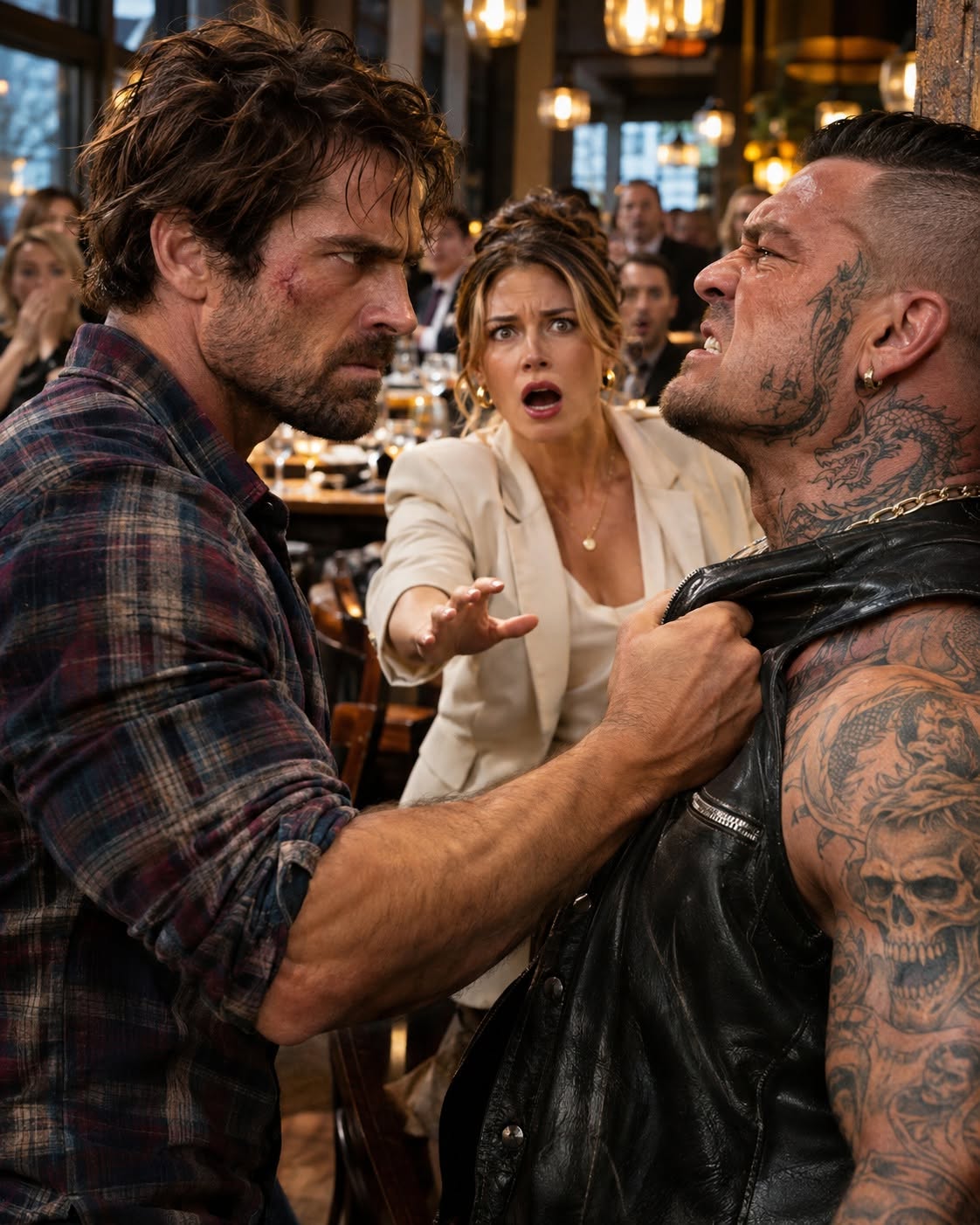
The man shoved me hard enough to knock my coffee across the café counter. Then he turned and sent a young waitress stumbling to the floor.
Audrey sat beside me on the couch, her small feet barely touching the carpet. She was holding the stuffed rabbit Ruby had given her on her fifth birthday, the one with the crooked ear and the faded pink ribbon. She looked at me for a long moment, waiting for an answer.
“Daddy, did somebody do something bad?”
I wanted to tell her no. I wanted to protect the little world she lived in, where problems could usually be solved with a hug, a Band-Aid, or a bedtime story.
But children notice more than adults think.
“Somebody made a mistake,” I said. “And instead of admitting it, they tried to make it look like someone else did it.”
“Was that someone you?”
I nodded.
Audrey frowned. “But you always tell me not to lie.”
“I know, sweetheart.”
“Then why would a grown-up lie about you?”
That question was harder to answer than anything Evelyn Brooks or her attorneys had asked me.
“Sometimes people get scared of losing something,” I explained. “Their money, their job, or what other people think of them. And sometimes they make bad choices because of that fear.”
Audrey considered this.
“Are you scared?”
I looked at her little face and decided she deserved the truth.
“A little.”
She moved closer and slipped her hand into mine.
“Mommy said brave doesn’t mean you’re not scared. It means you do the right thing even when you are.”
I couldn’t speak for a moment.
Ruby had been gone almost two years, but somehow she was still teaching both of us.
That night, after Audrey fell asleep, I sat at the kitchen table with every maintenance report I’d written over the previous eight months.
I had kept copies because Ruby had always insisted on keeping important paperwork organized. She used to joke that my military training had taught me how to survive in the wilderness but not how to find a receipt.
At 11:17 p.m., I noticed something that made me sit up straighter.
Three separate safety reports had identical approval timestamps.
The equipment inspections had supposedly occurred at different buildings, yet the approvals were recorded within forty seconds of one another.
One of those reports carried my employee number.
Another belonged to a technician named Luis Mendoza, who had retired six months earlier.
The third belonged to a man who had died the previous winter.
I stared at that last name.
Frank Delaney.
Frank had trained half the maintenance staff at Harbor Point. He was a careful man who checked everything twice and never signed a document without reading it.
According to the electronic records, he’d approved a safety inspection eleven weeks after his funeral.
I immediately contacted Evelyn’s legal team.
By eight the next morning, I was sitting across from an attorney named Rebecca Sloan.
She studied the documents without speaking.
Then she looked up.
“Daniel, where did you get these?”
“My own archived maintenance files.”
“Have you changed anything?”
“No.”
“Have you shared them with anyone else?”
“Only the company.”
Rebecca closed the folder.
“These records may change the entire investigation.”
I thought she’d be pleased.
Instead, she looked worried.
“There’s something else you need to understand,” she said. “Arthur Reid isn’t simply defending his job anymore. His attorneys are preparing to argue that Harbor Point knowingly submitted fraudulent certifications.”
I felt my stomach tighten.
“That’s not true.”
“Perhaps not. But if he convinces people that the problem originated with your employer, the investigation becomes much more complicated.”
She paused.
“And your name is on several of the disputed records.”
For the first time, I understood that proving Arthur’s wrongdoing might not automatically prove my innocence.
I could tell the truth and still lose everything while people argued about which documents to believe.
When I returned to Harbor Point, my supervisor, Tom Bennett, was waiting beside my locker.
He didn’t look happy.
“We need to talk.”
Tom had supervised me for three years. He wasn’t a cruel man, but he cared deeply about keeping the company profitable.
He followed me into the storage room and closed the door.
“Arthur’s attorney contacted our corporate office,” he said. “They’re demanding all employee disciplinary records and training histories connected to Brooks Holdings.”
“Fine. They can have mine.”
“Daniel, they’re looking for somebody to blame.”
“I know.”
Tom rubbed his forehead.
“We’ve already lost two smaller contracts because clients heard about the investigation. People are scared. Some of the guys think you should have kept your head down.”
I stared at him.
“You saw those maintenance reports.”
“Yes.”
“You know I warned everyone.”
“I do.”
“Then what exactly should I have kept quiet about?”
He didn’t answer.
That silence hurt more than I expected.
I had spent years believing that if you worked hard, followed procedures, and told the truth, the people around you would stand behind you.
Now I was discovering how quickly loyalty could disappear when money became involved.
I went home early that afternoon.
Audrey was at the kitchen table drawing a picture of our family.
There were three people in it.
She’d drawn Ruby above us, standing on a cloud.
I sat down beside her.
“What’s Mommy doing up there?”
“Watching,” she said.
“Watching what?”
“To make sure you’re okay.”
I smiled, although something inside me ached.
Then she pointed to the third figure.
“And that’s you. You’re holding my hand because we’re going somewhere.”
“Where?”
She shrugged.
“I haven’t decided yet.”
I kissed the top of her head.
For the next three days, nothing happened.
No phone calls. No new assignments from Brooks Holdings. No word from Evelyn.
Then, on Thursday morning, an envelope appeared beneath the windshield wiper of my work truck.
There was no return address.
Inside were two photocopied pages and a handwritten message.
“ASK WHY THE REPLACEMENT VENDOR WAS PAID BEFORE THE CONTRACT WAS AWARDED.”
The documents appeared to show payments from a company called Northbridge Facilities Group to a consulting firm named Meridian Strategic Advisors.
I recognized Northbridge immediately.
It was the maintenance vendor Arthur had been recommending.
Meridian meant nothing to me.
I didn’t confront anyone. I photographed the envelope where I found it, preserved the papers, and called Rebecca.
Within hours, the company’s independent investigators were examining the documents.
Two days later, Evelyn requested another meeting.
This time, she wasn’t alone.
Rebecca sat beside her, along with an outside forensic accountant named Samuel Price.
Evelyn looked exhausted.
“Daniel,” she began, “the investigators have confirmed that Meridian received several payments from Northbridge during the period Arthur was recommending the contract change.”
“Who owns Meridian?”
Samuel turned his laptop toward me.
“The listed owner is a woman named Caroline Reid.”
Arthur’s wife.
I sat back.
Evelyn continued.
“We don’t yet know whether these payments were legitimate. But Arthur failed to disclose the connection, and the timing raises serious concerns.”
“Then why forge the safety records?” I asked.
Samuel hesitated.
“That’s the part we’re still investigating.”
Rebecca opened another folder.
“We’ve also discovered that several repair requests were removed from the active maintenance database. The original submissions weren’t deleted, but their statuses were changed to completed.”
I recognized two of the work orders.
One involved a failing electrical component in West Tower.
The other concerned a backup power system at Riverside Plaza.
“Those repairs weren’t completed,” I said.
“We know,” Evelyn replied.
I looked from one face to another.
“What happens if Riverside loses power?”
Evelyn didn’t answer immediately.
Riverside Plaza housed office tenants, a physical therapy practice, and a medical clinic that treated patients with mobility limitations.
The backup system wasn’t supposed to make the building immune to every emergency. But it supported essential safety functions during a power interruption.
A false certification could leave people believing equipment was dependable when nobody had verified that it was.
“We’ve scheduled an independent inspection,” Evelyn said.
“When?”
“Monday.”
I shook my head.
“That’s four days away.”
Rebecca leaned forward.
“Daniel, the building engineers are monitoring the system.”
“Monitoring isn’t the same as knowing it’s safe.”
Evelyn held my gaze.
Then she picked up her phone.
“Move the inspection to today,” she told her assistant. “And have the facilities team evaluate whether any affected equipment needs to be taken out of service.”
I wasn’t sure whether she’d appreciate my persistence.
But I was beginning to realize that Evelyn didn’t want people who simply agreed with her.
She wanted people willing to tell her what she needed to hear.
That afternoon, the inspectors discovered that one section of Riverside’s backup system had not passed its required performance verification.
The problem wasn’t immediately catastrophic, but the equipment could not be relied upon as certified.
Evelyn authorized temporary safeguards and notified the affected tenants. Building management coordinated with the fire department and qualified contractors to determine what operations could safely continue.
The medical clinic temporarily relocated several appointments.
It cost Brooks Holdings thousands of dollars.
It also prevented people from being exposed to a risk they had never agreed to take.
The following morning, I received a certified letter.
I was being placed on administrative leave by Harbor Point pending an internal review.
The letter stated that the company needed to determine whether I had complied with all reporting obligations related to the disputed certifications.
I read it three times.
Then I called Tom.
“Are you seriously suspending me?”
“Daniel, corporate made the decision.”
“You know I didn’t approve those reports.”
“I know what you’ve told me.”
I closed my eyes.
“What does that mean?”
“It means there are lawyers involved now.”
I looked at the framed photograph of Ruby and Audrey on my desk.
My next paycheck was supposed to cover the mortgage.
“Is this paid leave?”
Tom went quiet.
That was my answer.
For several minutes after the call ended, I sat without moving.
Then I opened my banking app.
I calculated the mortgage, groceries, insurance, electricity, and the after-school program.
We had enough savings for a few weeks if nothing unexpected happened.
Ruby’s illness had taught me how quickly an ordinary family could become financially fragile.
I’d spent two years rebuilding that security.
Now it was disappearing again.
That evening, Audrey found me sitting in the garage.
I’d been staring at an old wooden birdhouse Ruby and I had started building before she became too sick to finish it.
“Daddy?”
“Hey, peanut.”
“Why aren’t you working?”
I wiped my hands on a rag.
“I’m taking a little break while some things get figured out.”
“Did you do something wrong?”
“No.”
“Then why do you look sad?”
I considered inventing another harmless explanation.
Instead, I pulled a stool beside mine.
“Remember when you told me about that girl at school who blamed you for spilling paint?”
Audrey nodded.
“And you told your teacher what really happened?”
“Yeah.”
“Did everybody believe you right away?”
“No. But Miss Carter checked, and then they did.”
“Sometimes grown-ups have to do the same thing,” I said. “Only it takes longer.”
She studied me.
“Are they checking?”
“Yes.”
“Then they’ll find out.”
I wished I had her confidence.
Three days later, somebody knocked on my door just after sunset.
I opened it to find a woman in her late forties standing on the porch.
She wore a navy raincoat and held a small canvas bag against her chest.
“Daniel Mercer?”
“Yes.”
“My name is Denise Park. I work for Brooks Holdings.”
I recognized the name immediately.
Denise was Arthur Reid’s executive assistant.
I kept one hand on the door.
“How can I help you?”
She looked toward the street.
“I think you should know what happened to your credentials.”
I invited her inside, but she declined.
“I can’t stay.”
She reached into her bag and removed a sealed envelope.
“Arthur told me to update some vendor records last spring. He said the approvals were delayed because the maintenance team hadn’t completed its electronic paperwork.”
“What kind of approvals?”
“Safety certifications.”
My heart started pounding.
“I didn’t understand what he was asking me to do at first,” she continued. “He told me the inspections had already been performed and the system just needed administrative corrections.”
“Did you use my employee number?”
Tears gathered in her eyes.
“Yes.”
I gripped the doorframe.
For weeks, I’d wondered who had entered those false approvals.
Now the person standing in front of me was admitting she’d done it.
“Why?” I asked.
“Because he told me everyone had authorized the changes. Then, when I questioned him, he threatened to accuse me of mishandling confidential records.”
She swallowed.
“My husband has been unable to work since his accident. We depend on my insurance. I was afraid.”
I thought about Audrey.
About the mortgage.
About what fear could do to a person.
“You should speak to the investigators,” I said.
“I know. I’ve already contacted an attorney.”
She offered me the envelope.
I didn’t take it.
“Give that to your lawyer or the independent investigators,” I said. “They’ll know how to preserve it properly.”
Denise nodded slowly.
“I was afraid you’d hate me.”
I looked at her for a long moment.
“I don’t think you understood the consequences when this started,” I said. “But once you knew, you had a responsibility to stop it.”
“I should have spoken sooner.”
“Yes,” I replied. “You should have.”
She lowered her eyes.
Then I added, “You can still help make sure nobody else gets hurt.”
She left without another word.
I called Rebecca and told her everything.
The next morning, Denise gave a formal statement through her attorney.
She also directed investigators to company records that had been retained outside Arthur’s department.
Those records revealed something none of us had anticipated.
The falsified safety certifications weren’t merely intended to protect Arthur from criticism.
They were part of a larger effort to conceal deferred maintenance costs while making Harbor Point appear unreliable.
The financial records suggested that Arthur had been presenting Brooks Holdings with two different versions of the same problem.
Internally, he minimized the need for expensive repairs.
When arguing for a vendor change, he blamed Harbor Point for supposedly failing to maintain equipment adequately.
Northbridge had offered a lower initial contract price.
But its proposed agreement contained expensive additional service provisions that would have increased long-term costs.
And Meridian, Arthur’s family-connected consulting firm, stood to benefit financially.
The more investigators uncovered, the more obvious the pattern became.
Arthur hadn’t been trying to save the company money.
He had been trying to move money somewhere he could benefit from it.
But knowing that wasn’t enough.
The investigators needed admissible evidence, witnesses, and a complete account of who authorized each action.
Arthur denied wrongdoing.
His attorneys argued that Denise had misunderstood routine administrative instructions and that the payments to Meridian involved legitimate consulting work.
Then Arthur made his boldest move.
He filed a formal complaint accusing me of falsifying maintenance records to conceal poor job performance.
The complaint included photographs of handwritten notes that appeared to be mine.
At first glance, they were convincing.
Same block lettering.
Same abbreviations.
Even the small slash I usually made through the number seven.
But the investigators noticed something.
Several notes appeared to have been copied from an old training workbook I’d prepared for Harbor Point technicians.
Entire phrases were identical.
Including an unusual spelling mistake I’d made in one training example.
The person who created the documents had copied my writing.
They hadn’t understood what they were copying.
Rebecca called me that evening.
“We’ve identified serious inconsistencies in Arthur’s evidence,” she said.
“Does that mean this is over?”
“Not yet.”
I laughed without humor.
“That’s becoming my least favorite answer.”
“I know. But there’s a hearing scheduled with the company’s independent review committee next Wednesday. We need you there.”
Wednesday.
I looked at the calendar hanging beside the refrigerator.
Audrey had a school field trip that morning.
I’d promised to go as a parent volunteer.
For several seconds, I didn’t speak.
Rebecca seemed to understand.
“Is there a conflict?”
“My daughter.”
“We can ask about adjusting your testimony time.”
I swallowed.
“Please do.”
That night, I explained the situation to Audrey.
She listened quietly.
“So you might miss the trip?”
“I might.”
She looked disappointed, but she didn’t complain.
“Are you helping the people in that building?”
“I’m trying to.”
“Then it’s okay.”
I shook my head.
“It’s not okay that you keep having to give things up because of this.”
Audrey reached across the table.
“Daddy, I’m not giving you up.”
I had spent months worrying about how to be both a good father and a good man.
My daughter was reminding me that those weren’t always competing responsibilities.
Sometimes being a good father meant showing her what integrity looked like, even when it was inconvenient.
On Tuesday afternoon, Harbor Point’s corporate office called.
They offered to end my suspension, provide several weeks of severance pay, and issue a neutral employment reference.
There was one condition.
I would have to resign voluntarily and sign an agreement that included a broad release of employment-related claims.
I asked whether the agreement would restrict my cooperation with the investigation.
The human resources representative said I should have an attorney review the document.
I did.
Rebecca referred me to an employment lawyer who explained that the agreement did not explicitly prohibit truthful testimony, but several provisions were written broadly enough to create unnecessary disputes.
The lawyer recommended negotiating changes before I signed anything.
I sent Harbor Point a written response.
I would cooperate with a fair internal review.
I would not admit to conduct I hadn’t committed.
And I would not accept language that could be used to discourage legitimate safety reporting.
They withdrew the offer.
That night, I barely slept.
I kept thinking about Audrey’s winter coat, the mortgage payment, and the price of groceries.
I wondered whether Ruby would have told me to compromise.
Then I remembered something she’d said during the final months of her treatment.
We’d been discussing a medical bill that had been processed incorrectly.
I was exhausted and ready to pay it just to make the calls stop.
Ruby had taken my hand.
“Daniel, being tired doesn’t mean you have to accept what’s wrong.”
I’d laughed at the time.
Now I understood how much strength those words contained.
Wednesday arrived with cold rain.
At seven in the morning, I dropped Audrey off at school.
Her teacher had arranged for another parent to accompany her on the field trip.
Audrey hugged me tightly.
“Tell the truth, Daddy.”
“Always.”
“And don’t forget lunch.”
I smiled.
“Wouldn’t dream of it.”
The review committee met in a conference center on the top floor of Brooks Holdings.
There were six committee members, two independent investigators, outside counsel, and a court reporter documenting the proceedings.
Arthur sat across the room in an expensive gray suit.
He looked calm.
When our eyes met, he gave me a small smile.
I recognized that kind of smile.
It was the expression of someone who believed the situation still belonged to him.
The hearing began with financial records.
Samuel Price explained the undisclosed relationship between Northbridge and Meridian.
Arthur’s attorney challenged the conclusions, arguing that the payments did not establish an improper exchange.
Then the technical evidence was presented.
Investigators described how electronic certifications had been altered through privileged administrative access.
Several entries used employee credentials belonging to people who hadn’t performed the inspections.
One belonged to Frank Delaney.
A committee member asked Arthur whether he was aware that Frank had died before the approval date.
Arthur shifted in his chair.
“I wasn’t personally responsible for every administrative entry.”
“But your department authorized the changes.”
“My department processes thousands of transactions.”
The committee member looked down at the report.
“Do thousands of those transactions involve approvals from deceased employees?”
Arthur’s attorney interrupted.
For the first time, Arthur’s composure slipped.
Then Denise testified.
She spoke quietly, occasionally stopping to collect herself.
She described the instructions she’d received, the pressure she felt, and the moment she realized the certifications were being used to conceal unfinished repairs.
She acknowledged her own role.
She didn’t try to portray herself as innocent.
That honesty mattered.
Arthur’s attorney questioned her aggressively.
Had she misunderstood instructions?
Had she acted without authorization?
Was she cooperating merely to avoid disciplinary consequences?
Denise answered every question.
Then she produced something unexpected.
A contemporaneous email she’d sent to Arthur asking him to confirm that the inspections had actually occurred.
His reply had been preserved in the company’s email archive.
“Process the approvals as instructed. We cannot allow technical objections to disrupt the transition schedule.”
The room went silent.
Arthur leaned toward his attorney.
They whispered for nearly a minute.
Then Arthur requested a break.
During the recess, Evelyn approached me near the hallway windows.
“Are you doing all right?”
I looked out at the city.
“Ask me when this is finished.”
She nodded.
“Fair enough.”
Then she hesitated.
“Daniel, I owe you an apology.”
“For what?”
“When I first reviewed Harbor Point’s contract, I assumed the maintenance problems were the result of poor performance. I looked at the numbers and the executive summaries. I didn’t look closely enough at the people who were raising concerns.”
“You couldn’t know everything.”
“No,” she said. “But I created a system where people could bring me problems, and then I allowed those problems to be filtered through the very executives responsible for them.”
I glanced at her.
“That’s a difficult thing for a CEO to admit.”
“It should be more difficult to ignore.”
Before I could respond, Rebecca appeared.
“They’re ready for you.”
I walked back into the conference room.
Arthur watched me take my seat.
I gave my name, confirmed my employment history, and answered questions about the inspections.
I explained the warnings I’d submitted.
The equipment I’d examined.
The repairs I’d recommended.
And the certifications I’d never approved.
Then Arthur’s attorney stood.
“Mr. Mercer, you have military training, correct?”
“Yes.”
“Specifically, training in physical restraint and defensive tactics?”
“Yes.”
“Would you agree that you’re accustomed to handling difficult situations through force?”
“No.”
He raised an eyebrow.
“Didn’t you recently restrain a man in a downtown café?”
“I did.”
“After a physical altercation?”
“After he assaulted people and attempted to strike me.”
The attorney placed a photograph on the screen.
It showed me holding Caleb Thorne’s arm behind his back.
From that angle, it looked aggressive.
“You don’t appear particularly hesitant to use force.”
I felt my jaw tighten.
Then I remembered the waitress on the floor.
And Audrey waiting at school.
“I used the minimum force necessary to stop an immediate threat,” I said.
“That’s your interpretation.”
“The responding police officers reviewed the incident. The café’s security footage was also preserved.”
The attorney changed direction.
He suggested that my military background made me rigid and confrontational.
He implied that my numerous maintenance warnings were evidence that I couldn’t work cooperatively with management.
Then he asked the question I had been expecting.
“Isn’t it true, Mr. Mercer, that you have a personal financial interest in having this committee believe your version of events?”
“Yes,” I answered.
Several people looked up.
The attorney seemed surprised.
I continued.
“I have a mortgage. I have a daughter. I need my paycheck. Losing my job would hurt us.”
He smiled slightly.
“So you admit your testimony is financially motivated?”
“No. I’m admitting that telling the truth has financial consequences for me.”
The smile disappeared.
“I could have signed a statement I knew was false. I could have accepted a settlement. I could have looked away from equipment that wasn’t safe.”
I glanced toward the committee.
“But if I do that, the next technician might believe those certifications. The next building manager might trust those records. And the next failure might happen when people can’t get out safely.”
I paused.
“My daughter depends on me. That’s why I can’t teach her that a paycheck is worth someone else’s life.”
Nobody spoke.
Then the committee chair thanked me.
I was excused.
The hearing continued for several hours.
Arthur maintained that he had acted in the company’s interests, and his attorneys disputed the interpretation of several financial transactions.
The committee didn’t announce an immediate decision.
It ordered further independent review and instructed the company to preserve all relevant evidence.
Arthur remained suspended from procurement and facilities oversight.
As I left the building, my phone vibrated.
A photograph from Audrey’s teacher appeared on the screen.
Audrey stood at the nature museum beside a huge model of a bird.
She was smiling so hard her eyes were nearly closed.
Below it was a message.
“She had a wonderful day. She told everyone her dad was helping keep buildings safe.”
I sat in my truck and cried.
Not because I’d won.
I hadn’t.
Not yet.
I cried because, despite everything I’d been afraid of losing, Audrey still saw me as her father.
Not a hero.
Not a victim.
Just the man who was supposed to show up, tell the truth, and come home.
The following weeks were difficult.
The investigation expanded to additional properties.
Several certifications were invalidated pending fresh inspections.
Independent engineers found maintenance problems that needed immediate correction, along with records that had simply been mishandled rather than deliberately falsified.
Evelyn authorized repairs and new reporting controls.
She also established a confidential process for employees and contractors to report safety concerns directly to an independent compliance function.
Harbor Point conducted its own review.
Tom eventually called to apologize.
He admitted that he’d been afraid of losing the Brooks Holdings contract and had allowed that fear to affect how he treated me.
“I should have stood up for you,” he said.
“Yes,” I replied. “You should have.”
He didn’t argue.
The company restored my withheld wages, corrected my employment record, and formally ended the suspension.
I returned to work, but something had changed.
I still liked fixing problems.
I still believed in the men and women who carried tools into hot mechanical rooms and climbed ladders while everyone else sat in comfortable offices.
But I no longer believed that safety depended on good intentions alone.
It needed people with authority to stop dangerous work.
It needed honest documentation.
And it needed leaders who didn’t punish employees for delivering bad news.
Six weeks after the hearing, Evelyn called me into her office again.
The independent review had reached its findings.
It concluded that Arthur had directed improper changes to safety records, concealed material maintenance information, and failed to disclose a significant financial conflict involving Meridian.
Brooks Holdings terminated his employment and referred the relevant evidence to appropriate authorities for further review.
The company also took disciplinary action against other employees whose conduct contributed to the failures, distinguishing deliberate wrongdoing from mistakes and failures of supervision.
The outside investigation couldn’t undo everything.
It couldn’t give Frank Delaney his name back on the records he’d never approved.
It couldn’t erase the stress Denise had lived with or the damage done to Harbor Point’s reputation.
But it established something important.
The truth had finally been documented by people who weren’t being paid to ignore it.
Evelyn slid a folder across her desk.
“I’d like you to consider something.”
Inside was a job description.
Director of Field Safety and Maintenance Integrity.
The position would report to an independent compliance committee rather than the facilities operations department.
It would involve reviewing maintenance standards, supporting investigations, and helping technicians raise concerns without fear of retaliation.
The salary was considerably higher than what I earned at Harbor Point.
I looked up.
“Why me?”
“Because you understand what happens on the ground,” Evelyn said. “And because you were willing to challenge me when my company was making a dangerous decision.”
I studied the document.
“I’m not an engineer.”
“I know. We have licensed engineers. This position isn’t meant to replace them.”
“Then what do you need?”
“Someone who understands procedures, respects professional boundaries, and knows that a signature on a safety report is a promise.”
I thought about it for several moments.
Then I closed the folder.
“I have conditions.”
She smiled.
“I expected you would.”
“I won’t be used as a public-relations story to make the company look good.”
“Agreed.”
“I need the authority to escalate serious safety concerns without interference from the people whose decisions are being questioned.”
“That’s built into the proposed structure.”
“And I need a schedule that lets me pick up my daughter from school most days.”
Evelyn looked at me.
Then she laughed softly.
“That last one might be the most important condition, isn’t it?”
“Yes, ma’am.”
She nodded.
“We can make that work.”
I didn’t accept immediately.
I had my own attorney review the offer and waited until the independent findings were finalized.
I also spoke with Tom and several technicians whose opinions I trusted.
When I finally accepted, I made sure my former coworkers understood that I wasn’t leaving because I thought their work was beneath me.
I was leaving because I’d learned how easily good workers could be placed in impossible situations when the systems above them failed.
My first project wasn’t a glamorous one.
It involved redesigning the process for reviewing unresolved maintenance warnings.
We created a system in which serious safety concerns couldn’t simply disappear into an administrative queue.
Qualified specialists would evaluate technical risks, and overdue corrective actions would be visible to people with the authority to address them.
We also changed how employee credentials were managed and how electronic approvals were independently verified.
It wasn’t exciting work.
Nobody made speeches about it.
But I knew that one day, somewhere in a building I’d never visit, those safeguards might make a difference.
Denise eventually left Brooks Holdings.
She had cooperated fully with investigators, but she also had to accept responsibility for her part in the false entries.
Before leaving, she sent me a letter.
She wrote that she’d spent years believing loyalty meant doing whatever her boss requested.
Now she understood that loyalty to a company should never require dishonesty toward the people who depend on it.
I kept the letter.
Not because I wanted to remind myself of what she’d done.
Because I wanted to remember that people can make serious mistakes and still choose to change.
A few months later, I received an invitation to Frank Delaney’s memorial gathering.
His family had organized a small event at a neighborhood community center.
Several former Harbor Point technicians attended.
Frank’s widow, Margaret, approached me after the ceremony.
She held a photograph of Frank standing beside a maintenance truck, smiling beneath the brim of his old baseball cap.
“I heard what happened with the records,” she said.
I nodded.
“I’m sorry his name got dragged into it.”
She shook her head.
“Frank spent thirty years telling people to do the job right, even when nobody was watching.”
Her eyes filled with tears.
“Thank you for making sure his name wasn’t left on something he never signed.”
I didn’t know what to say.
So I simply hugged her.
That afternoon, driving home, I understood that the investigation had never been just about my reputation.
It was about all the people whose names appeared on those reports.
Living or dead.
Each signature carried a responsibility.
And each false signature stole a little piece of the trust that kept people safe.
Life slowly settled into a new rhythm.
Audrey started second grade.
She lost another front tooth.
She learned to ride her bicycle without training wheels, although she still insisted I run beside her on steep sidewalks.
On Saturdays, we worked on the birdhouse Ruby and I had never finished.
Audrey painted it blue with yellow flowers.
She insisted on adding a tiny heart near the roof.
“That’s for Mommy,” she explained.
We hung it from the maple tree in our backyard.
For two weeks, no birds came.
Audrey checked every morning and grew increasingly impatient.
“Maybe they don’t like it.”
“Maybe they just haven’t found it yet,” I said.
One Saturday, while we were eating breakfast, a small brown bird landed on the edge of the roof.
Audrey nearly knocked over her orange juice.
“Daddy! Look!”
We stood at the window together.
The bird inspected the house, hopped to a nearby branch, and flew away.
Audrey sighed.
“It didn’t stay.”
“Not this time.”
“Do you think it’ll come back?”
“Maybe.”
She leaned against me.
“Mommy would’ve liked that.”
I wrapped my arm around her shoulders.
“She really would have.”
Later that spring, Evelyn invited me to speak at a company training session for supervisors.
I almost declined.
Public speaking had never bothered me in the military, but this felt different.
I’d have to explain the experience to people who might recognize themselves in the mistakes that had been made.
I finally agreed.
I didn’t tell them how brave I had been.
I didn’t describe the café fight or the hearing as victories.
Instead, I talked about how small compromises accumulate.
A delayed repair.
An inspection marked complete before anyone verifies it.
A concern dismissed because the person raising it doesn’t have an impressive title.
A manager who chooses an easy answer because the difficult one might affect a bonus.
None of those decisions necessarily looks dramatic when it happens.
But together, they can create a danger nobody intended to face.
Then I said something that made the room quiet.
“Most people don’t wake up planning to become dishonest. They tell themselves they’ll fix the problem next week. They’ll correct the paperwork later. They’ll speak up when the timing is better.”
I looked across the audience.
“But sometimes later is the moment after somebody gets hurt.”
Afterward, a young maintenance supervisor approached me.
He introduced himself as Eric.
He had recently discovered that a subcontractor had marked several inspections complete without providing the supporting reports.
“I was thinking about just asking them to fix the paperwork quietly,” he admitted.
“What are you thinking now?” I asked.
“That I need to verify what actually happened before I accept anything.”
I nodded.
“That’s a good place to start.”
As he walked away, I felt something I hadn’t experienced in a long time.
Peace.
Not the kind that comes from everything being perfect.
The kind that comes from knowing something painful wasn’t wasted.
One year after the incident at the café, Audrey and I returned there on a Saturday morning.
The waitress, Maya, still worked the weekend shift.
She recognized us immediately.
“Well, if it isn’t my favorite pancake customer.”
Audrey grinned.
“Can I have chocolate chips this time?”
Maya pretended to consider.
“I suppose I can make an exception.”
The café looked mostly the same.
Same counter.
Same windows.
Same smell of coffee and warm bread.
But there were new safety procedures posted near the employee area, and the manager had trained staff on how to respond to threatening customers.
Maya told me she had started taking evening classes in hospitality management.
She wanted to run her own café one day.
“Somewhere people can come in and feel safe,” she said.
“You’d be good at that,” I told her.
She smiled.
Then she lowered her voice.
“I heard the man who attacked us completed his court-ordered program.”
Caleb had pleaded guilty to a lesser assault charge after the café incident and had been required to complete community service and an anger-management program.
I hadn’t followed the case closely after giving my statement.
“Good,” I said.
Maya looked surprised.
“That’s all?”
“What else should I say?”
“After what he did?”
I glanced at Audrey, who was carefully arranging her chocolate chips into a smiley face.
“I hope he learned something,” I said. “I don’t need him to suffer forever.”
Maya nodded slowly.
“I think I understand.”
When she walked away, Audrey looked up.
“Daddy, was that the bad man?”
“Yes.”
“Do you still hate him?”
I thought about the question.
“No, sweetheart.”
“Why?”
“Because being angry at someone forever doesn’t fix what they did.”
She considered that.
“Does that mean you have to be friends?”
I laughed.
“Absolutely not.”
She laughed too.
Then she poured far too much syrup onto her pancakes.
I reached for a napkin.
She reached for another.
And for a while, we were simply a father and daughter having breakfast.
No investigations.
No lawyers.
No safety reports.
Just pancakes, sunlight, and the ordinary happiness I’d once been terrified of losing.
That afternoon, we visited Ruby’s grave.
Audrey placed a little bunch of yellow flowers beside the headstone.
Then she stepped back.
“Mommy, Daddy got a new job,” she announced.
I smiled.
“She knows, peanut.”
“And I learned to ride my bike.”
The breeze stirred the leaves overhead.
Audrey was quiet for a moment.
Then she turned toward me.
“Daddy, do you think Mommy would be proud of us?”
My throat tightened.
“Yes,” I whispered. “I think she’d be very proud.”
Audrey took my hand.
“Even when we’re scared?”
“Especially then.”
We stayed until the sun began slipping behind the trees.
On the way home, Audrey asked whether we could invite Maya to see her school play.
I told her we could ask.
Then she wanted to know whether the birdhouse needed a second floor.
I told her we’d have to consult the birds.
She laughed all the way to the car.
That evening, after she’d gone to bed, I opened the lunchbox I’d packed for the following day.
Inside was a folded piece of paper.
I recognized Audrey’s handwriting immediately.
She’d drawn a man holding the hand of a little girl.
Above them was a small yellow bird.
Underneath, in uneven letters, she’d written:
“Daddy, you don’t have to save everybody. Just don’t forget to come home.”
I stood there for a long time, holding the drawing.
For years, I’d thought courage was something you demonstrated in emergencies.
Standing between a violent man and someone who couldn’t defend herself.
Keeping your head when equipment failed.
Facing people who had more money, more influence, and more power than you did.
Those things required courage.
But I’d learned that courage also lived in smaller moments.
In a frightened employee deciding to tell the truth.
In a CEO admitting her system had failed.
In a supervisor accepting responsibility.
In a widow defending her husband’s good name.
And in a seven-year-old girl who could love her father without needing him to be invincible.
I put Audrey’s drawing beside Ruby’s photograph on the kitchen shelf.
Then I switched off the lights and checked the front door.
Before going to bed, I stopped outside Audrey’s room.
She was sleeping with her stuffed rabbit tucked beneath her chin.
I gently pulled the blanket over her shoulder.
“Good night, peanut,” I whispered.
As I turned to leave, her sleepy voice stopped me.
“Daddy?”
“Yeah, sweetheart?”
“You checked under my bed, right?”
I smiled.
“Not yet.”
I knelt, looked underneath, and found nothing except a missing sock, two crayons, and a library book.
“All clear.”
“Good,” she murmured.
Then she fell asleep again.
I stood in the doorway, listening to her breathe.
The world outside was still complicated.
People would still lie.
Good people would still make mistakes.
Sometimes doing the right thing would still cost more than it should.
But I no longer believed that protecting my daughter meant avoiding every difficult choice.
It meant teaching her that fear didn’t have to make those choices for us.
I’d once worried that standing up for the truth might cost me the life I’d built for Audrey.
Instead, the experience had taught me what that life was supposed to stand for.
Not money.
Not recognition.
Not winning every fight.
But honesty, responsibility, compassion, and the willingness to do what was right even when nobody could promise a reward.
I turned off the hallway light and went downstairs.
Tomorrow, there would be buildings to inspect, problems to solve, and people counting on me.
But tonight, my little girl was safe.
And I was home.
THE END.