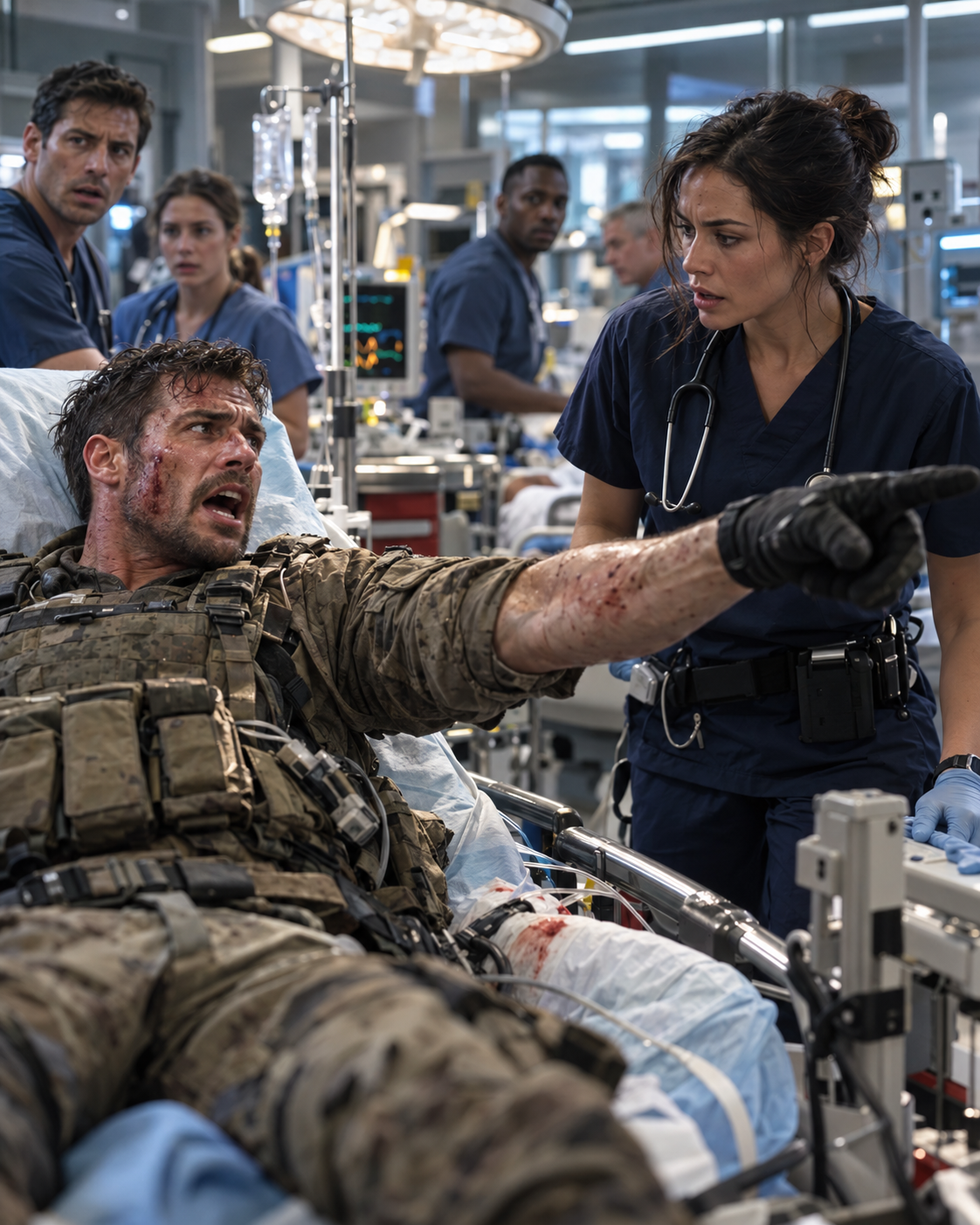
The man on the trauma table was bleeding through three layers of gauze when he suddenly stopped fighting the doctors
For several seconds, nobody said anything.
The hallway hummed around us.
A cart squeaked past.
Somewhere behind the trauma doors, a monitor alarm chirped and stopped.
Mercer kept watching me.
“Who was it?” she asked again.
I swallowed.
“Corporal Daniel Voss.”
Her eyes didn’t leave mine.
“He was my team liaison.”
“You were close?”
“Close enough.”
I looked through the glass toward the room where Silas had disappeared.
“Close enough that I watched him die.”
Mercer nodded once.
“That’s the problem.”
She motioned toward an empty consultation room.
We went inside.
Finch started after us.
Mercer turned at the door.
“Doctor, stay here.”
He bristled.
“I am responsible for this patient.”
“And federal agents are responsible for the investigation.”
The door closed between us.
I sat down.
My knees felt strangely weak.
Mercer remained standing.
“Tell me about Voss.”
“There isn’t much to tell.”
“There’s always something.”
I rubbed my palms together.
“Daniel was thirty-four. Communications specialist. Quiet. He hated coffee but drank it anyway because everyone else did. He could repair almost anything with duct tape.”
Mercer waited.
“He was the guy everyone trusted.”
“Why?”
“Because he made people feel like they were safe.”
She studied me.
“And you?”
“What about me?”
“Why did you become Valkyrie?”
I stared at the floor.
“I didn’t become her.”
“Then who did?”
I looked up.
“The job did.”
That was the answer I’d given myself for three years.
It had always sounded convincing.
Now it sounded incomplete.
Mercer placed a thin folder on the table.
“Silas claims someone on the inside has been feeding information through civilian contractors.”
“That’s broad.”
“It is.”
“Why bring this to me?”
“Because Silas specifically asked for you.”
My stomach tightened.
“Why?”
“He said you were the only person from Kestrel Ridge who would recognize the pattern.”
I almost laughed.
“Half my team died there.”
“I know.”
“And I spent three years trying not to remember any of it.”
“I know that too.”
The folder remained unopened between us.
Finally, I said, “What’s in there?”
“Evidence recovered from the ambush.”
She pushed it toward me.
“Silas had something on him.”
I opened the folder.
There were photographs.
A damaged communications device.
A handwritten note.
And a printout of a hospital directory.
My hospital directory.
My blood went cold.
“Why is Trident Bay on here?”
“We don’t know yet.”
I looked at the timestamp.
The directory had been printed before Silas was brought through our ambulance entrance.
Before I had spoken to him.
Before anyone at the hospital officially knew his name.
“Someone knew where he was going.”
Mercer nodded.
“That’s why I told you the facility itself may be compromised.”
I looked at her.
“You’re saying someone tracked him here.”
“I’m saying someone knew enough to try.”
The room suddenly felt smaller.
I thought about the night-shift parking lot.
The nurses who came and went.
The security desk.
The ambulance bay.
Every ordinary thing that had made this hospital feel safe now seemed full of invisible doors.
Mercer closed the folder.
“You’re not a suspect.”
“I wasn’t sure.”
“You are a witness.”
“That’s worse.”
A tiny smile touched her mouth.
“Usually.”
When I returned to the trauma floor, Finch was waiting.
He looked different.
Not arrogant.
Just pale.
“Are you military?”
The question was quiet.
I nodded.
“Former.”
He looked toward the hallway.
“Should I be worried?”
“Probably.”
His jaw tightened.
“Are we in danger?”
“I don’t know.”
For once, Dr. Finch didn’t have a clever answer.
He just nodded.
That night, security locked down the emergency department.
Extra officers arrived.
Visitors were restricted.
The hospital administration sent around an email full of bland phrases about “an elevated security posture.”
Nobody said the word federal.
Nobody said assassination.
Nobody said Kestrel Ridge.
Silas remained under observation.
I wasn’t assigned to him.
That didn’t stop me from checking on him every hour.
Around four in the morning, I stood outside his room.
He was awake.
“Come in,” he said.
I entered.
“You look terrible.”
He smiled weakly.
“So do you.”
“Occupational hazard.”
His eyes moved toward the door.
“Are they listening?”
“Probably.”
“Good.”
He shifted carefully.
“I need you to remember something.”
“What?”
“Kestrel Ridge wasn’t supposed to happen.”
“I know.”
“No. You don’t.”
His voice changed.
“The route wasn’t just compromised.”
I waited.
“The route was changed.”
My chest tightened.
“What?”
“The original extraction point was canceled six hours before we moved.”
“By command?”
“That’s what we were told.”
“And the replacement?”
“Voss recommended it.”
I stopped breathing.
“Daniel?”
Silas nodded.
“He said he’d received confirmation.”
I stared at him.
“You never told investigators that.”
“I tried.”
“And?”
“They said Voss was dead.”
The words sat heavily between us.
“Silas.”
He looked away.
“I thought he was compromised.”
“You said he died.”
“He did.”
“Then how could he be the source?”
Silas’s eyes met mine.
“That’s what I couldn’t explain.”
I left his room feeling as if the floor had shifted.
For three years, I had carried one image.
Daniel Voss standing beside the transport vehicle, waving us forward.
Then the explosion.
Then the screaming.
Then darkness.
I had blamed myself for following.
I had wondered whether I should have questioned the route.
Now I had a different question.
What if Daniel hadn’t betrayed us?
What if he had been used?
Meredith’s old habit came back to me: write everything down.
So I did.
I made a timeline.
The original route.
The changed route.
The communications blackout.
The extraction.
The survivors.
The names.
The equipment.
The strange black crescent.
By morning, I had filled six pages.
Mercer returned at eight.
I handed them over.
She read silently.
When she finished, she said, “There’s something missing.”
“What?”
“Your name.”
I stared at her.
“You weren’t supposed to be at Kestrel Ridge.”
The room went still.
“I was assigned to another team.”
“Exactly.”
“Then why was I there?”
Mercer looked at me.
“Because someone requested you specifically.”
My stomach dropped.
“Who?”
“We’re still tracing it.”
She hesitated.
“Your transfer orders were modified forty-eight hours before the mission.”
I felt cold.
“I never knew that.”
“I know.”
“Who signed them?”
“We’re working on it.”
For the first time, I understood why the old memories had always felt wrong.
I’d spent years thinking I’d volunteered to be there.
Maybe I hadn’t.
Maybe somebody had moved the pieces before any of us knew there was a game.
That afternoon, Silas had another setback.
His blood pressure crashed during a procedure, and the ICU team rushed him away.
I stood behind the glass while they worked.
For the first time since he’d arrived, I was afraid.
Not of the investigation.
Not of the person who might be hunting him.
Of losing another person while standing close enough to do something.
When his pressure stabilized, I sat alone in the stairwell and cried.
Not loudly.
Just enough to let my body release what it had been carrying.
Mei found me there.
She sat beside me.
“You don’t have to tell me what happened.”
“Good.”
“I can sit here anyway.”
“Okay.”
We stayed that way for ten minutes.
Then she said, “You know what I noticed?”
“What?”
“You’re not hiding anymore.”
I wiped my face.
“I wish I was.”
She smiled.
“Maybe hiding kept you alive for a while.”
I looked at her.
“Maybe.”
“But it doesn’t sound like you’re alive when you do it.”
That sentence stayed with me.
Two days later, Silas improved enough to speak with investigators.
His statement changed everything.
The black crescent wasn’t a military insignia.
It belonged to a private logistics contractor used by several government agencies.
A company called Northstar Meridian.
Mercer had already been investigating the company for unrelated irregularities.
One of its senior security consultants had once worked alongside Daniel Voss.
His name was Owen Rusk.
I recognized him immediately.
Not because I’d known him well.
Because I’d seen his photograph in the background of an old deployment briefing.
He’d been the civilian liaison attached to our unit.
The man who handled movement schedules.
The man who knew where we were going.
The man Daniel trusted.
Mercer watched me carefully.
“You’ve met him.”
“Once.”
“Would he know about your transfer?”
“Yes.”
“Would he know about the extraction?”
“Yes.”
“Would he know about Silas?”
“Yes.”
I sat back.
“Then why hasn’t he disappeared?”
Mercer gave me a tired look.
“Because we haven’t proven anything.”
That was the first major reversal.
The man we suspected wasn’t hiding.
He was sitting in Washington, testifying voluntarily.
And according to the evidence, he had an alibi for the original Kestrel Ridge leak.
For the next forty-eight hours, the investigation stalled.
Silas couldn’t identify the person who had ordered the recent ambush.
The communications records were incomplete.
The contractor records had gaps.
The old Kestrel Ridge files were classified beyond my clearance.
And my own memories were suddenly unreliable.
Then Mercer came to my apartment.
I had moved temporarily into my sister’s guest room, but Mercer had insisted I not return to my old place alone.
She stood in Chloe’s doorway holding a tablet.
“We found the connection.”
My heart began pounding.
“What?”
She showed me a document.
A transfer request.
My transfer request.
At the bottom was a digital authorization.
I stared at the signature.
It wasn’t Voss.
It wasn’t Rusk.
It wasn’t any commander I’d known.
It was mine.
I shook my head.
“I never signed this.”
“We know.”
“Then someone forged it.”
“Yes.”
“Why?”
Mercer sat across from me.
“Because the person who requested your reassignment wanted you physically present at Kestrel Ridge.”
I felt sick.
“Why me?”
She hesitated.
“Because you had the medical training.”
“So they needed a medic.”
“No.”
Her eyes held mine.
“They needed a survivor.”
I didn’t understand.
She continued.
“Whoever arranged the operation needed someone who could identify what happened afterward.”
I thought of my old field notes.
The wounds.
The blast patterns.
The sequence of casualties.
The things I’d noticed and later dismissed because I assumed trauma had distorted my memory.
My hands started shaking.
Mercer leaned forward.
“Valkyrie, you weren’t the target.”
I looked at her.
“You were the witness they couldn’t predict.”
For three years, I’d believed I had survived by accident.
Now I understood that my survival had been the flaw in someone else’s plan.
The next morning, Silas asked to see me.
He was sitting upright.
Still weak.
Still bruised.
But alive.
“I remember something,” he said.
“What?”
“The night before Kestrel Ridge.”
He reached beneath his pillow and pulled out a folded piece of paper.
“I found this in my gear after the blast.”
I opened it.
Three words were written in block letters.
DON’T TRUST THE MEDIC.
My stomach dropped.
I looked at him.
“Why didn’t you show this to Mercer?”
“Because I thought it was about you.”
I stared at the paper.
“Who gave it to you?”
“I don’t know.”
“Silas.”
He swallowed.
“I found it inside Daniel’s notebook.”
Everything inside me went still.
For three years, I’d remembered Daniel as the man who led us toward the compromised extraction point.
Now I was holding something he had apparently left behind.
A warning.
Maybe he had suspected the operation was compromised.
Maybe he’d tried to stop it.
Maybe the person who killed him wanted us to believe he was the traitor.
I looked at Silas.
“Where’s the notebook?”
His expression changed.
“I gave it to investigators.”
Mercer arrived less than an hour later.
The notebook had disappeared from evidence.
Not misplaced.
Not damaged.
Removed.
Someone with access had taken it.
That was the second major reversal.
The conspiracy wasn’t simply outside the hospital.
It reached into the investigation.
And then came the third.
Security footage from the hospital showed a man entering through a service corridor at 2:37 a.m. on the night Silas arrived.
His face was covered.
His badge was legitimate.
His access credentials belonged to a senior hospital administrator.
Mercer paused the footage.
“Do you recognize him?”
I stared at the screen.
The man turned slightly.
I saw his profile.
My stomach tightened.
It wasn’t Finch.
It wasn’t anyone from the emergency department.
It was Owen Rusk.
The man who had supposedly been in Washington.
Mercer stared at me.
“His alibi just collapsed.”
The next twelve hours were chaos.
Federal agents secured the hospital.
Rusk disappeared.
Silas was moved to a protected facility.
I was interviewed for six hours.
I told them everything I remembered, including things I had been ashamed to say aloud for three years.
At one point Mercer asked, “Why did you leave the military?”
I thought about it.
“Because I thought if I stopped being Valkyrie, I could stop being afraid.”
“Did it work?”
“No.”
She nodded.
“Then maybe it wasn’t the name you were running from.”
I looked at her.
“Maybe it was the part of yourself that survived.”
That was the first time I understood why I’d been so angry at Silas for recognizing me.
He hadn’t exposed me.
He had reminded me.
There was a difference.
Rusk was arrested six days later at a train station outside Baltimore.
The evidence against him wasn’t perfect.
He denied involvement in Kestrel Ridge.
He admitted to entering Trident Bay under false credentials but claimed he’d been trying to retrieve classified material.
He refused to explain the notebook.
The investigation remained open.
Some questions never received clean answers.
But we eventually learned enough.
Rusk had helped reroute the Kestrel Ridge extraction.
He had manipulated the transfer request that placed me with the team.
Daniel had discovered inconsistencies and tried to warn Silas.
The recent ambush had been designed to eliminate Silas before he could connect the old evidence to Rusk.
And I had survived both events because, ironically, the person who wanted me present had underestimated what survival would turn me into.
Months later, I visited Silas at a rehabilitation center.
He walked with a cane.
Slowly.
Deliberately.
“You look terrible,” he said.
“You still look worse.”
“Good.”
We laughed.
It was the first time either of us had laughed without something dark waiting underneath it.
He asked whether I was going back overseas.
“No.”
“Good.”
“I’m staying in emergency medicine.”
He nodded.
“That’s where you belong.”
I thought about correcting him.
Then I didn’t.
Maybe belonging wasn’t a location.
Maybe it was a choice.
I returned to Trident Bay.
Dr. Finch never apologized for the things he’d said before the night of Silas’s arrival.
He didn’t need to.
He started treating me differently, though.
Not reverently.
Not cautiously.
Just like a colleague.
That was enough.
Mei knew the truth.
A few others eventually learned pieces of it.
Most people didn’t.
I didn’t need everyone to know.
I had spent years thinking the secret itself was a prison.
It wasn’t.
The prison had been the belief that I had to remain the woman who survived Kestrel Ridge exactly as she was.
Quiet.
Useful.
Unseen.
I wasn’t that woman anymore.
On my first night back, just after two in the morning, I walked into the trauma bay.
The lights were harsh.
The floors gleamed.
A paramedic wheeled in a man with a fractured leg after a motorcycle accident.
Everyone moved.
Orders were shouted.
Someone asked for blood.
The familiar machinery of emergency medicine came alive around me.
I tied my hair back.
Pulled on gloves.
Stepped forward.
For a second, I remembered another trauma bay.
Another night.
Another man saying my old name.
Then I let the memory pass.
Not erase it.
Not worship it.
Just let it pass.
Mei caught my eye from across the room.
“You okay?”
I nodded.
“Yeah.”
And I meant it.
I had once believed courage meant becoming hard enough that nothing could reach me.
Now I understood something quieter.
Sometimes courage was allowing the past to remain part of you without allowing it to command you.
I still carried the scars.
Some were visible.
Most weren’t.
But when the monitors began their familiar chorus and the team moved together around another frightened patient, I no longer felt divided between the woman I had been and the woman I had become.
Valkyrie wasn’t dead.
She just wasn’t in charge anymore.
And when the next patient came through those doors, bleeding and terrified and depending on strangers to keep him alive, I stepped toward him without running from the woman who had once learned how.