The hail warning came through just as my father called to ask me for a favor he had no right to expect. “Owen, you have to save Toby’s wheat,” he said.
Dad looked at Toby for so long that I thought he might actually listen.
Then he said six words that nearly sent me back to my truck.
“Your brother put you up to this.”
Toby flinched, but he didn’t step away.
“No, Dad. Owen didn’t put me up to anything. I’ve been trying to tell you for four years.”
Dad turned toward me, his jaw working beneath his gray beard.
“You come rolling in here with two combines and suddenly everybody’s got something to say about how I run my family.”
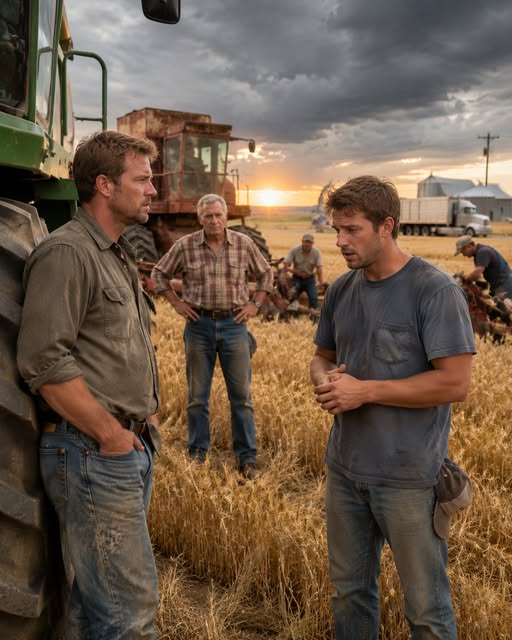
I could feel the neighbors watching us. Some had known me since I was a kid. Others had spent the past twenty-four hours hearing that I was willing to let my own father’s wheat get beaten into the dirt.
I wanted to tell him exactly what I thought.
Instead, I looked at the sky.
The clouds to the northwest had turned the color of bruised steel.
“Pete,” I called. “How much time?”
Pete checked his phone, then glanced toward the horizon.
“Maybe three hours before the worst of it. Less if that front speeds up.”
Dad folded his arms.
“Then you’d better get started.”
I looked back at him.
“That’s not how this works.”
His expression hardened.
“Excuse me?”
“You called me because you needed a harvesting crew. I brought one. We have a rate, we have conditions, and we have another customer waiting. You don’t get to order me around like I’m sixteen.”
A few neighbors shifted uncomfortably.
Dad’s face went red.
“You’re standing on my land.”
“Then tell me to leave.”
For a moment, I thought he would.
Toby stepped between us.
“Stop it. Both of you.”
His voice cracked, but he kept going.
“The wheat doesn’t care who’s right. And neither does that storm.”
He turned to me.
“Owen, I’ll sign whatever contract you need. I’ll pay your rate. I’ll take responsibility.”
Dad opened his mouth.
Toby raised his hand.
“Please, Dad. Just this once, let me finish.”
Something about hearing my little brother say those words stopped me cold.
When we were kids, Toby had followed Dad around like a shadow. He’d learned early that agreeing with him was easier than arguing.
Now he stood there with shaking hands, trying to claim a life he’d spent years being afraid to want.
I pulled the folded contract from my shirt pocket.
“Then let’s do business.”
Toby signed on the hood of my pickup.
Dad refused to touch the paper.
That should have been the end of the argument.
It wasn’t.
As Pete and Sam started checking the machines, Mom caught my arm.
“Owen, there’s something you need to know.”
Her face was pale.
I looked toward the fields.
“Can it wait?”
She hesitated.
“I don’t think it should.”
Before she could explain, Sam shouted from the equipment shed.
“Owen! You’d better come look at this!”
We hurried over.
Toby’s broken combine sat with its side panel open. Sam was crouched beside the engine compartment, holding a piece of twisted metal.
“This isn’t just a bearing failure,” he said.
Pete took the part, turned it over, and frowned.
“Where’d this come from?”
“Inside the drive assembly.”
Pete studied the damaged edges.
Then he looked at Toby.
“Who worked on this machine last?”
Toby swallowed.
“Dad’s been handling the maintenance.”
Dad stepped forward.
“Are you accusing me of something?”
Pete didn’t answer immediately.
He pointed toward the assembly.
“Somebody put the wrong spacer in here. It’s too thin. That lets the shaft move under load until the bearing tears itself apart.”
Dad shrugged.
“Parts get mixed up.”
“Sure,” Pete said. “But this spacer didn’t come from the manufacturer. Somebody cut it down.”
The silence that followed felt heavier than the approaching storm.
I looked at Dad.
He wouldn’t meet my eyes.
“Why would you do that?” Toby asked.
Dad’s head snapped up.
“I didn’t do anything.”
“Then who did?”
“I said I didn’t do anything!”
Pete handed the part back to Sam.
“Whatever happened, that machine isn’t running today.”
Dad turned away.
But I had seen something in his face.
Not anger.
Fear.
We didn’t have time to chase it.
There were nearly nine hundred acres of wheat standing, and the weather service had just moved the hail warning closer.
I sent Pete to the western field with our largest combine. Sam took the second machine toward the creek bottom. I climbed into the grain cart tractor and started coordinating the trucks.
Toby came running after me.
“What do you want me to do?”
I pointed toward the grain bins.
“Get the trucks moving. Keep the elevator informed. And stay on the radio.”
He nodded.
Then he stopped.
“Owen?”
“Yeah?”
“Thanks for coming.”
I looked at him for a second.
“Don’t thank me yet. We’ve got a lot of wheat to cut.”
By noon, the farm sounded like it had when I was a boy.
Diesel engines growled across the fields. Grain poured into trucks. Dust rolled behind the combines in golden clouds.
For the first time in four years, I was working the same ground where Dad had taught me to drive a tractor.
The familiarity hurt more than I expected.
I remembered being twelve, sitting beside him in an old cab while he explained how to read the color of wheat heads.
I remembered being seventeen and working until midnight because a thunderstorm was coming.
I remembered believing that someday this land would be partly mine.
Then I remembered the day he’d handed Toby the deed.
“You’re good with machines, Owen,” he’d told me. “You can make a living anywhere. Toby needs roots.”
I’d spent four years wondering what that meant about me.
Around one o’clock, Aunt Pam drove up in her SUV.
She marched straight toward my truck.
I braced myself.
“If you’ve come to tell me I’m selfish again,” I said, “you’ll have to get in line.”
She looked embarrassed.
“I came to apologize.”
That surprised me.
She glanced toward the field.
“Toby told me what happened. Your father left out quite a bit when he called everybody.”
I leaned against the truck.
“That’s one way of putting it.”
Pam lowered her voice.
“He also left out something else.”
I waited.
She looked toward the house.
“Your mother asked me not to say anything until she could talk to you herself. But I’m worried she’s going to lose her nerve.”
My stomach tightened.
“What are you talking about?”
Pam took a breath.
“The farm isn’t in the shape your father wants people to believe.”
I stared at her.
“What shape?”
“Financially.”
I almost laughed.
Dad had always acted like the farm was untouchable. He lectured everybody about debt, waste, and responsibility.
“He owns the land outright,” I said.
Pam shook her head.
“Not anymore.”
Before I could ask another question, Toby’s voice came over the radio.
“Owen, we’ve got a problem at the north field.”
I grabbed the microphone.
“What kind of problem?”
“Dad’s blocking the grain truck.”
I looked up.
Across the yard, Dad had parked his pickup sideways in front of one of our loaded trucks.
I climbed into my truck and drove over.
Dad was arguing with the driver, a young guy named Lucas who’d worked with us for two seasons.
“What’s going on?” I demanded.
Dad pointed at the loaded trailer.
“That wheat isn’t going to the elevator.”
I stared at him.
“It’s already scheduled.”
“I’ve got storage.”
“Your bins are full of last year’s corn.”
“Then we’ll make room.”
I stepped closer.
“Dad, every bushel we haul is weighed and recorded. That’s part of the contract.”
His eyes narrowed.
“You don’t understand what you’re interfering with.”
“Then explain it.”
He looked around.
Pam had followed us. Toby was coming across the yard. Mom stood on the porch.
Dad lowered his voice.
“Get that truck back to the bins.”
“No.”
“Owen—”
“No. The wheat goes to the elevator, the tickets get recorded, and the harvesting bill gets settled exactly as agreed.”
His face twisted.
“You think you’re so smart because you’ve got a couple machines and a payroll?”
I felt the old anger rising.
But before I could answer, Mom spoke from behind us.
“Frank, tell them.”
Dad froze.
Mom walked slowly down the porch steps.
“Tell your sons why you don’t want the wheat going through the elevator.”
Dad stared at her.
“Ellen, go inside.”
“No.”
It was such a small word.
But I’d never heard Mom say it to him that way.
She stopped beside Toby.
“I’m tired of watching this family tear itself apart because you’re afraid of being embarrassed.”
Dad’s voice dropped.
“Don’t do this.”
Mom looked at me.
“Your father borrowed against the farm three years ago.”
I felt the ground shift beneath me.
“How much?”
She swallowed.
“More than four hundred thousand dollars.”
Toby went white.
“What?”
Dad threw up his hands.
“It was operating capital!”
Mom shook her head.
“Some of it was. Not all of it.”
I looked from one parent to the other.
“What happened to the rest?”
Dad said nothing.
Mom’s eyes filled.
“He invested in a grain storage partnership with two men from out of state. They promised returns that sounded too good to be true.”
I remembered hearing Dad talk about an opportunity a few years earlier. He’d called it a way to secure the farm’s future.
“Those men disappeared,” Mom continued. “The money went with them.”
Toby sat down on the truck’s running board.
Dad looked like he might be sick.
“And the loan?” I asked.
Mom wiped her face.
“It’s coming due.”
The wind moved through the yard, rattling the loose tin on the old machine shed.
Suddenly, Dad’s behavior made a terrible kind of sense.
He hadn’t just been desperate to save the crop.
He’d been desperate to control where the money went.
“How long?” I asked.
Mom looked toward Dad.
He finally answered.
“Thirty days.”
I stared at him.
“You were going to hide the proceeds?”
“I was going to handle my business.”
“By putting the crop somewhere the lender couldn’t see it?”
Dad’s silence answered enough.
Toby stood up.
“Is that why you wanted me to stay?”
Dad looked at him.
“What?”
“You kept telling me I couldn’t leave. That the farm needed me. That I’d destroy everything if I went back to welding.”
“Toby—”
“Was it because you needed somebody to blame when this fell apart?”
Dad’s face crumpled for half a second.
Then his pride took over.
“I did everything for this family.”
I shook my head.
“No, Dad. You made decisions for this family. There’s a difference.”
The radio crackled.
Pete’s voice came through.
“Owen, radar’s getting ugly. We need to move.”
I took the microphone.
“Keep cutting. I’m coming.”
Then I looked at Dad.
“We’re finishing the harvest. But nobody is hiding grain, changing tickets, or lying to a lender. If that’s a problem, say so now.”
He stared at the ground.
Finally, he stepped away from the truck.
Lucas climbed back into the cab.
The wheat went to the elevator.
For the next two hours, nobody had time to argue.
The storm accelerated.
What had looked like a distant line on the radar became a wall of black clouds stretching across the western horizon.
Pete was running the big combine harder than I liked. Sam was cutting through the lower field, where the wheat was thick and dry.
We’d harvested nearly six hundred acres.
Three hundred remained.
At 3:17, the first gust hit.
Dust rose from the gravel road in a twisting brown curtain.
Pete came over the radio.
“Wind’s picking up. I’m getting debris across the header.”
“Finish your pass and turn toward the yard,” I told him.
Sam answered immediately.
“I’m still in the creek field. Give me twenty minutes.”
I checked the radar.
He didn’t have twenty minutes.
“Negative. Bring it in.”
“Owen, there’s good wheat down here.”
“Sam, bring it in.”
A moment later, his voice returned.
“Copy.”
I started toward the creek road to guide him out.
That’s when I saw the smoke.
It was coming from the old grain dryer behind the storage bins.
At first, I thought the wind was blowing dust through the machinery.
Then I saw orange flames licking along the wooden framing.
I slammed on the brakes.
“Fire at the bins!” I shouted into the radio. “Everybody clear the yard!”
Toby came running from the shop.
Dad was already racing toward the dryer with a fire extinguisher.
“Stay back!” I yelled.
He ignored me.
I called 911 and gave the dispatcher our location.
The wind was feeding the flames faster than I could believe.
The dryer hadn’t been used in months. Dad had apparently been running its electrical system to make space in the bins, and something had gone wrong.
Toby grabbed a second extinguisher.
I caught his arm.
“Don’t go in there.”
“Dad’s inside!”
I looked toward the smoke.
Dad had disappeared behind the dryer.
For one terrible second, I was seventeen again, watching him work through danger because he believed stubbornness could solve anything.
Then I heard a crash.
Toby pulled away from me.
I followed him.
The heat struck my face before we reached the doorway.
Inside, Dad was on the concrete floor beneath a fallen metal panel.
He was conscious, but his leg was trapped.
“Get out!” he shouted when he saw us.
Toby crouched beside him.
“Not without you.”
Together, we lifted the panel enough for Dad to drag his leg free.
The smoke thickened.
I grabbed his shoulders while Toby took his legs.
We stumbled through the doorway just as a section of burning insulation fell behind us.
Outside, we collapsed onto the gravel.
Dad coughed violently.
His pant leg was torn, and blood was running down his shin.
Toby knelt beside him.
“You okay?”
Dad looked at his youngest son.
For once, he didn’t have an answer.
The volunteer fire department arrived minutes later.
They kept the fire from reaching the main grain bins, but the dryer was destroyed.
And while the firefighters worked, the hail arrived.
It began with scattered white stones bouncing across the yard.
Then the sky opened.
Hail hammered the roofs, shattered a window in the equipment shed, and tore through the standing wheat.
I stood under the truck’s open door, watching the last three hundred acres disappear behind a curtain of ice.
Sam pulled beside me.
He climbed down, soaked and shaking.
“I’m sorry, Owen.”
I looked at him.
“For what?”
“We couldn’t finish.”
I watched the hail batter the fields.
Then I looked toward the ambulance, where Toby was sitting beside Dad.
“We got six hundred acres,” I said. “And everybody’s alive.”
Sam nodded.
But I could tell he knew what I was thinking.
The farm might not survive this.
By evening, the storm had passed.
The fields looked as though a giant hand had dragged a rake across them.
Wheat heads lay scattered in the mud. Broken stalks leaned in every direction.
The crop we’d harvested was safe at the elevator.
The rest was badly damaged.
Dad had a fractured ankle and smoke irritation, but the hospital expected him to recover.
Mom stayed with him.
Toby and I sat on the tailgate of my pickup, looking toward the ruined fields.
For a long time, neither of us spoke.
Then Toby said, “I used to think you hated me.”
I turned toward him.
“I was angry.”
“I know.”
“I thought you took everything I wanted.”
He stared at his hands.
“I thought you got everything I wanted.”
I frowned.
“What does that mean?”
He gave a sad little laugh.
“You got to leave. You got to build something. You got to make mistakes without Dad standing behind you telling you what kind of man you were supposed to be.”
I looked toward the horizon.
“I didn’t feel free when I left.”
“I know that now.”
He picked up a piece of gravel and rolled it between his fingers.
“I used to watch videos of your crew online. Sam posted one of you harvesting in Kansas. You were laughing with Pete while fixing a hydraulic line.”
I smiled faintly.
“That line cost us half a day.”
“Didn’t look like it bothered you.”
“It bothered me plenty.”
“But you looked happy.”
I thought about that.
I’d been so focused on proving Dad wrong that I hadn’t realized Toby had been watching me for a different reason.
He wasn’t jealous of my equipment.
He was jealous of my choices.
“I don’t know what’s going to happen to the farm,” he said.
“Neither do I.”
“Do you want it?”
The question landed harder than I expected.
Four years ago, I would have answered before he finished asking.
Now I wasn’t sure.
“I wanted a chance to run it,” I said. “That’s not necessarily the same as wanting it today.”
Toby nodded slowly.
“Then maybe we should stop pretending one of us has to take it.”
Three days later, we sat in a conference room at the county agricultural office.
Dad was there on crutches.
Mom sat beside him.
Toby and I faced a farm financial counselor named Rebecca Hayes, along with an attorney Mom had insisted we hire.
The numbers were worse than I’d feared.
The farm had a substantial secured loan, unpaid operating bills, and a damaged crop. Insurance might cover part of the hail loss, but it wouldn’t erase the debt.
The harvested wheat would bring in money, but much of it was already committed.
Dad kept insisting he could straighten things out with another season.
Rebecca didn’t argue.
She simply laid the cash-flow projections on the table.
“Mr. Miller, even under a favorable yield scenario next year, this operation cannot comfortably service its current debt.”
Dad stared at the papers.
“So what are you saying?”
“I’m saying you need to consider selling some assets, negotiating with your lender, or restructuring the operation. Possibly all three.”
He looked at Toby.
“You’re not going to let them sell your inheritance, are you?”
Toby sat straighter.
“Dad, the land might have my name on it, but the debt is tied to it too. And I can’t run a business I never wanted.”
Dad looked wounded.
I almost felt sorry for him.
Then he turned to me.
“You could take over. You’ve always wanted it.”
There it was.
The offer I’d spent four years wishing he’d make.
But it didn’t sound like a gift.
It sounded like another burden being handed across the table.
I looked at the numbers.
Then at Pete’s name on my crew payroll.
At Sam’s.
At the contracts we’d earned by working long hours in strange towns.
I had built something that belonged to me.
I wasn’t going to throw it away just to prove I deserved something else.
“No,” I said.
Dad blinked.
“What?”
“I won’t take over the farm.”
His expression changed from surprise to anger.
“So you’re going to abandon us?”
“No. I’m going to help you find a solution. But I’m not going to become the person you expect me to be just because you’re scared.”
Mom reached for Dad’s hand.
He pulled away.
The meeting ended without a decision.
That night, Dad called me.
I almost didn’t answer.
When I did, he sounded older than I’d ever heard him.
“Your mother says I owe you an apology.”
I waited.
He cleared his throat.
“I don’t know how to do this.”
“Try telling the truth.”
There was a long silence.
Then he said, “I gave Toby the farm because I thought he’d stay.”
I closed my eyes.
“And me?”
“You were always leaving, Owen. Even when you were a boy, you talked about seeing the country, owning machines, running your own business.”
“That didn’t mean I didn’t love the farm.”
“I know.”
His voice cracked.
“I know that now.”
I sat down at my kitchen table.
He continued.
“I was afraid if I gave you half, you’d sell your share and leave. I thought Toby would keep everything together.”
“So you punished me for being independent.”
“Yes.”
The word was barely audible.
It was the first time I could remember my father admitting he’d been wrong without adding an excuse.
He took a shaky breath.
“And when things started going bad, I couldn’t tell anybody. I’d spent my whole life telling people I knew how to run a farm. I didn’t know how to admit I’d made a mess of mine.”
I stared at the dark window.
“Dad, did you sabotage Toby’s combine?”
The silence stretched.
Then he answered.
“I put that spacer in.”
My grip tightened around the phone.
“Why?”
“I thought I could keep it running until harvest was over. The proper part was expensive, and I didn’t have the cash. I made one in the shop.”
I rubbed my forehead.
“Pete said it was the wrong thickness.”
“I know that now.”
“You could’ve gotten Toby hurt.”
“I know.”
For the first time, he sounded genuinely frightened by what he’d done.
“I wasn’t trying to destroy the machine, Owen. I was trying to keep everything from falling apart.”
I thought about the burning dryer, the ruined wheat, and the years we’d wasted.
“You can’t fix everything by hiding what’s broken, Dad.”
He didn’t answer.
A week later, Toby made an announcement that surprised the whole county.
He was leaving the farm.
Not running away.
Not disappearing in the middle of the night.
He’d accepted a welding position at a fabrication company two counties over.
He was moving into a small apartment and starting work the following Monday.
Dad didn’t attend the farewell dinner.
But Mom did.
So did Pete, Sam, Aunt Pam, and a handful of neighbors who’d watched Toby grow up.
When I asked him whether he was nervous, he grinned.
“Terrified.”
“Good,” I said. “Means it’s probably worth doing.”
He laughed.
Then he hugged me so hard I nearly dropped my drink.
“Thanks for showing me I could leave.”
I shook my head.
“You figured that out yourself.”
He pulled back.
“Maybe. But you made it look possible.”
Over the following months, the farm’s future took shape.
The lender agreed to a restructuring plan after Dad and Mom sold an unused parcel near the highway and several pieces of equipment.
The insurance settlement helped cover part of the storm losses.
Toby, as the legal owner, worked with the attorney to arrange a long-term lease of the remaining farmland to a neighboring family who had been looking to expand.
The lease income wouldn’t make anybody rich.
But it would help service the remaining debt while keeping the land in agricultural use.
Dad hated the idea at first.
He said leasing the ground meant giving up.
Mom told him something I wished she’d said years earlier.
“Frank, keeping a farm in the family means nothing if you lose the family trying to keep it.”
He didn’t answer.
But he signed the papers.
My harvesting business kept growing.
Pete found us a third combine at an auction in Nebraska. Sam negotiated a contract with a grain cooperative that kept us busy through most of the following season.
We hired two more drivers.
And for the first time, I stopped measuring my success against what Dad thought of me.
I still visited the home place occasionally.
Sometimes Mom made dinner.
Sometimes Toby drove over from his welding job, covered in metal dust and talking excitedly about a project he’d finished.
Dad was quieter.
He listened more.
He still had opinions about everything, but he was learning that an opinion didn’t have to become an order.
One evening the following summer, I pulled into the old farmyard after finishing a job nearby.
Dad was sitting on the porch, watching the sunset.
His ankle had healed, though he still walked with a slight limp.
I sat beside him.
For a while, we watched the neighboring farmer’s tractor move across the distant field.
Then Dad said, “I saw your new combine.”
I smiled.
“She’s a good machine.”
“Pete find it?”
“Yeah. Needed more work than he admitted.”
Dad chuckled.
“Sounds like Pete.”
The silence that followed wasn’t uncomfortable.
Then he reached beside his chair and handed me a small wooden box.
I recognized it immediately.
It had belonged to my grandfather.
Inside were an old pocket watch, a faded photograph, and a brass key.
“The key’s for the original machine shed,” Dad said.
I turned it over in my hand.
“Why are you giving me this?”
“Your grandfather gave it to me when I took over.”
I looked at him.
“Dad, I told you. I don’t want the farm.”
“I know.”
He stared out at the fields.
“I’m not giving you the farm.”
I waited.
“I’m giving you something I should’ve given you a long time ago.”
He pointed toward the photograph.
It showed Grandpa standing beside an ancient tractor, with Dad as a teenager and me as a little boy sitting on the fender.
“You belong to this family, Owen. Whether you work this land or not.”
I looked down at the picture.
For years, I’d thought the only way to heal that wound was to get back what I’d lost.
The land.
The house.
The place at the table.
But sitting there beside my father, I realized I hadn’t needed ownership.
I’d needed him to understand that I mattered without it.
“Thanks, Dad,” I said.
He nodded.
Then, after a moment, he added, “I’m proud of what you’ve built.”
I looked away before he could see my eyes.
A few weeks later, I got a call from a young farmer named Caleb.
He was twenty-six, newly married, and trying to keep his family’s operation alive after his father had died.
His combine had broken down with two hundred acres left to harvest.
He’d called three custom crews.
Nobody could fit him in.
I checked our schedule.
We had a narrow window before our next contract.
It would be tight.
But possible.
I called Pete and Sam.
Pete listened to the situation and said, “Sounds familiar.”
Sam laughed.
“What do you want to do, boss?”
I looked at the old brass key hanging on the hook beside my office door.
Then I thought about my father, my brother, and the storm that had nearly destroyed everything.
“Let’s go cut some wheat.”
We arrived at Caleb’s farm before sunrise.
He was standing beside a broken combine, looking exhausted.
When he saw our trucks pull in, his shoulders dropped with relief.
“I don’t know how I’m going to repay you,” he said.
I handed him our standard contract.
“Same fair rate as everybody else. We’ll work out a payment schedule that fits your cash flow.”
He stared at me.
“You’re sure?”
“I’m sure.”
As the sun rose, our combines rolled into the golden wheat.
I climbed into the cab and watched the first rows disappear beneath the header.
For a moment, I remembered the boy I’d been, dreaming of the day he’d inherit his father’s farm.
That dream hadn’t come true.
But something better had.
I’d built a life where my work mattered, my choices were my own, and the people beside me stayed because they wanted to.
My brother had found the courage to pursue his own future.
My mother had found her voice.
And my father, slowly and imperfectly, was learning that love wasn’t the same as control.
The storm had taken three hundred acres of wheat.
It had taken a grain dryer, a lot of money, and the last illusion that our family could survive on pride alone.
But it had also forced us to tell the truth.
And the truth, painful as it was, gave us something we hadn’t had in years.
A chance to begin again.
That evening, after we finished Caleb’s field, my phone buzzed.
It was a picture from Toby.
He stood beside a massive steel framework he’d helped weld, grinning beneath his safety glasses.
Underneath, he’d written:
“Best decision I ever made.”
I sent back a picture of our combines parked against the sunset.
“Same here.”
Then I started the truck and headed toward the next harvest.
I didn’t know what storms were waiting down the road.
Nobody ever does.
But I knew this much.
A family’s legacy isn’t measured only in acres, buildings, or the name written on a deed.
It’s measured in whether the next generation has the freedom to become who they were meant to be.
And sometimes, the greatest thing a father can give his sons isn’t a farm.
It’s permission to build a life beyond it.