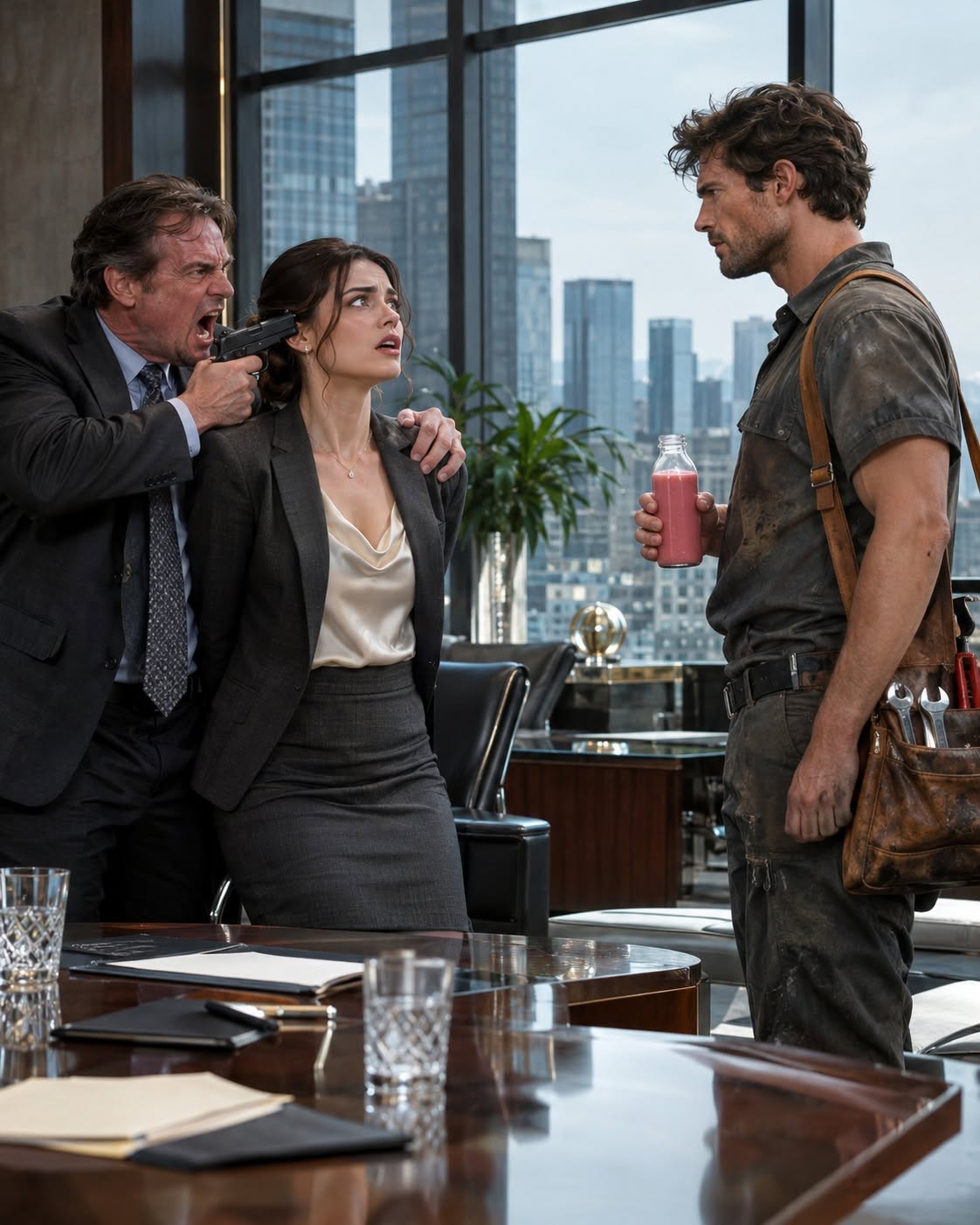
The gun was pointed straight at our billionaire CEO when I walked into the boardroom carrying my daughter’s strawberry juice box.
“Cancel the liquidation,” Clara said into the phone.
I looked up, certain I had misunderstood her.
“Effective immediately,” she continued. “No assets are to be sold, no termination letters are to be issued, and no accounts are to be frozen until I personally review every detail.”
There was a long silence on the other end.
Then a man’s voice spoke loudly enough for me to hear.
“Clara, you can’t be serious. The board approved that liquidation three weeks ago. We’re talking about a seventy-eight-million-dollar transaction.”
“I know exactly how much money we’re talking about, Richard.”
“Then you also know what happens if we walk away.”
Clara looked at me.
For the first time since I’d known her, she didn’t look like a woman calculating the cost of a decision.
She looked like someone wondering whether she’d spent her entire life calculating the wrong things.
“Schedule an emergency board meeting,” she said. “Tomorrow morning. Eight o’clock.”
Then she hung up.
I stood beside her desk, unsure whether I should say anything.
“You realize what you’ve just done?” I finally asked.
“Yes,” she replied. “I’ve made a decision that might cost me my position.”
She glanced at the enormous check I’d refused.
“And strangely enough, that’s not what scares me.”
I thought that was the end of my involvement.
I was wrong.
My name is Daniel Hayes. I’m forty-one years old, a widower, and the father of a seven-year-old girl named Lily.
For the past six years, I’d worked as a maintenance supervisor at Clara’s corporate headquarters.
Most executives barely noticed me.
I fixed broken elevators, replaced light fixtures, repaired air-conditioning units, and made sure the building functioned while the people inside it made decisions worth millions.
I wasn’t ashamed of my job.
It paid the bills, kept food on our table, and allowed me to pick Lily up from school most afternoons.
After my wife, Emily, died of cancer, stability became the most valuable thing in my life.
I didn’t need a mansion.
I needed my daughter to feel safe.
That evening, I picked Lily up from my sister’s house.
She climbed into my truck carrying a drawing of two people standing beneath a giant yellow sun.
“That’s you and me,” she announced.
I smiled.
“Who’s the third person?”
She pointed at a small figure drawn between us.
“Mommy. She’s just invisible because she’s in heaven.”
I gripped the steering wheel a little tighter.
Children have a way of touching the places adults spend years trying to protect.
“That’s beautiful, sweetheart.”
She studied my face.
“Daddy, are you sad?”
“Not right now.”
“Good. Because Aunt Rachel said you did something brave today.”
I glanced at her.
“What did Aunt Rachel tell you?”
“That you helped a man who was really upset.”
I nodded.
“Something like that.”
Lily considered this.
“Did you give him a hug?”
I almost laughed.
“No, baby. I just talked to him.”
She smiled proudly.
“Mommy always said talking nicely is better than yelling.”
I looked through the windshield at the fading sunlight.
“Yes,” I whispered. “She did.”
The following morning, I arrived at work to find three black SUVs parked outside headquarters.
Security guards stood near the elevators.
Two reporters waited across the street.
The story about the armed confrontation had already reached the news.
Someone had leaked my name.
By nine o’clock, strangers were calling me a hero.
By ten, my supervisor informed me that the executive board wanted to speak with me.
I assumed they wanted a statement for the insurance company.
Instead, I walked into a room filled with twelve people wearing suits that probably cost more than my monthly salary.
Clara sat at the head of the table.
Beside her was Richard Voss, the company’s chief financial officer.
Richard was a tall man with silver hair and a smile that never quite reached his eyes.
“Mr. Hayes,” he said. “Please sit.”
I remained standing.
“With respect, sir, I’ve got three broken heating units on the fourth floor. If this can be quick, I’d appreciate it.”
A few executives exchanged uncomfortable looks.
Clara almost smiled.
“Daniel, I asked you here because the board is discussing the future of Westbrook Manufacturing.”
That was the company owned by the desperate man who’d entered the boardroom with a gun.
His name was Thomas Bennett.
Before everything collapsed, he’d spent twenty-three years building Westbrook from a small machine shop into a manufacturer supplying specialized parts to hospitals and agricultural equipment companies.
Three hundred and forty-two people worked there.
Richard folded his hands.
“Westbrook has been losing money for eighteen months. Its debt exceeds its available credit. Liquidation is the financially responsible decision.”
“Then why did Clara stop it?” I asked.
His expression hardened.
“Because yesterday was an emotional day.”
Clara straightened.
“Yesterday was an educational day.”
Richard turned toward her.
“Clara, we cannot run a corporation based on sentiment.”
“No,” she replied. “But perhaps we shouldn’t run one without conscience, either.”
The room fell silent.
Richard opened a folder.
“Let’s be practical. The liquidation would recover approximately forty-six million dollars through asset sales. Keeping Westbrook operating could cost us another twelve million before the end of the year.”
I listened carefully.
Then I asked a question.
“What happens to the workers if you close it?”
Richard sighed.
“They’ll receive whatever severance is required under their contracts.”
“And their health insurance?”
“That depends on the applicable policies.”
“Their retirement benefits?”
“Mr. Hayes, these are complicated financial matters.”
I nodded.
“I’m sure they are.”
Then I looked around the table.
“But I notice everyone here knows exactly what the machines are worth. Nobody seems to know what happens to the people who operate them.”
One executive lowered his eyes.
Richard leaned back.
“With all due respect, you’re a maintenance worker. You’re not qualified to evaluate a corporate restructuring.”
I felt my face grow warm.
He wasn’t wrong about my education.
I’d never attended business school.
I didn’t understand mergers, acquisitions, or complicated financial instruments.
But I understood what happened when a family lost its income.
I’d lived through months of hospital bills.
I’d watched my wife apologize for being sick because she worried about what her treatment was costing us.
I’d sat at our kitchen table deciding which bill could wait another week.
So I looked Richard directly in the eyes.
“You’re right. I don’t know much about restructuring.”
I paused.
“But I know what desperation looks like. And yesterday, it walked into this building carrying a gun.”
Nobody spoke.
Then Clara closed her folder.
“I’m going to Westbrook this afternoon,” she announced.
Richard stared at her.
“Absolutely not.”
“I’m not asking permission.”
She turned toward me.
“Daniel, would you come with me?”
I hesitated.
“Why?”
“Because I think those people might tell you things they wouldn’t tell me.”
I thought about Lily.
About my responsibilities.
About the fact that I’d already become involved in something much bigger than myself.
Then I remembered the tears on Thomas Bennett’s face.
“All right,” I said. “But I need to be home by five.”
Clara nodded.
“Deal.”
Westbrook Manufacturing stood on the outskirts of a small industrial town forty miles away.
The factory was enormous, with redbrick walls, loading docks, and a faded American flag fluttering above the entrance.
As our car pulled into the parking lot, I noticed something strange.
There were almost no vehicles.
A security guard met us at the gate.
“Most workers were sent home yesterday,” he explained. “Management told them the plant might close.”
Clara stepped out of the car.
A group of employees stood near the entrance.
When they recognized her, their expressions changed.
One woman stepped forward.
She looked to be in her late fifties, with gray hair pulled into a tight ponytail.
“My name is Margaret Collins,” she said. “I’ve worked here thirty-one years.”
Clara extended her hand.
Margaret didn’t take it.
“My husband died eight years ago. This job helped me raise three children. My youngest is finishing nursing school.”
Her voice trembled.
“If you shut this place down, I lose my insurance. And I have surgery scheduled next month.”
Clara lowered her hand.
“I’m sorry.”
Margaret shook her head.
“I don’t need you to be sorry. I need you to understand.”
We spent the next three hours walking through the factory.
Workers showed us equipment they’d maintained for decades.
They explained how orders had declined after a major customer canceled a contract.
They described overtime cuts, delayed payments, and management meetings that ended without answers.
But something bothered me.
The factory didn’t look like a failing business.
The machines were clean.
The workers were skilled.
And several production lines were running at full capacity.
I asked a supervisor named Miguel why they were still manufacturing parts if the company was supposedly collapsing.
He frowned.
“Because we have orders.”
Clara stopped walking.
“What kind of orders?”
Miguel pulled a clipboard from the wall.
“Hospital equipment components. Agricultural pumps. Emergency replacement assemblies.”
He pointed to several numbers.
“We’re booked for almost seven months.”
Clara studied the paperwork.
“Then why are the financial reports showing declining revenue?”
Miguel shrugged.
“That’s above my pay grade.”
But I noticed his expression.
“You think something’s wrong?” I asked.
He hesitated.
Then he looked toward the security cameras.
“Mr. Hayes, can I show you something?”
He led us into a small office behind the production floor.
Inside were stacks of shipping records.
Miguel opened a drawer and removed a folder.
“These are copies of invoices we submitted to corporate accounting.”
Clara examined them.
Her face changed.
Several invoices were marked paid.
Others showed outstanding balances.
But the numbers didn’t match the reports she’d received.
“Where did you get these?” she asked.
“I kept copies because something didn’t make sense. Customers told us they’d paid, but our accounting department said the money never arrived.”
Clara flipped through the pages.
“How long has this been happening?”
“About nine months.”
I watched the color drain from her face.
Then she whispered something I hadn’t expected.
“Richard.”
That evening, Clara called me while I was making spaghetti for Lily.
“Daniel, I need your help.”
I balanced the phone between my shoulder and ear.
“What’s going on?”
“I had our internal auditors review the invoices. Someone has been redirecting customer payments through an outside consulting company.”
I stopped stirring the sauce.
“How much?”
“At least nineteen million dollars.”
I stared at the kitchen wall.
“That’s a lot of money.”
“It’s enough to explain most of Westbrook’s cash crisis.”
“Who owns the consulting company?”
Clara was silent for several seconds.
Then she answered.
“Richard’s brother-in-law.”
I closed my eyes.
Suddenly, the liquidation made sense.
If Westbrook shut down, the missing money might be buried beneath complicated bankruptcy proceedings and asset sales.
And Richard would walk away richer.
“What are you going to do?” I asked.
“Confront him tomorrow.”
“Don’t.”
She sounded surprised.
“Why not?”
“Because if he knows you’ve discovered the truth, he’ll have time to hide whatever else he’s done.”
Clara said nothing.
Then she asked, “What would you suggest?”
“Call someone who knows how to investigate financial crimes. Quietly.”
There was another pause.
“You’re becoming very difficult to underestimate, Daniel.”
I smiled faintly.
“Don’t worry. I still don’t know how to read half those spreadsheets.”
For the next four days, Clara worked with independent forensic accountants and outside legal counsel.
I returned to my normal duties.
Or tried to.
Reporters waited outside my apartment.
Strangers sent messages asking for interviews.
One television producer offered me ten thousand dollars to tell my story.
I refused.
The last thing Lily needed was a father who became famous because someone almost died.
But on Friday afternoon, everything changed.
I was replacing a light fixture in the underground parking garage when Richard approached me.
“Mr. Hayes.”
I climbed down from the ladder.
“Sir.”
He smiled.
“I hear you’ve been spending quite a bit of time with Clara.”
“Just helping where I can.”
“That’s admirable.”
He stepped closer.
“I also hear you’ve been asking questions about Westbrook.”
I said nothing.
Richard reached into his jacket and removed an envelope.
Inside was a document offering me a new position.
Regional facilities director.
A salary of two hundred and forty thousand dollars a year.
Company vehicle.
Private health insurance.
A substantial signing bonus.
I read the offer twice.
It was more than four times what I currently earned.
Richard watched my reaction.
“You’ve earned an opportunity, Daniel. Someone with your instincts shouldn’t be changing light bulbs.”
I looked up.
“What’s the catch?”
“No catch. Just one condition.”
There it was.
“You’ll need to sign a confidentiality agreement regarding recent corporate matters.”
I stared at the paper.
Richard lowered his voice.
“Think about your daughter. Think about what that kind of money could do for her future.”
For a moment, I did.
I imagined paying off our mortgage.
Replacing my aging truck.
Taking Lily to Disney World, the trip Emily had promised her before she got sick.
I imagined never worrying about medical bills again.
Then I remembered something my wife once told me.
“Money can make life easier, Danny. But it can’t make you proud of the person you’ve become.”
I handed the envelope back.
“No, thank you.”
Richard’s smile disappeared.
“You’re making a mistake.”
“Maybe.”
He stepped closer.
“People who interfere in matters they don’t understand sometimes lose more than their jobs.”
My stomach tightened.
“Is that a threat?”
He straightened his tie.
“It’s advice.”
Then he walked away.
I called Clara immediately.
She listened without interrupting.
When I finished, she said, “Go home, Daniel. I’ll have security review the garage footage.”
That night, I checked the locks twice.
I told myself I was being paranoid.
Then, shortly after midnight, my phone rang.
It was my sister Rachel.
“Daniel, someone’s outside your house.”
I sat up.
“What?”
“A dark sedan. It’s been parked across the street for almost an hour.”
Rachel lived three houses away.
I walked to the window.
The sedan was there.
Its headlights were off.
I could barely make out a figure behind the windshield.
“Call the police,” I told her.
Before she could answer, the car pulled away.
I stood in the darkness, listening to Lily breathing in the next room.
For the first time since the boardroom incident, I felt truly afraid.
Not for myself.
For her.
The next morning, I called Clara.
“I can’t keep doing this,” I told her.
She didn’t argue.
“I understand.”
“I have a daughter.”
“I know.”
“If something happens to me, she’s got nobody but my sister.”
Clara’s voice softened.
“Daniel, I’m sorry I put you in this position.”
I sat at the kitchen table, staring at Emily’s photograph.
“Just promise me you’ll finish what you started.”
“I promise.”
Three days later, Richard was arrested.
The news broke during Lily’s school recital.
I was sitting in the second row, watching her sing with twenty other children, when my phone vibrated.
A message from Clara appeared.
“We found everything. Richard has been taken into custody.”
I turned the phone facedown.
For the next forty minutes, I watched my daughter sing.
And for the first time in weeks, I felt like an ordinary father again.
But Richard’s arrest wasn’t the end.
It was the beginning of something much harder.
The investigation revealed that Richard had manipulated Westbrook’s financial statements, diverted customer payments, and pressured executives to approve liquidation.
He’d also arranged for a company connected to his family to purchase Westbrook’s most valuable equipment at a steep discount.
The evidence was overwhelming.
Yet recovering the stolen money would take time.
Westbrook still owed suppliers.
Employees were still worried.
And Thomas Bennett, the man who’d entered the boardroom with a gun, was sitting in jail awaiting trial.
Clara called an emergency meeting.
This time, she invited me without asking.
When I entered, the executives were discussing whether the corporation should sell Westbrook anyway.
One board member argued that keeping the company alive was too risky.
Another insisted that shareholders deserved immediate financial recovery.
Clara listened.
Then she stood.
“I’ve spent twenty years believing that being a good CEO meant protecting our investors from every possible loss.”
She looked around the room.
“But somewhere along the way, I forgot that a company’s greatest assets aren’t always listed on its balance sheet.”
Richard’s replacement, a cautious woman named Evelyn Park, raised her hand.
“Clara, compassion doesn’t eliminate debt.”
“No,” Clara agreed. “It doesn’t.”
She placed a folder on the table.
“But neither does destroying a functioning business when its financial crisis was manufactured by fraud.”
Inside was a new proposal.
The corporation would provide Westbrook with a temporary operating loan, backed by existing customer contracts and equipment.
An independent management team would oversee operations.
Employees would retain their jobs and benefits.
And once the business stabilized, workers would have the opportunity to purchase an ownership stake through a structured employee trust.
The room erupted.
“You’re asking us to take another risk!”
“This is unprecedented!”
“What about the shareholders?”
Clara waited until the voices faded.
Then she said something that made everyone quiet.
“I’m willing to personally guarantee the first ten million dollars.”
I stared at her.
That wasn’t a symbolic gesture.
It was real money.
Her own money.
Evelyn studied the proposal.
“Even with that guarantee, we’d need a credible recovery plan.”
Clara nodded.
“We have one.”
She opened another folder.
It contained seven months of confirmed orders, revised financial projections, and letters from customers willing to renew contracts if Westbrook remained operational.
Miguel and the plant supervisors had helped prepare the production forecasts.
Margaret had organized employee representatives.
And for the first time, the people whose livelihoods depended on the factory had been included in planning its future.
The board debated for nearly six hours.
Finally, the vote came.
Seven in favor.
Four against.
One abstention.
Westbrook would remain open.
I didn’t realize I was holding my breath until Clara turned toward me.
“We did it,” she whispered.
I shook my head.
“No. They did.”
A week later, Clara and I returned to Westbrook.
This time, the parking lot was full.
Employees crowded around the entrance.
Some carried handmade signs.
Others simply stood together, waiting.
When Clara stepped out of the car, Margaret approached her.
For a moment, neither woman spoke.
Then Margaret extended her hand.
“Thank you for giving us a chance.”
Clara took it.
“Thank you for showing me what I almost threw away.”
Someone began clapping.
Then another person joined.
Within seconds, hundreds of workers were applauding.
Clara looked overwhelmed.
I’d seen her receive awards, give speeches, and appear on magazine covers.
But I’d never seen her cry.
Until that moment.
She turned away, wiping her eyes.
I pretended not to notice.
Later that afternoon, I walked through the factory with Miguel.
The machines were running.
Forklifts moved between loading bays.
Workers laughed and called to one another.
It sounded like any ordinary manufacturing plant.
But I knew how close all of it had come to disappearing.
Miguel stopped beside a large metal press.
“Daniel, there’s something you should know.”
“What?”
“Thomas Bennett called me from jail yesterday.”
I felt my chest tighten.
“How is he?”
“Not good. He’s ashamed of what he did.”
I nodded.
“He should be.”
Miguel looked surprised.
I continued.
“He terrified innocent people. He could have killed someone. Losing everything doesn’t give a person the right to take someone else’s life.”
Miguel lowered his eyes.
“I know.”
“But that doesn’t mean he’s beyond redemption.”
Miguel nodded slowly.
“He asked me to tell you something.”
“What?”
“He said you were the first person who treated him like a human being after everything fell apart.”
I looked toward the factory floor.
“Tell him I hope he uses his second chance wisely.”
Several months passed.
Westbrook slowly recovered.
Customer payments returned to normal.
The company hired back several contractors who’d lost work during the crisis.
And Margaret underwent her surgery with her health coverage intact.
Meanwhile, Thomas accepted responsibility for his actions.
He pleaded guilty to charges related to the armed threat and received a prison sentence.
Before sentencing, he wrote letters of apology to every person who’d been in the boardroom.
He didn’t ask for forgiveness.
He simply acknowledged the fear he’d caused.
Clara received one of those letters.
She kept it in her desk.
Not because she excused what he’d done.
But because she never wanted to forget how close her own decisions had brought everyone to tragedy.
One afternoon, almost a year after the incident, Clara invited me to lunch.
I expected another conversation about Westbrook.
Instead, she handed me a photograph.
It showed a little girl standing beside a hospital bed.
I recognized Clara immediately.
She couldn’t have been older than nine.
The woman in the bed looked terribly ill.
“My mother,” Clara explained.
“She died when I was ten.”
I looked at her.
“I didn’t know.”
“Most people don’t.”
She stared at the photograph.
“My father owned a small printing company. When Mom got sick, he borrowed money to pay for her treatment. After she died, the business collapsed.”
Her voice became quiet.
“We lost our house. My father worked nights cleaning offices.”
I couldn’t speak.
Clara continued.
“I promised myself I’d never be poor again. I studied harder than everyone. Worked longer than everyone. Built a company worth billions.”
She paused.
“And somewhere along the way, I became exactly the kind of person who destroyed my father’s business.”
I looked down at the photograph.
“Clara, you didn’t know what Richard was doing.”
“No. But I knew three hundred and forty-two people would lose their jobs, and I didn’t bother to ask their names.”
She wiped a tear from her cheek.
“That part was my responsibility.”
For a while, we sat in silence.
Then she smiled faintly.
“There’s something else.”
She slid a document across the table.
It was an offer for a new position.
Director of Employee Relations and Community Impact.
The salary was generous.
The responsibilities included visiting company facilities, meeting workers, identifying concerns before they became crises, and helping executives understand how their decisions affected real families.
I stared at the document.
“Clara, I don’t have a college degree.”
“I know.”
“I’ve never managed a corporate department.”
“I know that too.”
“Then why me?”
She leaned forward.
“Because I can hire a hundred people who understand financial statements. What I need is someone who understands the people behind them.”
I looked at the offer.
Then I thought about Lily.
About Emily.
About the years I’d spent believing my greatest contribution was keeping buildings running.
“I’ll consider it,” I said.
Clara laughed.
“Of course you will.”
That evening, I brought the document home.
Lily was sitting at the kitchen table doing homework.
“Daddy, why are you smiling?”
I sat beside her.
“I might have a new job.”
“Will you still fix things?”
I thought about that.
“Yes, sweetheart. I think I will.”
She grinned.
“Good. You’re really good at fixing things.”
I kissed the top of her head.
Three weeks later, I accepted the position.
But I made one condition.
I wanted to spend at least two days every month visiting factories, warehouses, and offices without executives announcing my arrival.
I wanted to talk to people in break rooms.
Listen to workers who were afraid to speak up.
Understand problems before they became emergencies.
Clara agreed.
Over the next two years, our company changed.
Not overnight.
Not perfectly.
There were still difficult decisions.
Some departments were restructured.
Some projects failed.
There were disagreements, financial setbacks, and days when compassion seemed far more complicated than anyone wanted to admit.
But employees gained a stronger voice.
Managers were required to explain major decisions directly to the people affected.
And the company established emergency assistance programs for workers facing serious family crises.
Clara also introduced a policy requiring executives to visit operating facilities regularly.
Not for photographs.
Not for publicity.
To listen.
Westbrook eventually became profitable again.
Its employee ownership trust acquired a meaningful stake in the business, giving workers a direct interest in its future.
Margaret retired after thirty-three years.
At her retirement celebration, she stood in front of the entire factory holding a small plaque.
Then she called me onto the stage.
I tried to refuse.
She wouldn’t allow it.
“This man,” she announced, “reminded some very powerful people that we matter.”
The room erupted in applause.
I felt embarrassed.
Then Margaret hugged me.
“You gave us our lives back.”
I shook my head.
“No, Margaret. You fought for your own future. I just helped someone listen.”
That night, Lily asked why people kept thanking me.
I thought carefully before answering.
“Because sometimes people forget that everyone is carrying something you can’t see.”
She frowned.
“Like a backpack?”
I smiled.
“Exactly like a backpack.”
“What was in the angry man’s backpack?”
I looked at her.
“Fear. Sadness. And the feeling that nobody cared.”
She was quiet for a moment.
“Did you take it away?”
“No, sweetheart. I couldn’t.”
“Then what did you do?”
“I helped him remember he didn’t have to carry it by hurting somebody else.”
Lily nodded as though this made perfect sense.
Then she asked the question that stayed with me for years.
“Daddy, do rich people have backpacks too?”
I laughed softly.
“Yes, baby. Everybody does.”
Five years after the boardroom incident, Clara announced she was stepping down as CEO.
The company had grown stronger.
Westbrook had expanded into two new facilities.
Hundreds of additional jobs had been created.
And the employee assistance programs we’d built were helping families through emergencies I once would never have imagined.
At her farewell celebration, Clara stood before a room filled with investors, executives, employees, and community leaders.
She spoke about business growth.
She spoke about leadership.
Then she looked toward the back of the room, where I stood beside Lily.
“Years ago,” she said, “I believed success meant never allowing emotion to interfere with a decision.”
The room became quiet.
“Then one terrible afternoon, a man entered my boardroom carrying a gun. And another man entered carrying a child’s juice box.”
A few people smiled.
“I thought the first man was the most dangerous person in the room.”
She paused.
“But I eventually realized the greatest danger was the way I’d learned to see people as numbers.”
I felt Lily squeeze my hand.
Clara continued.
“Daniel Hayes didn’t teach me how to make money. He taught me something far more difficult.”
Her eyes found mine.
“He taught me that power means very little if you forget who your decisions affect.”
The audience stood and applauded.
I didn’t know what to do with myself.
So I did what I’d always done when emotions became too much.
I looked down at my daughter.
She was beaming.
“Daddy,” she whispered, “she’s talking about you!”
“I noticed.”
“Are you famous now?”
I smiled.
“Only to you, sweetheart.”
She shook her head seriously.
“You were already famous to me.”
I pulled her close.
And suddenly, all the applause in the world seemed very small compared with those words.
Later that evening, after the guests had gone, Clara found me standing near the empty boardroom.
The room looked different now.
The long polished table was still there.
The expensive chairs hadn’t changed.
But the walls displayed photographs of employees from every division of the company.
Mechanics.
Nurses.
Warehouse workers.
Engineers.
Drivers.
Families.
People whose names once would never have appeared in a boardroom.
Clara stood beside me.
“Do you ever think about that day?” she asked.
“Sometimes.”
“Do you regret getting involved?”
I thought about the fear.
The threats.
The sleepless nights.
Then I thought about Margaret, Miguel, and the hundreds of families who’d kept their livelihoods.
“No,” I answered.
“Not even a little?”
I smiled.
“Well, I regret leaving Lily’s strawberry juice box on the conference table. She was pretty upset about that.”
Clara laughed.
Then she grew serious.
“I’ve wanted to ask you something for years.”
“What?”
“When you walked into that room, weren’t you afraid?”
I looked at the chair where Thomas Bennett had once stood trembling with a gun.
“Of course I was.”
“Then why didn’t you run?”
For a long moment, I didn’t answer.
Because the truth was more complicated than courage.
I’d spent years watching my wife suffer.
I’d learned that pain could make people angry, frightened, and desperate.
And I’d learned that sometimes the most important thing you could offer someone wasn’t a solution.
It was the feeling that they weren’t completely alone.
Finally, I turned toward Clara.
“Because I saw a man who needed someone to hear him before he made the worst mistake of his life.”
She nodded slowly.
“And you saved me.”
I shook my head.
“I helped you survive that day. What you did afterward was your choice.”
Clara looked around the boardroom.
Then she whispered, “I’m glad I made a different one.”
When I got home, Lily was already asleep.
She was twelve now, growing taller every day, with her mother’s brown eyes and the same stubborn determination.
On her desk sat a framed photograph of Emily.
Beside it was a drawing Lily had made years earlier.
Two people beneath a yellow sun.
And a third person standing between them, invisible except for a faint outline.
I sat on the edge of her bed and brushed the hair from her forehead.
For years, I’d worried that I wasn’t giving her enough.
Not enough money.
Not enough opportunities.
Not enough of the life Emily and I had imagined.
But looking at her sleeping peacefully, I finally understood something.
My daughter didn’t need me to be the richest man in the world.
She needed me to show her what kind of person was worth becoming.
The next morning, I found a strawberry juice box in the refrigerator.
I smiled.
Then I placed it in Lily’s lunch bag beside a small note.
It read:
“Never underestimate what one act of kindness can change. Love, Dad.”
She discovered the note at school.
That afternoon, she came home and hugged me without saying a word.
I held her tightly.
And in that moment, I understood the greatest lesson of my life.
You don’t have to be powerful to change someone’s future.
You don’t have to be wealthy to give something valuable.
And you don’t have to solve every problem to make a difference.
Sometimes, you simply have to notice the person everyone else has stopped seeing.
Because a business can be rebuilt.
A fortune can be earned again.
A reputation can recover.
But the way we treat people when they have nothing left reveals who we truly are.
And sometimes, the smallest act of compassion can reach places that money, power, and fear never could.
I never became a billionaire.
I never wanted to.
But I helped raise a daughter who understood that every human being deserves dignity, even on their worst day.
And to me, that was a fortune no amount of money could ever buy.
THE END.