The flight attendant was screaming for someone to help. Both pilots were unconscious, the aircraft was losing altitude
The controller’s voice changed before he finished the sentence.
“Sir, the officer waiting for you is Colonel Daniel Hayes. He says you were the last person to speak to his father before he died.”
For a moment, the cockpit seemed to grow smaller.
Daniel Hayes.
I hadn’t heard that name in nearly thirty years.
I tightened my grip on the controls.
“His father?” I asked quietly.
“General Thomas Hayes, sir. He served at Falcon Ridge Air Base. Colonel Hayes says he has something important to tell you.”
I stared through the windshield at the endless clouds stretching beneath us.
General Thomas Hayes.
The name brought back memories I had spent decades trying to bury.
“Tell Colonel Hayes I remember his father,” I replied. “But right now, I have nearly two hundred people depending on me. Whatever he wants to discuss will have to wait until we’re safely on the ground.”
“Understood, sir.”
The radio went silent.
Behind me, the flight attendant, whose name tag read Emily, leaned forward.
“Do you know this colonel?”
I nodded without looking away from the instruments.
“I knew his father.”
“Was he a friend?”
I took a slow breath.
“He was the kind of man who could change the direction of your entire life with a single conversation.”
Emily didn’t ask anything else.
She had learned that some stories were better left alone until the danger had passed.
I returned my attention to the aircraft.
The situation was deteriorating.
The autopilot had disengaged completely, and the aircraft was drifting slightly off course. One engine was showing abnormal readings. The instrument panel was crowded with warnings, and the aircraft’s handling characteristics were becoming increasingly unpredictable.
I had flown military aircraft for thirty-two years.
I had landed damaged planes on unfamiliar runways, flown through violent weather, and made decisions under pressure that would have terrified most people.
But this was a commercial passenger aircraft.
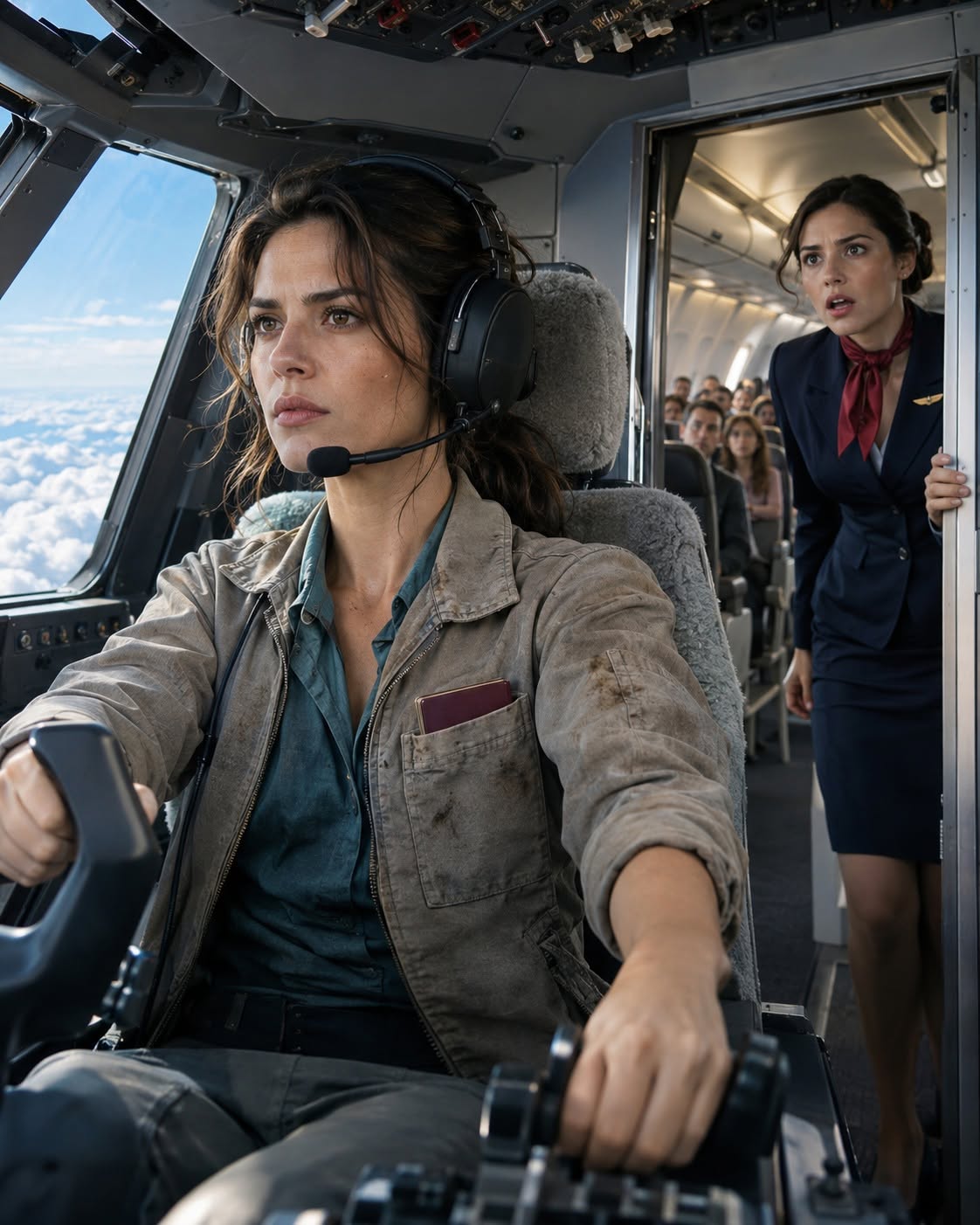
Every decision carried a different kind of weight.
I wasn’t protecting a mission or completing an assignment.
I was protecting people who had trusted an airline to get them home.
“Emily,” I said, “I need you to contact the cabin. Tell everyone to remain seated with their seat belts fastened. Have the crew prepare the passengers for an emergency landing. No one should stand up, regardless of what they hear.”
She nodded.
“Should I tell them how serious it is?”
“Tell them the truth, but don’t give them reasons to panic. We have a chance. That’s what they need to know.”
She picked up the interphone.
I adjusted my headset and called air traffic control.
“This is the aircraft requesting emergency priority. Confirm runway conditions and current wind.”
The controller answered immediately.
“Runway is clear. Emergency vehicles are positioned. Wind is variable, approximately twelve knots. The military base is coordinating with civilian emergency services.”
“Understood. I need the longest available runway and confirmation that the approach path is clear.”
“Roger that.”
Then another voice entered the frequency.
“Aircraft commander, this is Colonel Daniel Hayes. Can you hear me?”
I glanced at the radio.
“Affirmative, Colonel. I’m occupied at the moment.”
“I understand. I won’t keep you long. My father spoke about you almost every week before he passed.”
I swallowed.
“Your father was a good man.”
There was a pause.
“Sir, I know who you are. I know what happened at Raven Valley. And I know why you left the Air Force.”
My eyes remained on the instruments, but something inside me shifted.
Raven Valley.
A name I hadn’t heard spoken aloud in twenty-seven years.
“Colonel, this isn’t the time.”
“I know. But there’s something you need to understand. My father never blamed you.”
I closed my eyes for half a second.
Then I opened them.
“Colonel, I have to fly this airplane.”
“Understood, sir. I’ll be waiting when you land.”
The transmission ended.
I stared ahead.
Raven Valley had been a military rescue mission during the final years of my service. A transport aircraft carrying medical personnel and injured soldiers had gone down in mountainous terrain during a violent storm. General Hayes had been coordinating the operation.
I was the lead pilot assigned to the rescue.
The mission had gone wrong.
A sudden weather change had forced us to abandon our original route. I had made a decision to divert, and several members of the rescue team had been injured during the operation.
One of them had been Lieutenant Michael Hayes.
Daniel’s older brother.
He survived, but suffered injuries that ended his military career.
For years, I had carried the belief that my decision had destroyed another man’s future.
General Hayes had told me afterward that I had done everything possible.
I hadn’t believed him.
I had submitted my resignation months later.
And now, somehow, the past had climbed into my cockpit.
“Sir?”
Emily’s voice brought me back.
“The passengers are secured. There’s something else.”
“What is it?”
“A young boy is asking whether we’re going to die.”
I felt my throat tighten.
“How old?”
“Maybe eight. He’s sitting with his mother in row nineteen.”
I glanced at her.
“Tell him that the man flying the plane has gray hair, has made more landings than he can count, and doesn’t intend to let this be his last.”
For the first time, Emily smiled.
“I’ll tell him.”
She disappeared through the cockpit door.
I returned to the instruments.
The base was getting closer.
But the aircraft wasn’t behaving the way I needed it to.
The abnormal engine readings were worsening. The vibration had increased, and the aircraft was beginning to respond sluggishly to corrections.
I called the controller.
“Request updated weather and runway conditions.”
“Wind remains manageable. Visibility is good. Emergency crews are ready.”
“Any chance of a second runway?”
“Negative. The secondary runway is undergoing maintenance. Only the main runway is available.”
I looked at the navigation display.
One runway.
One opportunity.
I began calculating the approach.
Then the aircraft jolted violently.
A sharp metallic vibration traveled through the cockpit.
The warning alarm sounded again.
I looked at the engine instruments.
The readings had dropped.
“Come on,” I whispered.
I adjusted the aircraft’s attitude and made the necessary corrections.
The plane continued descending.
Then I heard a voice behind me.
“Captain, we have another problem.”
Emily had returned.
“What now?”
“The rear cabin is reporting smoke near the galley.”
I turned toward her.
“Is anyone injured?”
“Not that we know of. The crew is investigating, but they can smell something burning.”
I immediately contacted air traffic control.
“Emergency aircraft reporting possible smoke in the cabin. Request immediate landing priority.”
The controller responded without hesitation.
“Priority confirmed. You’re cleared to land on runway two-seven. Fire and rescue teams are standing by.”
I looked at the runway indicator.
We were close.
Very close.
“Emily, listen carefully. If the cabin crew confirms smoke, follow the airline’s emergency procedures. Keep everyone seated until we determine whether an evacuation is necessary. Do not open any doors while the aircraft is moving.”
She nodded.
I could see the fear in her eyes.
“Captain, what if we can’t make it?”
I looked at her.
“Then we make the best decision available with the information we have. But we’re not giving up while we’re still in the air.”
She nodded again.
Then she returned to the cabin.
The radio crackled.
“Aircraft commander, Colonel Hayes again. I need to speak with you.”
I almost ignored him.
But something in his tone made me hesitate.
“Go ahead.”
“Sir, my father left something for you. He gave it to me shortly before he died. I’ve carried it for twenty-seven years.”
“Colonel, I really don’t have time.”
“I understand. But I think you should know what it is before you land.”
I frowned.
“What?”
“A letter. Written by my father. It’s addressed to you.”
I shook my head.
“Why would he write me a letter?”
“Because he knew you would never forgive yourself for what happened at Raven Valley.”
My hands tightened around the controls.
The aircraft was descending through the clouds.
The runway was somewhere ahead.
I didn’t answer.
Colonel Hayes continued.
“My father wanted you to know that Lieutenant Michael Hayes didn’t lose his career because of your decision. He lost it because he made a decision of his own.”
I felt a sudden chill.
“What are you talking about?”
“He disobeyed a direct order during the rescue. He went back for two injured soldiers after the evacuation route had been closed. Your diversion saved the rest of the team. If you hadn’t changed course, all of them would have died.”
I stared at the instruments.
For twenty-seven years, I had believed I had made the wrong decision.
I had remembered the injured men.
I had remembered the criticism.
I had remembered General Hayes standing in front of me after the mission, saying, “You did what you had to do.”
But I had never known the whole story.
“Why didn’t he tell me?” I asked.
“My father tried. You wouldn’t answer his calls. You had already decided that you were responsible.”
The radio went quiet.
I felt something heavy rise in my chest.
Then the controller interrupted.
“Aircraft commander, you are approaching the final descent corridor. Confirm you have visual contact with the runway.”
I looked through the windshield.
Nothing but gray cloud.
“Negative. Still in cloud.”
“Understood. Continue on assigned heading.”
I checked the instruments again.
The aircraft was descending.
The warning lights were still flashing.
The engine vibration had become more pronounced.
Then, suddenly, the cloud began to thin.
A strip of dark land appeared beneath us.
And there it was.
The runway.
I had never been so relieved to see a piece of concrete.
“Runway in sight,” I reported.
“Cleared to land. Wind remains within limits. Emergency crews are ready.”
I adjusted my position.
My hands were steady.
My breathing was controlled.
But I knew we were entering the most dangerous part of the entire flight.
“Emily,” I called.
She appeared at the cockpit doorway.
“Yes, Captain?”
“How is the cabin?”
“Everyone is secured. The smoke has stopped spreading, but the crew still smells something burning.”
“Tell them to prepare for impact. Heads down when instructed. Make sure the children are protected.”
She nodded and disappeared.
I lowered the aircraft’s nose slightly.
The runway grew larger.
Then something unexpected happened.
A red warning appeared across the instrument panel.
The aircraft began responding poorly to my control inputs.
I made a small correction.
Nothing.
I tried again.
The response was delayed.
“Come on,” I whispered.
The runway was approaching quickly.
I needed the aircraft aligned.
I contacted the tower.
“Control, I’m experiencing degraded flight controls. Request immediate assistance.”
The controller answered.
“Understood. Fire crews are moving into position. Continue your approach if able.”
I made another correction.
This time the aircraft responded.
Not perfectly, but enough.
The runway was directly ahead.
I could see the emergency vehicles lining both sides.
Their lights flashed through the morning haze.
For a moment, I thought about the people behind me.
The mother holding her little boy.
The elderly couple who had probably been traveling to see their grandchildren.
The young businessman who had spent the entire flight complaining about the coffee.
All of them had lives waiting for them on the other side of this runway.
I wasn’t going to let those lives end here.
“Brace! Brace! Brace!” I shouted.
The aircraft descended.
The wheels touched the runway.
A violent jolt shook the entire cabin.
The aircraft bounced.
For one terrifying second, I thought we were going to lose control.
I made the necessary corrections.
The aircraft touched down again.
Hard.
A loud scraping noise came from beneath us.
The cabin shook.
Then the brakes engaged.
I kept the aircraft aligned as it rolled down the runway.
The speed began dropping.
Faster than I expected.
The aircraft veered slightly.
I corrected.
The emergency vehicles raced alongside us.
Smoke appeared behind the left engine.
Then, finally, the aircraft slowed.
And stopped.
For a moment, nobody moved.
I stared at the instruments.
The engines were shutting down.
The aircraft was no longer moving.
I looked at Emily.
“Are we on the ground?”
She stared at me.
Then she began crying.
“Yes, Captain. We’re on the ground.”
I leaned back in the seat.
My hands were shaking now.
Not from fear.
From the sudden realization that I had just brought nearly two hundred people through something none of us would ever forget.
Emily grabbed my shoulder.
“You did it.”
I looked at her.
“We did it.”
The next several minutes were a blur.
Firefighters surrounded the aircraft.
Medical teams approached.
The cabin crew began organizing the passengers for evacuation.
The smoke turned out to have originated from an overheated electrical component near the rear galley. It had caused enough concern to require immediate inspection, but the crew had managed to contain the situation.
The passengers were evacuated safely.
All 187 passengers and six crew members survived.
The two unconscious pilots were taken to a medical facility.
Later, doctors would determine that they had suffered a sudden medical emergency caused by an unexpected combination of conditions. Both would eventually recover.
I remained in the cockpit until emergency personnel confirmed that everyone had been accounted for.
Then I stepped outside.
The morning air felt different.
The sky was blue.
The runway stretched behind me.
And for the first time in twenty-seven years, I felt as though I could breathe without carrying a mountain on my shoulders.
A group of passengers stood near the terminal building.
Some were crying.
Some were hugging each other.
Others were speaking to emergency workers.
Then I saw the little boy from row nineteen.
He was holding his mother’s hand.
When he spotted me, he let go and ran toward me.
His mother quickly followed.
“Are you the man who flew the plane?” he asked.
I knelt slightly.
“I was helping out.”
He studied my face.
Then he asked a question I wasn’t prepared for.
“Were you scared?”
I smiled.
“Yes, buddy. Very scared.”
He looked confused.
“But you didn’t look scared.”
I placed a hand gently on his shoulder.
“Being brave doesn’t mean you aren’t scared. It means you do what needs to be done even when you are.”
His mother began crying.
She wrapped her arms around her son and thanked me.
I didn’t know what to say.
I simply nodded.
Then someone called my name.
“Sir!”
I turned.
A tall man in a military uniform was walking toward me.
He was in his late forties, with silver beginning to show at his temples.
His posture was straight.
His expression was serious.
Colonel Daniel Hayes.
He stopped a few feet away and saluted.
I returned the salute automatically.
“Colonel.”
“Sir.”
For several seconds, neither of us spoke.
Then he extended his hand.
“On behalf of everyone at Falcon Ridge, welcome home.”
I shook his hand.
“Thank you.”
He studied my face.
“You look older than I remember from the photographs.”
I laughed quietly.
“That’s what twenty-seven years of retirement will do.”
He smiled.
Then his expression became serious again.
“My father would have been proud of you today.”
I looked away.
“Your father was a better man than I ever gave myself credit for.”
Colonel Hayes reached into the inside pocket of his uniform jacket.
He removed a small, weathered envelope.
The paper had yellowed with age.
My name was written across the front.
In handwriting I recognized immediately.
General Thomas Hayes.
My throat tightened.
“Is this the letter?”
Daniel nodded.
“He told me to give it to you if I ever had the chance. He made me promise not to open it.”
I carefully took the envelope.
For a moment, I simply held it.
I had faced enemy fire without hesitation.
I had flown through storms that shook aircraft apart.
Yet I was suddenly afraid to open a piece of paper.
“Would you like some privacy?” Daniel asked.
I nodded.
We walked toward a quiet bench near the edge of the airfield.
I sat down.
My fingers struggled with the envelope.
Inside was a single sheet of paper.
I unfolded it.
The first line made my eyes fill with tears.
“To the man who saved my sons and then spent the rest of his life believing he had failed them.”
I stopped reading.
Daniel sat beside me.
I continued.
“Dear Michael,
“If this letter has finally reached you, I hope it means you have found your way back into the sky.
“I have wanted to tell you something for twenty-seven years, but I never found the right words.
“After Raven Valley, you came to my office and asked whether your decision had cost Lieutenant Michael Hayes his future.
“I told you that you had saved lives.
“You nodded, but I could see you didn’t believe me.
“I watched you leave the service not because you had lost your ability to fly, but because you had lost your ability to forgive yourself.
“Michael Hayes survived because of you.
“He went on to become a husband, a father, and a teacher. He taught young people how to repair aircraft engines. He spent the rest of his working life helping others find their place in aviation.
“He never regretted his decision to return for those soldiers.
“Neither did I.
“His injuries were not your failure. They were the consequence of a terrible day when good people made impossible decisions.
“You have spent too many years punishing yourself for surviving.
“I hope you understand that there is a difference between responsibility and guilt.
“Responsibility means learning from what happened.
“Guilt means refusing to let yourself live after it.
“You were never required to carry every life on your shoulders.
“You were only required to do your best.
“And you did.
“One day, I hope you will sit in an aircraft again and remember that the sky was never your enemy.
“It was where you belonged.
“With respect and friendship,
“Thomas Hayes.”
I lowered the letter.
For several seconds, I couldn’t speak.
Daniel stared toward the runway.
“My father kept a photograph of you in his office,” he said.
I looked at him.
“Really?”
He nodded.
“It was taken after the rescue mission. You were standing beside him, covered in mud, looking exhausted. He used to tell me that you were the finest pilot he’d ever known.”
I shook my head.
“Your father was generous.”
“No, sir. He was honest.”
Daniel paused.
“There’s something else.”
I looked at him.
“My brother is here.”
I turned toward the terminal.
A man was walking toward us.
He used a cane.
His hair was almost completely white, and his steps were slow, but his face carried the same unmistakable confidence I remembered from the old photographs.
Lieutenant Michael Hayes.
The man I had spent twenty-seven years believing I had failed.
He stopped in front of me.
For a moment, I couldn’t find my voice.
“Michael?”
He smiled.
“Hello, old man.”
I stood up.
Neither of us moved.
Then he opened his arms.
I stepped forward and embraced him.
He was thinner than I remembered.
His shoulders were weaker.
But he was alive.
And he was smiling.
“I thought you hated me,” I whispered.
Michael pulled back and looked directly into my eyes.
“Hated you? Why would I hate the man who kept me alive?”
I shook my head.
“I made the decision to divert.”
“And I made the decision to go back for those soldiers.”
He tapped his cane against the ground.
“Do you know how many times I’ve told that story to my students?”
I couldn’t answer.
“Every year, I’d tell them about a pilot who refused to risk an entire rescue team just to make one person feel better. I’d tell them that leadership sometimes means making a decision that everyone will question.”
He smiled.
“Then I’d tell them that the pilot was a stubborn idiot who never returned my calls.”
I laughed through my tears.
“I deserved that.”
“Yes, you did.”
We both laughed.
Then Michael’s expression softened.
“Listen to me, Michael. I lost the ability to fly military aircraft. I didn’t lose my life. I built another one. I got married. I raised two children. I taught hundreds of young people.”
He pointed toward the aircraft behind us.
“And today, you brought nearly two hundred people home.”
He paused.
“How much more do you think you need to do before you finally forgive yourself?”
I looked down at the letter in my hands.
I had no answer.
For years, I had thought forgiveness was something other people could offer me.
I hadn’t realized that the person I most needed to forgive was myself.
That afternoon, the airline’s emergency team interviewed me.
The base commander thanked me personally.
The surviving flight crew members embraced me.
Several passengers asked to take photographs.
I politely declined most of them.
I wasn’t interested in becoming a celebrity.
I simply wanted to go home.
But before I left, Emily approached me.
She was still wearing her uniform.
Her eyes were red from crying.
“Captain, may I ask you something?”
“Of course.”
She hesitated.
“When you stood up in the cabin, were you absolutely certain you could land that aircraft?”
I considered the question.
Then I shook my head.
“No.”
She looked surprised.
“But you said you could.”
“I said I would try. There’s a difference.”
She lowered her eyes.
“Everyone thought you were fearless.”
I smiled.
“Fearlessness is overrated. Experience teaches you to recognize danger. Training teaches you what to do. And courage reminds you that sometimes someone has to step forward, even when they aren’t certain how things will end.”
She nodded slowly.
Then she said something that stayed with me long after that day.
“Thank you for giving us something to believe in.”
I shook her hand.
“Thank you for keeping those passengers calm. You helped save them too.”
She smiled.
For the first time since the emergency began, she looked peaceful.
Three days later, I returned home.
My wife, Margaret, was waiting at the front door.
She had watched the news coverage.
She had seen my face on television.
And she had spent three days worrying that she might never see me again.
When I stepped inside, she didn’t ask about the flight.
She simply wrapped her arms around me.
I held her for a long time.
Then she pulled away and looked at me.
“Are you all right?”
I thought about the question.
For years, I had answered that question automatically.
Fine.
Everything’s fine.
I’m just tired.
But this time, I told her the truth.
“No. But I think I might be getting there.”
She took my hand.
“Then we’ll get there together.”
That evening, I placed General Hayes’s letter in a wooden box beside my old military photographs.
I hadn’t looked at those photographs in years.
I took one out.
It showed a much younger version of myself standing beside a fighter aircraft.
I barely recognized the man in the picture.
He looked confident.
Almost arrogant.
He believed he could control everything if he trained hard enough.
I smiled.
Then I realized something.
I didn’t miss being young.
I missed feeling useful.
For so long, I had believed retirement meant the end of my purpose.
I had convinced myself that the best years of my life were behind me.
But the emergency flight had taught me something I had forgotten.
A person’s value doesn’t disappear when their uniform comes off.
Experience doesn’t become worthless when someone stops receiving a paycheck.
And sometimes, the most important thing you can offer the world isn’t your strength, your title, or your accomplishments.
It’s simply being willing to help when everyone else is afraid.
Two weeks later, I received a phone call from Colonel Daniel Hayes.
He had an unusual request.
“Sir, the base is organizing a small ceremony to recognize your actions. We’d like you to attend.”
I hesitated.
“I’m not sure that’s necessary.”
“There’s another reason.”
“What is it?”
“My brother wants to speak to you. He has an idea.”
I agreed.
When I arrived at Falcon Ridge, I was surprised to see a room full of young aviation students.
Michael was standing at the front.
Beside him was a large photograph of the old rescue team.
He approached me with a smile.
“Remember what I told you about my students?”
I nodded.
“Well, I think it’s time you met them.”
He introduced me to the group.
They were between eighteen and twenty-five years old.
Some were preparing for military aviation careers.
Others were studying aircraft maintenance, engineering, and flight operations.
Michael explained that he wanted to establish a mentorship program for young people who had lost confidence after setbacks.
He wanted me to help.
I looked at him.
“Michael, I’m sixty-two. I’m retired.”
He smiled.
“Exactly. You have time to teach us what the textbooks can’t.”
The students laughed.
I looked around the room.
One young woman raised her hand.
“Sir, can I ask you something?”
“Go ahead.”
“Have you ever made a mistake you couldn’t forgive yourself for?”
The room fell silent.
I thought about Raven Valley.
I thought about the letter.
I thought about the years I had spent avoiding old friends and old memories.
Then I answered.
“Yes. I spent twenty-seven years believing one decision had ruined another man’s life. I was wrong about what happened, but I was even more wrong about what I allowed that belief to do to my own life.”
The young woman listened carefully.
I continued.
“You’re going to make mistakes. Everyone does. Some mistakes will be small. Others may follow you for years. But don’t confuse learning from a mistake with spending the rest of your life punishing yourself for it.”
I looked around the room.
“Take responsibility. Make things right whenever you can. Listen when people try to help you. And never let one difficult chapter convince you that the entire story is over.”
Nobody spoke for several seconds.
Then the young woman nodded.
“Thank you, sir.”
I smiled.
It was the first time in decades that I had spoken about Raven Valley without feeling the need to defend myself.
Over the following months, I returned to Falcon Ridge regularly.
I helped young pilots prepare for their evaluations.
I spoke to maintenance students about the importance of understanding the machines they worked on.
I taught them that confidence without humility could be dangerous, and that experience meant nothing if you stopped learning.
Michael joined me whenever he could.
We argued about old missions.
We laughed about our younger selves.
Sometimes we simply sat near the runway and watched aircraft take off.
One afternoon, he asked me whether I regretted leaving the Air Force.
I thought about it for a moment.
“Sometimes.”
He nodded.
“Me too.”
Then he smiled.
“But I don’t regret what came afterward.”
Neither did I.
A year after the emergency landing, the airline invited me to attend a small gathering with the surviving passengers and crew.
I almost declined.
But Margaret insisted that I go.
When I arrived, I saw familiar faces everywhere.
Emily was there.
The little boy from row nineteen was there too.
He was now nine years old.
He ran toward me holding a folded piece of paper.
“Look what I made!”
It was a drawing of an airplane.
Two hundred tiny people sat inside it.
At the front was a gray-haired pilot.
Above the aircraft, he had written four words in large blue letters:
“THE MAN WHO CAME.”
I laughed.
“That’s a pretty good picture.”
He looked up at me.
“My mom says you saved our lives.”
I knelt beside him.
“Your flight attendants helped. The firefighters helped. The people in the control tower helped. A lot of people worked together that day.”
“But you were the pilot.”
I smiled.
“Yes. And I was very lucky to have good people helping me.”
He considered that.
Then he handed me the drawing.
“Can you keep it?”
I accepted it carefully.
“Of course.”
As the gathering continued, I looked around the room.
There were families who had been reunited with loved ones.
There were people who had celebrated birthdays they once feared they would never reach.
There were children who had grown another year older.
And there were strangers who had become friends because of one terrible flight.
Emily approached me with two cups of coffee.
“Captain, I have a question.”
I laughed.
“Everyone seems to have questions for me these days.”
She handed me a cup.
“Have you ever thought about flying again?”
I looked at her.
“Not commercially.”
“That’s not what I asked.”
I glanced toward the runway outside the window.
An aircraft was climbing into the evening sky.
For the first time in many years, I felt something familiar.
Not regret.
Not fear.
Something closer to excitement.
“I’ve been thinking about taking a few students up in a training aircraft,” I said.
Emily smiled.
“I think you’d be good at that.”
I laughed.
“Well, let’s hope so.”
That night, I returned home and placed the child’s drawing beside General Hayes’s letter.
Two pieces of paper.
One written by a man who had spent his life trying to teach me that I wasn’t a failure.
The other drawn by a child who believed I was a hero.
I looked at them for a long time.
Then I realized neither description was entirely true.
I wasn’t a hero because I had landed an aircraft.
I wasn’t a failure because a rescue mission had gone wrong.
I was simply a man who had lived long enough to understand that life rarely gives us the opportunity to choose perfect circumstances.
Sometimes it gives us a damaged aircraft.
Sometimes it gives us an impossible decision.
Sometimes it gives us twenty-seven years of regret.
And sometimes, when we least expect it, it gives us another chance.
Another chance to help.
Another chance to reconnect.
Another chance to forgive.
I had spent much of my life believing that the most important moment of my flying career happened at Raven Valley.
I was wrong.
It happened on an ordinary commercial flight, at sixty-two years old, when a frightened flight attendant asked a cabin full of strangers if anyone knew how to fly.
I stood up that day because I knew how to operate an aircraft.
But what I learned afterward had nothing to do with flying.
It was about the responsibility we have toward one another.
About how courage isn’t always loud.
About how people can survive terrible moments and still build beautiful lives.
And, most importantly, about how no one should have to spend the rest of their life paying for a mistake they have already learned from.
Today, I still keep the drawing beside the letter.
Whenever I have a difficult day, I look at them.
One reminds me that forgiveness can arrive decades late and still change everything.
The other reminds me that a single act of courage can become part of someone else’s story forever.
I’m sixty-three now.
I no longer wear a uniform.
I no longer fly military missions.
But every week, I stand beside a group of young students and teach them about the sky.
Sometimes they ask me what the most important quality of a good pilot is.
They expect me to say discipline, intelligence, or confidence.
Instead, I tell them this:
“Never become so afraid of making the wrong decision that you forget to make the right one when someone needs you.”
Then I tell them something my old commander once wrote in a letter:
“You are not required to carry every life on your shoulders. You are only required to do your best.”
Because I’ve learned that the greatest measure of a person’s life isn’t how many mistakes they avoided.
It’s what they chose to do after making them.
And sometimes, the most extraordinary landing isn’t the one that brings an aircraft safely to the ground.
It’s the one that finally brings a person home to himself.