The flight attendant called me a reckless impostor in front of 300 passengers as I stood beside the cockpit door
The envelope sat between us like a loaded weapon.
Rain hammered the cockpit windows.
Outside, emergency crews moved through the mud while passengers were escorted away from the crippled 777.
I couldn’t take my eyes off my name.
“What’s inside?”
Julian didn’t answer immediately.
He looked toward the cockpit door to make sure nobody was listening.
“Open it somewhere private.”
That was when I knew this wasn’t about an aircraft.
It was about me.
I slipped the envelope inside my sweater.
“Who gave you this?”
“Someone who doesn’t want to be found.”
He climbed out before I could ask anything else.
I followed him down the emergency stairs.
My legs almost gave out when they touched the ground.
A paramedic caught my elbow.
“Easy, Major.”
I froze.
He stared at me.
Then his expression changed.
“I’m sorry.”
But the word was already too late.
Around us, passengers were beginning to realize who I was.
A woman pointed toward me.
“That’s the woman who flew the plane.”
Phones appeared.
Whispers spread.
For a few minutes, I became something I hadn’t been prepared to become.
A hero.
The irony nearly made me laugh.
Three months earlier, the same military system had called me reckless.
Now strangers were calling me brave.
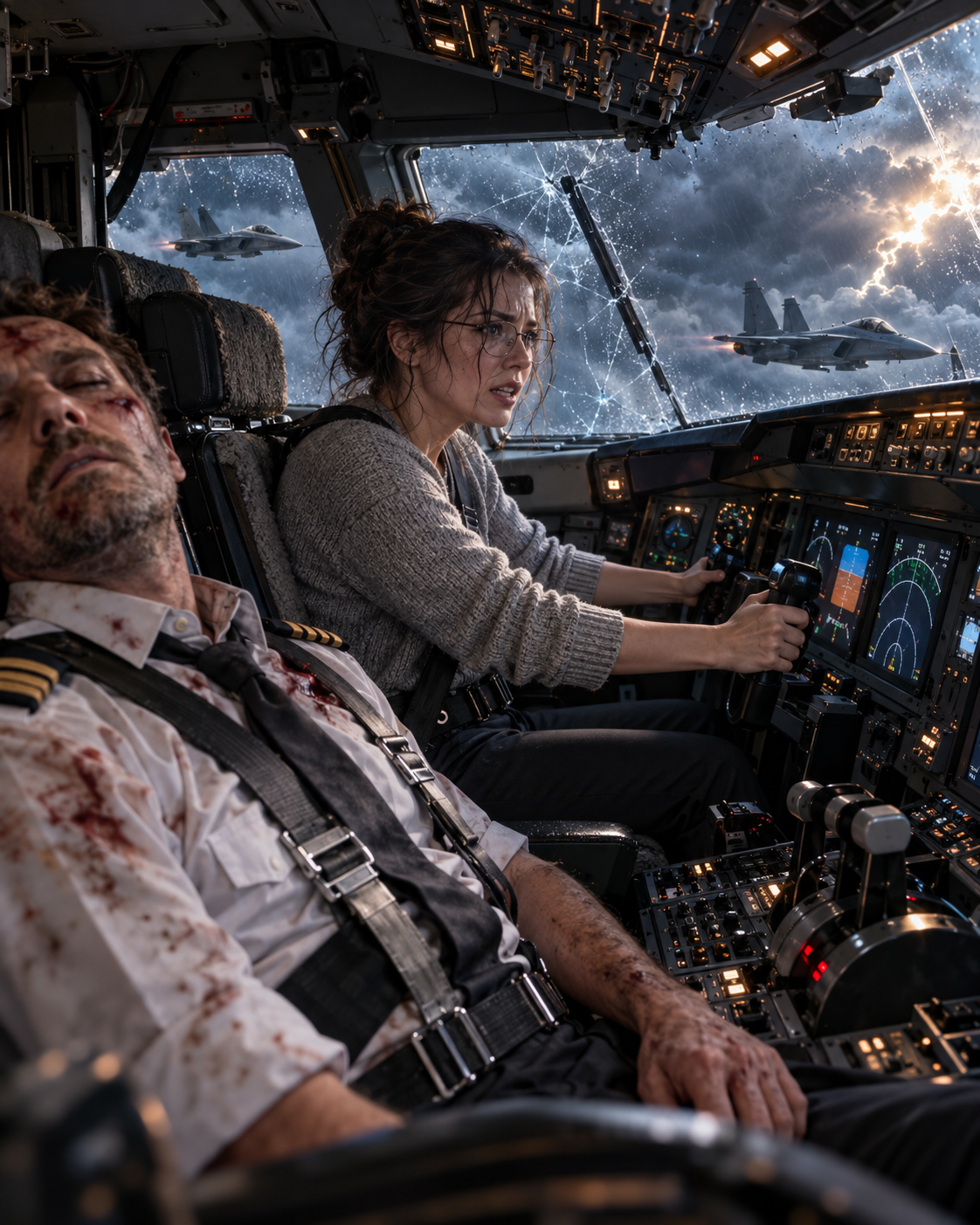
I didn’t feel brave.
I felt tired.
And afraid.
That night, after the passengers were safe and the authorities had secured the aircraft, Julian drove me to a quiet motel outside the airport.
Neither of us spoke much.
The envelope remained unopened.
Finally, I sat on the edge of the bed and tore it open.
Inside was a photograph.
My F-35 sat inside a maintenance hangar.
The picture had been taken from above.
Someone had circled the hydraulic system in red ink.
Beneath it was one sentence.
THE FAILURE WAS MANUFACTURED.
My breathing stopped.
I read it again.
Then again.
Julian stood near the window.
“You remember the Mediterranean incident?”
“Every second.”
“What you don’t know is that two days before your flight, somebody accessed the maintenance records.”
My stomach tightened.
“Who?”
“That’s the problem.”
He handed me another photograph.
It showed a maintenance panel removed from my aircraft.
Inside was a tiny device.
A signal transmitter.
Not military issue.
Not approved.
Not supposed to be there.
I remembered that day in the Mediterranean.
The vibration.
The sudden loss of pressure.
The way the aircraft had seemed to respond half a second slower than it should.
I’d blamed myself for trusting the instruments.
The military had blamed me for not trusting them enough.
For three months, I’d replayed the incident in my head.
Now I understood why nothing had ever made sense.
Someone had wanted me to doubt myself.
“Why would anyone do this?”
Julian’s voice became quieter.
“Because you noticed something.”
I looked at him.
“What?”
He pulled out his phone.
A recording played.
My own voice came through the speaker.
“I don’t recognize that maintenance signature.”
The recording was from the night before my Mediterranean flight.
I remembered it.
I’d reported an unusual entry in the maintenance system.
The supervisor told me it was a clerical error.
I had let it go.
Julian stopped the recording.
“You didn’t let it go.”
I frowned.
“What?”
“You filed a second report.”
I shook my head.
“No, I didn’t.”
“Exactly.”
The room seemed to shrink.
Someone had filed a report in my name.
Someone had used my credentials.
Someone wanted it to look like I had discovered nothing.
I stood and walked toward the window.
Below, headlights moved through the darkness.
“Who had access?”
“Maintenance, command, cybersecurity, flight operations.”
“That’s half the base.”
“Not half.”
He looked at me.
“Three people.”
I turned.
“Who?”
He hesitated.
Then the motel phone rang.
Neither of us moved.
It rang again.
Julian reached for it.
I stopped him.
The ringing ended.
A few seconds later, my phone vibrated.
Unknown number.
One message.
YOU SHOULD HAVE STAYED A PASSENGER.
My blood went cold.
Julian read it over my shoulder.
“How did they know where we were?”
I didn’t answer.
Because the worse question had already entered my mind.
How did they know I had survived?
The next morning, federal investigators arrived.
They wanted statements from everyone.
They wanted to know why I had entered the cockpit.
They wanted to know how a passenger knew enough to manually recover a crippled 777.
I told them the truth.
I had flown fighters.
I had training.
I had acted because nobody else could.
They looked impressed.
But one investigator didn’t.
His name was Daniel Mercer.
He had worked military aviation investigations for twenty-two years.
He listened without taking notes.
Then he asked, “Major Cross, why did you recognize the failure before the crew?”
“Because the aircraft was behaving differently.”
“That’s not an answer.”
“It was the only one I had.”
He leaned forward.
“Or perhaps you knew what was going to happen.”
The room went silent.
I stared at him.
“You think I sabotaged the plane?”
“I think someone knew you would be on it.”
That sentence changed everything.
I remembered buying the ticket.
The sudden reassignment.
The last-minute seat change.
The fact that I had originally been scheduled for another flight.
“Who changed my reservation?”
Mercer looked at me.
“That’s what we’re trying to find out.”
I didn’t tell him about the envelope.
Not yet.
That afternoon, I went back to the wreck.
Flight 409 looked less like an aircraft now and more like a wounded animal.
Engine two was being examined.
The right wing had been torn apart.
The cockpit windows were shattered.
I stood several feet away, staring at the mud where we had finally stopped.
A firefighter approached.
“Major?”
“Yes?”
“We found something.”
He led me toward the damaged wing.
A technician held a small metal fragment inside a clear evidence bag.
At first, it looked like ordinary debris.
Then I saw the markings.
I knew them.
They belonged to the same manufacturer whose components had been installed in my F-35.
My pulse quickened.
“Where did you find it?”
“Inside the engine.”
I looked at Julian.
His expression had gone pale.
“That isn’t supposed to be there.”
“What is it?”
He didn’t answer.
The technician did.
“Some kind of actuator fragment.”
I stared at the broken metal.
Then I noticed something scratched into its surface.
A tiny number.
I recognized it instantly.
It was the maintenance code from my Mediterranean aircraft.
The same code that had appeared in the falsified report.
My entire body went numb.
This wasn’t coincidence.
Someone had transferred a component from my fighter into the airliner.
Someone had connected two failures that should never have been connected.
And someone had wanted me sitting in that seat.
Mercer arrived moments later.
He saw the fragment.
Then he looked at me.
“Don’t touch it.”
“I wasn’t going to.”
He took the evidence bag.
But before he walked away, I noticed something tucked beneath his sleeve.
A small black mark.
The same symbol I’d seen on the transmitter photograph.
My heart sank.
Mercer wasn’t surprised by the fragment.
He had been expecting it.
That night, I called Julian.
“We can’t trust Mercer.”
There was silence.
Then he said, “I know.”
My stomach dropped.
“You knew?”
“I’ve suspected him for months.”
“Why didn’t you tell me?”
“Because every person I told disappeared from the investigation.”
I sat down.
“How many?”
“Four.”
For several seconds, neither of us spoke.
Then Julian said something that made my blood run cold.
“Valerie, there is one person we haven’t considered.”
“Who?”
“The man who signed your suspension.”
I knew the name.
General Thomas Weller.
The man who had looked me in the eyes after the Mediterranean incident and said, “A pilot who can’t trust her aircraft has no business flying it.”
I had believed those words for ninety days.
They had followed me into every sleepless night.
Now I wondered whether he had said them because he knew exactly what had happened.
I drove to his house before dawn.
He opened the door himself.
For a long moment, we simply stared at each other.
Then he said, “You survived.”
It wasn’t relief.
It was disappointment.
My heart sank.
“You knew.”
He looked away.
“I knew someone was trying to make you look unstable.”
“Who?”
He closed his eyes.
“People inside the program.”
“What people?”
He didn’t answer.
“General.”
His voice broke.
“I couldn’t stop them.”
“Then tell me what you did.”
He walked to a cabinet and removed a locked metal box.
Inside was a stack of reports.
Every report had my name.
Every one had been altered.
But one document was different.
It contained the original findings from the Mediterranean incident.
The hydraulic failure had not been mechanical.
It had been remotely triggered.
I stared at the page.
“Why didn’t you tell me?”
“Because the person who ordered it had access to classified flight systems.”
“And you were afraid.”
“Yes.”
The honesty hurt more than a lie.
I closed the folder.
“People could have died.”
“I know.”
“People did die.”
He looked at me.
“What?”
I had forgotten something.
The maintenance crew member who had inspected my aircraft before the Mediterranean flight.
His name was Aaron Bell.
He had died in a car accident two weeks after my suspension.
Officially, it had been an accident.
Now I wasn’t so sure.
I asked Weller for his records.
He refused.
“Valerie, walk away.”
“I already tried.”
“Then try harder.”
I left furious.
But halfway to my car, my phone rang.
Weller.
I answered.
His voice was barely a whisper.
“Don’t come back here.”
“Why?”
“They’re watching.”
The line went dead.
A gunshot cracked through the darkness.
I turned.
Weller’s front window shattered.
I ran back toward the house.
He was on the floor.
Blood spread across his shirt.
I dropped beside him.
“Stay with me.”
His eyes opened.
He grabbed my wrist.
“The aircraft wasn’t the target.”
I leaned closer.
“What?”
His lips trembled.
“You were.”
Then he died.
The police arrived minutes later.
Mercer arrived first.
Too quickly.
Far too quickly.
He looked at Weller’s body.
Then at me.
“Major Cross, step away.”
I didn’t move.
His eyes hardened.
“Now.”
Something inside me snapped.
I ran.
Julian was waiting in the car.
We drove without headlights until we reached an abandoned hangar outside the city.
There, he finally told me the whole story.
A private defense contractor had been secretly testing a remote flight-control system.
The system could interfere with military aircraft.
Someone had discovered it.
Aaron Bell had discovered it.
Then Weller had discovered it.
Then I had discovered it.
Everyone who got close to the truth had been discredited, transferred, threatened, or killed.
Flight 409 was supposed to be the final piece.
The plan was simple.
Trigger the engine failure.
Make it look like another unpredictable mechanical event.
Let the aircraft crash.
Then blame me.
A disgraced fighter pilot on administrative leave.
A perfect scapegoat.
Except they had underestimated one thing.
I had survived.
And worse for them, I had survived with witnesses.
Three hundred of them.
The next forty-eight hours became a blur.
Investigators recovered the transmitter.
Engineers found evidence of deliberate interference.
Passenger phones contained recordings of the cockpit.
The flight data recorder contradicted the official explanation.
The conspiracy began unraveling.
But Mercer disappeared.
So did two senior contractors.
Then, three days later, the military announced that I was being reinstated.
The ceremony was held quietly.
No cameras.
No speeches.
Just a hangar and a uniform waiting for me.
Julian stood beside me.
“You going back?”
I looked at the flight suit.
For months, I had dreamed of proving everyone wrong.
Now I realized I didn’t need to.
I had already proved something more important.
I could lose everything and still choose to save people.
I put the uniform on.
Then Julian handed me one final envelope.
“What now?”
“Someone mailed this to the base.”
My hands tightened.
“From who?”
He shook his head.
“No return address.”
Inside was a photograph of me sitting in seat 14B.
Taken before the storm.
Taken from inside the cabin.
On the back, four words were written.
WE NEVER PLANNED FOR JULIAN.
I looked up.
Julian was already reaching for his phone.
His face had changed.
“What?”
He showed me a message.
UNKNOWN NUMBER.
FLIGHT 409 WAS ONLY THE TEST.
For a long time, neither of us spoke.
Then I looked through the hangar doors toward the runway.
The first light of morning was spilling across the concrete.
I thought about the passengers.
The elderly man whose oxygen mask I had pulled into place.
Nathan, who had survived.
Captain Sterling, who had spent weeks recovering.
Three hundred strangers who would never know how close the ocean had come to swallowing them.
I finally understood something.
Courage wasn’t the absence of fear.
It wasn’t being fearless enough to walk into danger.
It was deciding that someone else’s life mattered more than your own fear.
That was what had saved Flight 409.
Not the aircraft.
Not the technology.
Not even my training.
A choice.
One terrible, impossible choice made in the middle of a storm.
I folded the photograph and placed it in my pocket.
Then I walked toward the waiting jet.
Julian followed.
“Valerie?”
I looked back.
“Where are we going?”
I smiled faintly.
“To find out who thought I would never come home.”
The engine started.
The hangar doors opened.
And somewhere, far beyond the runway, someone who had spent months believing I was broken was about to learn the truth.
I was never broken.
I was simply waiting for the right reason to fly again.
And this time, I wasn’t flying away from the past.
I was flying straight toward it.