The first time I saw a grown man capable of protecting my daughter better than my private security team
THE MAN WHO TAUGHT A BILLIONAIRE WHAT REAL PROTECTION MEANT
Ronan stared at the fireplace for several seconds before speaking again.
“Twenty years ago, I was part of a special operations unit. We handled situations that never made the news. Hostage rescues, high-risk extractions, and operations in places most people couldn’t find on a map.”
I looked at him, struggling to connect those words with the man who had spent the afternoon teaching my daughter how to whittle a wooden spoon.
“You were in the military?”
“Something like that.”
“Something like that?” I repeated. “You just took down four armed men. I think I deserve a little more than something like that.”
For the first time since I had known him, Ronan almost smiled.
“I was good at my job. Too good, perhaps. People started believing I could solve every problem by walking into a room with a weapon.”
He paused and rubbed his hands together.
“Then, during a mission overseas, everything went wrong. Our intelligence was bad. We were sent into a building that was supposed to be empty. It wasn’t.”
His voice grew quieter.
“My closest friend, Daniel, was killed. Three other men were seriously wounded. I survived, but I couldn’t stop thinking about the decisions that had put them there.”
I said nothing.
“After that, I left. I came home, married the woman I loved, and tried to build something ordinary. I wanted a house, a workshop, a son who would never have to learn how to recognize the sound of incoming fire.”
His eyes moved toward Leo.
“For a while, I had all of that.”
“What happened to your wife?” I asked carefully.
“She died three years ago. Cancer.”
He swallowed.
“Leo was six. I promised him that even if the world took his mother away, he would never have to wonder whether he was loved.”
Something tightened in my chest.
I knew what it meant to lose someone. My husband had died in a helicopter accident when Clara was four. But unlike Ronan, I had buried my grief beneath meetings, investments, and an increasingly complicated security operation.
I had convinced myself that providing everything was the same as being present.
Ronan looked at me.
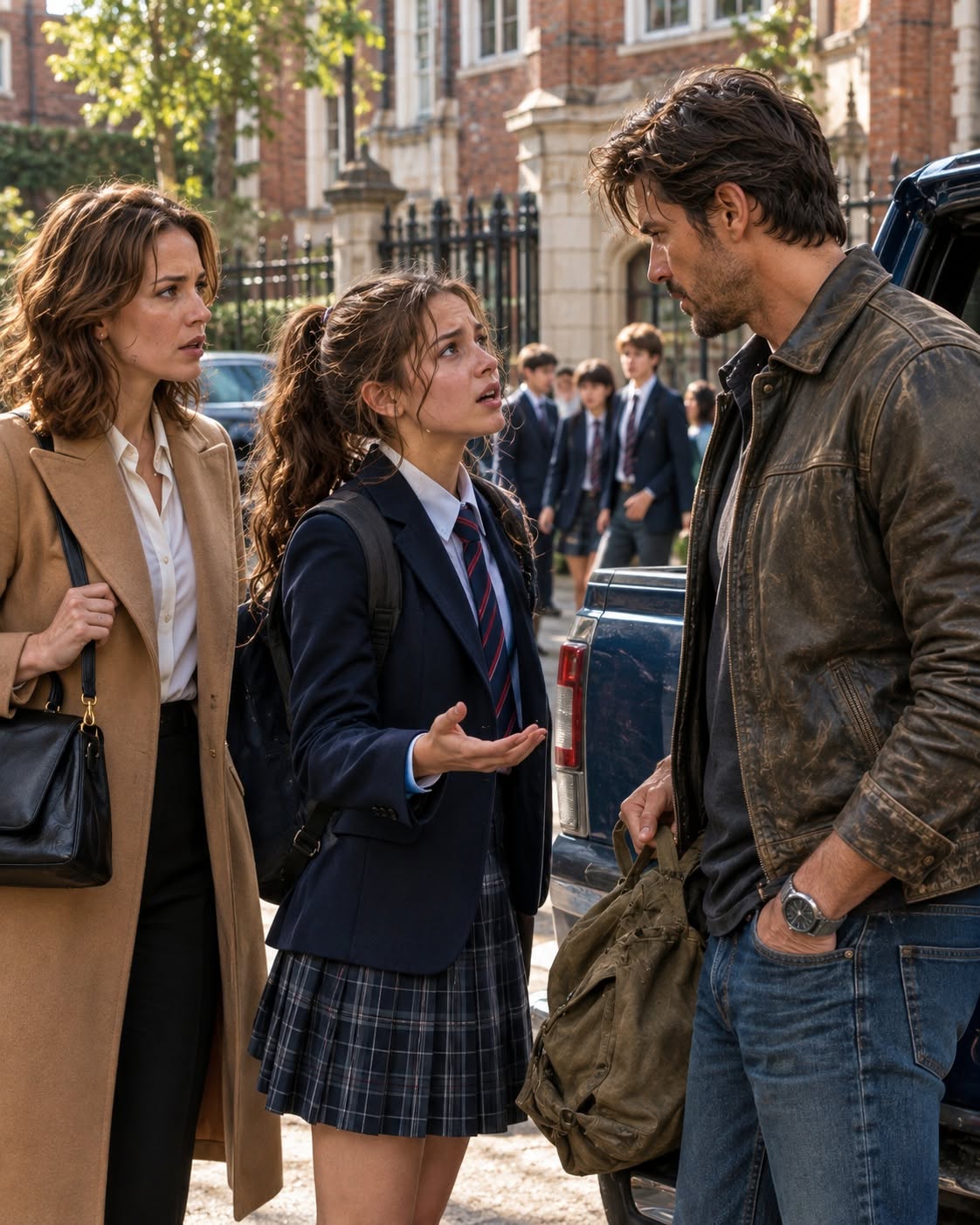
“That’s why I became a carpenter. Wood doesn’t care about your reputation. It doesn’t care how much money you have. If you make a mistake, you have to fix it with your own hands.”
Before I could respond, my phone vibrated on the table.
It was my head of security, Marcus.
I answered immediately.
“Where are you? I’ve been trying to reach you for hours!”
“Something happened. We were attacked on the trail.”
There was a brief silence.
“Are you injured?”
“No. Ronan handled it. Four men.”
Another silence.
Then Marcus asked something that made my stomach tighten.
“Did they take anything?”
I glanced at my jewelry box on the table.
“No. Why?”
“Listen carefully. Do not leave that cabin until I arrive. We have a serious problem.”
“What problem?”
“I’ll explain in person.”
The call ended.
I looked at Ronan.
He had already noticed my expression.
“Something wrong?”
“I don’t know. My security chief sounded frightened.”
Ronan slowly stood up.
“Show me your phone.”
I handed it over.
He examined the screen, then looked at the signal indicator.
“Did you tell anyone where you were going?”
“Only my assistant, my security team, and the driver who brought us here.”
“Did you give anyone the exact route?”
“I don’t remember.”
Ronan handed the phone back.
“Then someone knew where to find you.”
A cold feeling settled in my stomach.
I had spent fifteen years building a company worth billions. My business interests stretched across technology, real estate, and international logistics. I had enemies, certainly, but I had always believed my security arrangements were sophisticated enough to keep them at a distance.
Now I wasn’t so sure.
“Ronan,” I whispered. “Do you think those men were waiting for us?”
“I think we should assume they were.”
He walked to the window and pulled the curtain aside just enough to inspect the driveway.
The children were still sleeping.
I moved closer.
“What are you looking for?”
“Anything that doesn’t belong.”
He remained silent for a moment.
Then he noticed something.
A dark SUV was parked near the bend in the road.
It hadn’t been there earlier.
Ronan’s expression changed.
“Get the children dressed. Quietly.”
“Why?”
“Because we’re not staying here.”
He didn’t raise his voice. Somehow, that made the instruction more frightening.
I woke Clara gently and explained that we needed to leave.
She rubbed her eyes.
“Is something bad happening, Mommy?”
I wanted to tell her no.
I wanted to tell her everything was fine, that the scary part was over, and that the grown-ups had everything under control.
Instead, I knelt beside her.
“We’re going on a little adventure, sweetheart. Stay close to me.”
Leo woke up when Ronan lifted him.
Within minutes, we were outside.
The rain had stopped, leaving the forest covered in silver droplets.
Ronan led us toward a narrow path behind the cabin rather than the main driveway.
He carried Leo while Clara held my hand.
I followed him without asking questions.
For the first time in my life, I understood what it felt like to trust someone without needing to see their résumé, bank balance, or professional credentials.
After nearly twenty minutes, we reached an old maintenance shed beside a disused forestry road.
Ronan checked the surroundings before allowing us inside.
Then he took out an old satellite communication device from a metal cabinet.
I stared at it.
“You keep military equipment in a storage shed?”
“Some habits are difficult to break.”
He contacted an old colleague, a woman named Evelyn Shaw.
When she answered, his voice changed.
“Evelyn, it’s Ronan.”
There was a pause.
Then a woman’s surprised voice came through.
“Well, I’ll be damned. I thought you were living peacefully with your woodworking projects.”
“I need a favor.”
“That sounds expensive.”
“I need you to find out who has been tracking a woman named Victoria Hale.”
My heart skipped.
He gave her my name, then described the attack.
Evelyn became serious.
“Ronan, do you understand what you’re asking? If this is connected to the people I think it is, you should stay out of it.”
“I’ve tried staying out of things for five years.”
“That’s exactly why you need to keep doing it.”
Ronan looked at Clara and Leo.
“Four armed men came after two children today. I’m already involved.”
He ended the call.
I stared at him.
“Who was that?”
“Someone who knows how to find information.”
“Information about what?”
He hesitated.
“Your company.”
I frowned.
“What does my company have to do with this?”
“That’s what we’re going to find out.”
Twenty minutes later, Evelyn called back.
Her first words made the room feel smaller.
“Victoria, your company has a problem. And I don’t think the people responsible are trying to steal your jewelry.”
I stepped closer to the device.
“What are you talking about?”
“Three weeks ago, someone accessed confidential files connected to a subsidiary of Hale Global. Those files contained information about a major acquisition involving a defense technology contractor.”
I felt my pulse quicken.
“That acquisition hasn’t been announced.”
“Exactly. Someone leaked the details. And apparently, the deal involves a private security company with a rather unpleasant history.”
Ronan’s expression hardened.
“What’s the name?”
“Blackridge Solutions.”
He went completely still.
I noticed immediately.
“Do you know them?”
He didn’t answer.
Evelyn continued.
“Ronan, the company is connected to a former intelligence contractor named Victor Sloane.”
At that name, Ronan closed his eyes.
I looked between them.
“Who is Victor Sloane?”
Ronan finally spoke.
“A man I thought was behind me.”
Then he told me something that changed the entire situation.
Years earlier, when he was still serving, Victor Sloane had been responsible for providing intelligence to Ronan’s unit. He was the person who had approved the operation in which Daniel died.
But there had been something else.
The mission hadn’t failed because of bad intelligence.
Someone had deliberately provided their location to the enemy.
Ronan had spent years trying to discover who.
He eventually walked away because the investigation was buried, witnesses disappeared, and the people responsible were protected by powerful connections.
Now Blackridge was trying to acquire a company owned by Hale Global.
My company.
I felt sick.
“Are you saying someone used my business to get to you?”
“Possibly,” Ronan replied. “But we don’t know enough yet.”
Evelyn interrupted.
“There’s another problem. Victoria, your head of security has been communicating with Blackridge representatives.”
I stared at the device.
“Marcus?”
“Yes.”
I shook my head.
“No. Marcus has worked for my family for twelve years. He protected my husband. He has been with Clara since she was born.”
Ronan didn’t argue.
He simply asked, “Did you personally verify the identities of the four men on your security team?”
I couldn’t answer.
Evelyn continued.
“One more thing. I found a transfer authorization signed by your executive office. It releases the acquisition documents to an outside consultant. The authorization was processed using your digital credentials.”
“I never signed anything!”
“I believe you.”
My hands began trembling.
Someone had been using my identity.
And someone had known exactly where to find my daughter.
For the first time, the situation felt much bigger than an attempted robbery.
I looked at Clara.
She was sitting beside Leo, holding his hand.
I knew one thing with absolute certainty.
Whatever happened next, nobody was getting near her again.
We spent the next hour arranging a way out of the mountains.
Evelyn contacted a trusted local law enforcement officer who had no connection to my security company. Ronan insisted that we avoid the main road until the area had been checked.
When we finally reached a small town, I called my assistant from a borrowed phone.
Her name was Sophie.
She answered immediately.
“Victoria! Thank God. We’ve been worried sick.”
“Where is Marcus?”
“At headquarters. He said he was coordinating a response.”
“Don’t tell him anything about where I am.”
There was a pause.
“Victoria, what’s happening?”
“Listen to me. I need you to preserve every email, message, and access record related to the Blackridge acquisition. Don’t open anything sent by Marcus. Don’t discuss this with anyone.”
“Okay.”
“And Sophie?”
“Yes?”
“If someone asks where Clara is, you don’t know.”
Her voice broke slightly.
“Is she safe?”
I looked at my daughter.
“For now.”
We checked into a small family-owned motel under a different name.
It was the kind of place I would normally have passed without noticing. The rooms were simple, the furniture outdated, and the coffee tasted terrible.
Yet I had never felt more grateful for a locked door.
That evening, Clara sat on the edge of the bed while I brushed her hair.
“Mom?”
“Yes, sweetheart?”
“Is Ronan a soldier?”
I stopped brushing.
“Why do you ask?”
“Because he wasn’t scared when those men came. Daddy used to say brave people are the ones who do the right thing even when they’re scared.”
I felt my eyes fill.
“Your daddy was right.”
She looked down.
“Can Leo stay with us when we go home?”
I smiled sadly.
“We’ll see.”
She hesitated.
“Mom, I like having someone around who doesn’t always talk about work.”
The words hurt more than she could possibly understand.
After she fell asleep, I sat alone beside the window.
Ronan was outside, sitting on the motel steps.
He was repairing a loose strap on Leo’s backpack.
I walked over.
“Do you ever regret leaving your old life?”
He looked up.
“Every now and then.”
“Why?”
“Because sometimes I wonder whether I could have saved Daniel if I had stayed.”
I sat beside him.
“Do you think you could have?”
He considered the question.
“No. But guilt doesn’t care about facts.”
We watched the parking lot in silence.
Then I said something I had never admitted aloud.
“I spent years believing that if I became rich enough, nobody could hurt my family again.”
Ronan tightened the strap.
“Did it work?”
I shook my head.
“No.”
He looked at me.
“Then perhaps it’s time to build something different.”
The following morning, Evelyn arrived.
She was in her early fifties, with short gray hair and the unmistakable confidence of someone who had spent years asking questions people didn’t want to answer.
She brought a laptop and a thick folder.
“We have a problem,” she said as she entered.
“That’s becoming a theme,” I replied.
She gave me a brief smile.
“Marcus has been communicating with Victor Sloane for at least six months. He was paid through three shell companies.”
I opened the folder.
Inside were bank records, emails, and copies of documents bearing my signature.
“Why?”
Evelyn placed another photograph on the table.
It showed Marcus standing beside a man in a dark suit.
Victor Sloane.
“Blackridge wants control of your company’s logistics network. Your acquisition would give them access to several facilities and communications contracts.”
I stared at the photograph.
“But why target me personally?”
“Because you refused to sell.”
I remembered the meeting.
Three months earlier, representatives from Blackridge had approached my board with an offer to purchase a subsidiary.
I had rejected it.
They had returned with a higher offer.
I rejected that too.
At the time, I thought they were simply aggressive negotiators.
Now I understood.
“They wanted me out of the way.”
“Not necessarily permanently,” Evelyn said. “They wanted you frightened enough to sign the documents and disappear from the negotiations.”
Ronan studied the photograph.
“Victor doesn’t like losing control.”
Evelyn nodded.
“There’s something else. He knows you’re here.”
My stomach dropped.
“How?”
She turned the laptop toward us.
A photograph appeared on the screen.
It showed the motel parking lot.
Taken less than ten minutes earlier.
Someone had photographed us through the window.
Ronan immediately stood.
“Get the children.”
We didn’t have time to argue.
Evelyn called the local officer while Ronan guided us through the back exit.
But this time, something was different.
He wasn’t simply reacting.
He had a plan.
He moved us into a neighboring building connected to the motel through a service corridor.
A few minutes later, two men entered our room.
I watched from a narrow window as they searched through the luggage.
One of them was wearing the same security uniform I had seen at my estate hundreds of times.
My blood ran cold.
Marcus had sent people.
The local officer arrived shortly afterward, accompanied by two deputies.
The men were detained before they could leave.
One carried a photograph of Clara.
Another had a document containing the address of her academy.
I nearly collapsed.
Ronan caught my arm.
“Look at me,” he said.
I forced myself to meet his eyes.
“She’s safe.”
For once, I believed him.
The two men were questioned separately.
One eventually admitted that Marcus had hired them to retrieve my signature on the acquisition documents.
He insisted the mountain attack had been arranged to frighten me.
But when investigators asked who had ordered the men to approach Clara, he refused to answer.
That night, I made a decision.
I wasn’t going to run anymore.
I called my board of directors and demanded an emergency meeting.
I wanted every transaction frozen, every compromised employee suspended, and every external security contract reviewed.
Some board members objected.
One even suggested I was overreacting because of the mountain incident.
I listened quietly.
Then I said:
“Four men with guns approached my daughter. Someone inside this company knew exactly where she would be. If you believe that is an acceptable business risk, you are welcome to explain it to the authorities.”
Nobody spoke again.
Within hours, independent investigators were appointed.
The following morning, I received a call from Victor Sloane.
His voice was smooth and almost friendly.
“Victoria. I’m sorry about the unfortunate incident in the mountains.”
I stared at the phone.
“How did you get this number?”
“I have ways of staying informed.”
“Then you know I’ve turned everything over to investigators.”
He laughed softly.
“You’re making a mistake. Business disagreements are best handled privately.”
“Four armed men disagreeing with me on a hiking trail doesn’t sound like business.”
His voice became colder.
“Your company is too valuable to be destroyed by emotion.”
I leaned back.
“No, Mr. Sloane. My company is too valuable to be controlled by people who threaten children.”
He paused.
“Be careful. People who involve themselves in matters they don’t understand often lose more than money.”
I looked toward Ronan.
He was standing near the doorway, listening.
I replied:
“Then I suppose you’ll have to find out how much I’m willing to lose.”
I ended the call.
Ronan didn’t smile.
“He’s going to escalate.”
“I know.”
“Then we need to be ready.”
The next forty-eight hours were exhausting.
Investigators uncovered payments, forged signatures, and a network of shell companies used to move money through Blackridge.
Marcus was arrested after attempting to leave the country.
But Victor remained free.
He had powerful friends, expensive lawyers, and enough distance between himself and the operation to make prosecution difficult.
Then came the message that changed everything.
It arrived on an encrypted device Evelyn had given Ronan.
A single sentence.
“Ask him what happened to Daniel.”
Ronan stared at the screen.
His face lost its color.
I moved closer.
“What does that mean?”
He didn’t answer immediately.
Then he told me something he had never told anyone outside his old unit.
Before the fatal mission, Daniel had discovered evidence that Victor was selling classified information to private military contractors.
He had planned to expose him.
The night before the operation, Daniel had sent Ronan a message.
It read: “If anything happens to me, don’t believe the official report.”
Ronan had carried those words for years.
But there was something else.
Daniel had a younger sister, Hannah.
She had been the last person to speak with him before his death.
After the mission, she had disappeared.
Ronan had searched for her unsuccessfully.
Now, Evelyn had found something.
Hannah was alive.
And she had been working as an accountant for a company connected to Blackridge.
“Why would she work for them?” I asked.
“Because she may have been trying to find the evidence her brother died protecting.”
Evelyn checked the message again.
“She’s asking to meet.”
Ronan looked toward the children.
“I need to go alone.”
I shook my head.
“No.”
“Victoria—”
“You spent years carrying this alone. I’m not asking you to risk your life. I’m telling you that we’re going to let the authorities handle this, with the evidence properly documented.”
He looked at me for a long moment.
Then he nodded.
For the first time, he seemed willing to accept help.
The meeting was arranged at an old railway station outside town.
Investigators were present, though kept at a distance to avoid alarming Hannah.
She arrived wearing a dark coat, carrying a small leather bag.
When she saw Ronan, she stopped walking.
“You’re alive,” she whispered.
He nodded.
“So are you.”
Her eyes filled with tears.
“I tried to contact you years ago. Victor found out. He threatened my family.”
Ronan’s jaw tightened.
“Why didn’t you go to the authorities?”
“I did. Someone leaked my statement. After that, I knew I couldn’t trust anyone.”
She opened her bag and removed a small memory card.
“Daniel copied everything before he died. He hid it with me. I spent years trying to find someone who could expose Victor without getting killed.”
Ronan took the card carefully.
“Why now?”
Hannah looked at him.
“Because I saw the news about the attack. I recognized the name Victoria Hale. I realized Victor was repeating the same pattern.”
She turned to me.
“I’m sorry your daughter was caught in this.”
I nodded.
“Just help us make sure nobody else goes through it.”
Hannah gave the investigators the evidence.
It contained financial records, communications, and recordings linking Victor to the deliberate betrayal of Ronan’s unit.
But the most important file was an audio recording.
Daniel’s voice filled the small room.
“If you’re listening to this, something has gone wrong. Victor has been selling our positions. I have proof. Ronan, if this reaches you, remember something. None of this was your fault.”
Ronan lowered his head.
His shoulders trembled.
For the first time since I had known him, he cried.
Not loudly.
Not dramatically.
He simply stood there, holding the memory card as though it were the last piece of a life he had never been able to put down.
I didn’t touch him.
I just stood beside him.
Sometimes, the kindest thing you can do for someone is allow them to grieve without asking them to be strong.
Three weeks later, Victor Sloane was arrested.
The evidence had finally connected him to the old operation, the financial conspiracy, and the attempted coercion of my company.
Marcus agreed to testify in exchange for a reduced sentence.
Several executives resigned.
Blackridge’s acquisition was blocked, and the company became the subject of a wider investigation.
For the first time in years, I felt that justice might actually mean something.
But the biggest change happened somewhere much quieter.
On a cold Sunday morning, I drove to Ronan’s workshop.
He was sanding a small wooden chair.
Leo was painting another one nearby.
Clara sat on the floor, carefully arranging pieces of colored wood.
I stood in the doorway.
“Am I interrupting?”
Ronan looked up.
“Depends. Are you here to buy furniture?”
I laughed.
“Actually, I came to make an offer.”
He raised an eyebrow.
“That sounds dangerous.”
I placed a folder on his workbench.
It contained the documents for a new foundation.
The Hale-Ronan Children’s Initiative.
Its purpose was to provide support for children who had lost parents in military service, law enforcement, or other dangerous professions.
It would also fund counseling programs for families dealing with trauma and loss.
Ronan read the first page.
Then he looked at me.
“Why?”
“Because there are too many children growing up believing they have to be brave when they’re actually hurting.”
He glanced at Leo.
I continued.
“I want you to help lead it. Not because of what you did on the mountain. Because of what you did afterward. You understand what children need when adults are too busy fighting their own battles.”
He closed the folder.
“I don’t want to become some corporate spokesperson.”
“I wouldn’t ask you to.”
“And I don’t want my son growing up surrounded by people who think money solves everything.”
I smiled.
“Then help me build something that proves otherwise.”
He looked at the document again.
Finally, he nodded.
“All right. But I have one condition.”
“Anything.”
“We do this properly. No fancy offices. No ridiculous salaries. Every dollar has to make a difference.”
I laughed.
“Agreed.”
Six months passed.
My company recovered.
The investigations continued, but the most dangerous people had been removed from positions of influence.
I also made changes to my personal security arrangements.
Not simply adding more guards.
I changed the entire philosophy.
My daughter’s school was no longer treated like a military compound. Her daily schedule became more flexible. I stopped expecting security personnel to replace the people who should have been present in her life.
And I started coming home earlier.
Sometimes, Clara and I baked cookies.
Sometimes, we walked in the park without checking our phones every thirty seconds.
Sometimes, we did absolutely nothing.
Those ordinary moments became the most valuable part of my day.
One Saturday, Clara asked if we could visit Ronan and Leo.
When we arrived, the two children were building a treehouse.
Ronan was supervising from below.
“Mom!” Clara shouted. “Look! We’re making a secret clubhouse!”
I smiled.
“That sounds wonderful.”
Leo ran over.
“We’re going to have a rule. No grown-ups allowed unless they bring snacks.”
“That’s a very reasonable rule,” I said.
Ronan chuckled.
I watched him help the children secure a wooden plank.
His hands were scarred.
There was a small mark above his eyebrow that I hadn’t noticed before.
He moved carefully, patiently, never rushing them.
I realized something.
For years, I had thought strength meant being the person who could control the most things.
Ronan had taught me that real strength often meant knowing what not to control.
It meant staying when leaving would be easier.
It meant listening when you wanted to give orders.
It meant protecting someone without making them feel powerless.
That evening, after the children had gone inside, Ronan and I sat on the porch.
The sky was turning orange.
He handed me a cup of coffee.
“Clara seems happier,” he said.
“She is.”
“Good.”
I looked at him.
“Do you think you ever really leave your past behind?”
He considered the question.
“No. I think you learn to carry it differently.”
He took a sip.
“For a long time, I thought becoming a father meant keeping Leo away from everything painful. But he doesn’t need a father who pretends the world is perfect. He needs someone who shows him how to face it without becoming cruel.”
I nodded.
“That’s something I wish I’d understood earlier.”
He looked at me.
“You can still learn.”
A comfortable silence settled between us.
Then I asked a question I had been avoiding for months.
“Ronan, would you and Leo like to spend more time with us? Not because of the foundation. Not because of what happened in the mountains.”
He looked surprised.
“What do you mean?”
“I mean Clara has started calling Leo her best friend. And I think I have become rather fond of the man who keeps fixing things around her.”
He laughed quietly.
“You’re a difficult woman to say no to.”
“Is that a yes?”
He looked toward the house, where the children were laughing.
Then he looked back at me.
“Yes. I think I’d like that.”
I didn’t rush him.
Neither of us needed to make promises that evening.
We simply sat together, watching the last sunlight disappear behind the trees.
A year after the mountain attack, the foundation held its first major gathering.
There were families from across the country.
Children who had lost parents.
Parents who had lost spouses.
People who had spent years trying to look strong because they thought falling apart would make them a burden to everyone else.
Ronan stood on the small stage.
He wasn’t wearing a suit.
He wore a clean blue shirt and the same old watch he had worn when I first met him.
He looked uncomfortable beneath the bright lights.
But when he spoke, the room became silent.
“My son once asked me whether heroes are people who aren’t afraid,” he began.
“I told him no. Heroes are ordinary people who decide that someone else’s safety matters enough to make them act, even when they’re frightened.”
He paused.
“Then I realized something. Children don’t need heroes every day. They need adults who show up. They need someone to remember their favorite food, help with their homework, and sit beside them when they have nightmares.”
His eyes moved toward Leo.
“Sometimes the bravest thing a person can do is build a peaceful life after spending years surrounded by violence.”
I watched from the front row.
Clara was holding my hand.
When Ronan finished, the applause lasted nearly a minute.
But the most important moment came afterward.
A little boy approached Ronan.
He couldn’t have been older than eight.
“Sir,” he asked shyly, “were you really a soldier?”
Ronan knelt.
“Yes, once.”
“Did you save lots of people?”
Ronan thought about it.
“I tried.”
The boy looked down at his shoes.
“My dad was a firefighter. He died last year. My mom says he was a hero, but I don’t think I understand what that means.”
Ronan placed a gentle hand on his shoulder.
“It means your dad loved people enough to do something difficult for them. But you don’t have to become a hero like him. You can just be a good person. That’s enough.”
The boy nodded.
Then he hugged him.
I looked away, wiping my eyes.
That night, after everyone had gone home, Clara fell asleep in the back seat of my car.
Leo had fallen asleep against Ronan’s shoulder.
We stood beside the vehicles for a moment, reluctant to end the evening.
“Thank you,” I said.
Ronan looked confused.
“For what?”
“For showing me that protection isn’t the same as control.”
He smiled faintly.
“You already knew how to protect your daughter. You just needed to remember that she also needed you.”
I looked through the window at Clara.
She was smiling in her sleep.
He was right.
I had spent years building walls around her.
But walls, no matter how expensive, could never replace a mother’s arms.
Before we said goodnight, Ronan reached into his jacket and handed me something.
It was a small wooden bird.
Its wings were slightly uneven, and its body had been carefully polished.
“Leo made this with Clara,” he explained. “They wanted you to have it.”
I held it in my palm.
“What’s it supposed to represent?”
“Freedom, apparently.”
I laughed softly.
Then Ronan added something I would remember for the rest of my life.
“Birds don’t stay safe because they never leave the nest, Victoria. They learn to fly because someone gives them a place to return to.”
I looked at the little wooden bird for a long time.
The following morning, I placed it on my office desk.
It sat beside the framed photograph of my late husband.
For years, that desk had been covered with contracts, financial reports, and awards.
Now there was a wooden bird made by two children.
And somehow, it was the most important thing in the room.
People still asked me about the mountain incident.
Journalists wanted to know how a carpenter had defeated four armed men.
Business magazines wanted to write about the billionaire whose security chief betrayed her.
Some even wanted to turn Ronan into a celebrity.
He refused every interview.
When one reporter asked why, he simply replied:
“I didn’t do anything special. I just made sure two children got home safely.”
But I knew better.
I had seen what he carried.
I had seen the guilt he had lived with for years.
I had seen how carefully he protected the people he loved without asking for recognition.
And I had learned that the most dangerous thing in the world isn’t always a man with a gun.
Sometimes, it’s the belief that money can buy certainty, that power can prevent pain, and that control can replace love.
I was once a billionaire who believed every problem had a price.
Now I understand that some of the most important things in life cannot be purchased.
Trust must be earned.
Courage must be practiced.
Grief must be allowed to heal.
And children must never have to compete with their parents’ ambitions for a place in their hearts.
A few months later, Clara came into my bedroom carrying the wooden bird.
“Mom, can we visit Ronan and Leo today?”
I smiled.
“Of course. Why?”
She climbed onto the bed and hugged me.
“Because they’re family.”
I looked at her.
Then I hugged her back.
“Yes, sweetheart. They are.”
And for the first time in a very long time, I understood that family wasn’t simply the people whose names appeared on your birth certificate.
Sometimes, family was the person who stood between your child and danger.
Sometimes, it was the person who helped you rebuild after everything you thought you could control fell apart.
And sometimes, it was the quiet carpenter in a faded flannel shirt who reminded a billionaire that the greatest fortune in the world wasn’t money.
It was having someone who would stay when the world became frightening.
That afternoon, we drove toward the mountains.
Not because we were running away from danger.
Not because we needed to prove anything.
We went because the children wanted to see the cabin again.
As we approached the old trail, Clara rolled down the window and breathed in the cool mountain air.
“Mom,” she said, “do you remember the first time we came here?”
I nodded.
“I remember.”
“Were you scared?”
I glanced at Ronan’s old pickup truck driving ahead of us.
“Yes. Very scared.”
She smiled.
“But everything turned out okay.”
I reached over and held her hand.
“Yes, sweetheart. But not because nothing bad happened.”
She looked at me curiously.
“Then why?”
I thought about the question.
“Because when something bad happened, we discovered that we didn’t have to face it alone.”
She rested her head against my shoulder.
And as the mountains rose around us, I finally understood the lesson Ronan had been trying to teach me from the beginning.
The greatest protection you can give the people you love isn’t a wall high enough to keep the world out. It’s the courage to stand beside them, the wisdom to ask for help, and the love that makes them feel safe enough to live.
Money can buy guards.
Power can buy influence.
And success can build an empire.
But none of those things can guarantee that someone will be there when the lights go out and fear walks through the door.
For that, you need something money cannot buy.
You need people.
And if you’re lucky enough to find them, you’d better hold on.