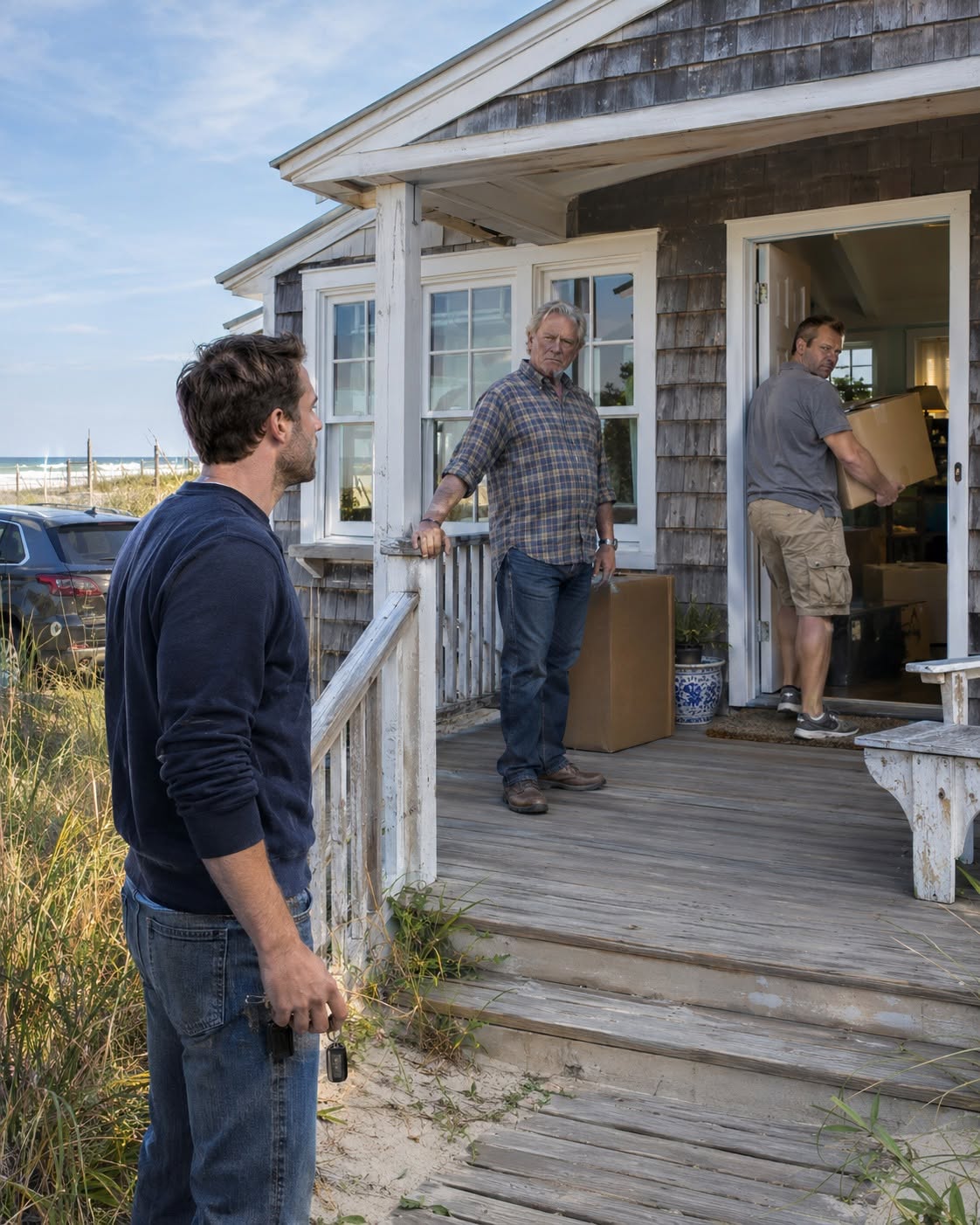
The first thing I noticed when I pulled into my beach house driveway was my brother’s truck.
THE HOUSE GRANDMA LEFT ME — AND THE FAMILY SECRET THAT ALMOST TOOK IT AWAY
I used to think the hardest part of what happened at the beach house was watching my own family carry my belongings outside as though I were a stranger in a place that belonged to me.
I was wrong.
The hardest part came later, when I realized that the people who had hurt me weren’t all sorry for the same reasons.
Some regretted what they had done.
Others regretted getting caught.
And one person, my mother, had spent years confusing keeping the peace with doing the right thing.
For several weeks after Mom reached out, I didn’t know what to do.
She sent me short messages through my aunt. Nothing dramatic. No long explanations. Just small things.
She hoped I was doing well.
She had seen a picture of the cottage after I repaired the porch.
She wondered whether Maya and I were still spending weekends there.
I read every message, but I rarely responded.
Eventually, I agreed to meet her for coffee.
We chose a small café halfway between her apartment and my office. I arrived ten minutes early and sat near the window, watching people hurry along the sidewalk.
When Mom walked in, I almost didn’t recognize her.
She had lost weight. Her hair, usually perfectly styled, was pulled into a loose ponytail. She wore an old cardigan I’d seen her wearing years ago when Grandma was still alive.
She looked tired.
Not the kind of tired that comes from a bad night’s sleep.
The kind that comes from finally having to live with decisions you’ve spent years avoiding.
She sat across from me.
“Thank you for coming,” she said.
I nodded.
For a moment, neither of us spoke.
Then she reached into her handbag and placed a small envelope on the table.
“I found something in your father’s desk after I moved out.”
I looked at it but didn’t touch it.
“What is it?”
“Something Grandma sent him before she died.”
That got my attention.
My grandmother had been careful about her estate. She had worked with an attorney, signed everything properly, and made sure each of us received exactly what she intended.
I had never questioned her decisions.
“What did she send Dad?”
Mom looked down at her coffee.
“A letter. And a copy of an older document.”
I opened the envelope.
Inside was a handwritten note addressed to my father, along with a photocopy of a property survey.
The letter was dated six months before Grandma died.
I read it twice.
Grandma had written that the beach house was not simply a vacation property. It was the one place where she had always felt free to make her own decisions.
She explained that she was leaving it to me because she believed I understood the difference between owning something and caring for it.
Then came the sentence that made my stomach tighten.
She had specifically instructed my father not to pressure me into sharing or transferring the property.
She had anticipated that someone might argue that a childless grandchild had less need for a family retreat.
She had written that no one should ever use the children as an excuse to take away another person’s choice.
I looked up.
“Why did you keep this from me?”
Mom’s eyes filled with tears.
“Because I knew what your father wanted.”
“That’s not an answer.”
She nodded slowly.
“Your father had been talking about the beach house for months. He thought it would be better if Owen had it. He said Owen had children and that you had a good job, an apartment, and Maya. He convinced himself that he was correcting an unfair inheritance.”
“And you agreed?”
“At first, I told him it wasn’t his decision. Then he started saying I was choosing you over the grandchildren. Every time I objected, he made it sound as though I was hurting the children.”
I felt my jaw tighten.
“So you stayed quiet.”
“Yes.”
She didn’t try to defend herself.
That was the first thing she had said that felt honest.
I folded the letter and placed it back in the envelope.
“Did you know Owen was going to forge my signature?”
“No. I swear I didn’t know about that part.”
“But you knew they were planning to move in.”
She nodded.
“And you let me walk into it without warning me.”
Her tears finally fell.
“I thought they would talk to you again. I thought your father would somehow convince you. I never imagined they would actually do it.”
I stared at her.
“Mom, they had already asked me. I said no. What did you think was going to happen?”
She had no answer.
For the first time, I understood that my mother’s greatest mistake wasn’t necessarily believing my father.
It was believing that her silence made her innocent.
We finished our coffee without resolving anything.
Before leaving, she asked whether she could visit the cottage someday.
I told her I wasn’t ready.
She accepted that.
It was a small thing, but it mattered.
For the first time, she had asked for something without assuming she was entitled to it.
Two days later, I brought Grandma’s letter to my attorney.
He read it carefully, then asked whether I had the original estate documents.
I did.
He compared everything and confirmed that the letter wasn’t legally necessary to establish my ownership, but it was valuable evidence of Grandma’s intentions.
He also noticed something unusual in the property survey.
A narrow strip of land behind the cottage had been marked as a separate parcel.
I had never paid much attention to it.
It contained an old storage shed and a small overgrown path leading toward the marsh.
“Do you know who owns this section?” he asked.
I shook my head.
He made a few calls.
By the following week, we had an answer.
The narrow parcel had also belonged to Grandma.
It hadn’t been included in the original estate distribution because it was held under a separate deed.
And according to the county records, it was still in her name.
My attorney explained that the estate would need to address the title before anyone could transfer it.
I wasn’t particularly interested in acquiring another piece of property.
I already had enough problems.
But when I visited the cottage that weekend, I decided to inspect the shed.
Inside, beneath a dusty tarp, I found a wooden cabinet.
The cabinet contained old photographs, gardening tools, a rusted lantern, and a cardboard box filled with letters.
Most were ordinary correspondence.
Birthday cards.
Receipts.
Notes from neighbors.
Then I found a photograph of Grandma standing beside a young woman I didn’t recognize.
They were sitting on the beach, smiling at the camera.
On the back, Grandma had written:
“September 1989. The summer we learned that a home is supposed to be a place where nobody has to ask permission to breathe.”
I turned the photograph over again.
Something about the young woman looked familiar.
I couldn’t place it.
I called my aunt.
When I described the photograph, she went quiet.
“That’s Eleanor,” she finally said.
“Who?”
“Your grandmother’s older sister.”
I had never heard of Eleanor.
My aunt explained that the two sisters had grown up together, but their relationship had deteriorated after a disagreement over an inheritance.
Eleanor had wanted to sell their family property. Grandma had refused.
They hadn’t spoken for years.
Eventually, Eleanor moved away, and the family stopped mentioning her.
“Why didn’t Grandma ever tell me about her?”
“I don’t know. Maybe she didn’t want the old arguments repeated.”
I looked at the photograph.
“Did Eleanor have children?”
“One daughter. Her name was Rebecca.”
The name meant nothing to me.
Until three days later, when an unfamiliar woman called my phone.
She introduced herself as Rebecca.
She said she had been searching for me because she had received a letter from Grandma shortly before her death.
And she wanted to know whether I had found the wooden cabinet.
I immediately became suspicious.
After everything that had happened, I wasn’t particularly eager to welcome another unexpected relative into my life.
But Rebecca sounded calm.
She explained that Grandma had contacted her because she wanted to reconnect the two branches of the family.
She had left Rebecca a small collection of family photographs and a letter explaining the history of the property.
“Your grandmother told me something,” Rebecca said.
“She said the beach house was where she had hoped the family might someday stop fighting over who deserved what.”
I didn’t know what to say.
Rebecca asked whether we could meet.
After discussing it with Maya, I agreed.
She came to the cottage the following Saturday.
She was in her early fifties, with silver beginning to show in her dark hair. She carried a folder of documents and a framed photograph.
When I opened the door, she smiled.
“You look like her.”
I stepped aside and invited her in.
We sat at the kitchen table.
Rebecca explained that Eleanor had died several years earlier. Before her death, she had reconciled with Grandma through letters, although neither woman had been comfortable discussing the past openly.
Grandma had wanted Rebecca to inherit something from the family, but the paperwork for the separate parcel had never been completed.
Rebecca wasn’t interested in taking the property.
She simply wanted to understand what Grandma had intended.
Then she showed me the letter.
It contained a sentence that changed the way I viewed the entire inheritance.
“Give the house to the person who needs a place to be themselves, not the person who needs another thing to own.”
I looked at Maya.
She had been listening quietly from the living room.
Rebecca continued.
“Your grandmother told me she worried about your father. She thought he had started measuring people’s worth by what they could provide. She said Owen was following the same path.”
I felt uncomfortable hearing someone speak so directly about my family.
But Rebecca wasn’t finished.
“She also said she hoped you wouldn’t become bitter because of them.”
I laughed without humor.
“She had a lot of faith in me.”
Rebecca smiled sadly.
“She had faith in your heart. She wasn’t asking you to let people hurt you.”
That distinction stayed with me.
Over the next few weeks, my attorney worked with Rebecca to resolve the ownership of the separate parcel.
Eventually, she agreed to transfer her interest in the land to me in exchange for a small sum and the preservation of the old shed.
I agreed.
Not because I wanted more property, but because I wanted to keep that piece of Grandma’s history intact.
Maya suggested we clean the shed and turn it into a small reading room.
I loved the idea.
We spent several weekends repairing the floor, replacing the windows, and painting the walls.
Rebecca visited twice to help sort through the photographs.
One afternoon, while we were working, she asked about my father.
I told her we hadn’t spoken since the second attempted break-in.
“Do you think he’ll ever apologize?” she asked.
I shrugged.
“I don’t know. And honestly, I’m not sure an apology would change anything.”
She nodded.
“Sometimes people want forgiveness because they want the consequences to stop. That isn’t always the same as wanting to repair the damage.”
I thought about that for a long time.
Meanwhile, the legal case against Owen continued.
His attorney initially argued that the moving paperwork was an administrative mistake.
However, the investigation uncovered messages between Owen, Valerie, and Dad.
In one exchange, Owen had written that once the family was inside the house, it would be difficult for me to remove them.
Dad had replied that I would eventually give in because I wouldn’t want to upset the children.
Another message discussed the signature.
Owen had admitted that he had copied it from an old document.
Reading those messages made me feel physically sick.
They hadn’t misunderstood my position.
They had planned to ignore it.
The criminal investigation moved forward, and Owen eventually accepted a plea agreement related to the forgery.
He received probation, financial penalties, and an order requiring him to reimburse certain costs associated with the case.
The civil proceedings also resulted in a settlement covering damage to the property and my legal expenses.
Dad’s situation was more complicated.
He hadn’t signed the forged paperwork, but investigators established that he had helped organize the move and encouraged the unauthorized occupation.
His attorney negotiated a separate resolution that included financial compensation and restrictions on contact.
Valerie was not charged with the forgery, but her involvement in the repeated unauthorized entry became part of the civil dispute.
The entire process took months.
There were hearings, statements, paperwork, and several moments when I wondered whether protecting the cottage was worth the emotional cost.
Maya never told me what decision to make.
She simply reminded me why I had started fighting in the first place.
“You didn’t do this because you hate them,” she said one night.
“You did it because you deserve to feel safe in your own home.”
I held her hand.
Sometimes the people who love us are the ones who make us question whether we have the right to protect ourselves.
I was learning that love didn’t cancel that right.
Then, six months after the first incident, I received a letter from Owen.
It arrived in a plain white envelope.
I almost threw it away.
Instead, I opened it.
The letter was three pages long.
The first page was mostly excuses.
He talked about financial pressure, his expensive renovations, the cost of raising two children, and how Dad had convinced him that Grandma’s wishes had been unfair.
The second page was different.
He admitted he had been jealous.
He said he had always believed I received the better inheritance because the cottage was worth more than he expected.
He had convinced himself that I didn’t appreciate it.
He wrote that seeing me enjoy the house while he struggled with his finances had made him angry.
Then came the final paragraph.
“I knew you said no. I knew you meant no. I thought if we moved in first, you would eventually accept it because we’re family. I never imagined you would actually take legal action against me. I thought you would protect me.”
I read that sentence several times.
There it was.
Not an apology.
An expectation.
He hadn’t merely wanted my house.
He had expected my love to function as a safety net for his behavior.
At the bottom of the letter, he asked whether I would consider meeting him.
I showed it to Maya.
She asked what I wanted.
“I want to know whether he understands what he did.”
“Then you don’t have to meet him until you believe he does.”
I put the letter away.
For several weeks, I didn’t respond.
Then something unexpected happened.
I received a call from Christopher.
He was thirteen by then and had somehow obtained my number from an old family contact.
His voice was nervous.
“Uncle?”
I sat down.
“Hey, buddy.”
There was a long silence.
Then he asked whether I was still angry with him.
My heart sank.
“No. Why would I be angry with you?”
“Because Dad said you didn’t want us at the beach house.”
I closed my eyes.
“Christopher, listen to me. You and Tessa did nothing wrong.”
“But Dad said you called the police because you didn’t want us there.”
I took a breath.
“I called the police because adults came into my house without permission and wouldn’t leave. That wasn’t your fault. You were children, and you were put in the middle of something you shouldn’t have been involved in.”
He was quiet.
Then he said something I wasn’t prepared for.
“Mom says Dad was wrong, but Dad says everyone is against him.”
I didn’t know what to tell him.
So I told him the truth as gently as I could.
“Sometimes adults make bad decisions, Christopher. And sometimes they have trouble admitting it. But you don’t have to choose sides to love your parents.”
He started crying.
I stayed on the phone until he calmed down.
Before we hung up, he asked whether he and Tessa could ever visit the cottage.
I looked toward the window.
The ocean was visible between the trees.
“Maybe someday,” I said. “But it would have to be when everyone understands that visiting someone’s home is an invitation, not something you can demand.”
He said he understood.
I didn’t tell him that I was crying too.
After the call, Maya found me sitting on the porch.
She wrapped a blanket around my shoulders.
“That was hard,” she said.
I nodded.
“I don’t want those kids growing up thinking love means someone gets to ignore your boundaries.”
“Then show them something different.”
A month later, I received a message from Valerie.
It was short.
She said she had started counseling and was trying to understand how she had allowed herself to participate in what happened.
She admitted she had wanted the cottage because she imagined the children having summers by the ocean.
She had also believed Owen when he said I would eventually agree.
Then she wrote something I found more revealing than the rest.
“I think I was afraid of disagreeing with him. It was easier to tell myself you were being selfish than to admit we were doing something wrong.”
I didn’t respond immediately.
I had no desire to become the person who reassured everyone that their bad decisions were understandable.
But I also didn’t want to spend the rest of my life carrying anger.
So I wrote back.
“I hope you do the work you need to do. The children deserve better than what happened. But rebuilding trust will take more than explanations.”
She replied with a simple acknowledgment.
It was enough for that day.
Dad, however, remained silent.
I heard through my aunt that he was furious about the financial consequences.
He had apparently told relatives that I had destroyed the family over a beach house.
That description bothered me more than I expected.
Not because I believed it.
Because it was such a convenient rewriting of what had happened.
The family hadn’t fallen apart because I protected my property.
It had fractured because people believed my refusal didn’t matter.
One evening, I finally called him.
He answered on the second ring.
“Well, look who’s calling.”
His tone was cold.
“I wanted to ask you something.”
“What?”
“Do you actually believe I destroyed the family?”
He sighed.
“I think you took something that could have been settled privately and turned it into a legal nightmare.”
“You mean I refused to let you move my brother into my house?”
“You know that’s not what I meant.”
“Then tell me what you meant.”
He was silent.
Then he said, “Owen needed help.”
“So did I, apparently. But nobody asked whether I needed my own home.”
“You’re successful. You have money. You could afford to be generous.”
I laughed quietly.
“That’s what you still don’t understand.”
“What?”
“Being able to afford something doesn’t mean I owe it to someone.”
Dad became angry.
He said I had changed.
He said Grandma would never have wanted us fighting.
I interrupted him.
“Grandma specifically warned you not to pressure me into giving up that house. You knew that. You ignored her wishes because you thought you knew better.”
He didn’t answer.
For a moment, I thought he might finally apologize.
Instead, he said, “She spoiled you.”
I felt something inside me settle.
Not break.
Settle.
“Goodbye, Dad.”
I ended the call.
I didn’t cry.
I didn’t feel triumphant.
I simply felt finished.
A few months later, the little shed was ready.
We had restored the wooden floor, installed shelves, and placed Grandma’s photographs along one wall.
Rebecca donated an old writing desk that had belonged to Eleanor.
Maya found a comfortable secondhand sofa.
I placed Grandma’s handwritten letter inside a glass frame.
Not the entire letter.
Just one sentence:
“A home should be a place where nobody has to ask permission to breathe.”
We named the room The Quiet House.
The idea came from Maya.
She suggested we occasionally open it to people who needed somewhere peaceful to spend an afternoon.
At first, I thought she meant friends.
Then she suggested partnering with a local community organization that supported caregivers and people dealing with family crises.
The room wasn’t large, and we couldn’t offer accommodation, but we could provide a quiet place to read, write, or simply sit near the water.
I contacted the organization.
They loved the idea.
Within a few weeks, we had arranged monthly open afternoons.
The first visitor was an older woman named Margaret.
She had spent years caring for her husband after a stroke.
When she walked into the room, she looked around and asked whether she was allowed to sit by the window.
I smiled.
“Of course.”
She settled into the chair and stared at the ocean for nearly an hour.
When she left, she thanked us.
“I forgot what it felt like to be somewhere nobody needed me to do anything.”
I thought about Grandma.
I thought about the letter.
And I finally understood what she had been trying to give me.
It wasn’t simply a property.
It was permission to have a life that belonged to me.
That summer, Christopher and Tessa visited for the first time.
Their parents weren’t with them.
My aunt brought them down for an afternoon, after checking with me beforehand.
The children had grown.
Christopher was taller, quieter, and much more thoughtful than I remembered.
Tessa still had the same bright smile.
They stood awkwardly on the porch.
“Are we allowed inside?” Tessa asked.
I laughed.
“That’s usually how invitations work.”
They came in.
I showed them the restored armchair, the old photographs, and the room we had built in the shed.
Christopher stopped in front of Grandma’s letter.
He read the framed sentence twice.
Then he turned to me.
“Did Grandma really say that?”
“She did.”
He nodded.
“I think she was right.”
We spent the afternoon making sandwiches, walking along the beach, and looking for shells.
Before they left, Tessa asked whether they could come back next summer.
I told her we could talk about it.
I didn’t promise anything.
I didn’t need to.
For the first time, the cottage felt like a family place without being treated as family property.
That distinction meant everything.
A few weeks later, Mom came to visit.
She called ahead, asked whether it was a good time, and waited at the gate until I opened it.
I invited her in.
She looked around the living room.
Grandma’s armchair stood beside the window again.
The old photographs were back on the shelves.
The house smelled faintly of coffee and fresh paint.
Mom touched the arm of the chair.
“I thought they had ruined this place forever,” she whispered.
“They damaged some things. We fixed them.”
She nodded.
Then she noticed the photograph of Grandma and Eleanor on the wall.
“Where did you find that?”
I told her about Rebecca and the old shed.
Mom studied the photograph for a long time.
“Your grandmother would have loved this.”
We sat on the porch.
For a while, we talked about ordinary things.
Her new apartment.
My work.
Maya’s plans for the coming year.
Then Mom asked whether I was still angry with her.
I considered the question carefully.
“Sometimes.”
She looked down.
“That’s fair.”
“I don’t want to punish you forever, Mom. But I can’t pretend you didn’t know what was happening.”
“I know.”
“And I need you to understand that if we’re going to have a relationship, I can’t be expected to ignore things just because we’re related.”
She nodded.
“I understand.”
I watched the waves roll toward the shore.
“Then we can start slowly.”
She began to cry, but this time she didn’t ask me to comfort her.
She simply sat beside me.
When she left, she thanked me for inviting her.
I watched her walk down the driveway.
I didn’t know whether we would ever be as close as we once were.
Maybe we wouldn’t.
But for the first time, I felt that our relationship might have a chance to become something honest.
And that was enough.
The following spring, something else happened.
My aunt called to tell me Dad had sold his house.
He had moved into a smaller property inland.
Owen and Valerie had separated temporarily, although they were attending counseling and trying to work through their problems.
I didn’t celebrate any of it.
I also didn’t rush to rescue anyone.
For years, my family had treated my stability as a resource they could draw from whenever they needed something.
I had finally stopped confusing being dependable with being endlessly available.
Then, one Saturday morning, I found another envelope in my mailbox.
This one was addressed in Dad’s handwriting.
I recognized it immediately.
I took it inside and left it on the kitchen counter for several hours.
Maya noticed it.
“Are you going to open it?”
“Eventually.”
“Do you want me to read it with you?”
I shook my head.
“Not yet.”
That evening, after dinner, I sat alone on the porch and opened it.
The letter was only one page.
Dad wrote that he had been thinking about the last year.
He admitted that he had treated the cottage as something the family could redistribute according to its needs.
He said he had convinced himself that his intentions justified his actions.
He also admitted that he had been angry when I refused because he wasn’t accustomed to being told no.
The last paragraph was short.
“I don’t expect you to forgive me. I don’t even know whether I deserve another chance. I only want you to know that I finally understand you were not keeping your brother’s children away from a beach house. You were asking me to respect your right to own one.”
I read the letter again.
It wasn’t perfect.
He didn’t mention every lie.
He didn’t explain the second attempt.
He didn’t ask me to withdraw anything or pretend the legal consequences hadn’t happened.
For once, he wasn’t telling me what Grandma would have wanted.
He was speaking for himself.
I put the letter away.
I didn’t call him that night.
Instead, I wrote a short response the following week.
I told him I appreciated his acknowledgment.
I said I wasn’t ready for a visit, but I was willing to exchange occasional letters if he continued to respect my boundaries.
He replied two weeks later.
No argument.
No guilt.
Just a thank-you.
That was how things began to change.
Not with a dramatic family reunion.
Not with everyone gathering around a table and declaring the past forgotten.
Just small steps.
Some relationships slowly returned.
Others remained distant.
Owen eventually sent another letter, this time without excuses.
He admitted that he had been jealous of what I had inherited and embarrassed by his own financial decisions.
He said he had spent years believing that being the oldest son meant he deserved more influence over family matters.
I didn’t immediately forgive him.
But I did acknowledge his apology.
We agreed that if we ever met again, it would be somewhere neutral.
I still haven’t decided when that will happen.
And I’m learning that I don’t have to decide everything at once.
Last summer, Maya and I celebrated our third anniversary at the cottage.
We cooked dinner on the porch, watched the sunset, and listened to the waves.
After dinner, she handed me a small wooden box.
Inside was a brass key.
I looked at her.
“What’s this?”
She smiled.
“A key to the little room. I thought it deserved something special.”
I turned the key over in my palm.
Then I noticed a tiny engraving.
“Always welcome. Never entitled.”
I laughed.
“That’s a little direct.”
“Your family inspired me.”
I pulled her into a hug.
Later that evening, I walked down to the water alone.
The beach was almost empty.
The wind carried the smell of salt and the distant sound of boats returning to shore.
I thought about the first day I had arrived and found Grandma’s armchair sitting beside garbage bags.
I remembered the anger.
The disbelief.
The shame of having to ask strangers to remove my own family from my home.
For a long time, I believed the cottage had been the thing I needed to protect.
But that wasn’t entirely true.
I had needed to protect the part of myself that had spent years believing I had to earn the right to say no.
My grandmother had understood something I was only beginning to learn.
A person doesn’t become selfish simply because they refuse to surrender what belongs to them.
And forgiveness doesn’t mean handing someone another opportunity to hurt you.
The next morning, I opened the little reading room.
A woman from the community organization arrived with her teenage daughter.
The girl looked nervous.
She asked whether she could sit by the window and draw.
I smiled and pulled out a chair.
“Of course. Make yourself comfortable.”
She sat down and began sketching the ocean.
Her mother settled into the sofa with a book.
For a while, neither of them spoke.
I stood in the doorway, looking at the room Grandma had unknowingly helped create.
Then I noticed the old photograph of her and Eleanor.
Two sisters sitting together on the beach.
Two people who had once allowed pride and resentment to keep them apart.
I wondered how many years they had lost because neither knew how to take the first step.
I also wondered whether Grandma would have approved of what I had done.
I think she would have.
Not because I had punished anyone.
Not because I had won a legal battle.
But because I had refused to let someone else’s definition of family determine what I was allowed to keep.
That evening, I sat in Grandma’s armchair with a cup of coffee.
Maya was outside watering the flowers.
The children from the community organization had left their drawings on the table.
One showed the cottage, the ocean, and a little wooden room beside the house.
At the bottom, the girl had written:
“Somewhere safe.”
I stared at those two words for a long time.
Then I placed the drawing beside Grandma’s letter.
The house was finally becoming what she had wanted it to be.
Not a prize.
Not an inheritance to fight over.
Not something one person could claim because they believed their needs mattered more.
It was simply a place where people could come, rest, and remember that they belonged to themselves first.
My phone buzzed.
A message from Mom.
“Thank you for letting me visit last week. I know trust takes time. I won’t rush you. I love you.”
I read it, smiled faintly, and typed back.
“I love you too. We’ll take it one day at a time.”
Then I put the phone down.
Outside, the sun was disappearing behind the water.
For the first time in a very long while, I wasn’t waiting for the next argument, the next accusation, or the next person demanding something from me.
I was home.
And that was the greatest thing my grandmother had ever left me.
Because sometimes the most important inheritance isn’t money, property, or a beautiful house by the sea.
Sometimes it’s the courage to understand that love should never require you to abandon yourself.
And sometimes, the most loving thing you can do for your family is to teach them that the word “no” doesn’t mean you have stopped loving them. It means you finally love yourself enough to be respected, too.