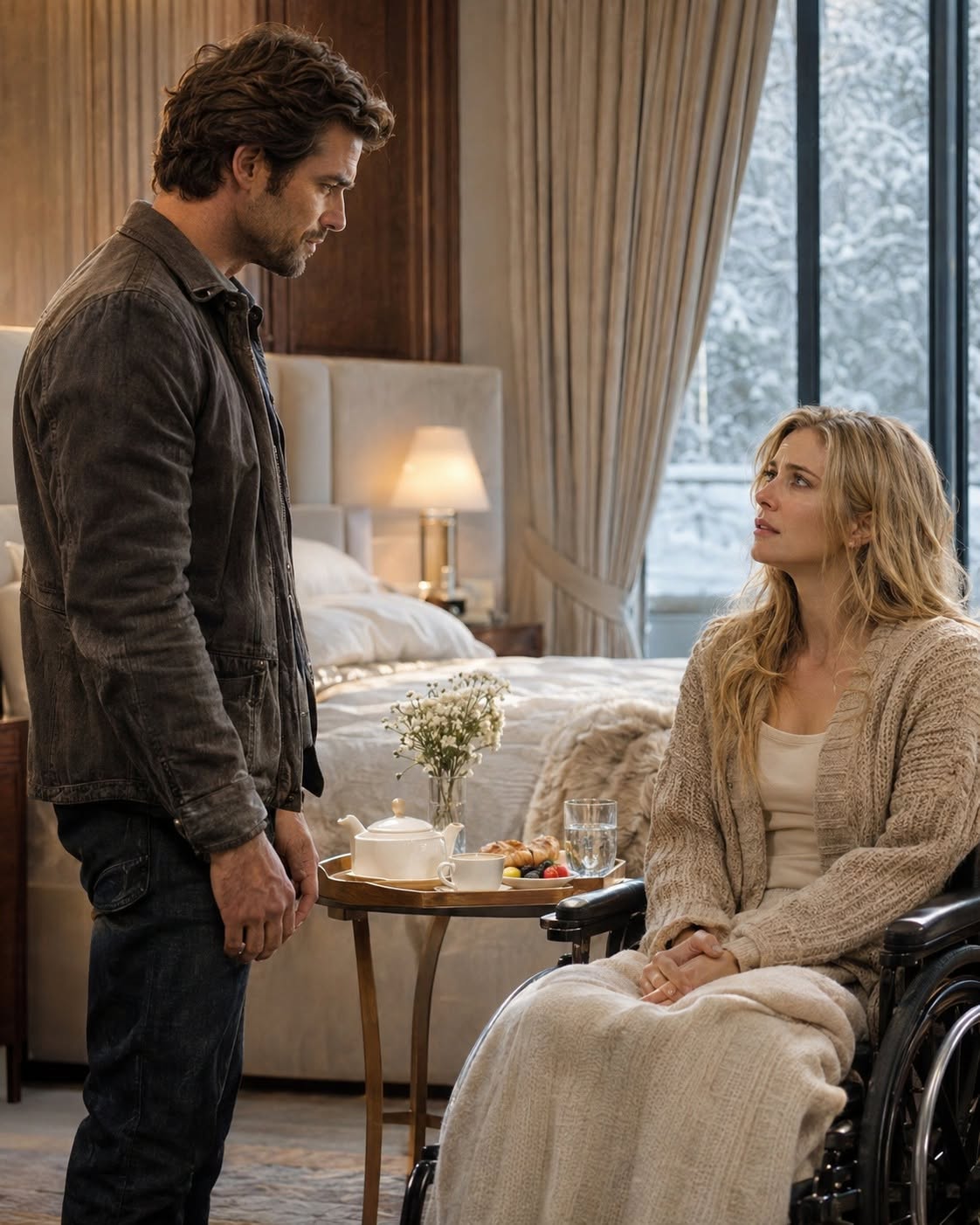
The first thing Daphne Brooks did when I walked into her bedroom was knock her breakfast tray onto the floor.
“I can’t answer that question while you’re paying me to be here,” I finally said.
Daphne’s fingers tightened around the standing frame.
“That’s a very convenient answer.”
“No. It’s probably the most inconvenient answer I could give you.”
She studied my face, searching for something I wasn’t sure I knew how to express.
“Because you don’t feel the same way?”
“Because I want to be certain that whatever happens between us is a choice. Not a consequence of your needing help or my needing a job.”
For several seconds, neither of us spoke.
Then Owen appeared in the doorway, holding his book upside down and announcing that he had finished another chapter.
Daphne smiled at him.
The conversation ended there, but something between us had changed permanently.
Over the following weeks, I began helping Daphne interview candidates who could eventually take over her daily care. She resisted the idea at first, arguing that replacing someone she trusted was ridiculous.
Eventually, however, she understood.
We hired a woman named Marisol, a compassionate rehabilitation aide with fifteen years of experience and an extraordinary ability to ignore Daphne’s occasional attempts at intimidation.
Watching them together was reassuring.
It was also unexpectedly painful.
I had become accustomed to being needed in that house.
One Thursday morning, Brenda called Daphne during breakfast. The conversation lasted nearly forty minutes, and by the time Daphne put down her phone, she looked as though someone had drained the color from her face.
“Warren is suing me.”
I pulled out a chair.
“For what?”
“Wrongful termination. Defamation. Breach of contract. Apparently, I’m also guilty of destroying his professional reputation.”
She laughed bitterly.
“He stole millions from my company, and somehow I’m the villain.”
But Warren’s lawsuit wasn’t the worst part.
His attorney had submitted documents suggesting that Daphne’s cognitive judgment had deteriorated since her accident. Among those documents was a statement from a former caregiver who claimed Daphne had become emotionally unstable and incapable of making sound financial decisions.
There were also accusations against me.
According to Warren, I had deliberately concealed my medical background, manipulated a vulnerable patient, and positioned myself to gain access to her considerable fortune.
“He wants the board to question every decision I’ve made since the accident,” Daphne explained.
“Can he actually do that?”
“He can certainly make enough noise to frighten our investors.”
She looked toward the garden.
“And frightened investors don’t wait around for the truth.”
Two days later, the story appeared online.
The headline described me as a disgraced medical professional who had infiltrated the household of a disabled millionaire.
Someone had discovered that my former hospital position had been eliminated shortly after Nora’s death. They twisted the circumstances until it sounded as though I had been dismissed for misconduct.
Photographs of me leaving Daphne’s house appeared alongside speculation about our relationship.
By Monday, Owen’s school principal had called.
A parent had circulated the article in a private messaging group, and several children had begun teasing my son.
When I picked him up that afternoon, he climbed into the car without saying hello.
“Dad?”
“Yeah, buddy?”
“Did you do something bad to Miss Daphne?”
I turned off the engine.
“Why would you ask me that?”
“Connor said you were stealing her money.”
His little face crumpled before I could answer.
“He said that’s why Mom isn’t here anymore. Because you’re a bad person.”
I felt something inside me break.
I unbuckled my seat belt, leaned toward him, and held him while he cried.
“Your mom loved you more than anything in this world. Nothing anyone says can change that. And I haven’t stolen anything from Daphne.”
“Promise?”
“I promise.”
That evening, after Owen fell asleep, I called Daphne and told her I was resigning immediately.
She was silent for so long that I thought the connection had failed.
“Because of Warren?”
“Because my son came home crying.”
Her voice softened.
“What happened?”
I explained.
When I finished, she didn’t argue.
“Take care of Owen,” she said quietly. “I’ll take care of this.”
The following morning, Evelyn arrived at my apartment carrying a cardboard box.
Inside were Owen’s books, a sweater I had forgotten, and several drawings he had made while visiting Daphne.
At the bottom was an envelope.
I expected a severance check.
Instead, I found a handwritten letter.
Daphne had written that she understood my decision and would never hold it against me. She thanked me for treating her like a person when she had made it nearly impossible for anyone to do so.
Then, near the bottom, she had added something that made me sit down.
“You taught me that accepting help doesn’t mean surrendering control. Now I need to prove that I learned something.”
I read the letter three times.
For the next several days, I concentrated on Owen. We made pancakes, visited the library, and built a spectacularly unstable model of the solar system for his science project.
I also applied for jobs.
Unfortunately, Warren’s allegations had reached several rehabilitation facilities. Interviews that initially seemed promising ended with vague promises to contact me.
One hiring manager was kind enough to explain the situation.
“We don’t believe everything we read,” she said. “But our legal department is concerned.”
I thanked her and went home.
That night, I opened the kitchen cupboard and counted how many weeks I could survive without another paycheck.
The answer wasn’t encouraging.
Still, I refused to call Daphne.
I couldn’t risk proving Warren’s accusations right in the eyes of people who had already decided what kind of man I was.
Then, nearly two weeks after my resignation, Gareth called.
“Have you spoken to Daphne recently?”
“No. Why?”
“She canceled three therapy appointments.”
I sat upright.
“Is she sick?”
“She says she’s busy. Marisol says she’s barely eating.”
He hesitated.
“And there’s something else. She’s been experiencing severe spasms and increased pain. I recommended a medical evaluation, but she keeps postponing it.”
I knew Daphne well enough to understand what she was doing.
She was sacrificing her health to keep her company from falling apart.
“Has her physician been informed?”
“Yes. We’re working on it.”
After we hung up, I stared at my phone.
Finally, I called her.
She answered on the fourth ring.
“Well,” she said, “I was wondering whether you’d forgotten my number.”
“Gareth called.”
“Traitor.”
“Daphne.”
“I have a board meeting tomorrow.”
“And you have a body that needs attention today.”
She sighed.
“You’re not my employee anymore.”
“Exactly. So you can’t fire me for telling you you’re making a terrible decision.”
For the first time in weeks, I heard her laugh.
She agreed to see her physician that afternoon.
But before we ended the call, she said something that unsettled me.
“Warren offered to withdraw his accusations against you.”
“What does he want?”
“My resignation. A substantial settlement. And an agreement preventing us from pursuing the missing money.”
I closed my eyes.
“Don’t do it.”
“He’s hurting Owen.”
“And he’ll keep hurting people if you reward him for it.”
“What if I lose everything?”
I thought about the woman who had thrown her breakfast tray onto the floor because she couldn’t bear the thought of needing another stranger.
“You’re not everything you own, Daphne.”
She didn’t respond immediately.
Then she said, “I wish I’d met you before the accident.”
“I think we met when we were supposed to.”
The following afternoon, Daphne attended an emergency board meeting.
I learned what happened later from Brenda.
Warren’s attorney had presented a proposed settlement, warning that a prolonged legal battle could damage the firm’s reputation beyond repair.
Several directors appeared ready to accept it.
Then Daphne asked everyone to turn their attention to Evelyn.
For weeks, Evelyn had been quietly working with independent forensic accountants. The original audit had revealed the missing money, but their expanded investigation had uncovered something far more damaging.
Warren had been redirecting company funds long before Daphne’s accident.
He had also arranged unauthorized payments disguised as consulting fees and instructed employees to destroy certain records.
Among the recovered documents were emails demonstrating that he had deliberately exaggerated Daphne’s medical limitations to secure additional authority over the company.
One email contained a sentence that reportedly left the entire room silent.
“As long as she remains dependent, we can manage her.”
Daphne allowed the directors to read it.
Then she addressed them.
“I trusted this man for fourteen years. When I woke up in the hospital and couldn’t move my legs, he told me not to worry about the company. He said he would protect everything I’d built.”
She paused.
“Apparently, what he meant was that he would take whatever I was too injured to defend.”
The board rejected the settlement.
The evidence was turned over to the authorities, and an independent investigation was authorized.
But Daphne wasn’t finished.
She issued a carefully prepared public statement correcting the false allegations against me. My former hospital also released documentation confirming that my position had been eliminated during a corporate restructuring and that no disciplinary action had been taken against me.
By the end of the week, several news outlets had amended their articles.
The damage wasn’t completely undone, but at least the truth was finally catching up.
Then something extraordinary happened.
A former colleague named Dr. Miriam Ellis contacted me.
She was developing an outpatient rehabilitation program at a community medical center and needed someone with experience coordinating spinal cord injury services.
“We can’t offer what you earned before,” she admitted.
“But we can give you predictable hours, a good team, and a chance to build something meaningful.”
I accepted before she finished explaining the benefits.
When I told Owen, he jumped onto the couch and declared that we needed a celebration cake.
We bought one from the grocery store, even though it had an enormous frosting flower and the words HAPPY RETIREMENT across the top.
It was discounted, and neither of us cared.
I sent Daphne a photograph.
She replied almost immediately.
“Congratulations on your retirement at the age of forty-two.”
Then another message appeared.
“I’m proud of you.”
Three months passed.
Daphne and I spoke occasionally, but I kept my distance while the legal proceedings continued and she established a routine with Marisol.
My new job was demanding in the best possible way.
I met patients who reminded me why I had entered rehabilitation in the first place. Some were learning to transfer independently. Others were struggling to accept permanent changes to their lives.
Their victories rarely looked dramatic to outsiders.
But I knew what it meant when someone dressed themselves for the first time after an injury or returned home after months in a hospital.
One evening, I received an invitation from Daphne.
Dinner, Saturday. No medical discussions. Owen is invited. Attendance is strongly encouraged but entirely voluntary.
I laughed.
When we arrived, Owen ran straight toward her.
She opened her arms, and he hugged her without hesitation.
Dinner was wonderfully ordinary.
Owen told ridiculous jokes. Evelyn complained about the garden squirrels. Daphne admitted she had attempted to bake chocolate cookies and nearly destroyed a very expensive oven.
After dinner, Owen fell asleep in the reading room.
Daphne and I went onto the terrace.
The autumn air was cool, and the garden lights cast soft shadows across the stone pathway.
“I’ve missed this,” she said.
“The cookies?”
“Being around someone who doesn’t want me to approve a budget.”
I smiled.
She looked at me.
“Actually, I’ve missed you.”
There was no sharpness in her voice, no demand for reassurance.
Just honesty.
“I’ve missed you too.”
She reached for my hand.
“Are we allowed to have this conversation now?”
I looked down at our hands.
“Yes.”
“And if I ask you to dinner next week without your son as a chaperone?”
“I’d probably say yes.”
“Probably?”
“I’m negotiating.”
She laughed.
Then, very gently, I kissed her.
It wasn’t dramatic. There was no music, no sudden realization that every painful experience had led us toward this exact moment.
It was simply two people choosing to begin something.
And for me, that was enough.
Our relationship developed slowly.
We argued about restaurants, discovered we had completely different opinions about movies, and learned that neither of us was particularly good at admitting when we were frightened.
Daphne sometimes worried that I saw her as a responsibility.
I sometimes worried that loving someone again meant betraying Nora.
One Sunday afternoon, while cleaning out an old storage closet, Owen found a box containing photographs of his mother.
He carried it into the living room, where Daphne was visiting.
“Do you want to see my mom?”
Daphne looked at me before answering.
“I would love to.”
For nearly an hour, Owen explained every photograph.
He showed her our wedding picture, a vacation at the beach, and an image of Nora holding him as a newborn.
“She was really funny,” he said.
“I can tell,” Daphne replied.
“Dad used to laugh all the time when she was here.”
I looked away.
Later, after Owen went outside, Daphne asked whether she could tell me something.
“Of course.”
“I don’t want to replace her.”
My throat tightened.
“I know.”
“And I don’t want Owen to feel that loving me means he’s losing another piece of his mother.”
She took my hand.
“There should always be room for Nora in this house, wherever our house eventually happens to be.”
That was the moment I understood how deeply I had fallen in love with Daphne Brooks.
Not because she was wealthy or powerful.
Not because she needed me.
But because she understood that love didn’t require erasing what had come before.
Unfortunately, life wasn’t finished testing us.
The following spring, Daphne developed a serious infection that required hospitalization. Her recovery was difficult, and weeks of rehabilitation progress were temporarily lost.
When I visited her, she was staring at the hospital ceiling.
“I hate this,” she whispered.
“I know.”
“I was getting stronger. Gareth thought I might be able to manage supported standing for longer periods.”
She turned toward me.
“Now I can barely get through a therapy session.”
I sat beside her.
“Recovery doesn’t always move in one direction.”
“I’m tired of being brave.”
“Then don’t be brave today.”
Her eyes filled with tears.
For once, she allowed herself to cry without apologizing or trying to make a joke.
I stayed beside her until she fell asleep.
It took several months for Daphne to regain much of the strength she had lost.
There were no miraculous first steps.
Her doctors explained that significant neurological limitations were likely to remain permanent.
When Daphne shared the news with me, she seemed unusually calm.
“I spent so much time thinking that walking again would prove I’d beaten the accident.”
“And now?”
“Now I think I’ve been measuring the wrong thing.”
She glanced toward Owen, who was attempting to teach Marisol how to play chess.
“I have a life again. I don’t think my legs get to decide whether that counts.”
Around that time, Warren pleaded guilty to financial crimes connected to the company’s missing funds. Caleb also faced legal consequences, and efforts began to recover portions of the stolen assets.
Daphne could finally put that chapter behind her.
Instead of returning to her old schedule of endless meetings, she began making changes within the firm.
Brenda assumed more operational responsibility, allowing Daphne to focus on strategic decisions and projects that mattered personally to her.
One of those projects involved rehabilitation access.
She had discovered how many families struggled to afford adaptive equipment, transportation, and home modifications after disabling injuries.
With independent oversight, she established a foundation to help address those needs.
She asked whether I would serve as an unpaid clinical adviser alongside several other rehabilitation professionals.
I agreed.
Our first major initiative helped provide accessible transportation and equipment for patients who otherwise would have struggled to continue treatment.
At the launch event, Daphne surprised everyone by speaking without a prepared statement.
“After my accident, I thought independence meant never needing anyone,” she told the audience.
“I was wrong. Independence is having the support and freedom to make your own choices. Everyone deserves that, regardless of their bank account.”
Watching her speak, I remembered the shattered breakfast plate on her bedroom floor.
The woman before me hadn’t become a different person.
She had simply discovered that her strength could accomplish more when she stopped using it to keep everyone away.
Two years after we first met, I proposed.
There were no photographers, expensive restaurants, or elaborate arrangements.
We were sitting in her reading room while rain tapped against the windows.
Owen was building a tower of books on the carpet.
I handed Daphne a small box.
She stared at it suspiciously.
“What did you do?”
“Something I’ve been thinking about for a while.”
When she opened it, she became completely still.
“Are you sure?” she whispered.
I nodded.
“About everything?”
“Not everything. Nobody can be sure about everything. But I’m sure about wanting to spend my life with you.”
Owen abandoned his book tower.
“Say yes!” he shouted.
Daphne laughed through her tears.
“Yes.”
We married the following summer in her garden.
Evelyn cried before the ceremony even started. Gareth arrived with flowers. Brenda delivered a speech that somehow included three jokes about corporate governance.
Owen carried the rings and took his responsibilities extremely seriously.
Near the entrance stood a small table holding a photograph of Nora and a candle.
Daphne had arranged it herself.
When the ceremony began, she came down the garden pathway in her wheelchair, wearing a beautiful ivory dress and the happiest expression I had ever seen.
She didn’t need to stand to make the moment meaningful.
She didn’t need to walk toward me to prove anything.
She arrived exactly as she was, and I had never been more certain of anything in my life.
Years later, Owen would sometimes ask me what I remembered most about meeting Daphne.
He expected a romantic answer.
Instead, I always told him about the breakfast tray.
He thought it was hilarious.
Daphne insisted that the incident had been exaggerated.
“It was a very poorly balanced tray,” she would say.
“And you deliberately pushed it.”
“An unproven allegation.”
Our home became filled with these little arguments, laughter, photographs, books, and the comforting disorder of people who no longer needed to pretend they had everything under control.
Daphne remained a wheelchair user.
I continued working in rehabilitation.
Owen grew into a thoughtful young man who understood that kindness was not weakness and that asking for help was nothing to be ashamed of.
One evening, long after our wedding, Daphne and I sat together watching the sunset.
“Do you remember what I asked you when I was using the standing frame?” she said.
I nodded.
She had asked whether I would still be there if she never walked again.
“I was terrified,” she admitted. “I thought everyone would eventually get tired of me.”
I took her hand.
“You know what I was afraid of?”
“What?”
“That I’d spend the rest of my life thinking the happiest years were already behind me.”
She rested her head against my shoulder.
“And were they?”
I looked through the window, where Owen was laughing at something Evelyn had said.
“No,” I answered. “They weren’t.”
When I first entered Daphne’s bedroom, I thought I was accepting a temporary job to support my son.
Daphne thought she was hiring another person who would eventually disappoint her.
Neither of us understood that we were standing at the beginning of a different life.
She didn’t need someone to rescue her.
I didn’t need someone to erase my grief.
We needed the courage to trust again, the patience to accept uncertainty, and the understanding that people deserve love without having to prove they are worthy of it.
Sometimes the most remarkable recoveries have nothing to do with what the body can accomplish.
Sometimes healing means discovering that the future can still be beautiful, even when it looks nothing like the one you originally imagined.
And sometimes the person who challenges you to see how long you’ll last becomes the person you choose to stay beside for the rest of your life.