The first missile warning hit just as our patrol crossed the coast. Six hostile fighters had appeared out of the electronic fog
“Unidentified pilot, state your name and former unit. Now.”
The transmission crackled through my headset, followed by a burst of static. Outside my canopy, smoke drifted from the damaged fighter, and the remaining enemy aircraft were regrouping beyond the clouds. My hands were steady on the controls, but I could feel the old memories rising with every breath.
I glanced at the radio panel.
“Call sign Raven. Former unit: Nightwatch.”
The silence that followed was different from the silence before. This time, it wasn’t confusion. It was recognition.
“Nightwatch?” the flight leader repeated. “That unit was deactivated years ago.”
“Correct.”
“You’re telling me you flew with Nightwatch?”
“I’m telling you we have six aircraft trying to kill us, and I’d appreciate it if we discussed my résumé after we landed.”
Nobody laughed. But I heard someone swallow hard over the radio.
“Raven,” command said, “you are not authorized to assume operational command. Return control to your flight leader immediately.”
I looked at the radar display, which was still nothing more than a screen full of noise. Then I looked through the canopy at the enemy formation spreading into a wide arc.
“Command, with respect, your radar is blind, your reconnaissance aircraft is exposed, and your flight leader has a hostile aircraft six seconds from a firing position. If you want to take command, you can do it from the ground. Right now, I need everyone in the air to listen.”
A second passed.
Then another.
“Flight leader,” command finally said, “make your decision.”
The flight leader, Mason, had spent the last two years treating me like the person who brought him coffee, printed his maps, and corrected his paperwork. I could practically hear him wrestling with the fact that the quiet officer he’d dismissed was now the only person in the formation who seemed to understand what was happening.
“Raven has temporary tactical control,” he said. “Until we get out of this.”
“Understood,” command replied, though the tone suggested they were already preparing a disciplinary report.
I didn’t care.
“Everyone, listen carefully. We’re not going to win by chasing six aircraft. They’re trying to force us into separate fights. We stay together, protect the reconnaissance aircraft, and make them work for every second.”
My wingman, Lieutenant Cole, came over the radio.
“Raven, I have two on my tail. I’m running low on fuel. What do you want?”
“Don’t turn toward them. Keep moving north. I’ll meet you at the cloud bank.”
“That’s a long way to trust you.”
“Then trust the math. They’re faster than you, but they can’t maintain that position forever without committing.”
“Copy.”
He pulled away.
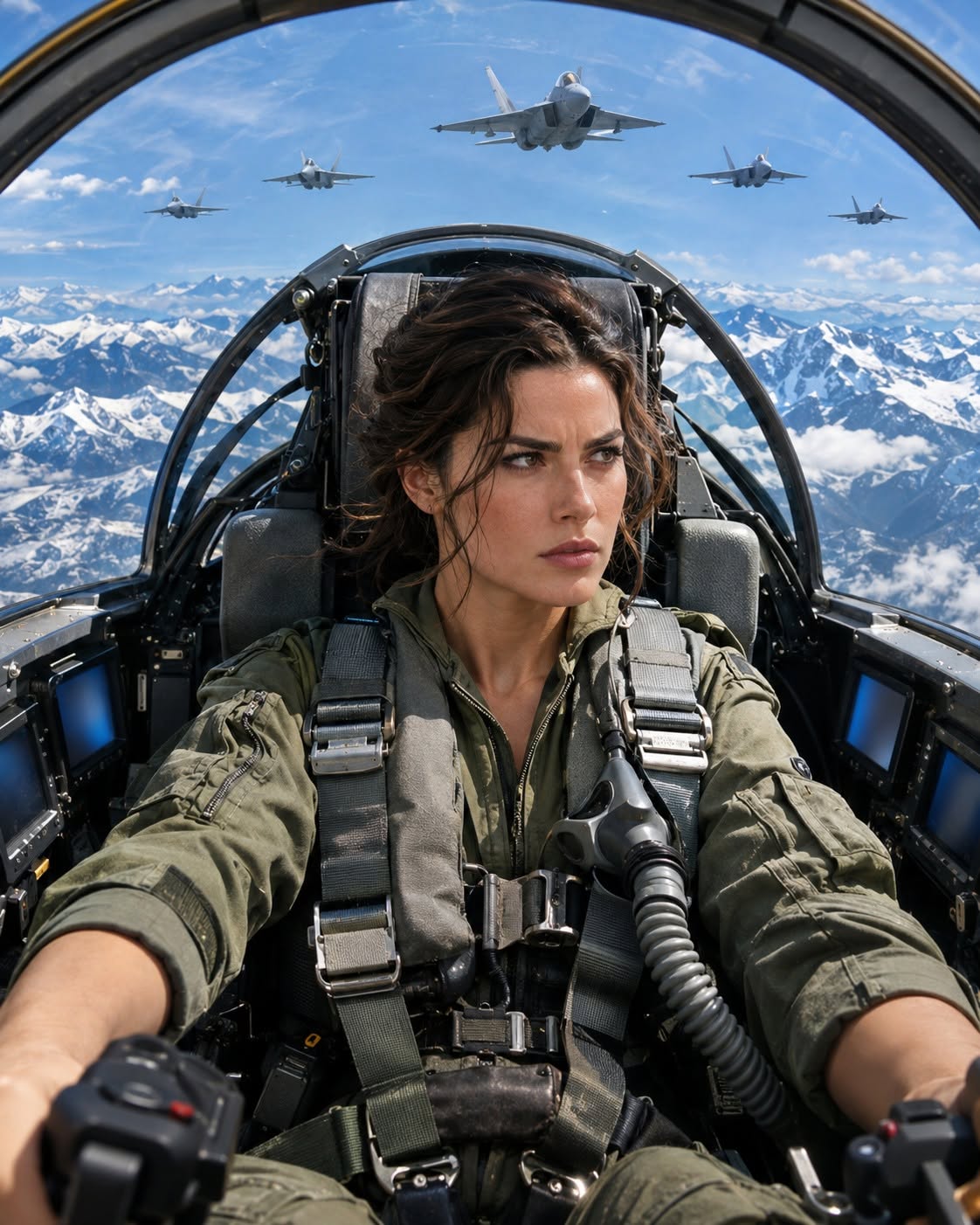
Two enemy fighters followed him, exactly as I expected. Their formation had begun to fracture. The pilot leading the attack was impatient, aggressive, and convinced we were falling apart. He didn’t realize we were beginning to control the shape of the fight.
“Flight lead, take the reconnaissance aircraft lower. Stay within visual range of the coastline, but don’t cross the ridge.”
“That’s not the planned route.”
“Neither is being hunted by six fighters.”
Mason hesitated, then followed my instruction.
The reconnaissance aircraft descended, its wings shaking as it struggled to keep pace. I watched the hostile formation react. Three aircraft went after Cole. Two turned toward Mason. The sixth stayed behind, holding position like a predator waiting for the wounded animal to make one final mistake.
That sixth aircraft was the one I worried about most.
It wasn’t following the others.
It was watching me.
I had seen that tactic before. Years ago, during a mission that had ended with two aircraft missing and a third pilot never making it home, an enemy commander had used the same patience. He didn’t waste fuel chasing every target. He waited for the leader to expose himself.
I adjusted my throttle.
“Raven, your altitude is dropping,” Mason warned.
“I know.”
“You’re getting too close to the terrain.”
“I know that too.”
The clouds opened, revealing a narrow valley cutting through the coastal hills. I wasn’t going to fly into it. I wanted the enemy to think I might.
The lone fighter shifted.
There it was.
“Cole, how many behind you?”
“Two. They’re getting impatient.”
“Good. Keep them impatient.”
“That’s your plan?”
“That’s the first half.”
He laughed nervously. “I hate plans with halves.”
“Then stay alive for the second.”
The reconnaissance aircraft suddenly called out.
“Warning! Engine temperature rising! We have a mechanical problem!”
My stomach tightened.
“Can you maintain flight?”
“Barely. We’re losing power.”
The mission was no longer about defeating the enemy. We had a damaged aircraft carrying two crew members, a wingman running low on fuel, and six hostile fighters that had figured out our weakness.
I made a decision.
“Mason, escort the reconnaissance aircraft. Forget the fighters. Get them home.”
“What about you?”
“I’ll keep the enemy occupied.”
“Raven, that’s suicide.”
“Not if they believe I’m the target.”
Before he could argue, I turned sharply and climbed into the sunlight.
The enemy leader followed.
The other fighters reacted almost immediately. Their formation tightened, and the radio filled with angry calls. They believed I’d finally made a mistake. A lone aircraft climbing into open sky was an easy target.
I felt the old rhythm return.
The sky became a map. The aircraft became a moving point. Every turn, every hesitation, every change in distance carried information. I stopped thinking about the names of the men who had once flown beside me. I stopped thinking about the desk I had returned to, the reports I had signed, and the promise I’d made to myself never to go back.
I thought only about the next ten seconds.
The first fighter came in fast.
I rolled away from its attack, forcing it to overshoot. The second tried to cut across my path. I changed direction, leaving it with a decision it didn’t want to make.
For a moment, both enemy aircraft were out of position.
“Raven, two are breaking off!” Cole shouted.
“Let them.”
“That’s three coming toward you now!”
“I can count.”
The enemy leader had finally joined the fight.
His aircraft appeared above me, dark against the sun. I couldn’t see his markings clearly, but I could see the way he moved. He wasn’t rushing. He was waiting for me to make the same mistake his wingmen had made.
I smiled despite myself.
“About time.”
He came down.
I held my line a fraction longer than instinct allowed. Then I moved, and his attack passed close enough that the vibration rattled through my cockpit. I wasn’t trying to outfly him. I was trying to make him think he had already won.
He turned.
I was waiting.
The radio erupted.
“Enemy aircraft breaking! Raven, you got him!”
“No,” I said. “He got impatient.”
The leader pulled away, but his formation was now scattered. Two fighters were chasing Cole far from the patrol. One had broken toward the coastline. The others were trying to find the reconnaissance aircraft.
I could hear Mason’s breathing over the radio.
“Raven, the recon aircraft is losing power. We can’t keep it airborne much longer.”
“Can you reach the emergency strip at Point Harbor?”
“Maybe. If we don’t get chased.”
“Then you won’t.”
I switched frequencies.
“Command, Raven. The reconnaissance aircraft is damaged and needs an emergency landing. Request the coastal strip be cleared immediately.”
“Point Harbor is a civilian facility. It is not approved for military operations.”
“Then today is a good day to approve it.”
“Raven, you do not have the authority—”
“Command, if you want two crew members alive, stop arguing about the name of the runway.”
For the first time, the controller didn’t respond with a warning.
Instead, another voice came through.
“Point Harbor is being cleared. Emergency services are on standby. Proceed.”
I recognized the voice.
Colonel Hayes.
The man who had signed my transfer out of Nightwatch.
The man who had been present the day I walked away from combat flying.
“Raven,” he said quietly, “I know who you are.”
I didn’t answer.
“Get them home.”
The reconnaissance aircraft made its approach, fighting the wind and the failing engine. Mason stayed beside it, while Cole finally broke away from the two fighters pursuing him.
I watched from a distance, unable to help without exposing them again.
“Come on,” I whispered.
The aircraft touched down hard.
Its landing gear bounced once, twice, then held. It skidded along the runway, smoke trailing behind it, and finally came to a stop near the far end.
“Recon is down!” Mason shouted. “They’re alive!”
For a moment, I forgot the fighters.
Then I saw them.
The enemy leader had regrouped with two remaining aircraft. They were heading toward the coastline, not away from it.
They were coming for the runway.
“Raven, three contacts approaching Point Harbor!” command warned.
I looked at the fuel indicator.
Almost empty.
Cole was even worse.
Mason had landed and couldn’t rejoin the fight. The reconnaissance crew was alive, but exposed. If the enemy attacked the runway, they could destroy the aircraft, the emergency crews, and anyone who hadn’t cleared the area.
I had no weapons left that could change the outcome.
But I had something else.
“Command, how many friendly aircraft are available at Point Harbor?”
“None. The facility is civilian.”
“Any aircraft at all?”
A pause.
“Two training jets. They’re grounded pending inspection.”
“Are they fueled?”
“Raven, those aircraft are not combat-ready.”
“Are they airborne?”
“No.”
“Then they’re not grounded anymore.”
“Absolutely not!”
I wasn’t asking permission.
I was asking a question.
Colonel Hayes came back on the frequency.
“Raven, what are you thinking?”
“I’m thinking the enemy believes this runway is defenseless.”
“It’s a civilian strip. There are people on the ground.”
“Then we need to make sure they never get close enough to see them.”
Hayes went silent.
Then he said, “The training aircraft are cleared for emergency defensive use. Pilots are already moving.”
I watched two small aircraft roll out from the hangars. They weren’t designed for this kind of fight. They lacked the equipment and performance of the enemy fighters. But they were flown by young pilots who had heard everything over the radio.
One of them called me.
“Raven, this is trainee pilot Jensen. We’re ready.”
I could hear the fear in his voice.
“Jensen, how many hours have you flown?”
“Forty-two, ma’am.”
“Then you have enough experience to know when to listen. Do not chase anything. Stay near the runway. Your job is to protect the people, not prove you’re a hero.”
“Yes, ma’am.”
The two training aircraft lifted into the air.
The enemy saw them and hesitated.
That hesitation was all we needed.
Cole positioned himself near the runway, while I moved toward the coastline. The enemy leader had to choose between attacking the damaged reconnaissance aircraft or facing a formation that was suddenly larger than he expected.
He chose to attack.
“Jensen, stay defensive. Don’t let them draw you away.”
“Copy.”
The first hostile fighter moved toward him. Jensen broke away, barely avoiding the attack. His wingman followed the movement, keeping the enemy from getting a clean shot.
They weren’t winning.
They were buying time.
And time was enough.
The emergency crews finished moving the reconnaissance crew into shelter. The damaged aircraft was secured. The runway lights were switched off, and the civilians were moved away from the hangars.
The enemy made one final pass.
Then, unexpectedly, they turned away.
Their fuel was running low. Their formation was broken. They had lost the advantage they came with, and now they were facing an unpredictable group of pilots who refused to panic.
The sky slowly emptied.
“Enemy aircraft withdrawing,” command announced.
Nobody cheered.
We were too tired to celebrate.
I returned to Point Harbor with barely enough fuel to make the landing. My aircraft rolled to a stop, and I sat in the cockpit for several seconds, staring at the instrument panel.
My hands were shaking.
Not from fear.
From the realization that I had returned to a life I thought I had left behind.
When I finally climbed out, Mason was waiting.
He looked at me for a long time before speaking.
“Why didn’t you tell us?”
I removed my helmet.
“Because I didn’t want to be that person anymore.”
“Nightwatch?”
“Especially Nightwatch.”
He looked toward the damaged reconnaissance aircraft.
“Two crew members are alive because of you.”
“They’re alive because everyone finally listened.”
Mason lowered his eyes.
“I didn’t.”
I didn’t make him apologize. There was nothing to gain from making him feel smaller than he already did.
“Then do better next time,” I said.
He nodded.
Across the runway, Jensen was sitting on the wing of his training aircraft. He looked like he had just aged ten years in forty minutes.
I walked over.
“You did well.”
He shook his head.
“I nearly lost control.”
“But you didn’t.”
“I was scared the whole time.”
“So was I.”
He looked up at me, surprised.
“You?”
“Fear isn’t something you outgrow. It’s something you learn to carry without letting it make your decisions.”
He nodded slowly.
That night, the squadron gathered in the operations room. The damaged reconnaissance aircraft had been secured, the crew was receiving medical attention, and the enemy had retreated beyond our patrol zone.
Colonel Hayes stood at the front.
“Today’s mission was a failure on paper,” he said. “We lost our planned route, our reconnaissance platform was damaged, and we violated several operational restrictions.”
Nobody moved.
“However, every member of the patrol returned alive. The reconnaissance data was recovered. And the civilian facility was protected.”
He looked directly at me.
“Some people believe leadership is a title. Others believe it comes with rank. Today, we learned that neither is enough.”
I stood near the back, uncomfortable with the attention.
Hayes continued.
“Flight Officer Raven will be temporarily reassigned as tactical training advisor. She will evaluate our formation response, emergency communication procedures, and leadership readiness.”
A few pilots looked surprised.
Mason raised his hand.
“Sir, if I may.”
Hayes nodded.
“I’d like to request that Raven lead our next training exercise. Not because of her former unit. Because she earned our trust today.”
The room was quiet.
Then Cole spoke.
“Agreed.”
Jensen followed.
“Agreed.”
One by one, the pilots nodded.
I looked around the room at the faces that had once ignored me. They weren’t looking at my old call sign anymore. They were looking at the person standing in front of them.
And somehow, that felt more important.
Later, after everyone had left, I sat alone at the operations desk. The same desk where I had spent months drawing routes, correcting reports, and listening to pilots talk as if I were invisible.
The old Nightwatch patch was still tucked inside my drawer.
I took it out and turned it over in my hands.
For years, I had believed leaving the cockpit meant leaving behind the person I used to be. I had thought silence would protect me from the memories. But silence had only made me afraid of being seen.
I placed the patch beside my flight plans.
Not hidden.
Not displayed.
Just there.
The next morning, I arrived early. Jensen was already waiting outside the briefing room, holding a notebook and trying to look calm.
“Ma’am,” he said, “I wrote down everything you told me yesterday. I have a question.”
“Ask.”
“What if I never become as good as you?”
I looked at him, then at the flight line where the aircraft were being prepared for the day’s training.
“Then become the kind of pilot someone can trust when things go wrong.”
He considered that.
“That’s better than being the best?”
“It’s a lot more useful.”
He smiled.
Inside the briefing room, Mason was arranging the flight plans. When he noticed me, he stood.
“Morning, Raven.”
I almost corrected him. I almost told him to use my actual rank, to stop treating a call sign like a legend.
But I didn’t.
“Morning, Mason.”
The squadron began to gather. The room filled with voices, maps, questions, and the ordinary noise of people who had another chance to do their jobs.
I opened the briefing folder.
For the first time in years, I didn’t feel like I was hiding from my past.
I felt like I was finally using it for something.
Because the sky doesn’t care about your title, your history, or how many people underestimated you.
It only gives you one question when everything goes wrong:
Who will you be when someone needs you?
And that morning, I finally knew my answer.