The first man offered me $50,000 for a rusted-out Camaro without even looking under the hood.
Genevieve Sterling stared at me for a long moment before closing her leather folder.
“His name is Victor Hargrove,” she said. “He’s eighty-four years old, and he lives on a private estate outside Cincinnati.”
“Then let’s call him.”
“It isn’t that simple.”
“People keep telling me that about a car I bought for seven hundred dollars.”
Sam stepped into the garage and folded his arms.
“Dan, before you go chasing some billionaire’s business partner, there’s something you need to know.”
I turned toward him.
He looked at Genevieve, then back at me.
“My father worked at a Sterling manufacturing plant in 1978. He lost his job after asking questions about a project that wasn’t on the company books.”
Genevieve went completely still.
“What was your father’s name?”
“Thomas Brooks.”
Her face lost its color.
I had known Sam for twenty-seven years. We’d rebuilt engines together, buried friends together, and spent more Saturday mornings drinking terrible coffee than I could count.
But I’d never heard him mention anything about the Sterling family.
“Sam, why didn’t you tell me?”
“Because I didn’t think it mattered anymore.”
He pointed toward the Camaro.
“Until I saw that number.”
Genevieve slowly lowered herself onto an old shop stool.
“Thomas Brooks was the last person to see my father alive.”
The garage fell silent.
I looked between them.
“Your father died in 1982, didn’t he?”
Genevieve nodded.
“Officially, it was a heart attack.”
“Officially?”
She opened her folder again.
“Three days before his death, my father requested a meeting with federal investigators. The meeting never happened.”
Sam’s jaw tightened.
“My father always said Sterling was trying to make something right.”
“Make what right?” I asked.
Neither answered immediately.
Then Genevieve looked toward the Camaro.
“That’s what I came here to find out.”
I walked to my workbench and picked up the unsigned agreement.
“If we’re going to investigate this, we do it my way.”
Genevieve waited.
“No private security guards inside my shop. No one touches that chassis without my permission. And every document we find gets copied to an independent attorney.”
She nodded.
“Agreed.”
“And one more thing.”
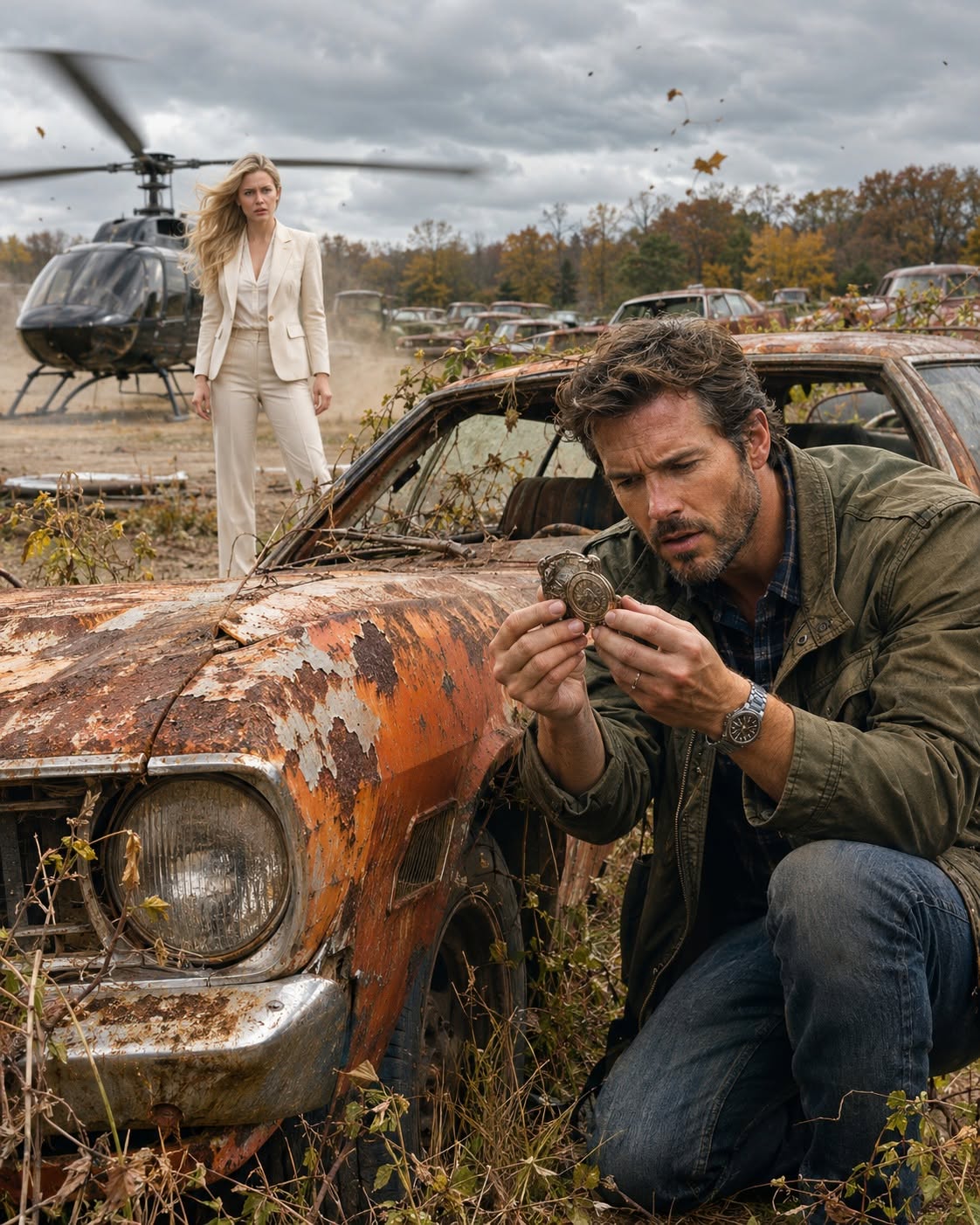
“What?”
“Whatever this car is hiding, nobody gets to bury it again.”
For the first time, she looked relieved.
“Then we should move quickly.”
“Why?”
“Because Victor Hargrove knows you have the car.”
I glanced at the broken camera.
“How?”
Genevieve hesitated.
“Someone inside my organization has been feeding him information.”
That afternoon, I called a lawyer named Margaret Ellis, who’d handled Ellen’s estate after she died.
Margaret was seventy, sharp as a razor, and had absolutely no patience for rich people who believed money could replace honesty.
When I explained the situation, she listened without interrupting.
Then she said, “Daniel, please tell me you haven’t signed anything.”
“Not yet.”
“Good. Don’t.”
She agreed to meet us the following morning.
But before I could hang up, she asked one question.
“Does the Camaro have a complete firewall?”
I looked across the garage.
“Most of it. Why?”
“Because if somebody altered the identification numbers, there may be more than one hidden marking.”
I stared at the rusted shell.
Margaret continued.
“My late husband worked insurance investigations. He always said criminals hide what they want found in one place, and what they truly fear losing somewhere else.”
After the call, I spent two hours examining the firewall.
Nothing.
Then I moved to the rocker panels.
Still nothing.
At nearly midnight, Sam found me lying beneath the car with a flashlight.
“You planning to sleep here?”
“Probably.”
He handed me a cup of coffee.
“Ellen would’ve hated that.”
I smiled despite myself.
“She would’ve brought me a blanket and complained the whole time.”
Sam chuckled.
Then his expression grew serious.
“Dan, I need to show you something.”
He pulled an old photograph from his wallet.
It showed three men standing outside a factory.
One was Sam’s father.
Another was a younger Victor Hargrove.
The third was Genevieve’s father, Arthur Sterling.
Behind them sat a partially assembled Camaro.
I leaned closer.
There was something unusual about the car.
The rear quarter panel had the same tiny crease as mine.
“Where did you get this?”
“My father gave it to me before he died.”
I turned it over.
Four words were written in faded blue ink.
“THE WEIGHT IS WRONG.”
I looked up.
“What does that mean?”
Sam shook his head.
“I’ve been wondering for thirty years.”
The next morning, Margaret arrived with two engineers she’d hired independently.
One specialized in vehicle identification.
The other, a woman named Dr. Rebecca Shaw, was an expert in industrial metallurgy.
Genevieve arrived without her helicopter.
This time, she drove herself.
I appreciated that more than I expected.
Rebecca spent nearly an hour examining the rear quarter panel.
Then she asked me to bring over my portable scanning equipment.
“What are you looking for?” I asked.
“Something that shouldn’t be there.”
She pointed to the welded patch.
“The metal around this area isn’t consistent with the rest of the body.”
“I noticed the weight difference.”
“It’s more than weight.”
She ran another test.
Her expression changed.
“This section contains an unusually dense alloy.”
Genevieve stepped closer.
“What kind?”
Rebecca studied the readings.
“A tungsten-heavy material, possibly part of a specialized shielding assembly.”
I frowned.
“Shielding from what?”
“That’s what concerns me.”
She looked at the car again.
“This wasn’t installed for structural strength.”
Margaret immediately asked everyone to step away while Rebecca performed additional safety checks.
By noon, we had our first real answer.
The Camaro had once been modified to transport a compact experimental device inside a concealed compartment.
The compartment was empty.
But its construction suggested the contents had required protection from heat, vibration, and unauthorized inspection.
“Military?” Sam asked.
Rebecca shook her head.
“Not necessarily. High-security industrial research used similar methods.”
Genevieve stared at the chassis.
“My father funded advanced battery research in the late seventies.”
I looked at her.
“Battery research?”
She nodded.
“He believed electric vehicles would eventually replace gasoline engines. He invested millions in technologies that never reached production.”
I glanced toward the empty engine bay.
“Then why use a Camaro?”
“Because no one would question an automotive test vehicle moving between facilities.”
Rebecca looked thoughtful.
“Or because the project needed a vehicle capable of carrying a heavy experimental power system.”
Before anyone could respond, Margaret’s phone rang.
She answered, listened for several seconds, and walked outside.
When she returned, her face was grim.
“We have a problem.”
“What now?” I asked.
“Someone filed a legal claim alleging this Camaro was stolen property.”
Genevieve’s expression hardened.
“Victor.”
Margaret nodded.
“The claimant is Hargrove Industrial Holdings.”
I laughed once, without humor.
“Of course it is.”
“They’re demanding immediate surrender of the vehicle.”
“Can they do that?”
“Not without establishing ownership. But they can make your life expensive.”
I looked at the rusted Camaro.
For a machine that couldn’t move under its own power, it was causing an extraordinary amount of trouble.
Margaret folded the paperwork.
“We’re going to challenge the claim. Meanwhile, I strongly recommend relocating the chassis to a secure facility.”
I didn’t like the idea.
My shop was the one place I’d always felt in control.
But Sam was right.
People willing to smash cameras might be willing to do worse.
That evening, we moved the Camaro to a locked restoration building owned by a retired racing mechanic Margaret trusted.
Only five people knew the location.
Or so I thought.
At 2:17 the following morning, my phone rang.
It was Genevieve.
“Daniel, Victor wants to meet.”
I sat upright.
“Where?”
“His estate.”
“When?”
“Tomorrow morning.”
I glanced at Ellen’s photograph on my nightstand.
“Why the sudden invitation?”
Genevieve was quiet.
Then she said, “Because he claims he can tell us what happened to my father.”
The following morning, Sam insisted on coming with me.
Margaret came too.
Genevieve arranged the meeting, but I made one condition clear.
No private conversations.
Whatever Victor said, we would all hear it.
His estate sat behind iron gates and acres of manicured lawns.
The house looked more like a museum than a home.
Victor Hargrove received us in a library lined with dark wood and expensive paintings.
He was thin, silver-haired, and moved with a cane.
But his eyes were sharp.
“Mr. Mercer,” he said. “You’ve caused quite a disturbance.”
I sat across from him.
“Funny. I thought I bought a junk car.”
He smiled.
“You bought something that never belonged in a junkyard.”
“Then tell me what it is.”
Victor looked at Genevieve.
“Your father was a brilliant man. Unfortunately, he lacked the temperament required for serious business.”
Genevieve stiffened.
“Don’t speak about him that way.”
Victor ignored her.
“In 1979, we began developing a high-density energy storage system. Arthur believed it could transform transportation.”
I leaned forward.
“What kind of system?”
“An experimental thermal battery. It stored energy through a process involving specialized metallic compounds.”
Rebecca’s findings suddenly made more sense.
Victor continued.
“The technology was years ahead of anything commercially available. But there were complications.”
“What complications?” Margaret asked.
“Safety concerns. Financial concerns. Nothing unusual for experimental research.”
Sam spoke for the first time.
“My father said workers were getting sick.”
Victor’s smile vanished.
“Your father misunderstood the situation.”
“Then why was he fired?”
Victor tapped his cane against the floor.
“Because he violated confidentiality agreements.”
Sam leaned forward.
“He was a machinist. He didn’t steal anything. He asked why people were being sent home after working near the test chambers.”
Victor looked toward the door.
“I believe this meeting is over.”
I stood.
“Not quite.”
He looked up.
I placed Sam’s photograph on the desk.
“What’s this message mean?”
Victor stared at the words on the back.
THE WEIGHT IS WRONG.
His fingers tightened around the cane.
“Where did you get that?”
“Does it matter?”
He looked at Sam.
“Thomas should’ve destroyed it.”
Sam’s face hardened.
“Why?”
Victor’s voice dropped.
“Because some things are better forgotten.”
I felt a chill.
“That’s what the first man who offered me fifty thousand dollars said.”
Victor looked toward Genevieve.
“You should’ve bought the car when you had the chance.”
Genevieve stood.
“What happened to my father?”
Victor said nothing.
She stepped closer.
“Did he discover something?”
For the first time, the old man seemed genuinely tired.
“Arthur discovered that ambition has consequences.”
Then he looked directly at me.
“Mr. Mercer, I’ll give you one million dollars for that chassis. No questions. No publicity. You can retire comfortably.”
I thought about my little repair shop.
The leaking roof.
The overdue equipment upgrades.
The quiet house waiting for me every evening.
A million dollars would change everything.
Then I thought about Sam’s father.
About workers who might have gotten sick.
About Arthur Sterling dying before he could speak to investigators.
I pushed the photograph toward Victor.
“Keep your money.”
His expression turned cold.
“Then you may lose more than you understand.”
I stood.
“Maybe. But at least I’ll know what I lost it for.”
We left without shaking hands.
Halfway down the driveway, Genevieve received a message.
She read it twice.
Then she whispered, “Oh, my God.”
“What?”
She turned the screen toward me.
It was a photograph of the restoration building where we’d hidden the Camaro.
Taken that morning.
Beneath it was one sentence.
“LAST CHANCE.”
We called the sheriff immediately.
By the time deputies reached the building, the front lock had been damaged.
The Camaro was still there.
But someone had entered.
They hadn’t taken the chassis.
They’d searched it.
Rebecca arrived an hour later and examined the exposed metal.
“They were looking for something specific,” she said.
“How can you tell?”
“Because they ignored everything except the passenger-side rocker panel.”
I frowned.
“I already checked that area.”
“From the outside?”
“Yes.”
She pointed toward the interior.
“What about beneath the reinforcement?”
I stared at the panel.
Then I remembered something from my engineering days.
Prototype vehicles sometimes carried temporary structural inserts that looked permanent.
I retrieved my tools.
Working carefully, we removed a narrow reinforcement plate.
Behind it was a sealed aluminum tube.
My pulse quickened.
Sam leaned closer.
“Please tell me that’s not another bombshell.”
I almost laughed.
Then I unscrewed the tube.
Inside was a tightly rolled sheet of thin film, protected by waxed paper.
And a small brass key.
The film contained dozens of tiny photographic images.
Microfilm.
Margaret immediately stopped us from handling it further.
She arranged for a professional archivist to examine and digitize it.
The next afternoon, we gathered around a computer monitor.
The first images showed engineering diagrams.
Then test schedules.
Then internal correspondence.
Finally, we reached a document titled:
“PROJECT HARBOR — OCCUPATIONAL EXPOSURE REVIEW.”
The room went silent.
Rebecca read the first page.
Her expression changed.
“Oh, no.”
“What?” I asked.
She turned toward us.
“The experimental system wasn’t simply dangerous because it could overheat.”
She pointed at a section of the report.
“Some test materials contained toxic compounds. The internal review documented inadequate ventilation, contaminated work areas, and repeated employee exposure.”
Sam gripped the edge of the desk.
“My father.”
Rebecca continued reading.
“Several workers reported neurological symptoms, respiratory problems, and unexplained fatigue.”
Genevieve covered her mouth.
The next document contained a list of affected employees.
Thomas Brooks was number seventeen.
There were forty-three names.
Beside several were handwritten notes indicating hospitalizations.
Three had the word “deceased.”
I felt sick.
Sam stared at his father’s name.
“He spent years telling doctors something happened at that factory.”
His voice broke.
“They told him it was stress.”
Genevieve closed her eyes.
“My father knew.”
Margaret shook her head.
“Keep reading.”
The next document was a letter from Arthur Sterling to Victor Hargrove.
It was dated six days before Arthur died.
“I will not authorize further testing until the affected employees receive independent medical evaluations and the exposure findings are disclosed to the appropriate authorities.”
Another letter followed.
This one was from Victor.
“Public disclosure would destroy the project, damage the company, and create unacceptable financial exposure. I strongly advise reconsideration.”
Then came a handwritten memorandum.
Arthur’s handwriting.
Genevieve recognized it immediately.
“If anything happens to me, the duplicate records are secured in Vehicle H-11. Thomas Brooks knows the identification code.”
I looked toward Sam.
He was crying silently.
“My father knew,” he whispered.
“He knew the truth was somewhere.”
I put a hand on his shoulder.
The final microfilm image showed an inventory sheet.
At the bottom was a notation:
“Original medical files transferred to Archive Room B. Access key secured with duplicate records.”
I looked at the brass key lying on the table.
For the first time, I understood.
The Camaro hadn’t been hidden because it was a valuable prototype.
It had been hidden because it was a witness.
And someone had spent forty years trying to silence it.
Margaret contacted federal authorities and an independent occupational health attorney.
Within days, investigators began reviewing the evidence.
But Victor wasn’t finished.
A week later, Genevieve received notice that Hargrove Industrial Holdings had filed an emergency petition to restrict access to the microfilm, claiming trade-secret protections.
Margaret was furious.
“He’s trying to turn evidence of worker exposure into proprietary information.”
“Can he succeed?” I asked.
“He can delay things. But he can’t automatically conceal evidence of possible wrongdoing simply by calling it confidential.”
Then she looked at the brass key.
“We still need to find Archive Room B.”
Genevieve knew where it was.
The original Sterling research facility had closed in 1991.
Most of the buildings had been demolished.
But one underground records vault remained beneath a warehouse that Hargrove Industrial Holdings still controlled.
Getting inside legally would require a court order.
And time.
Time Victor might use to remove whatever remained.
Fortunately, the investigators understood the urgency.
After reviewing the microfilm and ownership records, authorities obtained the necessary legal authorization to search the facility.
I wasn’t permitted inside during the search.
Neither was Genevieve.
We waited in a nearby office with Sam and Margaret.
Three hours passed.
Then four.
Finally, an investigator entered.
He carried a sealed evidence bag.
Inside was an old metal file box.
The brass key had opened it.
The investigator looked at Genevieve.
“Your father left something else.”
He handed her a scanned copy of a letter recovered from the box.
It was addressed to her.
She unfolded it with trembling hands.
“My dearest Genevieve,
If you are reading this, then I failed to finish what I started.
I built this company believing that innovation could make people’s lives better.
Somewhere along the way, I allowed ambition to blind me to the suffering happening under my own roof.
I trusted men who valued profits more than people.
And I failed the workers who trusted me.
I cannot undo that.
But I can make sure the truth survives.
If you ever inherit the power I once held, use it differently.
A company is not great because of the wealth it creates for its owners.
It is great because of the lives it improves without destroying others.
I love you.
Dad.”
Genevieve couldn’t finish reading aloud.
She pressed the letter against her chest and wept.
I looked away.
Some grief deserves privacy.
The search uncovered medical reports, payroll records, and internal correspondence that corroborated much of the microfilm.
Investigators also discovered evidence that certain safety findings had been deliberately withheld from employees and regulators.
The records didn’t prove Victor had caused Arthur’s death.
That question remained unanswered.
But they established that the worker exposure concerns were real.
And that the people responsible had known far more than they’d admitted.
Over the next several months, the story became national news.
Former Sterling employees came forward.
Families shared medical histories.
Some had spent decades wondering why their loved ones became ill after working at the plant.
Others had never known the exposure reports existed.
Genevieve made a decision that surprised everyone.
She established an independently administered fund for medical evaluations, treatment assistance, and compensation for affected workers and their families.
She also released the historical safety findings to investigators and authorized public disclosure of records that could legally be shared.
Her advisers warned her it could cost hundreds of millions.
She did it anyway.
When a reporter asked why, she answered with one sentence.
“Because the truth doesn’t become less important just because it’s expensive.”
Victor’s legal troubles grew.
Investigators pursued allegations involving concealed records, financial misconduct, and obstruction connected to the recent attempts to recover the Camaro.
The criminal proceedings took time, and not every allegation could be proved.
But the evidence was enough to end his control over the remaining project archives.
His reputation, built over half a century, collapsed under the weight of documents he’d spent decades trying to keep hidden.
One afternoon, Sam came to my shop carrying a small cardboard box.
Inside were his father’s old work gloves, identification badge, and a photograph of him standing beside a factory machine.
Sam placed them on my workbench.
“Dad died thinking nobody believed him.”
I didn’t know what to say.
Sam looked at the Camaro, which had finally returned to my garage.
“You believed something was wrong before anybody else did.”
I shook my head.
“I just noticed a heavy quarter panel.”
He smiled sadly.
“Sometimes that’s enough.”
A month later, Genevieve visited again.
No helicopter.
No security entourage.
Just a woman in a blue sweater driving an ordinary sedan.
She brought a document.
“I’d like to buy the Camaro,” she said.
I raised an eyebrow.
“Here we go again.”
She laughed.
“Not to hide it.”
She placed the proposal on my desk.
“I want to restore the body and place it in a public transportation history museum. The exhibit would tell the complete story of Project Harbor, including the workers who suffered and the people who preserved the evidence.”
I read the proposal.
It included funding for an educational program on engineering ethics and industrial safety.
There was also a permanent section dedicated to Thomas Brooks and Arthur Sterling.
“What about the other workers?” I asked.
“Every name we can responsibly document will be included, with their families’ permission.”
I looked at the rusted shell.
For months, I’d seen it as a mystery.
Now it felt like a responsibility.
“I have one condition.”
Genevieve smiled.
“I expected that.”
“Don’t make it look new.”
She looked surprised.
“Why not?”
“Because the rust is part of its story. So are the welds, the damaged panels, and the hidden compartment.”
I rested my hand against the quarter panel.
“If you polish away everything ugly, people might forget what happened.”
She considered that.
Then nodded.
“Agreed.”
We settled on a preservation project rather than a full restoration.
The car would remain structurally stable, but its scars would stay visible.
I refused a large personal payment.
Instead, I asked that the money be directed toward scholarships for students pursuing automotive engineering and workplace safety.
Genevieve insisted on reimbursing my expenses.
I let her.
Ellen would’ve scolded me for refusing the rest.
But I knew she’d understand.
Six months later, the exhibit opened in Columbus.
The Camaro stood beneath soft museum lighting.
Its missing engine bay was visible.
The altered identification plate remained on display.
And beside the rear quarter panel was a photograph of the eleven-character number that had started everything.
A plaque explained the discovery.
But the largest wall wasn’t about the car.
It was covered with photographs of the workers.
Men and women who had built machines, supported families, and trusted their employers to keep them safe.
Sam stood beside his father’s picture for a long time.
I stayed nearby.
Eventually, he turned toward me.
“Think Dad would’ve liked this?”
I looked at Thomas Brooks smiling in the old photograph.
“I think he’d be glad somebody finally listened.”
Genevieve joined us.
She carried a small framed photograph of Arthur Sterling.
“I found this in my father’s papers,” she said.
It showed Arthur standing beside the Camaro during its early testing.
On the back, he’d written:
“Progress means nothing if we forget who pays the price.”
She placed the photograph beside the exhibit.
Then she looked at me.
“Daniel, I owe you more than I can explain.”
I shook my head.
“You don’t owe me anything.”
“You could’ve taken the money.”
“Probably should have,” I joked.
She smiled.
Then I grew serious.
“But if I had, I would’ve spent the rest of my life wondering what I sold.”
That evening, after the museum closed, I drove home alone.
The sky over Columbus was turning orange.
Traffic moved steadily along the highway.
Ordinary people going home after ordinary days.
I thought about how easily the Camaro could’ve disappeared.
One trip through a crusher.
One signature on a check.
One decision to stop asking questions.
Forty years of buried history might have stayed buried forever.
When I reached my house, I parked in the driveway and sat behind the wheel for a while.
Ellen’s favorite rosebush was blooming beside the porch.
I could almost hear her voice.
“You brought home another broken thing, didn’t you, Dan?”
I smiled.
“Yeah, sweetheart. I did.”
Then I laughed softly.
“And this one turned out to be a real headache.”
For the first time in a long while, the empty house didn’t feel quite so empty.
Not because I had forgotten her.
But because I had finally remembered something she’d tried to teach me.
A meaningful life doesn’t end when the person you love is gone.
Sometimes, the love they gave you becomes the reason you keep showing up.
The following Monday, I opened my repair shop at eight.
Sam arrived with coffee.
A teenager named Marcus brought in an old pickup that wouldn’t start.
His mother had recently lost her job, and he needed the truck to get to his apprenticeship.
He looked embarrassed when he explained he couldn’t afford much.
I opened the hood.
“Let’s see what we’re dealing with.”
He watched me inspect the wiring.
“Are you the guy who found that famous Camaro?”
I smiled.
“Depends who’s asking.”
He grinned.
“My teacher showed us the museum story. Said you could’ve been a millionaire.”
I tightened a loose connection.
“Maybe.”
“Don’t you regret it?”
I thought for a moment.
Then I looked at him.
“Marcus, when I was your age, I thought success meant having enough money that nobody could tell me what to do.”
I handed him a wrench.
“Now I think success means knowing what matters enough that nobody can pay you to forget it.”
He considered that.
Then nodded.
We worked on his truck together.
By lunchtime, the engine started.
Marcus nearly jumped out of his shoes.
“How much do I owe you?”
I wiped my hands on a rag.
“Come back Saturday and help me organize the parts room.”
His face lit up.
“Seriously?”
“Seriously.”
He shook my hand so hard I thought he’d pull my shoulder loose.
After he drove away, Sam leaned against the doorway.
“You know, Ellen would’ve liked that kid.”
I nodded.
“She would’ve fed him until he couldn’t move.”
We both laughed.
Then Sam looked around the garage.
“You ever think about retiring for real?”
I glanced at the empty space where the Camaro had stood.
“Not yet.”
“Why?”
I picked up an old alternator waiting on the bench.
“Because there are still broken things worth fixing.”
Sam smiled.
“Some of them?”
I looked toward the road where Marcus’s truck had disappeared.
“More than people think.”
And that was how a seven-hundred-dollar Camaro changed my life.
Not by making me rich.
Not by making me famous.
But by reminding me that the most valuable things in this world aren’t always the things someone offers to buy.
Sometimes, they’re the truths people are afraid to tell.
The promises people refuse to break.
The dignity of workers whose names were almost forgotten.
And the quiet courage of ordinary people who decide that doing the right thing matters more than doing the easy thing.
I had spent thirty years studying how metal bends, cracks, and fails under pressure.
But that old Camaro taught me something no engineering textbook ever had.
A machine can be rebuilt after its strongest parts fail. A reputation can be polished until it shines. But integrity is different. Once you sell it, no amount of money can guarantee you’ll ever get it back.
And sometimes, the greatest treasure you’ll ever find is hidden inside something the rest of the world has already decided is worthless.
THE END.