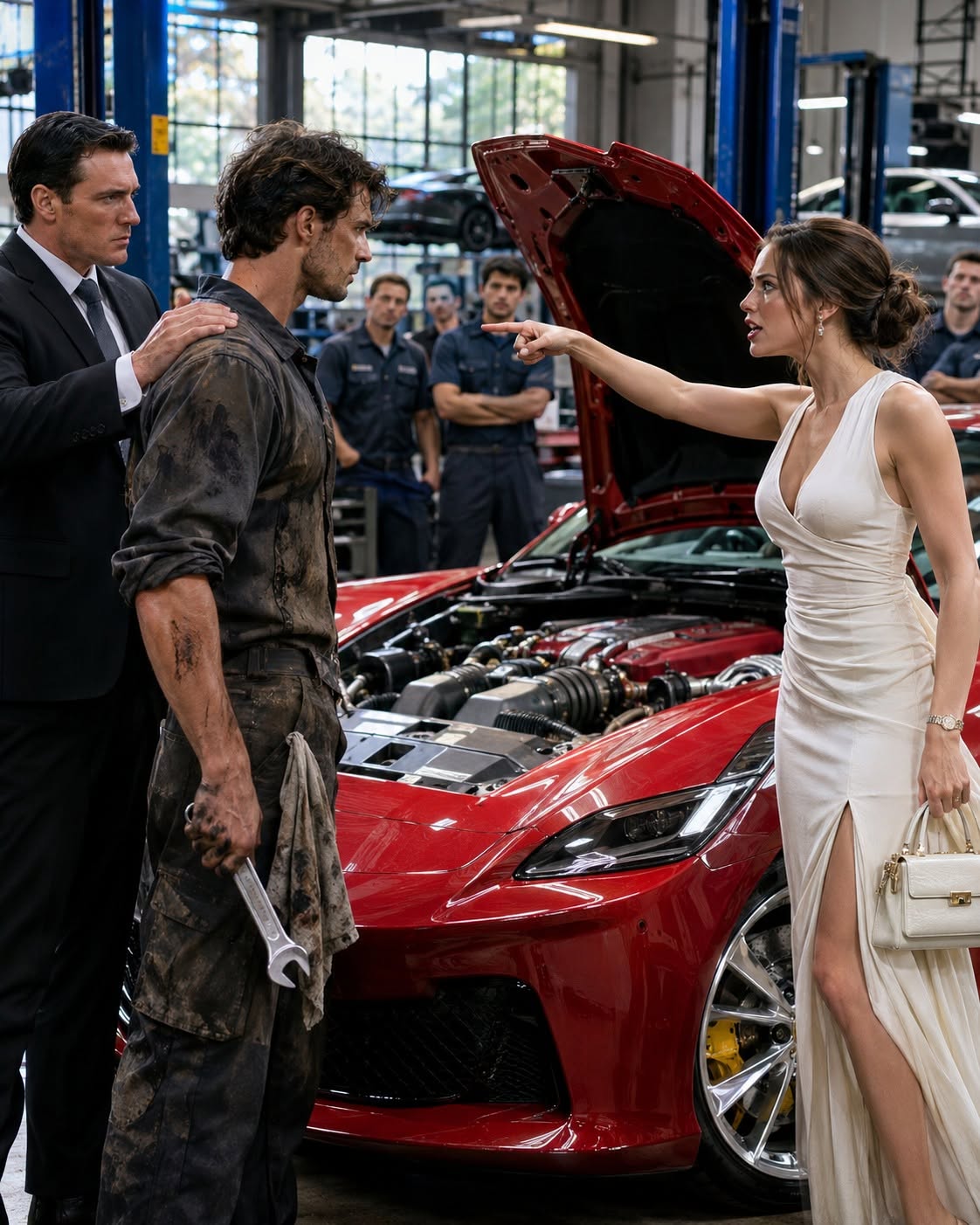
The Ferrari wouldn’t start—not after three days of work, dozens of engineers, and every diagnostic tool money could buy.
“I can offer you something that will change your life,” the CEO said.
I looked at the expensive watch on her wrist, then at the cracked screen of my phone.
“Unless it can pick up my daughter from school in the next twenty minutes,” I said, “I’m afraid it’ll have to wait.”
The garage went silent.
One of the executives raised his eyebrows. The lead engineer looked as though I’d just insulted the president.
But the woman in the tailored suit didn’t seem offended.
Instead, she smiled.
“What’s your daughter’s name?”
“Chloe.”
“How old?”
“Eight.”
She glanced at the clock on the wall.
“Then we have nineteen minutes before you need to leave. My name is Victoria Bennett. And I think nineteen minutes is enough time to tell you why that Ferrari matters more than you realize.”
I hesitated.
Something about the way she said it made me look back at the car.
It was a 1967 Ferrari 330 GTC, painted a deep midnight blue that looked almost black beneath the garage lights. Its leather seats were worn in all the right places, and the wooden steering wheel had been polished by decades of hands.
It was beautiful.
But it was also strangely familiar.
Victoria noticed me staring.
“Do you recognize it?”
“Not exactly,” I said. “But I’ve seen something like it before.”
She exchanged a look with the older executive standing beside her.
Then she said something that made my stomach tighten.
“Your name is Daniel Mercer, isn’t it?”
I slowly turned toward her.
“Yes.”
“And fifteen years ago, you worked for Ashford Performance Technologies.”
I hadn’t heard that name spoken aloud in years.
The toolbox suddenly felt heavier in my hand.
“That was a long time ago.”
“Not long enough for everyone to forget.”
The lead engineer, whose name I’d learned was Richard Collins, straightened.
“Wait. Daniel Mercer? The Daniel Mercer who developed the adaptive ignition calibration system?”
I said nothing.
Richard looked at me differently now.
“I studied your work in graduate school.”
I almost laughed.
Twenty minutes earlier, he’d been making jokes about my dirty jacket.
Now he was looking at me like I’d stepped out of a textbook.
Victoria folded her arms.
“Then you understand why I wanted to meet you.”
“I’m not sure I do.”
She nodded toward the Ferrari.
“That car belonged to my father.”
Her voice softened.
“He bought it when he was twenty-nine. He drove it for forty years. When he became too sick to drive, he asked me to keep it running.”
I looked at the car again.
“He passed away six months ago,” she continued. “Tomorrow would have been his eightieth birthday.”
“I’m sorry.”
“Thank you.”
She ran her fingers along the Ferrari’s roof.
“He left me a letter. In it, he asked me to drive this car to the little church where he married my mother. He wanted me to remember the beginning of their story instead of the end.”
For the first time, I understood why the engineers had looked so exhausted.
This wasn’t simply a mechanical problem.
It was a promise.
“We’ve been trying to get it running for three days,” Victoria said. “And you fixed it in less than ten minutes.”
“Sometimes that’s how it goes.”
“No,” she replied. “Sometimes that’s how it goes when the right person is holding the wrench.”
I glanced at my phone again.
Seventeen minutes.
Victoria stepped closer.
“I want to offer you a position here. Senior Director of Mechanical Innovation. Full benefits. Your own engineering team. A salary of three hundred and twenty thousand dollars a year.”
I stared at her.
For a moment, I wondered if I’d misheard.
Three hundred and twenty thousand dollars.
My repair shop barely brought in enough to cover rent, electricity, and groceries.
Some months, I chose which bills could wait.
Last winter, I’d sold my wedding ring to replace the shop’s heating system.
And now a woman I’d met fifteen minutes earlier was offering me more money than I’d earned in the last five years combined.
Richard looked stunned.
The executives looked uncomfortable.
But Victoria watched me carefully.
“I know it’s unexpected,” she said. “You don’t have to answer today.”
I swallowed.
“There’s something you should know.”
“Go ahead.”
“I leave work at three every afternoon. My daughter has school, and I’m the only parent she has.”
Victoria’s expression changed.
“My wife died four years ago,” I continued. “Chloe was four. I promised her I’d always be there when school ended.”
The room became very quiet.
“I know that probably doesn’t work with a position like this.”
Victoria studied me for a long moment.
Then she said, “You’d be surprised what can work when people stop assuming it can’t.”
Before I could respond, my phone rang.
CHLOE’S SCHOOL.
I answered immediately.
“Hello?”
“Mr. Mercer? This is Mrs. Patterson from Willow Creek Elementary.”
My heart jumped.
“Is Chloe okay?”
“She’s fine. But she’s waiting in the office. She said you were coming, and I wanted to make sure everything was all right.”
I checked the time.
Somehow, more minutes had passed than I’d realized.
“I’m on my way.”
I grabbed my toolbox.
Victoria stepped aside.
“Go get your daughter, Daniel.”
I nodded.
“And about the job—”
“We’ll talk tomorrow.”
I hurried toward the garage door.
But just before I reached it, she called after me.
“One more thing.”
I turned.
“Don’t let anyone convince you that choosing your daughter means you stopped being an engineer.”
I didn’t know what to say.
So I simply nodded and left.
I drove through downtown with my heart pounding.
The traffic lights seemed determined to turn red whenever I approached.
By the time I reached Willow Creek Elementary, the parking lot was almost empty.
Chloe sat on a bench outside the office, swinging her legs.
She wore a yellow sweater and had her hair tied into two uneven braids.
My wife, Emily, had always been better at braiding hair.
I was still learning.
When Chloe saw my truck, she jumped up.
“Daddy!”
I climbed out and hugged her.
“I’m sorry, sweetheart.”
She pulled back and examined my face.
“Did you fix the fancy car?”
I smiled.
“Yeah. I fixed it.”
“Was it red?”
“No. Blue.”
She frowned.
“A blue Ferrari? That’s weird.”
I laughed.
“Apparently, rich people can buy them in different colors.”
She giggled.
Then she noticed something.
“Daddy, why are your hands shaking?”
I looked down.
They were.
I hadn’t realized it.
“Something happened today.”
“Bad something?”
“No.”
I knelt in front of her.
“Maybe something really good.”
Her eyes widened.
“Did we win the lottery?”
“Not exactly.”
“Did someone give us a puppy?”
“No.”
She sighed dramatically.
“Then how good could it be?”
I laughed harder than I had in weeks.
That evening, we ate spaghetti at our little kitchen table.
Chloe told me about a boy in her class who had tried to convince everyone that dinosaurs still lived in Canada.
I listened, laughed, and asked questions.
But my mind kept drifting back to Victoria’s offer.
After dinner, Chloe helped me wash the dishes.
Then she noticed the envelope sticking out of my jacket pocket.
“What’s that?”
I pulled it out.
Inside was a check for fifteen thousand dollars.
I stared at it.
The original agreement had been for five thousand.
Victoria had apparently tripled it.
There was also a handwritten note.
“Your work deserves to be valued. This is payment for the repair, not an advance on tomorrow’s decision. —Victoria”
I sat down.
Fifteen thousand dollars.
Enough to pay the overdue rent.
Enough to replace the broken lift in my shop.
Enough to stop worrying about groceries for a while.
Chloe climbed into the chair beside me.
“Daddy?”
“Yeah?”
“Are we rich now?”
I looked at her.
“No, sweetheart.”
She considered that.
“Can we buy the good cereal?”
I felt something catch in my throat.
“The one with the chocolate marshmallows?”
She nodded seriously.
I pulled her into my arms.
“We can buy two boxes.”
She cheered like I’d just announced a trip to Disneyland.
Later, after I tucked her into bed, I sat alone at the kitchen table.
I opened my old laptop and searched for Victoria Bennett.
The results showed a woman who had transformed her father’s struggling automotive technology company into a billion-dollar business.
She’d expanded into electric vehicles, precision manufacturing, and advanced engineering.
Her company employed nearly four thousand people.
And she wanted me.
I opened another search.
Daniel Mercer, Ashford Performance Technologies.
My old patents appeared.
So did a photograph from fifteen years earlier.
I was standing beside a prototype engine, wearing a clean white shirt and smiling at the camera.
Emily had taken that picture.
Back then, we’d believed the future was something you could plan.
I closed the laptop.
Then I went into my bedroom and opened the bottom drawer of my dresser.
Beneath some old shirts was a small wooden box.
Inside lay Emily’s wedding ring and a photograph of us holding newborn Chloe.
I picked up the picture.
“I don’t know what to do, Em,” I whispered.
The room offered no answer.
But I remembered something she’d told me during her final weeks.
“Don’t make our daughter your excuse for being afraid to live.”
At the time, I’d promised her I wouldn’t.
Four years later, I wasn’t sure I’d kept that promise.
The next morning, I opened my repair shop at seven.
Mercer Auto Repair sat between a laundromat and an abandoned furniture store on the edge of town.
The sign above the door had faded so badly that the red letters looked pink.
I loved that place.
I’d built it with my own hands after leaving engineering.
It had given me a way to earn a living while staying close to Chloe.
But lately, it had begun to feel less like a business and more like a sinking boat.
At eight-thirty, a black SUV pulled into the parking lot.
Richard Collins stepped out.
He wore a pressed shirt and expensive shoes.
I was underneath a pickup truck changing an oil filter.
“Morning,” I called.
He looked around the shop.
“Daniel.”
“Something wrong with the Ferrari?”
“No. It’s running perfectly.”
“Then what can I do for you?”
He hesitated.
“I wanted to talk before your meeting with Victoria.”
I slid out from beneath the truck.
“About what?”
He closed the distance between us.
“Look, I’m going to be straightforward. The position she’s offering you was supposed to be mine.”
I wiped my hands.
“Okay.”
“I’ve worked at Bennett Automotive for eleven years. I’ve led projects, managed teams, and put in eighty-hour weeks.”
“That sounds exhausting.”
His jaw tightened.
“You walk in, fix one loose connector, and suddenly you’re being offered a director’s position.”
“I didn’t ask for it.”
“That doesn’t change anything.”
I leaned against my workbench.
“Richard, if you’re here to tell me I don’t deserve the job, save your breath. I haven’t accepted it.”
He looked surprised.
“You haven’t?”
“No.”
“Why not?”
“Because I have a life outside work.”
He gave a bitter laugh.
“Must be nice.”
Something in his tone caught my attention.
“What does that mean?”
He looked away.
“Nothing.”
I waited.
Finally, he sighed.
“My son turned twelve last month. I missed his birthday dinner because we were preparing that Ferrari for Victoria.”
I didn’t respond.
“My wife says he’s stopped asking when I’ll come home.”
For the first time, Richard didn’t sound arrogant.
He sounded tired.
“Then maybe you should go home,” I said.
He looked at me sharply.
“You think it’s that simple?”
“No. I think it’s that important.”
Richard stared at the floor.
Then his expression hardened again.
“Whatever. I came to warn you. This company isn’t what it looks like from the outside.”
“What do you mean?”
Before he could answer, his phone rang.
He checked the screen and went pale.
“I have to go.”
“Richard—”
But he was already walking toward his SUV.
He drove away without another word.
I stood there wondering what he’d been about to tell me.
At eleven, Victoria called.
“Daniel, could you come by this afternoon?”
“Sure. After I pick up Chloe.”
“Bring her.”
I blinked.
“Bring my daughter?”
“Yes. I’d like to meet the person who’s apparently more important than my entire executive team.”
I laughed.
“She’s a tough negotiator.”
“Then I look forward to meeting her.”
At three-thirty, Chloe and I arrived at Bennett Automotive.
She wore her favorite purple sneakers and carried a notebook filled with drawings.
As we entered the lobby, she whispered, “Daddy, this place looks like a spaceship.”
“Try not to touch anything expensive.”
She immediately put her hands behind her back.
Victoria met us personally.
“You must be Chloe.”
Chloe nodded.
“Are you the boss?”
Victoria smiled.
“I am.”
“Do you get to tell everyone what to do?”
“Sometimes.”
Chloe thought about that.
“My teacher says being bossy isn’t nice.”
Victoria laughed.
“Your teacher sounds wise.”
She led us upstairs to a conference room overlooking the engineering facility.
Below us, dozens of technicians worked on vehicles in spotless bays.
Chloe pressed her face against the glass.
“Daddy, look at all the cars!”
Victoria handed her a small model Ferrari.
“Would you like to build one while your dad and I talk?”
Chloe’s eyes lit up.
Within seconds, she was sitting at the table, assembling tiny pieces.
Victoria turned toward me.
“I reviewed your background last night.”
I nodded.
“Then you probably know why I left Ashford.”
“I know what the public records say.”
I looked at her.
“What do they say?”
“That you resigned after a dispute over a safety system you believed wasn’t ready for production.”
My stomach tightened.
“That wasn’t a dispute.”
Victoria waited.
“It was a warning.”
I took a breath.
“Ashford was developing an electronically controlled throttle system. During testing, I discovered a failure that could cause unintended acceleration under certain conditions.”
“What happened?”
“I reported it. Management told me the problem was statistically insignificant.”
“And you disagreed.”
“I had test data proving otherwise.”
Victoria leaned forward.
“Then why did you resign?”
“Because they ordered me to sign off on the design.”
I remembered the meeting vividly.
The polished table.
The lawyers.
The vice president telling me I was jeopardizing hundreds of jobs.
“I refused. They offered me a promotion and a bonus if I’d change my report.”
Victoria’s expression darkened.
“And when you wouldn’t?”
“They threatened to destroy my career.”
I looked down at my hands.
“Emily had just been diagnosed with cancer. We needed the insurance. We needed the money.”
For a moment, I couldn’t continue.
“But I couldn’t put my name on something I knew might hurt people.”
“What did you do?”
“I documented everything and reported it to the appropriate authorities. The project was suspended. Ashford blamed me for the delay.”
Victoria nodded slowly.
“I remember that investigation.”
“Most people only remember that I disappeared afterward.”
“Why didn’t you return to engineering?”
I looked at Chloe.
She was concentrating on a tiny plastic wheel, her tongue sticking out slightly.
“Because Emily got worse. And after she died, I couldn’t imagine leaving Chloe with strangers for twelve hours a day.”
Victoria followed my gaze.
“Daniel, I didn’t invite you here just because you repaired my father’s car.”
“Then why?”
She slid a folder across the table.
“Because we have a problem.”
Inside were photographs of a new electric performance vehicle.
The design was stunning.
“What is this?”
“Our most ambitious project. The Bennett Axiom.”
She opened another page.
“We’re six weeks from unveiling it. But during recent testing, we’ve experienced three unexplained power interruptions.”
I frowned.
“Three?”
“All under different conditions. Our software team believes they’re unrelated.”
“And you?”
“I don’t believe in three unrelated failures when the same system is involved.”
I studied the diagrams.
Something looked familiar.
Not the hardware.
The assumptions behind the design.
“Who approved the safety architecture?”
Victoria hesitated.
“Richard Collins.”
I looked up.
“And who oversees the project?”
“Our chief operating officer, Martin Hale.”
I recognized the name immediately.
Martin Hale had been a senior executive at Ashford.
The same man who’d tried to make me sign the false safety report fifteen years earlier.
My blood went cold.
“Daniel?” Victoria asked.
I closed the folder.
“You have a bigger problem than you think.”
Before I could explain, the conference room door opened.
A tall man with silver hair entered.
He wore a charcoal suit and carried himself with the confidence of someone accustomed to controlling every room.
Martin Hale.
He stopped when he saw me.
For one brief second, his face lost all color.
Then he smiled.
“Well, well. Daniel Mercer.”
I stood.
“Martin.”
Victoria looked between us.
“You two know each other?”
Martin laughed.
“Of course. Daniel and I worked together years ago.”
He turned to her.
“Victoria, may I speak with you privately?”
“Anything you have to say can be said here.”
His smile tightened.
“Very well. I think hiring Daniel would be a serious mistake.”
The room went silent.
Chloe looked up from her model car.
Victoria’s expression remained calm.
“Why?”
“His departure from Ashford was controversial. There were questions about his judgment.”
I felt the old anger rising.
“Questions raised by you.”
Martin ignored me.
“He has no recent experience managing modern engineering teams. He’s been repairing neighborhood cars for years.”
Victoria leaned back.
“And yet he solved a problem our best engineers couldn’t.”
“One mechanical repair doesn’t qualify someone to lead a major division.”
“Perhaps not,” she said. “But integrity does matter.”
Martin’s eyes narrowed.
“Integrity?”
I stepped forward.
“Tell her about the throttle system, Martin.”
His face changed.
“Be careful, Daniel.”
“Tell her why the project was suspended.”
“That’s confidential.”
“Not the investigation findings.”
Victoria stood.
“Martin, I think you should leave.”
He looked stunned.
“Victoria—”
“Now.”
He glanced at me with an expression I remembered all too well.
Then he walked out.
Chloe waited until the door closed.
“Daddy?”
“Yes, sweetheart?”
“Is that the bad guy?”
Victoria covered her mouth to hide a smile.
I sighed.
“It’s complicated.”
Chloe returned to her model.
“He seems like the bad guy.”
I couldn’t argue.
Victoria looked at me.
“I need you to examine the Axiom.”
I hesitated.
“I’m not employed here.”
“Then I’ll hire you as an independent consultant. Whatever your normal rate is, multiply it by ten.”
“Victoria—”
“Please. If there’s a safety issue, I need to know before someone gets hurt.”
That settled it.
I couldn’t walk away from a possible safety failure.
“Show me the car.”
For the next three hours, I worked alongside Richard and two technicians.
Chloe stayed in a nearby office with coloring books, snacks, and a very patient assistant named Sarah.
The Axiom was an extraordinary machine.
Its battery management system, power electronics, and motor controls represented years of sophisticated engineering.
But as I examined the fault logs, a pattern emerged.
The interruptions weren’t random.
They happened during rapid changes in power demand.
The system detected a mismatch between two sensor readings and shut down propulsion.
That was the correct response to certain dangerous conditions.
But something was triggering the mismatch.
I asked Richard to show me the original validation reports.
He hesitated.
“Why?”
“Because I want to know whether the system is detecting a real problem or reacting to bad information.”
Richard looked toward the security camera.
Then he lowered his voice.
“Some of the reports were revised.”
I stopped.
“Revised how?”
“I don’t know. Martin’s office handled the final documentation.”
“Richard, did you approve those changes?”
He swallowed.
“I signed the final report.”
“Without reviewing it?”
He looked miserable.
“I was told the changes were administrative.”
I stared at him.
“Did you believe that?”
He didn’t answer.
I understood.
He’d spent eleven years building a career.
He’d convinced himself that following orders was the same as doing his job.
Then one of the technicians called out.
“Daniel, you need to see this.”
On the screen was a detailed event log from the second power interruption.
I leaned closer.
The vehicle had been traveling at highway speed when the system cut propulsion.
Not because of a sensor malfunction.
Because an internal software threshold had been altered.
I checked the revision history.
The change had been approved under Martin Hale’s credentials.
My stomach dropped.
“Shut down all road testing,” I said.
Richard looked alarmed.
“We have a demonstration scheduled tomorrow.”
“Cancel it.”
“We can’t just—”
I turned toward him.
“Richard, this car could lose power without warning in traffic. Do you want someone driving it tomorrow?”
He stared at the screen.
Then he picked up his phone.
Within minutes, the engineering floor was buzzing.
Victoria arrived with Martin close behind her.
“What happened?” she demanded.
I showed her the logs.
“Someone changed the protection thresholds without completing the required validation.”
Martin stepped forward.
“That’s a gross oversimplification.”
“Then explain the missing test records.”
He glared at me.
“Those adjustments were made to improve performance.”
“By weakening the safety response?”
“The original settings were too conservative.”
“Then you should have tested the revised settings before approving them.”
His voice rose.
“We don’t have unlimited time!”
Victoria turned toward him.
“Martin, did you authorize those changes?”
He hesitated.
“Technically, yes.”
“Were they validated?”
Silence.
Victoria’s expression hardened.
“Answer me.”
“We were going to complete validation after the demonstration.”
Richard closed his eyes.
Victoria stared at Martin as if she were seeing him for the first time.
“You were going to put an unvalidated vehicle on a public road?”
“It was a controlled event.”
“With journalists in the passenger seats,” I said.
Martin pointed at me.
“This man has been here less than a day! You cannot let him destroy years of work!”
I stepped closer.
“I’m not destroying your work, Martin. I’m trying to keep it from destroying someone else’s life.”
He looked ready to strike me.
Instead, he turned to Victoria.
“If you cancel tomorrow, our investors will panic. The board will demand answers. You’ll lose millions.”
Victoria stood perfectly still.
Then she said, “Cancel the demonstration.”
Martin stared.
“You can’t be serious.”
“I’m completely serious.”
“You’ll regret this.”
Victoria met his eyes.
“I would regret letting someone get hurt a great deal more.”
She turned to security.
“Escort Mr. Hale out of the engineering facility. Suspend his system access pending an independent investigation.”
Martin’s face twisted.
“You’re making a mistake.”
“No,” Victoria replied. “I’m correcting one.”
As security led him away, Richard sat heavily on a stool.
He looked like a man who’d just survived a car crash.
I put a hand on his shoulder.
“You okay?”
He shook his head.
“I knew something was wrong.”
I waited.
“I saw inconsistencies in the reports. I asked questions. Martin told me to focus on my department.”
“Why didn’t you push harder?”
Richard stared at his hands.
“Because I was afraid.”
His voice cracked.
“I’ve got a mortgage. Two kids. My wife hasn’t worked since her surgery. I kept telling myself someone else had checked everything.”
I sat beside him.
“Fear makes people do things they never thought they’d do.”
He looked at me.
“Are you going to tell Victoria I signed the report?”
“She already knows you were responsible for the project.”
“Then I’m finished.”
“Maybe. Maybe not. But you need to tell her the truth.”
He nodded slowly.
Then he stood and walked toward her office.
I watched him go.
I didn’t know whether he’d keep his job.
But for the first time that day, I respected him.
At six-thirty, I found Chloe asleep on a couch in Sarah’s office.
Her model Ferrari sat on the table, completed except for one missing wheel.
I gently picked her up.
She stirred.
“Daddy?”
“I’m here.”
“Did you fix the other car?”
“Not yet.”
She yawned.
“That’s okay. Some things take longer.”
I kissed her forehead.
She rested her head against my shoulder.
As I carried her toward the elevator, Victoria approached.
“Daniel.”
I stopped.
“Thank you.”
“You did the right thing.”
“You made it easier.”
She looked at Chloe.
“Have you thought about my offer?”
I hesitated.
“I have.”
“And?”
“I can’t accept the position the way it’s written.”
She nodded, disappointed but unsurprised.
“I understand.”
“But I have a different proposal.”
Her eyebrows rose.
“I’m listening.”
“I want to keep my repair shop.”
Victoria tilted her head.
“I see.”
“I want to turn it into a training center. A place where young mechanics, technicians, and engineers can learn to solve problems with their hands and their minds.”
I glanced toward the engineering floor.
“People like Richard know more about software than I ever will. People like me know what a worn connector feels like before a diagnostic tool finds it. We need both.”
Victoria listened carefully.
“I’d like Bennett Automotive to sponsor the center,” I continued. “Provide equipment, scholarships, and internships. I’ll consult on safety-critical projects, but I won’t spend my life sitting in meetings.”
“And your daughter?”
“I’ll still pick her up at three.”
Victoria smiled.
“That’s quite a proposal.”
“I know.”
“What would you call this training center?”
I looked down at Chloe.
Then I thought of Emily.
Her encouragement.
Her stubborn belief that knowledge was only valuable when it helped someone.
“The Emily Mercer Institute,” I said.
Victoria’s smile softened.
“I like it.”
She extended her hand.
“Let’s discuss the details tomorrow.”
I shook it.
But the story didn’t end there.
Three days later, Bennett Automotive publicly announced that the Axiom demonstration had been postponed pending additional safety testing.
The company’s stock dropped sharply.
Financial reporters called it a disaster.
Industry commentators questioned Victoria’s leadership.
And then something unexpected happened.
A major automotive safety organization praised the decision.
Other manufacturers began reviewing their own validation procedures.
Engineers from across the country wrote to Bennett Automotive, thanking the company for choosing transparency over deadlines.
Two weeks later, an independent investigation confirmed that Martin had authorized multiple changes without adequate testing and had pressured employees to approve incomplete documentation.
He was dismissed.
The findings were referred to the appropriate authorities.
Richard wasn’t fired.
Instead, Victoria placed him on a corrective action plan and required him to help rebuild the company’s safety review process.
He accepted responsibility publicly within the engineering department.
One afternoon, he came to my shop.
This time, he wore jeans and an old sweatshirt.
He looked around at the cluttered workbenches.
“Need a hand?”
I raised an eyebrow.
“With what?”
He pointed toward a battered engine sitting on a stand.
“That.”
I smiled.
“Ever rebuilt a carburetor?”
“Not since college.”
“Then you’re about to remember how.”
We worked until the sun began to set.
At three, I left to pick up Chloe.
Richard stayed behind and cleaned the workbench.
When I returned, he was still there.
“You know,” he said, “my son asked me to help him build a go-kart.”
“Sounds like a good project.”
“I told him I didn’t have time.”
I looked at him.
“And now?”
He smiled faintly.
“I think I’ll make time.”
Six months later, the Emily Mercer Institute opened its doors.
It wasn’t a grand building.
It was my old repair shop, renovated with new equipment, brighter lights, and enough workstations for twenty students.
The faded sign was replaced with a simple blue one.
EMILY MERCER INSTITUTE
ENGINEERING BEGINS WITH CURIOSITY
Victoria funded the renovation through a company grant.
Several local businesses donated tools.
Retired mechanics volunteered to teach.
And Bennett Automotive created paid apprenticeships for students who completed the program.
Our first class included high school graduates, career changers, and two single parents who needed flexible schedules.
One student was a nineteen-year-old named Marcus.
He’d been rejected by three technical programs because of his poor grades.
But during his interview, he took apart a broken lawn mower engine and identified a damaged valve without being asked.
I accepted him on the spot.
Three months later, Marcus diagnosed a complicated electrical problem that had stumped two experienced technicians.
When I congratulated him, he looked embarrassed.
“Nobody ever told me I was good at anything before.”
I remembered standing in that private garage, surrounded by people who’d judged me by my jacket.
“Get used to hearing it,” I told him. “You’ve earned it.”
On opening day, Victoria arrived in her father’s blue Ferrari.
It purred into the parking lot like a living memory.
Chloe ran outside.
“That’s the car Daddy fixed!”
Victoria stepped out, laughing.
“It certainly is.”
She handed Chloe the keys.
Chloe’s eyes widened.
“Can I drive?”
“Not for another eight years.”
Chloe groaned.
“That’s forever.”
Victoria laughed.
Then she turned toward me.
“Would you like to take it for a spin?”
I looked at the Ferrari.
For a moment, I imagined myself behind the wheel, driving down an open road.
Then Chloe tugged my sleeve.
“Daddy, can we go get ice cream?”
I smiled.
“Actually, I’ve got a better idea.”
I turned to Victoria.
“Would you mind taking us both?”
Twenty minutes later, the three of us were parked outside a little ice cream shop near the river.
Victoria sat in the driver’s seat.
Chloe and I shared a chocolate sundae at an outdoor table.
The Ferrari drew plenty of attention.
People stopped to take pictures.
A teenager asked Victoria how much it was worth.
She considered the question.
“More than I could ever sell it for,” she said.
The boy looked confused.
“But what’s the price?”
Victoria smiled.
“Some things have a price. Others have a story.”
That evening, after the celebration ended, Chloe and I returned home.
Our house was still small.
The kitchen cabinets still needed painting.
My truck still had two hundred thousand miles on it.
But the overdue bills were gone.
The shop was thriving.
And for the first time in years, I wasn’t afraid of opening the mailbox.
After dinner, Chloe sat beside me on the porch.
The sky was turning orange.
“Daddy?”
“Yeah, sweetheart?”
“Are you famous now?”
I laughed.
“Not even close.”
“But Mrs. Patterson said you saved a car company.”
“I helped some people find a problem.”
“That’s kind of like saving them.”
“Maybe a little.”
She thought about that.
Then she asked, “Are you going to become one of those rich people who never come home?”
I turned toward her.
Her expression was serious.
I realized she’d been carrying that worry since the day I’d told her about Victoria’s offer.
I put my arm around her.
“No, Chloe.”
“Promise?”
“Promise.”
She leaned against me.
“Good. Because I still need help with fractions.”
I laughed.
“Sweetheart, fractions might be harder than fixing a Ferrari.”
She giggled.
We sat together until the first stars appeared.
A week later, Victoria sent me a framed photograph.
It showed the original Ferrari garage on the day we’d met.
I was leaning over the engine in my stained jacket, holding a small flashlight.
Behind me stood Richard and the other engineers.
On the back, Victoria had written:
“Thank you for reminding us that the smallest overlooked thing can change everything.”
I hung the photograph beside Emily’s picture in my office.
For a long time, I stood looking at them.
One showed the day my life had unexpectedly opened a new door.
The other showed the woman who’d taught me how to walk through it.
I thought about the years I’d spent believing that leaving my engineering career meant I’d failed.
I thought about the nights I’d worried that Chloe deserved a father who could give her more.
More money.
More opportunities.
A bigger house.
A better life.
But somewhere along the way, I’d forgotten that a better life wasn’t always a bigger one.
Sometimes it was having dinner together.
Sometimes it was being there when the school bell rang.
Sometimes it was teaching a young man that his hands and his mind were worth something.
And sometimes it was finding the courage to say no to a wonderful opportunity so you could build one that was right for you.
One Friday afternoon, nearly a year after I’d repaired the Ferrari, I was closing the shop when a familiar black SUV pulled into the parking lot.
Richard stepped out with his twelve-year-old son, Ethan.
They were carrying a cardboard box.
“Got a minute?” Richard asked.
“Sure.”
Ethan placed the box on my workbench.
Inside was a small homemade go-kart engine.
It was covered in grease and missing a few bolts.
“We can’t get it started,” Ethan said.
I looked at Richard.
He grinned.
“We’ve tried everything.”
I laughed.
“Well, that’s usually when things get interesting.”
Ethan watched as I examined the engine.
I checked the fuel line, inspected the spark plug, and followed the wiring.
Then I noticed a small connector hanging loose beneath the ignition coil.
I pointed to it.
“What do you think that does?”
Ethan leaned closer.
“Carries electricity?”
“Exactly. And what happens if it’s not connected?”
He looked at the engine.
Then at me.
His face lit up.
“It won’t start!”
I handed him a flashlight.
“Then I think you know what to do.”
He carefully secured the connector.
Richard watched without interfering.
Ethan stepped back and pulled the starter cord.
The engine sputtered.
Then roared to life.
Ethan shouted with excitement.
Richard threw his arms around his son.
For a moment, neither of them noticed me standing there.
I didn’t mind.
That was the whole point.
A few minutes later, Chloe came running into the shop, her backpack bouncing against her shoulders.
“Daddy! Ready to go?”
I checked the clock.
Three o’clock.
Right on time.
I put down my wrench.
“Always.”
As we walked toward my truck, Ethan called after me.
“Mr. Mercer?”
I turned.
“Yeah?”
“When I grow up, I want to be an engineer like you.”
I smiled.
“Then start by staying curious.”
He nodded.
“And don’t be afraid to get your hands dirty.”
Richard laughed.
Chloe slipped her hand into mine.
We climbed into the truck and drove home beneath the warm afternoon sun.
The world hadn’t suddenly become perfect.
There would still be difficult days, broken machines, unexpected bills, and problems nobody knew how to solve.
But I no longer measured my worth by the size of my paycheck or the title printed on a business card.
I’d learned that success wasn’t about being the most important person in the room.
It was about knowing what mattered when you walked out of it.
And the greatest thing I ever repaired wasn’t a million-dollar Ferrari.
It was the belief that I had to choose between being a good father and being the person I was born to be.
Because sometimes, the life you’ve been searching for doesn’t require abandoning everything you’ve built.
Sometimes it only takes one small connection, overlooked by everyone else, to remind you where you truly belong.
And on that ordinary Friday afternoon, with my daughter’s hand in mine and the sound of a young boy’s laughter fading behind us, I knew exactly where that was.
Home.