The chairman looked at my grease-stained shirt, then at my six-year-old son, and laughed. “You honestly think a backyard mechanic can restore a Caldwell Hargrove Sovereign?”
Arthur Vance stood beside the restored Sovereign, waiting for my answer.
I wiped my hands on an old rag and looked at him.
“My father taught me.”
Arthur’s expression changed slightly.
“Your father? Who was he?”
I hesitated for a moment.
“Daniel Mercer. He used to work on experimental engines for Caldwell Hargrove.”
The name seemed to strike him like a physical blow.
A murmur traveled through the people standing nearby.
Arthur slowly lowered his clipboard.
“Daniel Mercer?” he repeated. “That’s impossible.”
I gave him a tired smile.
“My father died eleven years ago. I wouldn’t call it impossible.”
Arthur glanced at the engine again, then back at me.
“Your father was dismissed from Caldwell Hargrove in 1998. His engineering credentials were revoked. He was accused of stealing proprietary designs.”
I felt my jaw tighten.
There it was.
The story I’d spent most of my childhood trying to forget.
“My father never stole anything,” I said quietly.
Arthur looked uncomfortable.
Before he could respond, Evelyn Sterling approached us. She had been listening to the entire conversation.
“Mr. Vance,” she said, “I think we should let him explain.”
Arthur folded his arms.
“I’m waiting.”
I looked at the Sovereign.
“Then perhaps we should start with the engine.”
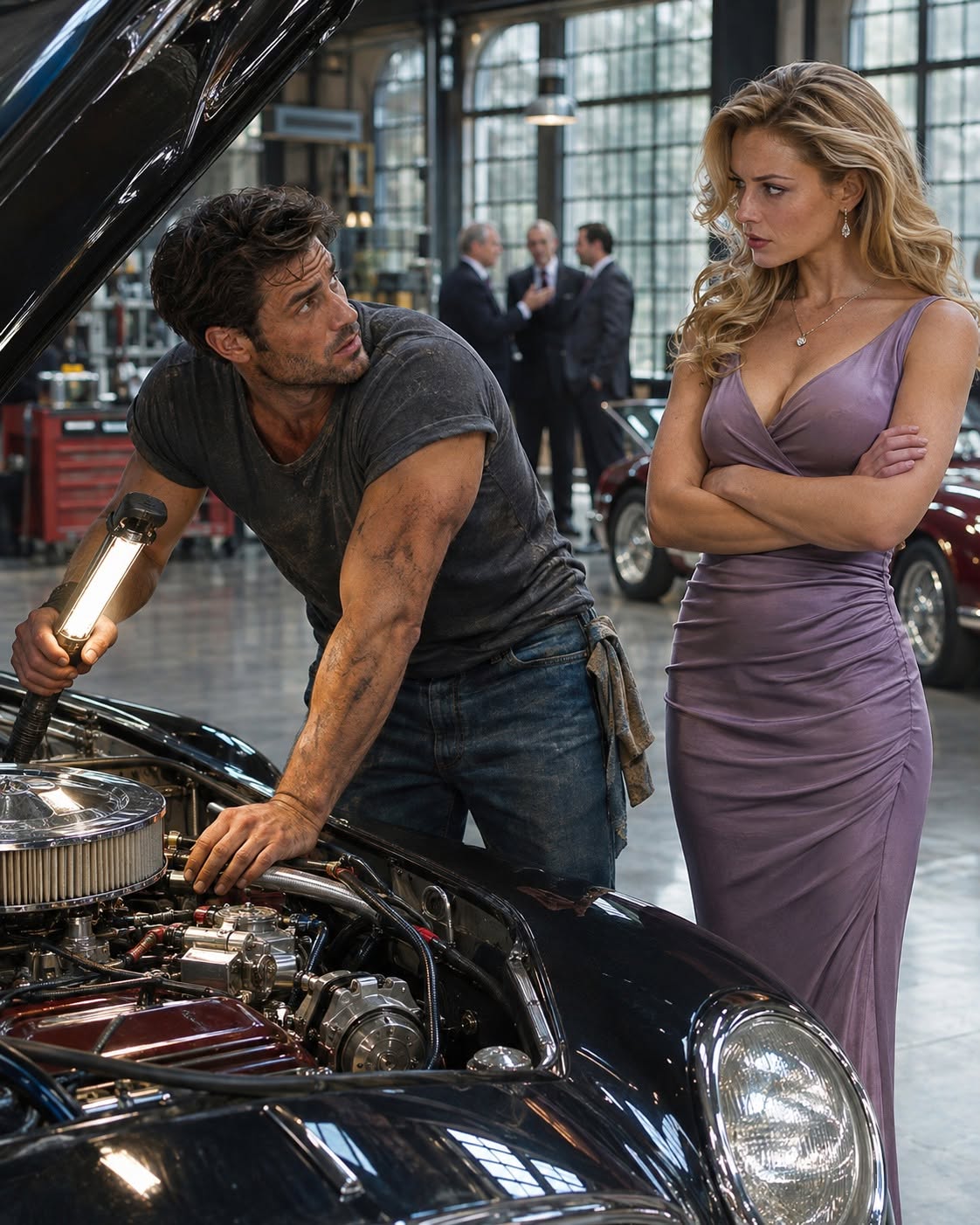
I opened the hood and pointed toward the timing assembly.
“Everyone who attempted this restoration treated the twin-spline mechanism as a conventional synchronized timing system. They assumed the two spline shafts had to rotate at precisely the same speed.”
Arthur nodded reluctantly.
“That is what the technical specifications indicate.”
“Because those specifications are incomplete.”
I reached into my toolbox and removed a small, battered notebook.
The leather cover was cracked, and several pages had yellowed with age.
“This belonged to my father.”
I opened it to a diagram I’d memorized years ago.
“The original Sovereign engine wasn’t designed to use two independently synchronized shafts. The second spline was supposed to compensate for pressure fluctuations during high-load transitions.”
Arthur leaned closer.
“That’s not in the official documentation.”
“No. It was in the experimental documentation. My father designed that system.”
A few people exchanged glances.
I continued.
“The problem is that the second shaft requires a specific offset during the transition between compression and ignition. Every shop that worked on this car adjusted the timing according to the published specifications. They were correcting a problem that wasn’t actually there.”
Evelyn stared at the notebook.
“Are you saying your father designed this engine?”
“He designed the timing assembly. He was part of the original engineering team.”
Arthur’s face had lost some of its confidence.
“Why didn’t you mention this when you entered?”
I looked at him.
“Because I wanted the engine restored. I didn’t come here to settle an argument about my father’s reputation.”
For several seconds, nobody spoke.
Then Arthur did something unexpected.
He laughed.
Not the loud, mocking laugh from the previous day.
This one was nervous.
“Interesting story,” he said. “But a notebook isn’t proof.”
I nodded.
“I agree.”
He seemed surprised.
“So what would convince you?”
I closed the notebook.
“Let the engine run under load. Then have an independent engineer inspect the timing assembly. If the system performs as I’ve described, the restoration should speak for itself.”
Arthur looked toward the competition judges.
“Fine.”
He turned to the technical team.
“Prepare the testing station.”
I noticed something in his expression.
He wasn’t simply skeptical anymore.
He was worried.
And I was beginning to understand why.
The testing station occupied the center of the exhibition hall. It had been built specifically for engines that required controlled performance demonstrations.
A team of mechanics connected the Sovereign to the diagnostic equipment.
Evelyn stood beside me while Toby held my hand.
“Your father sounds like he was an extraordinary engineer,” she said.
“He was,” I replied. “But people didn’t always give him credit.”
She studied my face.
“Is that why you became a mechanic?”
I smiled faintly.
“I suppose so. My father used to tell me that an engine didn’t care about your education, your clothes, or your bank account. It only cared whether you understood what you were doing.”
Evelyn looked at my grease-stained shirt.
“I think he would be proud of you.”
Before I could answer, the chief technician called us over.
“Everything is connected.”
I checked the fuel pressure, inspected the cooling system, and reviewed the sensor readings.
Then I nodded.
“Start it.”
The engine came alive with a deep, steady rumble.
Several spectators moved closer.
The diagnostic monitor began displaying the operating parameters.
At first, everything looked normal.
Then the engine entered the first load cycle.
The sound changed.
A slight metallic vibration emerged from the rear of the assembly.
I frowned.
“Stop the test.”
The technician immediately cut the ignition.
Arthur stepped forward.
“What happened?”
“Something isn’t right.”
He gave me a thin smile.
“Perhaps your father’s design wasn’t as reliable as you believe.”
I ignored him and leaned over the engine.
The vibration had been brief, but I had heard something familiar.
I checked the oil pressure.
Normal.
I examined the timing readings.
Normal.
Then I noticed a small discrepancy in the second spline’s return position.
It was less than a millimeter.
But it mattered.
“Who installed this coupling?” I asked.
One of the technicians raised his hand.
“I did. According to the restoration instructions.”
“Where did you get the replacement?”
“From the competition’s approved parts supplier.”
I examined the component more closely.
The metal finish looked correct, but the internal machining was slightly different.
I took out my measuring gauge.
Then I looked at Arthur.
“Who approved this part?”
Arthur didn’t answer immediately.
“It’s an authorized replacement.”
“That’s not what I asked.”
His expression hardened.
“Are you suggesting someone supplied a defective component?”
“I’m suggesting this coupling has the wrong internal clearance.”
I turned to the technician.
“Can you remove it?”
He looked uncertainly at Arthur.
Evelyn stepped forward.
“Please do what he asks.”
The technician began disassembling the coupling.
When it came free, I placed it on the workbench and measured the internal channel.
My suspicion was confirmed.
The original design required a clearance of 0.18 millimeters.
This replacement had a clearance of 0.31.
That difference was enough to disrupt the second spline under heavy load.
I looked at the technician.
“Do you have the original part?”
He shook his head.
“Not anymore. It was discarded when we started the restoration.”
I closed my eyes briefly.
The replacement part hadn’t come from the three restoration companies that had failed.
It had come from the competition’s own supplier.
I glanced at Arthur.
He looked genuinely surprised.
But something about his reaction bothered me.
“Can you make another one?” Evelyn asked.
“Yes,” I replied. “But it will take several hours.”
Arthur checked his watch.
“The final demonstration is in two hours.”
“Then we’ll need to work quickly.”
He shook his head.
“I’m afraid the rules don’t allow modifications during the official demonstration.”
I looked at him.
“You’re telling me I can’t correct a defective part?”
“I’m telling you that the competition has strict procedures.”
Evelyn’s expression became cold.
“Mr. Vance, I paid to enter this vehicle because I wanted it restored, not because I wanted it displayed as an ornament.”
Arthur straightened.
“The rules apply to everyone.”
“Then apply them fairly.”
The room grew quiet.
Arthur looked around at the spectators.
“I will consult the technical committee.”
He walked away.
Toby tugged at my sleeve.
“Daddy?”
I crouched beside him.
“What is it, buddy?”
“Is the car broken again?”
I looked at his worried face.
“Not really. We just found one more problem.”
“Can you fix it?”
I smiled.
“That’s what mechanics do.”
He nodded as if that settled everything.
Then he reached into his little backpack and pulled out a folded piece of paper.
“I made you something.”
It was a drawing of the Sovereign.
The wheels were enormous, the hood was bright blue, and a tiny figure stood beside it holding a wrench.
At the bottom, Toby had written in crooked letters:
MY DAD CAN FIX ANYTHING.
I swallowed hard.
For a moment, the noise of the exhibition hall seemed to disappear.
I folded the drawing carefully and placed it inside my father’s notebook.
“Thank you, buddy.”
Then I stood up and returned to the workbench.
I had a coupling to remake.
And I wasn’t going to let anyone stop me.
The next hour passed in a blur.
Evelyn arranged access to a small machine shop behind the exhibition building.
I studied the original design in my father’s notebook, calculated the required tolerances, and began machining a replacement coupling.
Two young technicians volunteered to help.
They had initially joined the competition because they wanted to learn from the famous restoration companies.
Now they were watching a man in an old shirt build a component from scratch.
One of them, a young woman named Claire, examined the notebook.
“Mr. Mercer, can I ask something?”
“Of course.”
“Why does your father’s drawing show a relief channel on the inside of the coupling?”
I smiled.
“Because the second spline needs somewhere to release excess pressure during the transition.”
She studied the diagram.
“But the official replacement doesn’t have that.”
“Exactly.”
She looked at me with growing excitement.
“So the original design was never intended to be completely sealed?”
“Now you’re getting it.”
Claire immediately began checking the measurements.
The other technician, Marcus, inspected the machining equipment.
Together, we finished the new coupling in just under an hour.
I cleaned it, checked the dimensions twice, and handed it to the team.
“Let’s put it in.”
As we worked, Evelyn returned with a folder.
“I found something,” she said.
She placed several documents on the bench.
They were old correspondence records from the original Caldwell Hargrove development project.
My father’s name appeared on several pages.
So did another name.
Arthur Vance.
I stared at the documents.
“Where did you get these?”
“They were included in the Sovereign’s original ownership archive. I requested the complete records when I purchased the car.”
I turned the pages.
Arthur had been a junior administrative engineer at Caldwell Hargrove during the final years of the Sovereign project.
He had also signed several reports concerning my father’s dismissal.
One document caught my attention.
It was a technical review dated October 1998.
The report accused Daniel Mercer of removing confidential engine designs from the company’s development facility.
But beneath the accusation was a handwritten note.
The handwriting was unmistakable.
My father’s.
He had written:
The timing design has been altered without authorization. If the original assembly is not restored, the Sovereign will fail under sustained load.
Below it was another signature.
Arthur Vance.
I felt the room tilt slightly.
“What happened?” Evelyn asked.
I pointed to the document.
“My father warned them. Someone had changed the timing specifications, and he refused to approve the alteration.”
Evelyn turned another page.
“And this?”
It was a letter from the company’s legal department.
The company had accused my father of stealing proprietary documents after he refused to sign the revised design.
I read the final paragraph twice.
The case had been closed without a public hearing.
My father had lost his position, his professional standing, and eventually his ability to work in the industry.
He never spoke much about those years.
He simply took small repair jobs and raised me as best he could.
I remembered him sitting at our kitchen table, drawing mechanical diagrams on the backs of grocery receipts.
I remembered asking why he didn’t return to engineering.
He had always answered the same way.
“Sometimes doing the right thing costs more than people expect, son.”
Now I understood.
Arthur had known who my father was from the beginning.
He hadn’t simply doubted my qualifications.
He had recognized the name.
And he had wanted me removed before I could demonstrate the engine’s true design.
I looked toward the exhibition hall.
Arthur was standing near the judges’ table, speaking quietly with another committee member.
Evelyn followed my gaze.
“Do you think he knew?”
“I think we need to ask him.”
I finished installing the coupling.
Then I checked every connection and prepared the Sovereign for another test.
This time, the engine ran smoothly.
The first load cycle passed.
Then the second.
Then the third.
The metallic vibration was gone.
The diagnostic monitor displayed stable pressure, consistent timing, and an impressive level of mechanical efficiency.
Claire looked at the readings.
“This is incredible.”
Marcus grinned.
“You didn’t just repair it. You corrected the original engineering problem.”
I nodded.
“We corrected a problem that should never have been there.”
Then a voice came from behind us.
“Enough.”
Arthur had returned.
He stood beside the testing station with two security officers.
“Mr. Mercer, your demonstration is suspended pending a review of your unauthorized modifications.”
Evelyn stepped between us.
“Those modifications were necessary to correct an approved replacement part that was manufactured incorrectly.”
“The component was supplied under competition authorization.”
“Then the supplier should be investigated.”
Arthur ignored her.
“Your entry has already violated the rules.”
I looked at him.
“Is that why you stopped my father, too?”
His face changed.
“Be careful what you accuse people of.”
I opened the folder Evelyn had given me and held up the old technical review.
“Did you sign this report?”
Arthur looked at the page.
For a fraction of a second, the confidence disappeared from his face.
Then he recovered.
“That matter was resolved decades ago.”
“Not for my father.”
“You have no idea what happened back then.”
“Then explain it.”
Arthur looked around.
The spectators had begun gathering again.
He lowered his voice.
“This is not the place.”
I took a breath.
“Perhaps it should be.”
Evelyn stepped forward.
“I agree. The committee should hear everything.”
Arthur turned toward the judges.
“This is becoming a distraction from the competition.”
But one of the senior judges, an elderly engineer named Harold Bennett, had been examining the documents.
He adjusted his glasses.
“Mr. Vance, I would like to see that report.”
Arthur hesitated.
Harold took the folder and read it carefully.
Then he looked at me.
“Your father was Daniel Mercer?”
“Yes, sir.”
Harold’s expression softened.
“I worked with him.”
I stared at him.
“You did?”
He nodded.
“He was one of the finest mechanical designers I ever met.”
Arthur shifted uneasily.
Harold continued.
“I remember the Sovereign project. I remember the dispute. And I remember being told that Daniel had resigned voluntarily.”
I felt my throat tighten.
“He didn’t resign. He was fired.”
Harold closed the folder.
“Then someone lied.”
The silence that followed was heavier than anything I’d experienced that day.
Harold turned to Arthur.
“I want the original project records reviewed immediately.”
Arthur’s voice rose.
“This committee has no authority to reopen a corporate employment dispute from nearly thirty years ago.”
“Perhaps not,” Harold replied. “But we have every right to investigate whether this competition has been compromised by a conflict of interest.”
Arthur went pale.
Evelyn placed another document on the table.
It was a recent invoice from the competition’s authorized parts supplier.
The replacement coupling had been ordered under a special instruction.
The instruction specified a modified internal clearance.
The authorization signature belonged to Arthur Vance.
Everyone stared at him.
Arthur opened his mouth, then closed it.
I felt a cold anger settle inside me.
“You knew the part wouldn’t work.”
He shook his head.
“You don’t understand the technical specifications.”
“Then why did you personally authorize a component that contradicted them?”
He said nothing.
Evelyn looked at the judges.
“I want the entire restoration process independently examined. Every document, every part, and every decision.”
Harold nodded.
“So do I.”
Arthur tried to leave.
But the two security officers stepped forward.
“Mr. Vance,” Harold said, “please remain here while the committee conducts its review.”
For the first time since I’d arrived, Arthur had no answer.
The investigation lasted several hours.
The competition was temporarily suspended, and the technical committee examined the Sovereign’s engine, the replacement components, and the original engineering records.
What they discovered was worse than I had expected.
The altered coupling wasn’t an isolated mistake.
Several replacement components supplied to previous restoration shops had been manufactured to the same incorrect specifications.
The companies had spent thousands of hours trying to compensate for problems created by those parts.
Their failures had damaged their reputations.
Some had even returned the Sovereign to Evelyn, claiming that its original design was fundamentally flawed.
But the original design had never been the problem.
Arthur had been involved in a private dispute with my father decades earlier.
The documents revealed that my father had refused to approve a revised timing assembly that Arthur wanted included in the production model.
My father believed the modification would make the engine unstable under sustained load.
He had refused to put his name on it.
The company had chosen to protect the project rather than investigate the warning.
Arthur had helped prepare the accusation that ended my father’s career.
Years later, when the Sovereign became the centerpiece of Evelyn’s restoration project, Arthur recognized the opportunity to bury the original design once more.
He had not expected the son of Daniel Mercer to walk through the exhibition doors.
And he certainly hadn’t expected that son to know how to repair the engine.
The committee eventually announced that Arthur would be suspended from his position pending a formal investigation.
The supplier’s authorization was revoked.
The competition’s official records were also amended to acknowledge the original design work.
But there was one final surprise.
Harold Bennett approached me after the announcement.
“There’s something else you should know.”
He handed me a sealed envelope.
The paper was old, but the handwriting on the front was unmistakable.
Daniel Mercer.
I stared at it.
“Where did you find this?”
“In the original Caldwell Hargrove archive. It was never delivered.”
My hands began to tremble.
I opened the envelope carefully.
Inside was a letter dated three weeks before my father was dismissed.
It read:
To my son,
If you’re reading this, perhaps you’ve found your way into the world of machines.
I hope you have.
I hope you understand that there is beauty in taking something broken and discovering what it was meant to become.
One day, someone may tell you that you aren’t qualified to do something because you don’t have the right title, the right clothes, or the right connections.
Don’t let them decide what you’re capable of.
But remember this: being able to repair a machine is not the same as knowing what to do with the knowledge you have.
Use what you know to help people. Never use it to humiliate them.
And if you ever have to choose between protecting your reputation and telling the truth, choose the truth.
It may cost you something.
But at least you’ll still be able to look at yourself in the mirror.
I love you, son.
Dad.
I read the letter twice.
Then a third time.
I had spent years wishing my father could see me standing in that exhibition hall.
Now, in a way, he was there.
Toby appeared beside me.
“Daddy, are you crying?”
I laughed softly and wiped my eyes.
“Just a little, buddy.”
He looked at the envelope.
“Is that from Grandpa?”
I nodded.
“Yeah.”
“Did he fix cars, too?”
I crouched down.
“He did more than fix cars. He helped people understand things that nobody else could figure out.”
Toby thought about that for a moment.
“Like you?”
I hugged him.
“Hopefully, like both of us.”
The following morning, the final awards ceremony took place.
The committee had originally planned to award prizes based on appearance, historical accuracy, and mechanical performance.
After everything that had happened, they introduced a new category.
The Heritage Engineering Award.
It recognized restorations that preserved the original intent of an engineering design while demonstrating exceptional technical understanding.
Harold Bennett stepped onto the stage.
He held a small wooden presentation case.
“Today, we recognize a restoration that accomplished something extraordinary,” he announced.
“The Caldwell Hargrove Sovereign was considered beyond repair by several established companies. Its original engineering documentation was incomplete, its replacement components were incorrect, and its historical design had been misunderstood for decades.”
He paused.
“Yet one mechanic, working with limited equipment and an extraordinary understanding of the original engineering principles, restored the vehicle to operational condition.”
He looked toward me.
“Ladies and gentlemen, please welcome Daniel Mercer’s son, the restorer of the Sovereign.”
The applause began slowly.
Then it spread throughout the hall.
I walked onto the stage with Toby holding my hand.
Harold handed me the presentation case.
Inside was a beautifully engraved silver medal.
It bore two names.
DANIEL MERCER
AND
HIS SON
I couldn’t speak.
Harold leaned closer.
“Your father should have received recognition a long time ago.”
I looked down at the medal.
“He would have appreciated this.”
Then I glanced at Toby.
“But I think he’d be happier knowing the truth finally came out.”
The crowd applauded again.
Evelyn approached the stage after the ceremony.
“I’d like to make you an offer,” she said.
I raised an eyebrow.
“What kind of offer?”
She smiled.
“I own a small collection of vintage vehicles, and I’ve been looking for someone to oversee their restoration. I’d like you to take the position.”
I looked at my hands.
They were still rough, with small cuts from the machining work.
“I appreciate it, but I have a repair shop back home.”
“Then keep it. I’m not asking you to abandon what you’ve built. I’m offering you the resources to expand it.”
She handed me a folder.
Inside was a proposal to establish an independent restoration workshop dedicated to preserving historically important engineering designs.
There was also a scholarship fund for young mechanics who couldn’t afford formal technical education.
I looked at her.
“Why are you doing this?”
Evelyn smiled.
“Because I know what it feels like to have people dismiss something valuable simply because they don’t recognize it.”
She glanced at Toby.
“And because I think the world needs more people who believe that skill should be measured by what someone can do, not by the title printed on their business card.”
I accepted the folder.
But I made one condition.
The scholarship had to carry my father’s name.
Evelyn agreed immediately.
Six months later, our little repair shop looked completely different.
We still had the old wooden workbench, the same battered toolbox, and the same sign hanging above the entrance.
MERCER AUTO REPAIR.
But now there was a new room at the back.
It contained precision machining equipment, diagnostic systems, and a small library of historical engineering documents.
Above the door was a plaque:
THE DANIEL MERCER ENGINEERING WORKSHOP.
Young mechanics came from surrounding towns to learn.
Some had degrees.
Some had never attended college.
A few were former apprentices who had been told they weren’t smart enough to work on complicated machinery.
I treated them all the same.
I taught them to measure twice, question assumptions, and never confuse confidence with knowledge.
Toby became a regular visitor.
He had a proper little workbench now, complete with child-sized tools.
His toy wrench still sat on the shelf above it.
One afternoon, I found him helping a young apprentice clean an old carburetor.
He was explaining something with great seriousness.
“See? You have to look carefully. Sometimes the problem isn’t where everyone thinks it is.”
I stood in the doorway, smiling.
The apprentice looked at me.
“Is that something you taught him?”
I shook my head.
“Some things he figured out himself.”
That evening, after everyone had gone home, I took my father’s old notebook from the drawer.
I opened it to the first page.
There, in his familiar handwriting, were three words:
UNDERSTAND BEFORE REPAIRING.
I ran my thumb across the faded ink.
For years, I’d believed my father’s greatest legacy was the engineering knowledge he’d passed down to me.
But now I understood that it was something much bigger.
He had taught me that true expertise didn’t need to announce itself.
It showed up in patience, in careful work, and in the willingness to admit when something needed another look.
He had also taught me that the truth could take decades to emerge, but it was still worth protecting.
Toby appeared at the workshop door, holding his little toy wrench.
“Daddy, are you coming home?”
I closed the notebook.
“Right behind you, buddy.”
He ran toward the parking lot.
I followed him, switching off the lights behind me.
Outside, the evening sun reflected off the polished hood of the Sovereign, which Evelyn had loaned to our workshop for educational demonstrations.
For a moment, I stopped and looked at it.
The engine hummed softly as it cooled.
A machine that had once been considered impossible to restore was now running better than it had in years.
But the greatest thing we had repaired wasn’t the engine.
It was a truth that had been buried for nearly three decades.
And as I watched my son run toward the future with a toy wrench in his hand, I finally understood something my father had tried to teach me all along:
A person’s worth isn’t measured by the credentials they carry or the respect others give them. It’s measured by the honesty of their work, the courage to stand by what is right, and the knowledge they choose to pass on.
I smiled, turned off the workshop lights, and went home with my son.
For the first time in a very long time, I felt that my father had finally received the justice he deserved.