The CEO fired me in front of the entire executive board for telling her that her skyscraper was about to become a death trap.
The name on the metal case was the name of the man who had helped destroy my life.
THOMAS WHITMORE.
Her father.
For several seconds, neither of us moved.
The rain hammered against the roof of the old shed, and somewhere beyond the trees, a branch snapped beneath someone’s weight.
My former CEO stared at the inscription as though she had just discovered a grave.
“Why is my father’s name on this?”
I slipped the key into the lock but didn’t turn it.
“Because he was the one who gave me the original documents. And because he was the only person powerful enough to make sure the truth never came out.”
Her expression changed.
“You’re telling me my father knew?”
“I’m telling you that your father knew more than anyone. Whether he was trying to protect me or protect himself is something I’ve spent twelve years trying to understand.”
She took a step backward.
“My father died six years ago.”
“I know.”
“Then how could he have given you these documents?”
I looked at the metal case.
“Because he came to see me two weeks before he died.”
She covered her mouth.
Before I could explain further, a flashlight beam swept across the shed’s dirty window.
Someone was approaching.
I turned off the small flashlight in my hand.
“Stay behind me,” I whispered.
The footsteps stopped outside.
Then a familiar voice broke through the darkness.
“Come on out. We need to talk.”
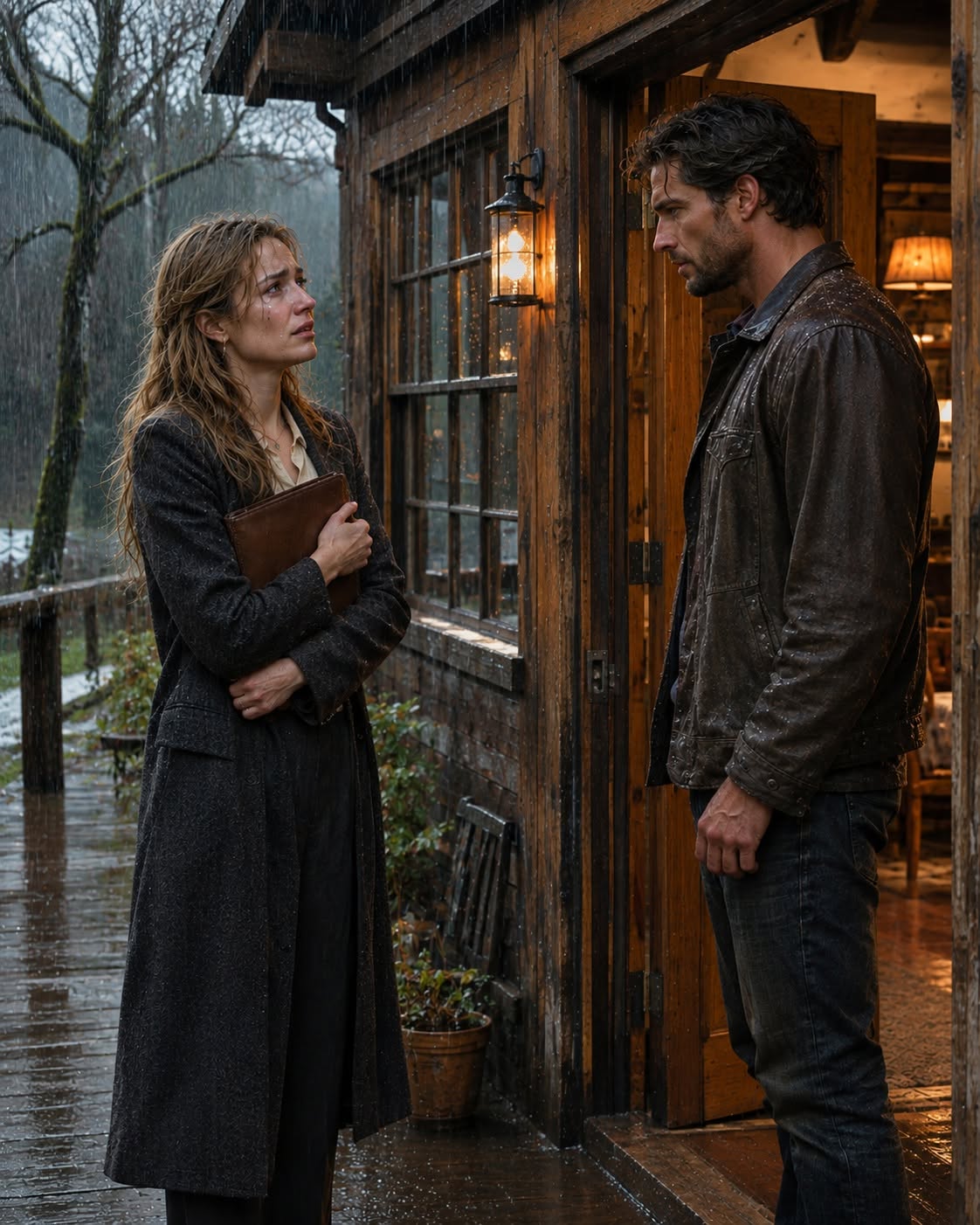
It was Daniel Cross, the company’s chief operating officer.
The same man who had spent years convincing the industry that I was a dishonest engineer.
The same man whose signature appeared on the falsified reports.
And now, apparently, the man who had followed his own CEO into the woods.
“You’re making this much more complicated than it needs to be,” Daniel called.
I looked at the woman beside me.
She was shaking, but not from the cold.
“Don’t open that case,” she whispered. “He’ll do anything to keep whatever is inside from getting out.”
I almost smiled.
“He should have thought about that twelve years ago.”
Then I turned the key.
The lock clicked.
Inside were three thick folders, an old digital recorder, several photographs, and a sealed envelope bearing Thomas Whitmore’s handwritten signature.
I picked up the envelope.
On its front were five words:
FOR THE PERSON WHO FINALLY ASKS WHY.
I recognized the handwriting immediately.
My hands began to tremble.
Twelve years earlier, I had been the lead electrical systems engineer on the Whitmore Tower project.
I had designed the building’s original power distribution architecture, including an emergency isolation system that could prevent a localized electrical fault from spreading across multiple floors.
It was the most important project of my career.
I had spent four years working on it.
Then, shortly before the building’s final inspection, I discovered that several protective components had been replaced with cheaper equipment.
The substitutions had been approved using documents bearing my signature.
I had never signed them.
I reported the changes.
Three days later, I was accused of falsifying engineering certifications.
My professional license was suspended while the allegations were investigated.
My employer dismissed me.
The investigation dragged on until my savings disappeared and my marriage collapsed under the pressure.
By the time the authorities acknowledged that some of the documents had been manipulated, the people responsible had already buried the evidence.
Daniel Cross had been the project administrator back then.
He was young, ambitious, and close to Thomas Whitmore.
He had also been the person who persuaded the board that I had invented the entire safety issue to cover my own mistakes.
I lost my career.
He gained a promotion.
Now, twelve years later, he was standing outside my shed.
“Open the door,” he said.
“Not until we finish reading this,” I answered.
A short silence followed.
Then Daniel laughed.
“You really think a few old papers can change anything?”
I looked at the CEO.
“Your father thought they could.”
She reached for the envelope.
“Let me read it.”
I handed it to her.
She carefully unfolded the letter.
The first sentence made her knees weaken.
My daughter, if you are reading this, then I have failed to correct a terrible mistake while I was still alive.
She continued.
I knew the original engineering reports were altered. I knew Daniel Cross had arranged for cheaper electrical components to be installed in the tower. I also knew that the engineer who objected was innocent.
Her eyes filled with tears.
“Keep reading,” I said.
She swallowed.
I allowed the investigation to proceed because Daniel threatened to expose financial irregularities in my company. I convinced myself that protecting thousands of jobs justified sacrificing one man’s career. I told myself I would repair the damage later.
But later became another year. Then another. And eventually I was too ashamed to admit what I had done.
She stopped.
For a moment, the only sound was the rain.
Then she whispered, “He let this happen.”
“Yes.”
“He knew you were innocent.”
“Yes.”
“And he did nothing.”
I nodded.
She pressed the letter against her chest.
“My father always told me that a leader’s greatest responsibility was protecting people.”
I looked at her.
“Sometimes people teach the values they are least willing to practice.”
Outside, Daniel struck the shed door with his fist.
“Enough! Give me the case!”
The CEO turned toward the door.
“Daniel, you’re finished.”
He laughed again.
“You have no idea what you’re dealing with.”
“Actually, I think I do.”
She took out her phone.
I stopped her.
“Wait.”
She looked confused.
“Why?”
“Because he didn’t come here just to frighten us. He came because he knows what’s in that case. If we confront him without understanding everything, he’ll find another way to escape.”
I opened the second folder.
Inside was a detailed financial record showing that Daniel had received payments through three shell companies.
The amounts were substantial.
But what caught my attention was the date of the final transaction.
It was only four months ago.
The recipient was a company called Northbridge Technical Solutions.
I recognized the name.
It had been awarded the contract to replace the electrical protection system in Whitmore Tower.
The same system I had warned the board about before being fired.
I looked at the CEO.
“Your father wasn’t the end of this.”
Her face went pale.
“What do you mean?”
“Someone continued using the same arrangement. Daniel has been making money from the tower’s maintenance contracts for years.”
I turned another page.
There it was.
A technical assessment warning that the replacement components did not meet the building’s original safety specifications.
The report was dated eleven months earlier.
It had been signed by a consulting engineer.
And beneath the signature was a handwritten note:
Do not circulate. CEO has been informed.
The woman beside me stared at the document.
“That can’t be right.”
“Why?”
“Because I was never shown this report.”
I looked at her.
“Then someone was making decisions in your name.”
She shook her head.
“Daniel handled the maintenance budget. He told me the building had passed every inspection.”
I closed the folder.
“That’s how he operates. He makes sure the people at the top see the numbers they want to see.”
A sudden crash came from outside.
The shed door shook.
Daniel was no longer pretending to be patient.
“Last chance!”
I reached for the recorder.
It was an old model, scratched and worn, but the batteries were still inside.
I pressed the playback button.
At first, there was static.
Then a man’s voice emerged.
Thomas Whitmore.
“I know what you did, Daniel.”
Another voice answered.
Daniel’s voice.
“Then you know why you need to keep quiet.”
“People could die.”
“Nobody is going to die. The building has redundant systems.”
“You removed the redundancy.”
“We reduced unnecessary expenses.”
“That’s not what the engineers said.”
A chair scraped.
Then Daniel spoke again.
“Listen carefully, Thomas. Your company is worth billions because investors believe you are in control. If the original reports come out, the government will investigate every project we’ve approved. Your name will be everywhere.”
A long silence followed.
Then Thomas whispered something I had never heard before.
“You’re asking me to sacrifice an innocent man.”
Daniel answered without hesitation.
“I’m asking you to protect the company.”
The recording ended.
The CEO stood perfectly still.
Then she turned toward the door.
“Daniel!”
The shed door opened before she could say anything else.
He stood in the doorway, holding a small flashlight.
His expensive coat was wet, and his face had lost its usual confidence.
For a moment, he looked at the documents in our hands.
Then his eyes settled on the recorder.
I pressed the playback button again.
He lunged forward.
I stepped aside, and he stumbled into the shed.
The CEO moved between him and the case.
“Don’t touch him.”
Daniel straightened his jacket.
“You’re making a mistake.”
“No. I made a mistake when I trusted you.”
He looked at her with something close to pity.
“Your father understood how this business works. You think a company survives by being honest? It survives because someone makes the difficult decisions.”
“Firing an innocent engineer was one of your difficult decisions?”
“It was necessary.”
“Replacing safety equipment with inferior components?”
“Those components met the minimum requirements.”
“They didn’t meet the original engineering specifications.”
“Nobody reads those specifications.”
I stepped forward.
“People living and working in the building do.”
Daniel turned toward me.
For the first time in twelve years, we stood face to face without a boardroom separating us.
“You should have stayed in your cabin,” he said.
“I tried.”
“Then why come back?”
I glanced at the case.
“Because the people inside that tower didn’t get the choice to walk away.”
He clenched his jaw.
Then he looked at the CEO.
“Give me the documents. We can still handle this privately.”
She shook her head.
“Not anymore.”
He pulled a phone from his pocket.
“Think carefully. I have enough information to destroy this company. Your father wasn’t the only person involved in the original approval.”
She froze.
“What does that mean?”
Daniel smiled.
“It means you should ask yourself why your father signed the final authorization.”
I looked down at the letter.
There was something I hadn’t noticed before.
A second page was folded inside.
I pulled it out.
At the bottom was Thomas Whitmore’s signature, followed by another name.
EVELYN WHITMORE.
The CEO’s name.
She stared at it.
“No.”
Her voice was barely audible.
Daniel’s smile widened.
“Now you understand.”
She reached for the paper.
“That’s impossible. I was twenty-two. I had just graduated. I had nothing to do with the engineering approval.”
I studied the signature.
It was genuine.
But beneath it was a date.
The document had been signed three months after the original approval.
And there was a handwritten note beside it.
Acknowledgment of subsequent disclosure. Not approval of technical specifications.
I turned the page toward her.
“This isn’t an authorization.”
She read it twice.
Daniel’s smile disappeared.
“What did you do?” she asked him.
He took a step backward.
“I didn’t do anything.”
“Then why did you tell me I approved the project?”
“Because you signed the acknowledgment.”
“I signed a document confirming that my father had informed me of the investigation. I never approved any equipment changes.”
The pieces were finally coming together.
Daniel had taken an innocent acknowledgment and presented it as proof of her involvement.
He had used the same method on me years earlier.
Alter a document.
Change its meaning.
Then let the organization destroy the person whose name appeared on it.
I looked at him.
“You didn’t just steal my reputation. You built your entire career on making other people look responsible for your decisions.”
He said nothing.
Then, from somewhere beyond the trees, a siren sounded.
Daniel turned sharply.
The CEO lowered her phone.
“I called the state investigators before we came here. They were already reviewing the electrical failure. I sent them the location and copies of the documents.”
For the first time, Daniel looked genuinely frightened.
“You wouldn’t dare.”
“I already did.”
He rushed toward the door.
But two investigators appeared through the trees, followed by a uniformed officer.
“Daniel Cross,” one of them called. “Step away from the case.”
He stopped.
For a few seconds, he seemed to consider running.
Then he slowly raised his hands.
As the officers approached, he looked directly at me.
“You think this is over? You have no idea how many people are involved.”
I held his gaze.
“Then I hope they start talking.”
They took him away in handcuffs.
The CEO remained beside the open case.
She looked at the letter again.
“My father knew the truth,” she whispered. “And he left me to discover it after he was gone.”
I didn’t answer.
Some wounds couldn’t be repaired by discovering who had caused them.
Some apologies arrived too late.
But the story was far from over.
The next morning, the company released a statement announcing an independent investigation into the electrical failure at Whitmore Tower.
The building remained closed.
Engineers found that the failure had triggered a dangerous overload across several distribution circuits. The original protection architecture had been compromised in multiple places.
If the emergency isolation system had failed completely, the consequences could have been catastrophic.
The investigation also revealed something even more disturbing.
Daniel had ordered the temporary bypass of a critical protection relay during the previous maintenance cycle.
That decision had allowed the initial failure to spread.
The system had not collapsed because of an unavoidable accident.
It had collapsed because someone had repeatedly ignored warnings to save money and protect a fraudulent contract.
Fortunately, the emergency response team evacuated the affected floors quickly.
There were injuries, but no fatalities.
That fact mattered more to me than anything else.
I didn’t want to be right.
I wanted everyone to be safe.
Within a week, the board convened an emergency meeting.
This time, I was invited.
I almost refused.
I had spent twelve years avoiding rooms like that one.
But the CEO called me personally.
“There’s something you deserve to hear,” she said.
I arrived at the headquarters on a cold Monday morning.
The building looked different from the outside.
Police vehicles stood near the entrance. Reporters crowded the pavement. Employees walked through the lobby carrying boxes and personal belongings.
The company that had once seemed untouchable was suddenly struggling to remain standing.
Inside the conference room, every executive was waiting.
The same table.
The same polished wood.
The same faces.
But the atmosphere had changed.
The CEO stood when I entered.
“Thank you for coming.”
I nodded.
She gestured toward an empty chair.
It was the seat where I had been humiliated and fired.
I remained standing.
“Let’s get to the point.”
She took a breath.
“An independent forensic review has confirmed that your original engineering assessments were accurate. Your professional credentials were deliberately undermined through falsified records. The company has formally requested that the licensing authorities review your case.”
One executive lowered his head.
Another stared at his hands.
She continued.
“We have also identified a series of fraudulent contracts, unauthorized equipment substitutions, and concealed safety violations. Daniel Cross has been suspended pending criminal proceedings. Several other employees are under investigation.”
Then she placed a document on the table.
It was a formal statement from the board.
The company was acknowledging that I had been wrongfully accused and dismissed.
My name was being cleared.
My professional record would be corrected.
My lost wages and legal expenses would be compensated.
I looked at the document.
Twelve years of my life had been reduced to a few paragraphs.
I didn’t feel the triumph I had imagined during the lonely nights at my cabin.
I felt tired.
Very tired.
“Is that all?” I asked.
The CEO looked surprised.
“No. There’s one more thing.”
She opened another folder.
“The board has authorized an offer. We want you to return as chief safety engineer, with full authority to review every building in our portfolio.”
The room fell silent.
For a moment, I remembered the person I had been before everything happened.
The engineer who believed that good work would always speak for itself.
The man who had once walked into boardrooms with confidence.
Then I remembered the last twelve years.
The cabin.
The river.
The silence.
I closed the folder.
“No.”
The CEO blinked.
“No?”
“I’m not coming back to work for this company.”
She nodded slowly.
“I understand.”
“But I haven’t finished.”
I looked around the room.
“If you really want to make things right, don’t offer me a title. Fix the systems that allowed this to happen.”
Nobody spoke.
“Create an independent safety department. Give its engineers direct access to the board. Make every inspection report available to the people responsible for approving the work. Protect employees who report dangerous conditions. And don’t let anyone bury a warning simply because it threatens a quarterly profit.”
One of the directors shifted in his chair.
“That would require substantial restructuring.”
I looked at him.
“Then consider it part of the cost of building something people can trust.”
The CEO lowered her eyes.
After a moment, she nodded.
“I agree.”
She turned toward the board.
“If we want this company to survive, we need to become the kind of organization that deserves to survive.”
For the first time, I believed she might mean it.
Over the following three months, the company underwent a complete restructuring.
Several executives resigned.
Two senior managers were dismissed after investigators uncovered evidence of their involvement in the falsified approvals.
The fraudulent maintenance contracts were terminated.
Every major property underwent an independent safety inspection.
The company also established a protected reporting system, allowing engineers and maintenance workers to raise concerns without going through their direct supervisors.
The reforms were expensive.
The stock price fell.
Several investors withdrew.
But something unexpected happened.
Employees who had once been afraid to speak began reporting problems.
Some were minor.
Others were serious.
One report identified a fire suppression system that had been improperly maintained for years.
Another uncovered structural corrosion in an underground parking facility.
A third revealed that an entire maintenance department had been operating with outdated emergency procedures.
Each discovery cost the company money.
Each correction prevented a potentially devastating failure.
And gradually, people began to trust the company again.
Meanwhile, the investigation into Daniel Cross uncovered a network of shell companies and falsified procurement contracts stretching across several states.
He had not acted alone.
The evidence also revealed that he had paid several consultants to discredit engineers who challenged his decisions.
The man who had destroyed my career had spent years building an entire business around silencing people who understood the dangers of his shortcuts.
He eventually pleaded guilty to multiple charges related to fraud, falsified records, and financial misconduct.
But the most important moment came during the trial.
One former employee testified that she had warned Daniel about a defective electrical component two years earlier.
He had threatened to ruin her career if she continued raising concerns.
She had resigned rather than risk being blamed for an accident.
When the prosecutor asked why she had waited so long to speak, she looked directly at the jury.
“Because I watched what happened to the last person who told the truth.”
I knew exactly who she meant.
After the hearing, she approached me in the courthouse corridor.
“I’m sorry,” she said.
I frowned.
“For what?”
“For staying quiet.”
I shook my head.
“You were protecting yourself. He made sure people were afraid.”
She looked down.
“I should have been braver.”
I considered her words.
“Maybe. But the next person who speaks up shouldn’t have to be brave just to do their job.”
She nodded.
Then she began to cry.
I didn’t know what to say, so I simply stood beside her until she was ready to leave.
Six months after the disaster, the CEO visited my cabin again.
This time, she didn’t arrive in a luxury car.
She drove an ordinary vehicle and carried a small paper bag.
I was repairing an old generator beside the river when I heard her footsteps.
“Still fixing things?” she asked.
I wiped my hands on a rag.
“Some things are worth repairing.”
She smiled faintly.
Inside the bag was a framed photograph.
It showed the original engineering team from the Whitmore Tower project.
I recognized several faces.
Some had retired.
Some had moved away.
One had passed on.
And there I was, standing in the middle, holding a set of building plans.
For a moment, I couldn’t speak.
“Where did you find this?”
“In my father’s old office. It was hidden behind a cabinet.”
I took the photograph carefully.
On the back was a handwritten message.
To the people who built this tower safely. May the people who manage it always remember what that means.
I sat down.
For years, I had believed everyone had forgotten the work we had done.
But someone had kept the photograph.
Someone had remembered.
The CEO sat on an old wooden bench.
“I’ve been thinking about what you said at the board meeting.”
“Which part?”
“That people shouldn’t have to be brave just to report a dangerous problem.”
She looked toward the river.
“I used to think leadership meant having all the answers. I thought confidence meant never showing doubt. When someone challenged me, I treated it as a threat.”
I listened.
“I fired you because your report embarrassed me. I didn’t investigate it because I was afraid the board would think I was incapable of running the company.”
She paused.
“And now I understand that the moment I stopped listening was the moment I stopped leading.”
I looked at her.
“Understanding that is a start.”
“I know.”
She reached into her coat and handed me a document.
It was a proposal for a new independent engineering foundation.
Its purpose was to support whistleblowers, provide legal assistance to engineers who faced retaliation, and offer independent technical reviews for companies that could not afford full safety departments.
The foundation would be named after the original project team rather than any individual executive.
She wanted me to lead it.
I read the proposal carefully.
“Why me?”
“Because you’ve experienced what happens when the truth becomes inconvenient. And because I don’t want this to become another corporate project designed to make us look good.”
I folded the papers.
“I’ll consider it.”
She nodded.
Then she stood.
Before leaving, she turned back.
“There’s something else. My father’s estate still contains money from the original settlement he arranged with Daniel. I have asked the lawyers to transfer it into a fund for the workers and families affected by the fraudulent contracts.”
I looked at her.
“That won’t bring back the years I lost.”
“No,” she said. “It won’t.”
“Or repair every life he damaged.”
“No.”
She took a breath.
“But it’s something he should have done while he was alive.”
For the first time, I saw her as more than the CEO who had fired me.
I saw a woman trying to take responsibility for a legacy she had inherited.
That didn’t erase what she had done.
But it meant she had finally stopped running from it.
A year later, the Whitmore Tower reopened.
Not with a grand celebration or a ribbon-cutting ceremony.
The company held a small event for the engineers, electricians, inspectors, maintenance workers, and emergency personnel who had helped make the building safe again.
I attended because the workers had invited me.
The CEO stood at the podium.
She spoke briefly about the disaster, the failures that had caused it, and the people who had helped prevent it from becoming a tragedy.
Then she did something I hadn’t expected.
She stepped away from the microphone and invited a maintenance technician to speak.
He was a young man named Marcus.
He had been working in the building for only eight months when he noticed unusual fluctuations in one of the electrical panels.
He reported them.
This time, nobody dismissed him.
An investigation revealed a defect that could have caused another serious failure.
Marcus had been given the resources to document the problem, the authority to stop work in the affected area, and the protection to speak without fear of losing his job.
He stood at the microphone, nervous but determined.
“I’m not an engineer,” he began. “I’m just someone who checks the equipment every day. But I think the people who work in a building should be allowed to say when something doesn’t look right.”
The room applauded.
I stood near the back and felt something loosen inside my chest.
That was what I had wanted all along.
Not revenge.
Not a title.
Not even an apology.
I wanted the next person to be heard before it was too late.
After the ceremony, the CEO approached me.
“The foundation is ready,” she said.
I smiled.
“Then let’s get to work.”
I didn’t return to the company.
I never wanted another executive office or another seat at its boardroom table.
Instead, I helped build an independent organization that investigated safety concerns, trained maintenance teams, and gave technical workers a way to report dangerous conditions without risking everything they had.
Our first year was difficult.
Funding was limited.
Some companies refused to cooperate.
A few executives called us troublemakers.
But others began asking for help before problems became disasters.
And slowly, the foundation grew.
We eventually supported engineers and maintenance workers in more than twenty cities.
Some cases involved electrical systems.
Others involved structural failures, fire protection, industrial machinery, and unsafe construction practices.
Every case reminded me of the same lesson.
A dangerous building rarely becomes dangerous in a single moment.
It happens through small compromises.
A report ignored.
A component replaced with something cheaper.
An inspection rushed.
A worker silenced.
A signature forged.
A warning buried.
And one day, all those little decisions become something no one can control.
Two years after the disaster, I received a letter from a young engineering student.
She had read about the Whitmore Tower investigation and wanted to know whether I regretted speaking up.
I sat at my kitchen table for a long time before answering.
Then I wrote:
There were many days when I regretted what speaking up cost me. I lost my career, my home, and people I thought would stand beside me.
But I have never regretted trying to protect the people who trusted us to build safe places.
Never confuse silence with professionalism. Never confuse authority with wisdom. And never believe that your position in a company determines the value of what you have to say.
If you discover something dangerous, document it, report it through the proper channels, and seek independent support when necessary. You may not be able to control how powerful people respond, but you can refuse to make their comfort more important than other people’s safety.
I signed the letter and placed it in the mailbox.
Then I walked down to the river.
The water moved slowly between the trees, just as it had when I first arrived at the cabin.
For years, I had come here because I wanted to disappear.
I thought leaving the world behind was the only way to find peace.
But I had learned something different.
Peace didn’t come from pretending the past had never happened.
It came from refusing to let the past decide what kind of person I would become.
My phone rang.
It was the foundation’s office.
A maintenance worker at a newly constructed hospital had reported a problem with its emergency power system.
The construction company was insisting everything had passed inspection.
The worker was afraid he would be fired if he continued raising concerns.
I looked across the river.
Then I picked up the phone.
“Tell him we’re listening,” I said. “And tell him not to touch anything dangerous until a qualified team has assessed it.”
I put on my jacket and headed toward my truck.
There would always be another building.
Another warning.
Another person who needed someone to believe them.
I couldn’t repair every mistake in the world.
But I could make sure that the next person who spoke up wouldn’t have to stand alone.
And that, I realized, was a better legacy than any title I had ever held.
Because a building is only as strong as the people responsible for protecting it. And a company is only as strong as its willingness to hear the truth—even when the truth is inconvenient.