The captain had stopped arguing with me and started smiling, which scared me more than the vibration ever had
The crack was followed by a boom so deep I felt it in my teeth.
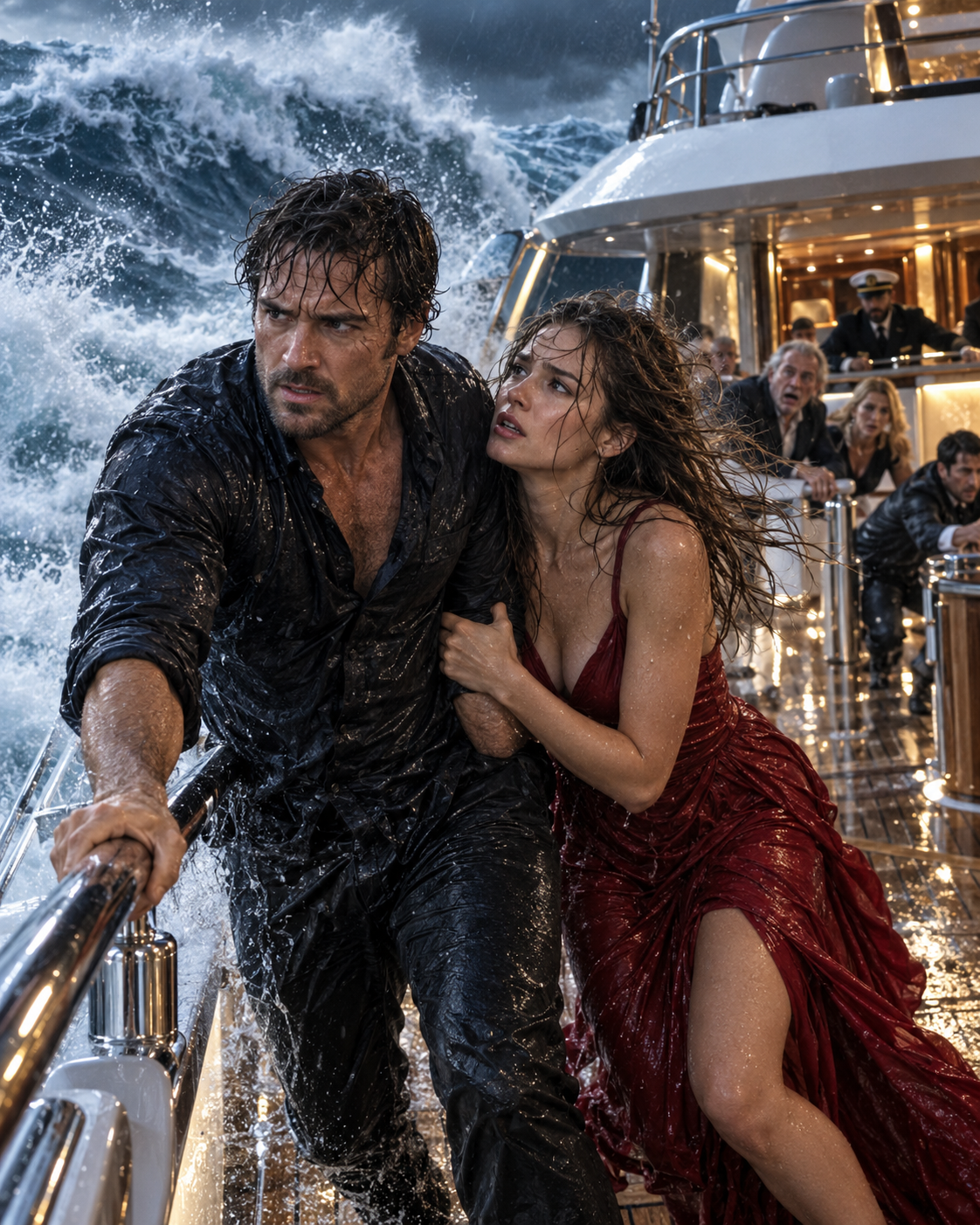
The Resolute lurched hard to port.
Something heavy slammed against the engine-room bulkhead, and I went down on one knee. For a moment there was nothing but the ringing in my ears and the hiss of escaping steam.
Then the emergency lights came on.
Red.
Dim.
Flickering.
The bilge alarm did not.
I was already moving before I had time to think.
“Caleb!”
Darren Cole, the first mate, came down the ladder two steps at a time.
“Engine room’s flooding.”
“How bad?”
“Bad enough.”
We reached the lower compartment and water was already washing across the deck plates.
A high-pressure saltwater line had ruptured near the port auxiliary system. The blast had damaged a control cabinet, and whatever power remained was dying in sections.
“Shut the isolation valve,” I said.
Darren stared at me.
“Manual?”
“There’s no other kind.”
He grabbed the wrench.
The storm had arrived almost without warning. Outside, the calm Pacific had become a gray wall, rain hammering the windows hard enough to erase the horizon. The yacht pitched beneath us.
Arthur had pushed the engines after the first warning vibration.
Now one engine was dead and the other was coughing.
The bridge radio crackled.
“Caleb, get up here.”
It was Beatrice.
I climbed to the bridge soaked to the waist.
The room looked nothing like it had twenty minutes earlier. Champagne had spilled across the floor. Two guests were crying. Someone was praying quietly near the navigation console.
Arthur stood at the helm.
“Navigation is down,” he said.
“I noticed.”
“Radar’s intermittent.”
“GPS?”
“Dead.”
I looked through the windshield.
Nothing but rain.
“How far offshore?”
Darren answered from behind me.
“About eight nautical miles from the shoals.”
Eight miles.
That number settled into the room like a weight.
The coastal rocks ahead weren’t visible in the storm, but everyone knew they were there.
Arthur reached for the throttle.
I caught his wrist.
“Don’t.”
His face hardened.
“We need steerage.”
“You push that engine any harder and you’re going to lose it.”
“What do you suggest?”
I pointed toward the electrical panel.
“Get me emergency power.”
Arthur laughed once.
Not because anything was funny.
“You’re a mechanic.”
“Yes.”
“Not a captain.”
“Correct.”
“Then don’t tell me how to handle my ship.”
Beatrice stepped between us.
“Arthur.”
He turned.
She looked at me.
“Can you get us power?”
“If the batteries aren’t compromised.”
“Can you get us steerage?”
“If I can bring the port engine back without feeding the fire.”
Arthur stared at her.
She didn’t look away.
Then she said the words that changed the rest of my life.
“Caleb, you have absolute authority over the vessel’s survival. Whatever you need, you get it.”
Arthur’s jaw tightened.
But he stepped aside.
Darren followed me below.
We worked without talking much because there wasn’t much worth saying.
The isolation valve was almost impossible to reach with water rising around our knees. I crawled through the compartment, found the line, and felt the vibration of the ruptured pipe through my glove.
“Here.”
Darren handed me the wrench.
I turned it.
Nothing.
I turned harder.
The valve moved a fraction.
Then another.
The spray weakened.
“Again.”
He leaned over me and pulled.
The valve finally slammed shut.
For a second we just breathed.
Then Darren said, “You’re bleeding.”
I looked down.
My forearm was cut from the metal cabinet.
“Later.”
He nodded.
We traced the emergency circuits and discovered the worst possible news: the auxiliary batteries were good, but the transfer switch had been wired incorrectly.
Not accidentally.
Incorrectly.
Someone had routed emergency power through a circuit that should have been isolated during a machinery casualty.
I remembered the burnt wiring upstairs.
The bypassed alarms.
The fake maintenance tags.
This wasn’t neglect.
It was a pattern.
“Darren.”
“Yeah?”
“Who rewired this?”
He didn’t answer.
That told me more than an answer would have.
We improvised a temporary route, stripped back the damaged cable, and fed power to the port engine controls.
The first attempt failed.
The second gave us a spark.
The third made the engine cough.
“Come on,” I whispered.
The starter turned.
Once.
Twice.
Then the engine caught.
The sound wasn’t beautiful.
It was rough and uneven and probably the ugliest engine I’d ever loved.
But it was alive.
We got barely enough thrust to steer.
Darren ran to the bridge.
I followed.
Arthur took the helm while I shouted headings based on the last known chart position and the compass repeater.
The cove was nearly six miles away.
The storm made it feel like sixty.
For forty minutes, we fought the sea.
The guests had stopped screaming.
That frightened me more than the screaming.
People get quiet when they finally understand the seriousness of something.
At one point a wave struck broadside and knocked Beatrice against the console.
She caught herself and looked at me.
“Are we going to make it?”
“I don’t know.”
It was the first completely honest answer anyone had given all day.
She nodded.
“Okay.”
No speech.
No reassurance.
Just okay.
That mattered.
We reached the leeward side of a rocky cove just after dark.
The anchor held on the second attempt.
The port engine died immediately afterward.
We had made it with less than ten minutes of useful power left.
Then we discovered the next problem.
The bilge pumps couldn’t keep up.
The lower compartment was still taking water.
So we formed a bucket brigade.
Executives, crew, mechanics, spouses, everybody.
I watched Julian Mercer pass a bucket to a woman in a silk dress while his thousand-dollar shoes filled with seawater.
For the first time that day, nobody cared who anyone was.
We spent the night like that.
At sunrise, the Coast Guard reached us.
They secured the yacht and began evacuating the guests.
I expected relief.
Instead, I felt hollow.
Because while everyone else was climbing onto the rescue boat, I noticed Julian standing alone near the aft stairwell.
He was holding his phone.
He wasn’t calling his wife.
He wasn’t calling the Coast Guard.
He was deleting files.
I walked toward him.
He looked up.
“Private business.”
“You were deleting maintenance records.”
“No.”
“You were.”
He stepped closer.
“Careful, Caleb.”
I took out my phone.
“I photographed the invoices.”
His expression changed.
Not much.
Just enough.
“What invoices?”
“Pacific Crest Marine.”
He stared at me.
Then he smiled.
It was the same smile Arthur had worn that morning.
Only now I understood it.
“You’re going to regret accusing me of something you don’t understand.”
He walked away.
I watched him go.
And for the first time, I wondered whether I had been wrong about one thing.
Maybe Julian wasn’t the person who had started this.
Maybe he was only the person who had been caught inside it.
By noon, Diana Ward, the company’s general counsel, arrived with Rebecca Crane, the chief financial officer.
They had flown down from San Francisco after Beatrice called them.
Diana was a compact woman with gray eyes and a habit of letting silence stretch until other people filled it.
Rebecca looked exhausted.
She sat across from me in the temporary command room aboard the rescue vessel.
“How many records did you photograph?”
“Enough.”
“Show me.”
I handed over my phone.
She scrolled.
Her face changed slowly.
Diana leaned closer.
“Pacific Crest Marine,” she said.
“You know them?”
Rebecca laughed bitterly.
“I know the payments.”
She pulled a folder from her bag.
“One point six million dollars over fourteen months.”
My stomach tightened.
“To that company?”
“On paper, yes.”
“Who approved them?”
She looked at Diana.
Diana answered.
“Julian.”
“Arthur?”
“Some of them.”
Rebecca opened another file.
“These were supposed to be engine overhauls, pump replacements, electrical inspections.”
I pointed to the photograph of the maintenance certificate.
“Half those parts were never installed.”
Rebecca nodded.
“We know.”
I sat back.
“How long have you known?”
“Not long enough.”
That sentence stayed with me.
Then she told me something I hadn’t expected.
Beatrice had ordered a confidential internal audit three weeks before the retreat.
She suspected maintenance costs were inflated.
She had not told Arthur.
She had not told Julian.
She had asked Rebecca and Diana to trace the money quietly.
“Then why leave?” I asked.
Diana’s expression hardened.
“Because Julian told Beatrice the vibration was minor and the vessel had already been cleared.”
I looked toward Beatrice.
She was standing outside on the deck, speaking to a Coast Guard officer.
“She believed him?”
“She believed her captain,” Diana said.
That distinction mattered.
Arthur had worked for the Sterling family for twenty-two years.
He had brought Beatrice home from a storm when she was twenty-eight and had stayed through three company expansions, two divorces in the executive suite, and the death of her father.
Trust is not always earned in one moment.
Sometimes it’s accumulated so slowly that you don’t notice when it becomes dangerous.
Arthur came into the room that afternoon.
He looked twenty years older than he had that morning.
Diana stood.
“Captain.”
Arthur sat down.
Nobody spoke.
Finally he said, “I didn’t know the full extent of it.”
I believed him.
At least at first.
Then he added, “Julian said the bypasses were temporary.”
Diana’s voice stayed quiet.
“Did you sign the inspection logs?”
Arthur closed his eyes.
“Yes.”
“Did you suppress the alarm reports?”
A long silence.
“Yes.”
Rebecca put both hands over her mouth.
Arthur stared at the floor.
“I thought we were buying time.”
“Buying time for what?”
“To fix it properly.”
I couldn’t help myself.
“Then why didn’t you?”
He looked at me.
And what I saw wasn’t greed.
It was shame.
“I was afraid.”
The room went still.
“Of Julian?”
“Of losing the ship. The contract. The company. Everything.”
I understood that kind of fear.
Not his version.
But fear itself.
The kind that makes a person choose tomorrow over today until one day tomorrow arrives holding a bill you can’t pay.
Arthur had not created the fraud.
But he had helped it survive.
That mattered.
The next morning, Julian disappeared.
His car was still at the marina.
His phone had been found smashed behind a maintenance shed.
For several hours, everyone assumed he’d run.
Then security footage showed him entering the corporate office before dawn.
Diana called me.
“We need you here.”
When I arrived, police were already inside.
Julian had been trying to destroy the paper trail.
But he’d made one mistake.
The company’s cloud backup had captured the files before deletion.
And the yacht’s onboard data recorder had something even better.
Every engine command.
Every alarm bypass.
Every change to the emergency electrical routing.
Every throttle increase during the storm.
The data showed Arthur had pushed the compromised engine despite three warnings.
It also showed Julian had remotely acknowledged the warnings from the bridge console.
That was the moment the story stopped being an argument about maintenance.
It became evidence.
Julian was arrested that afternoon.
Arthur wasn’t.
Not immediately.
Beatrice insisted he tell the board everything.
He did.
For nearly three hours.
He admitted signing false logs.
Admitted accepting Julian’s instructions.
Admitted telling crew members not to escalate minor alarm faults because “management was handling it.”
When he finished, he removed his captain’s badge and placed it on the table.
Nobody had to ask him to resign.
Arthur Sterling was stripped of his position and later referred to authorities along with Julian for the conduct uncovered in the investigation.
The company suspended Pacific Crest Marine and began tracing every vessel and every maintenance invoice connected to it.
Three weeks later, I went back to work.
I repaired fishing boats.
Changed impellers.
Rebuilt fuel systems.
Argued with suppliers.
Picked Mason up from school when he missed the bus.
Helped Lily finish the science project she’d texted me about while I was standing in a blacked-out engine room.
Life became ordinary again.
That was the strange part.
After surviving something extraordinary, you still have to remember to buy milk.
One evening, Beatrice came to my shop.
No driver.
No assistant.
Just her.
She stood beside my old workbench while I wiped grease from my hands.
“I owe you an apology,” she said.
“You don’t owe me anything.”
“I do.”
She looked around the shop.
“This is where you belong.”
I smiled.
“That’s either an insult or a compliment.”
“Neither.”
She handed me a folder.
Inside was an employment agreement.
Director of Fleet Reliability.
Authority over every Sterling Pacific vessel.
Authority to order immediate inspections.
Authority to ground any vessel without executive approval.
No override by operations.
No override by finance.
No override by the CEO.
I looked at the last page.
There was a clause I’d never seen in a corporate contract before.
Any engineer or crew member could report a safety concern directly to my office without retaliation.
I looked up.
“You wrote this?”
“With Diana.”
“Why?”
She hesitated.
“Because I thought listening was something responsible people did naturally.”
I waited.
She continued.
“I was wrong.”
I closed the folder.
“I’ll take it under one condition.”
She nodded.
“Every mechanic, engineer, electrician, deckhand, and crew member gets the same protection. Not a policy memo. Not a promise. A legal right.”
“It will cost us.”
“Yes.”
“Some people will abuse it.”
“Probably.”
She smiled faintly.
“Then we’ll deal with that problem.”
I signed.
Months later, my office was still a converted storage room overlooking the maintenance yard.
I liked it.
I could smell diesel from my window.
I could hear tools striking metal.
And nobody had a boardroom table big enough to make a bad vibration disappear.
The first real test came on a Tuesday morning.
A new operations manager brought me a report from another yacht.
“Odd vibration,” he said.
“How odd?”
“Hard to say.”
“Did the engineer flag it?”
“Yes.”
“What did you tell him?”
The manager hesitated.
“That we had a departure window.”
I set the report down.
“Shut it down.”
He blinked.
“We’re scheduled to leave in ninety minutes.”
“Then the schedule can wait.”
He stared at me.
For half a second, I saw the old world trying to return.
The world where somebody with a title decided how much risk another person was allowed to notice.
Then he picked up his radio.
“Stand down departure,” he said.
I watched him walk away.
Nobody argued.
Nobody called upstairs.
Nobody asked whether the client would be disappointed.
I sat back in my chair and listened to the maintenance yard.
Somewhere beyond the window, a mechanic started an engine.
It caught cleanly.
Steady.
No hesitation.
No hidden tapping beneath the noise.
And for the first time since my wife died, I understood something I had spent years getting wrong: protecting people didn’t always mean keeping fear away from them. Sometimes it meant giving them permission to speak when fear told them to stay quiet.
I reached for the next inspection report.
The vibration was already circled in red.
And this time, somebody had listened before the water started rising.