The call came at 7:12 on a Tuesday morning, years after I had walked away from my family. My mother was crying, but her first question was whether I still had a clean record.
“Tessa told the social worker that Maya isn’t the only child she’s been leaving alone…”
For a moment, I thought I had misunderstood my mother.
I stood in my kitchen, still wearing the same hospital scrubs I’d put on before sunrise. Maya’s drawing lay on the counter beside an untouched cup of tea.
“What are you talking about?” I asked.
My mother didn’t answer immediately.
I heard my father speaking somewhere in the background, his voice low and irritated. Then a door closed.
“There’s a little boy,” she whispered.
I gripped the phone tighter.
“What little boy?”
“His name is Noah. He’s three.”
I waited for her to explain.
Instead, she started crying again.
“Tessa was going through a difficult time. She didn’t know how to tell anyone. Your father and I thought we could handle it.”
“Handle what, Mom?”
Another silence.
Then she said the words that changed everything.
“Noah is Tessa’s son.”
I stared at the wall.
My sister had another child.
A three-year-old boy.
And somehow, nobody had thought I deserved to know he existed.
“Where is he?” I demanded.
“He’s safe.”
“Where?”
“With someone who takes care of him.”
“Who?”
My mother exhaled sharply.
“Please don’t start interrogating me. We’re trying to protect this family.”
I felt something inside me go cold.
“Mom, where is Noah?”
“He’s with a woman named Evelyn. She watches him when Tessa needs help.”
“Is she his babysitter?”
“Something like that.”
“Does she know he’s been left alone?”
My mother didn’t answer.
I looked down at Maya’s drawing.
Three stick figures stood outside a yellow house. One was taller, with long brown hair. Another was small and wore a purple dress.
The third figure was tiny.
I’d assumed Maya had drawn herself, her mother, and perhaps me.
Now I wasn’t so sure.
“Does Maya know about Noah?”
My mother’s voice became hard.
“You need to stop asking questions and sign those papers.”
I closed my eyes.
There it was again.
The same command I’d heard throughout my childhood.
Don’t ask.
Don’t question.
Just do what your sister needs.
But this time, two children were involved.
“I’m calling the caseworker,” I said.
“Don’t you dare.”
“Goodbye, Mom.”
I hung up.
My hands were shaking so badly that I nearly dropped the phone.
Then I called the number on the business card the caseworker had given me.
Her name was Rachel Bennett.
She answered on the third ring.
“Rachel, it’s Maya’s aunt. I need to tell you something.”
When I mentioned Noah, she went quiet.
Then she asked me a question I wasn’t prepared for.
“Who told you about him?”
“My mother.”
“Did she tell you where he is?”
“She said he’s staying with a woman named Evelyn.”
I heard papers moving.
“Do you know Evelyn’s last name?”
“No.”
“Did your mother give you an address?”
“No. Is Noah missing?”
Rachel paused.
“I can’t discuss details of another child’s case without authorization. But I can tell you that any information about his location is important.”
My stomach tightened.
“Rachel, please. Is he safe?”
“We’re working to verify that.”
That answer frightened me more than anything else she could have said.
I gave her every detail I remembered.
When we finished, she asked me not to contact Evelyn or attempt to locate Noah myself.
“Let the appropriate people handle that,” she said. “Right now, I need you to focus on what you’re comfortable doing for Maya.”
I looked at the drawing again.
“I want to help her,” I said.
“But I need to know what that actually means.”
Rachel’s voice softened.
“That’s exactly the right question.”
The following morning, I met Rachel at her office.
She explained the placement process, the home assessment, the background check, and the responsibilities involved in caring for a child who had experienced neglect.
There would be court hearings.
Medical appointments.
Possibly counseling.
Uncertainty.
And no guarantee that Maya would remain with me permanently.
“You’re allowed to say no,” Rachel told me.
I appreciated that more than she probably realized.
My family had spent my entire childhood treating my boundaries like personal insults.
Rachel was the first person involved in this situation who seemed to understand that caring about a child didn’t automatically mean I could take on everything.
“I work twelve-hour shifts,” I said.
“We would need a realistic childcare plan.”
“My apartment only has two bedrooms.”
“That may be workable.”
“I don’t have much family support.”
Rachel studied me.
“Do you have friends?”
I thought about my coworker Denise, who had become like an older sister to me.
I thought about my neighbor, Mrs. Alvarez, who watered my plants whenever I worked nights.
I thought about the people who had celebrated my nursing school graduation when my own parents hadn’t even called.
“Yes,” I said slowly.
“I do.”
Rachel smiled.
“Then you may have more support than you think.”
That afternoon, I spoke to my nursing supervisor.
I expected an uncomfortable conversation about scheduling.
Instead, when I explained the situation, she listened carefully.
“We can look at temporary adjustments,” she said. “You’ve covered enough shifts for everyone else. Let us help you for once.”
I almost cried.
Not because she’d promised to solve everything.
Because she hadn’t made me feel guilty for asking.
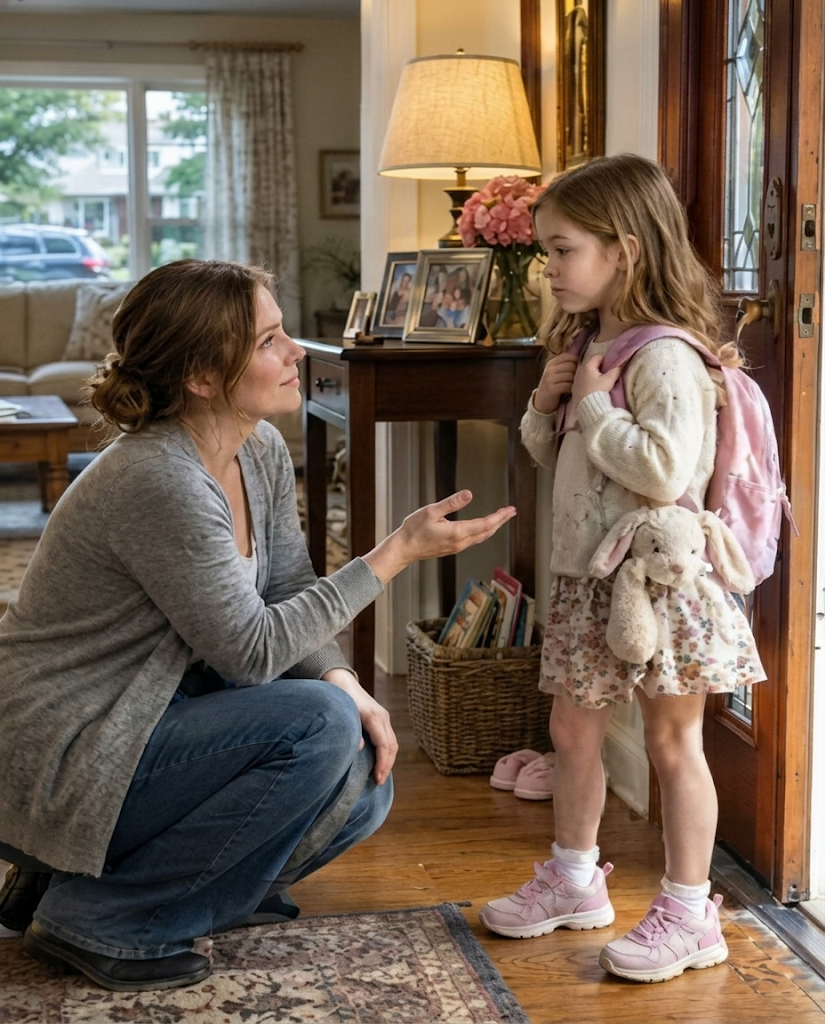
Three days later, after the required checks and emergency placement arrangements, Maya arrived at my apartment carrying a pink backpack.
Inside were two shirts, a pair of pajamas, a stuffed rabbit missing one eye, and a plastic bag filled with crayons.
That was almost everything she owned.
Rachel stayed while Maya explored.
She walked into the bedroom I’d prepared with clean sheets, a small lamp, and a stack of children’s books.
“Is this really mine?” she asked.
“For as long as you’re staying here,” I said.
She touched the blanket.
“Can I sleep with the light on?”
“Of course.”
“Even all night?”
“Even all night.”
She looked at me suspiciously.
“Mommy says electricity costs money.”
I swallowed.
“We’ll be okay.”
That first night, Maya barely spoke.
She ate half a grilled cheese sandwich and asked whether she was allowed to save the other half.
I wrapped it and put it in the refrigerator.
Then she asked whether I would be angry if she got hungry later.
“No, sweetheart.”
She nodded, but didn’t look convinced.
At bedtime, she placed her backpack beside the bedroom door.
“Why don’t we put that in your closet?” I suggested.
She shook her head.
“I need it ready.”
“Ready for what?”
“In case I have to go.”
I sat on the edge of the bed.
“You don’t have to pack tonight.”
She stared at the rabbit in her hands.
“Sometimes Mommy says we’re leaving, and then she forgets.”
I didn’t know what to say.
So I didn’t make promises I couldn’t keep.
I simply told her where my bedroom was and that she could call for me whenever she needed.
At 2:17 in the morning, I heard footsteps.
Maya stood in my doorway.
“Are you still here?”
I pushed back the covers.
“I’m right here.”
She nodded.
Then she returned to her room.
Twenty minutes later, she checked again.
By the fourth time, I brought a chair into the hallway and sat there with a blanket over my knees.
When Maya opened her door, she found me reading.
Her shoulders relaxed.
“Are you waiting for somebody?” she asked.
“Yes,” I said.
“Who?”
“You.”
For the first time since I’d met her, she smiled.
The next week brought a new kind of exhaustion.
I learned that Maya hated the sound of the microwave because it reminded her of waiting for dinner that never came.
She kept crackers under her pillow.
She apologized whenever she spilled water.
And every time my phone rang, she stopped whatever she was doing and watched my face.
One afternoon, while we were coloring at the kitchen table, she asked whether I knew Noah.
I kept my voice calm.
“I know you have a little brother.”
Her crayon stopped moving.
“Is he okay?”
“I know people are working to make sure he’s safe.”
She looked down.
“He cries when he’s hungry.”
My heart began pounding.
“Did you take care of him sometimes?”
She nodded.
“Mommy said I was the big girl.”
I waited.
Maya continued coloring.
“Sometimes she went out after dinner. Noah didn’t like the dark, so I sang to him.”
“How often did that happen?”
She shrugged.
“Lots.”
I wanted to ask a hundred questions.
But Rachel had explained that children shouldn’t be repeatedly questioned about frightening experiences. Trained professionals needed to handle those conversations.
So I simply said, “You should never have had to take care of everything by yourself.”
Maya pressed her lips together.
Then she whispered, “I tried really hard.”
I reached across the table.
“I believe you.”
That evening, after Maya went to bed, I called Rachel and reported exactly what she’d told me.
Rachel listened without interrupting.
When I finished, she said, “Thank you. That’s important information.”
“Have you found Noah?”
There was a pause.
“Yes.”
I sat down so quickly that the chair scraped across the floor.
“Is he okay?”
“He’s receiving appropriate care, and his immediate safety has been addressed.”
I covered my mouth.
For the first time in days, I could breathe.
But the relief didn’t last.
Two mornings later, my father appeared outside my apartment.
He was standing beside his truck when I returned from taking Maya to a scheduled appointment.
I hadn’t seen him in almost four years.
He looked older.
His hair had thinned, and the deep lines around his mouth made his usual expression of disapproval even harsher.
“We need to talk,” he said.
I stopped several feet away.
“How did you find my address?”
“Your mother had it.”
Of course she did.
I’d given it to her years earlier, back when I still believed sending Christmas cards might repair something between us.
“You can’t just show up here.”
He ignored that.
“Your sister is falling apart.”
I folded my arms.
“Then she needs professional help.”
“She needs her family.”
“She has two children who needed their mother.”
His face reddened.
“You don’t understand what she’s been through.”
“Then explain it.”
He looked toward my apartment building.
“Not out here.”
“We’re not going inside.”
He gave a bitter laugh.
“You always were difficult.”
I almost smiled.
There was something strangely comforting about hearing the old accusation.
It reminded me exactly why I’d left.
“What do you want, Dad?”
He reached into his jacket and pulled out a folded envelope.
Inside was a document.
I recognized Tessa’s signature at the bottom.
My father held it toward me.
“Your sister wants you to sign a statement saying she’s always been a good mother.”
I stared at him.
“You came all this way for that?”
“It would help her case.”
“Would it be true?”
He looked offended.
“She’s your sister.”
“That wasn’t my question.”
He shoved the paper back into the envelope.
“You’ve got a good job and a nice apartment. You’ve done well for yourself. Why can’t you do one thing for the family?”
I felt the familiar sting of those words.
One thing.
As if the years of stolen savings, unpaid bills, and sacrifices had never happened.
As if every favor I’d done had vanished the moment Tessa needed another.
“I am doing something for this family,” I said.
“I’m taking care of Maya.”
His expression changed.
“Don’t pretend you’re better than us because you’ve got a nursing degree.”
I looked directly at him.
“I don’t think I’m better than you. I think children deserve to be safe.”
For a moment, neither of us spoke.
Then he said something that made me understand how far this had gone.
“If you keep cooperating with those people, your mother and I could lose everything.”
I stared at him.
“Everything?”
“The house. Our savings. Our reputation.”
Not one word about Maya.
Not one word about Noah.
I stepped backward.
“Leave, Dad.”
He shook his head.
“You’re making a mistake.”
“No,” I said.
“For once, I’m refusing to help you make another one.”
He drove away without saying goodbye.
That night, I received seventeen missed calls from my mother.
Then came the messages.
She accused me of stealing Maya.
She claimed I was trying to destroy Tessa.
She said I’d always been jealous of my sister.
The final message was the worst.
“You couldn’t have children of your own, so now you’re taking hers.”
I stared at those words for a long time.
My mother didn’t know anything about my plans for children.
She hadn’t asked about my relationships, my health, or my future in years.
But she knew exactly which words might hurt.
I saved the messages and sent copies to Rachel.
Then I blocked her number.
Two weeks passed.
Maya started attending a new school.
Her teacher, Mrs. Collins, was patient and kind.
She noticed that Maya became anxious whenever classmates talked about their parents picking them up.
So we created a simple routine.
Every morning, I told Maya who would collect her.
Every afternoon, I arrived when I said I would, or made sure her approved caregiver did.
At first, Maya waited beside the classroom door with her backpack already on.
Eventually, she started staying at her desk until dismissal.
It seemed like a tiny change.
To me, it felt enormous.
Then came the first supervised visit with Tessa.
Rachel explained that Maya’s wishes and emotional readiness would be considered, along with the court’s directions.
I didn’t attend the visit itself.
I waited nearby.
When Maya came out, she was unusually quiet.
In the car, she stared through the window.
“Do you want to talk about it?” I asked.
She shook her head.
I didn’t push.
That evening, while I was washing dishes, she appeared beside me.
“Mommy said I made everybody sad.”
I turned off the faucet.
“What do you mean?”
“She said if I hadn’t told the lady about being alone, she could come home.”
I felt anger rise so suddenly that I had to grip the counter.
But I kept my voice steady.
“Maya, telling someone you needed help was the right thing.”
“She cried.”
“Sometimes adults cry when things are difficult.”
“She said Grandma cries too.”
I crouched to her level.
“You are not responsible for making adults happy.”
Her eyes filled with tears.
“Even Mommy?”
“Even Mommy.”
She looked at me for a long moment.
Then she stepped forward and wrapped her arms around my neck.
I held her while she cried.
Later, I documented what she’d said and informed Rachel.
The visit raised concerns, and the professionals involved reviewed how future contact should be handled.
Meanwhile, the investigation into Tessa continued.
I learned that Noah had been staying with Evelyn Parker, a retired daycare worker who had initially agreed to help Tessa during a difficult period.
But temporary babysitting had turned into something else.
Tessa had stopped paying her.
Then she’d begun disappearing for days.
Evelyn had repeatedly asked Tessa to arrange proper care for Noah.
According to information later presented in court, my parents knew about the arrangement.
They had occasionally delivered groceries and diapers.
But instead of addressing the situation, they had encouraged Evelyn to keep quiet.
Evelyn eventually contacted authorities after Tessa failed to return for Noah and stopped responding to calls.
That was how the second child’s situation came to light.
The details emerged gradually through the official process.
What stunned me most was discovering that my parents had known Noah existed from the beginning.
They had visited him.
Bought him birthday presents.
Taken photographs with him.
They’d simply kept him separate from the rest of the family.
When I asked Rachel why, she couldn’t answer.
But a few days later, I received a letter from Tessa.
It arrived in a plain white envelope.
Her handwriting looked exactly as it had when we were teenagers.
I almost threw it away.
Instead, I opened it after Maya went to sleep.
The letter began with an apology.
For a few sentences, I thought my sister might finally be taking responsibility.
Then I reached the middle.
She wrote that gambling had started as something harmless.
After her divorce, she’d felt lonely and overwhelmed.
She’d won money at first.
Then lost it.
Then borrowed money to recover what she’d lost.
Eventually, she’d begun using rent money, grocery money, and money my parents gave her.
She described feeling trapped.
I could understand desperation.
I could understand shame.
But then she wrote:
“I never meant for Maya to tell anyone. She was always such a good girl. I thought she understood that we had to keep our family problems private.”
I put the letter down.
Maya was six.
Six years old.
And Tessa had expected her to protect the adults who were failing her.
The final paragraph asked me to speak positively about her at the next hearing.
She promised she’d change.
She said she loved her children.
She said I was the only person who could save her.
I folded the letter and placed it in a drawer.
Then I sat alone in my living room for a long time.
I believed Tessa loved her children in whatever way she understood love.
But love wasn’t the same as providing safety.
And promises weren’t the same as change.
The next hearing took place on a rainy Thursday.
I arrived early with Rachel and a lawyer who had explained my rights and responsibilities as a relative caregiver.
My parents sat across the hallway.
My mother looked at me with open hatred.
Tessa sat beside them, twisting a tissue between her fingers.
When she saw me, she stood.
“Can we talk?”
I hesitated.
Then I nodded toward a quiet area where we could remain in view of the others.
She looked thinner than I remembered.
Her makeup couldn’t hide the exhaustion around her eyes.
“Thank you for taking Maya,” she said.
It was the first time she’d said those words.
“You’re welcome.”
She looked down.
“Does she miss me?”
“Yes.”
Her face crumpled.
I waited.
“Does she hate me?”
“No, Tessa. She’s six. She’s confused and scared.”
Tessa wiped her cheeks.
“I didn’t mean for any of this to happen.”
“I know you didn’t plan to lose your children.”
She looked up sharply.
“I’m not losing them.”
“I hope you can do the work necessary to become a safe parent.”
Her expression hardened.
“You sound just like those social workers.”
“They’re trying to protect your kids.”
“You think you’re perfect now?”
“No.”
“You think because you wear scrubs and have a clean apartment, you’re better than me?”
I sighed.
“This isn’t about us.”
She stepped closer.
“You’ve always wanted what I had.”
I stared at her.
For years, I’d wondered whether my sister understood what our childhood had been like for me.
Now I had my answer.
She had lived in a world where every sacrifice made for her was invisible.
And every boundary someone else established felt like betrayal.
“I never wanted your life, Tessa,” I said.
“I wanted parents who treated me like I mattered.”
For the first time, she had no response.
I walked away before the conversation could become another argument.
The hearing itself was difficult.
The court reviewed the children’s circumstances, the safety concerns, and the steps Tessa would need to take.
There was discussion of treatment for her gambling problem, parenting services, stable housing, and consistent cooperation.
My parents’ conduct was also examined.
Their repeated attempts to conceal neglect had raised serious concerns.
I wasn’t asked to decide whether Tessa deserved another chance.
That wasn’t my role.
I was asked about Maya.
Her routines.
Her schooling.
Her health.
Her emotional needs.
I answered truthfully.
When the judge asked whether I understood the responsibilities of continuing as her caregiver, I said yes.
Then I added something I’d been thinking about for weeks.
“I want Maya to have a relationship with her mother if it can be safe and healthy. But I don’t want her to believe that keeping her mother happy is her job.”
The judge listened.
And for once, my family’s opinions didn’t determine what happened next.
Maya remained in my care under the existing protective arrangement.
Noah remained in a separate approved placement while his needs were assessed.
The professionals involved began exploring appropriate sibling contact.
That last part mattered more to Maya than anything else.
When I told her there might be a chance to see Noah, she stared at me.
“Really?”
“That’s what they’re working on.”
She looked frightened.
“Will he remember me?”
“I think he’ll be happy to see you.”
She nodded slowly.
Then she disappeared into her bedroom.
A few minutes later, she returned carrying the stuffed rabbit.
“Can I give him this?”
I smiled.
“Are you sure?”
She held it tightly.
“He likes the floppy ear.”
The first sibling visit happened several weeks later in a supervised family room.
Noah entered holding the hand of his caregiver.
He was a small boy with dark curls and serious brown eyes.
Maya froze when she saw him.
Then she whispered his name.
“Noah?”
He looked up.
For a moment, nothing happened.
Then he let go of the caregiver’s hand and ran toward her.
“Maya!”
She dropped to her knees.
He threw himself into her arms.
I turned away because I couldn’t stop crying.
Maya held him so tightly that the supervising worker gently reminded her to give him room to breathe.
She laughed through her tears.
Then she pulled out the rabbit.
Noah squealed.
“Bunny!”
They spent the next hour building towers, sharing crackers, and arguing over which crayon was blue.
They looked like ordinary children.
And that was what made it beautiful.
They weren’t responsible for fixing their family.
For one hour, they were simply a brother and sister playing together.
Afterward, Maya held my hand all the way to the car.
“Can Noah come live with us?”
I had known the question was coming.
“I don’t know yet, sweetheart.”
Her face fell.
“But we’re going to keep asking what arrangements are best for both of you.”
She considered that.
Then she said, “He needs his night-light.”
I squeezed her hand.
“I’ll make sure the people caring for him know.”
Over the following months, my life changed in ways I hadn’t expected.
My apartment filled with children’s books, mismatched socks, and drawings taped to the refrigerator.
I learned how to braid hair badly.
I discovered that Maya loved strawberries but hated strawberry yogurt.
She could memorize entire pages of a book after hearing them twice.
She also had nightmares.
Sometimes she became furious over small things.
Once, when I told her we were out of her favorite cereal, she screamed that I was a liar and knocked a bowl off the counter.
Then she burst into tears and begged me not to send her away.
I sat on the kitchen floor beside the broken pieces.
“We’ll clean this up,” I told her.
“Are you mad?”
“I’m upset that the bowl broke. But I’m not sending you away because you’re upset.”
She stared at me.
“Even if I’m bad?”
“You’re not bad, Maya. You had a hard moment.”
She leaned against me.
And together, we cleaned the floor.
There were difficult days when I wondered whether I was doing enough.
I was tired.
I missed sleeping late.
I missed having a quiet apartment.
I worried about money and childcare and whether I could give Maya everything she needed.
Denise reminded me that I didn’t have to do everything alone.
Mrs. Alvarez began helping with after-school care on certain days.
My supervisor worked with me to create a more predictable schedule.
Maya’s therapist helped us understand her fears and build routines that made her feel secure.
Slowly, we became something that resembled a family.
Not a perfect one.
A real one.
Six months after Maya moved in, Rachel called with news.
Tessa had entered a structured treatment program.
She had started attending counseling and cooperating more consistently with the court’s requirements.
I was relieved.
But I was also cautious.
I’d heard promises from my sister before.
This time, the changes needed to last.
My parents, however, remained focused on blaming everyone else.
My mother sent letters claiming the investigation was unfair.
My father insisted that families should solve their own problems privately.
Neither seemed willing to acknowledge the harm done to Maya and Noah.
Eventually, I stopped reading their letters.
I kept copies for the appropriate professionals, but I no longer allowed their accusations to fill my evenings.
Then, nearly a year after the original phone call, something unexpected happened.
Evelyn Parker asked whether she could speak with me.
Rachel helped arrange the conversation appropriately.
Evelyn was a gentle woman in her early sixties with silver hair and tired eyes.
We met in a small conference room.
She brought a folder.
“I wanted you to have these,” she said.
Inside were photographs of Noah.
His first birthday.
His first steps.
A picture of him asleep on a couch beneath a blue blanket.
And a photograph of Maya holding him when he was a baby.
I touched the edge of the picture.
“I didn’t know any of this.”
Evelyn nodded.
“I figured.”
She looked down at her hands.
“I should have called for help sooner.”
I didn’t know what to say.
She continued.
“I kept believing Tessa would get herself together. Your parents told me they were handling everything. They said if I involved authorities, the children would be separated.”
Her eyes filled with tears.
“I was afraid I’d make things worse.”
I looked at the photographs.
“You were trying to protect him.”
“I was. But I waited too long.”
For a moment, we sat quietly.
Then she said something I never forgot.
“Sometimes people think keeping a family secret is the same as protecting a family. It isn’t.”
I carried those words home with me.
That night, after Maya went to bed, I took out the drawing she’d given me on the day we met.
The yellow house.
The three stick figures.
I studied the smallest figure.
Noah.
Of course.
Maya had been telling me what she wanted from the beginning.
She didn’t want a perfect house.
She wanted her brother.
She wanted someone to come home.
And she wanted to stop being afraid.
I placed the drawing back in its folder.
Then I made a decision.
I asked Rachel what it would take to be considered as a placement for Noah too.
She didn’t promise anything.
There were assessments to complete, practical concerns to address, and decisions that belonged to the court and child welfare professionals.
I understood.
I wasn’t going to rush into something simply because it felt emotionally right.
But I wanted to explore whether I could offer both children a stable home.
Over the next several months, I worked through the process.
I reviewed my finances.
I adjusted my schedule.
I met with professionals who explained the additional needs of caring for two children who had experienced instability.
I talked to Denise.
I talked to Mrs. Alvarez.
I talked to my supervisor.
And I spent many nights asking myself whether I could really do this.
The answer wasn’t always a confident yes.
Sometimes it was a frightened maybe.
But every time I watched Maya say goodbye to Noah after their visits, I knew I needed to find out.
Eventually, the court approved Noah’s placement with me.
The day he arrived, he carried a small blue suitcase.
Maya had spent the entire morning arranging his toys.
When he stepped through the doorway, she ran toward him.
“Your room is here!”
He looked around, overwhelmed.
Then he pointed at the hallway.
“Where’s Maya’s room?”
“Right next door,” I said.
He considered that.
“Can I see her?”
Maya laughed.
“I’m right here, silly!”
That evening, the two of them sat on the living room rug building a tower.
Noah knocked it over.
Maya shouted.
He started crying.
She apologized.
Then they built it again.
I watched from the kitchen, holding a dish towel.
It wasn’t a magical moment where every problem disappeared.
It was noisy and messy.
And it was exactly what I’d hoped for.
A home where children could make mistakes without fearing abandonment.
The legal process continued.
Tessa made some progress in treatment, but she also experienced setbacks.
She missed appointments.
She struggled to maintain stable housing.
At times, she blamed me.
At other times, she sent letters thanking me for caring for her children.
I learned to accept that both things could be true.
She could love them.
And she could still be unable to care for them safely.
The court continued reviewing her progress and the children’s needs.
I supported appropriate contact when it was authorized and safe.
I never told Maya or Noah that their mother didn’t love them.
But I also refused to lie about what had happened.
When Maya asked why she couldn’t live with Tessa, I explained it in words she could understand.
“Your mom has some grown-up problems she needs help with. None of those problems are your fault.”
“Will she get better?”
“I hope so.”
“Will we go back?”
“I don’t know what the future will look like. But the people making those decisions are working to keep you safe, and I’ll tell you the truth about what I know.”
She nodded.
Then she asked for another bedtime story.
Children have a way of reminding you that life continues even when adults are drowning in uncertainty.
Nearly two years after that Tuesday morning phone call, the court made a permanent decision.
After reviewing Tessa’s circumstances, her progress, and the children’s need for stability, the court ended the effort to reunify them with her.
The decision was devastating for Tessa.
I didn’t celebrate it.
I knew how much grief was contained in those legal words.
But I also knew that Maya and Noah deserved a childhood that wasn’t suspended indefinitely while adults tried to decide whether they were ready to change.
After further proceedings, I was able to adopt both children.
The day the adoption became final, Maya wore a yellow dress.
Noah insisted on wearing a tiny bow tie that kept sliding sideways.
Denise came.
Mrs. Alvarez came.
Rachel attended in her professional capacity for part of the day and offered her congratulations afterward.
Evelyn sent a card.
My parents weren’t there.
Neither was Tessa.
That absence hurt in a way I hadn’t expected.
Not because I wanted another confrontation.
But because part of me had once imagined that, eventually, my family would understand what they’d done.
They never gave me that moment.
Instead, I had something better.
Two children who were safe.
When the judge asked Maya whether she had anything she wanted to say, she looked at me.
Then she raised her hand.
“Can I still call her Auntie?”
The judge smiled.
“Of course you can.”
Maya looked relieved.
Then Noah shouted, “Me too!”
Everyone laughed.
I wiped my eyes.
Afterward, we went to a small diner and ordered pancakes for dinner.
Maya poured too much syrup on hers.
Noah got whipped cream on his nose.
Denise took photographs.
At one point, Maya leaned against my shoulder.
“Does this mean we’re staying together?”
I put my arm around her.
“Yes, sweetheart.”
“For real?”
“For real.”
She looked across the table at Noah, who was trying to balance a strawberry on his spoon.
Then she smiled.
“Good.”
That night, after both children were asleep, I sat alone in the living room.
The apartment was quiet except for the hum of the refrigerator.
I thought about the morning my mother had called.
She’d asked whether I had a clean record.
Not whether I was happy.
Not whether I was healthy.
Not whether I was ready.
She’d wanted a signature.
A convenient solution.
Someone to absorb the consequences of choices nobody else wanted to face.
For most of my life, I’d believed being a good daughter meant saying yes.
Giving more.
Sacrificing more.
Accepting less.
But Maya and Noah had taught me something different.
Love wasn’t about surrendering your boundaries.
It wasn’t about protecting people from accountability.
And it certainly wasn’t about keeping dangerous secrets because telling the truth might embarrass someone.
Love was showing up.
It was listening.
It was creating safety where there had been fear.
It was choosing honesty even when honesty changed everything.
A few weeks after the adoption, I received one final letter from my mother.
It contained no apology.
She wrote that I’d torn the family apart.
She said I’d turned my sister’s children against her.
She accused me of forgetting where I came from.
I read the letter once.
Then I placed it in a box with the other documents from the case.
I didn’t respond.
Not every accusation deserves an argument.
And not every relationship can be repaired by the person who was hurt.
That weekend, Maya asked if we could hang a new picture in the hallway.
She had drawn another house.
This one had a blue roof, green grass, and three people standing outside.
The tallest figure wore blue hospital scrubs.
The smaller girl held a purple balloon.
The little boy carried a stuffed rabbit.
Above them, Maya had drawn an enormous yellow sun.
I looked at the picture for a long time.
“Who are these people?” I asked, even though I already knew.
Maya rolled her eyes.
“That’s us, Auntie.”
“And what’s this?” I asked, pointing to the house.
She grinned.
“Home.”
Noah came running down the hallway.
“Home!” he repeated.
Maya grabbed his hand.
Then she looked up at me.
“Can we put it where everybody can see?”
I found a frame.
We hung it beside the front door.
And every morning, before I left for work, I saw that picture.
Three people.
One house.
A family nobody had planned.
A family built not because everything had gone right, but because, when things went terribly wrong, someone finally chose to put the children first.
I used to think walking away from my parents meant I’d lost my family.
For years, that belief hurt more than I could explain.
But I understand something now that I didn’t understand then.
Sometimes walking away from the people who taught you to accept mistreatment is the first step toward learning what real love looks like.
My mother called me selfish for refusing to sign papers without asking questions.
My father called me disloyal for telling the truth.
My sister accused me of taking what belonged to her.
But Maya and Noah never asked me to rescue their family’s reputation.
They needed a safe place to sleep.
Someone who would feed them.
Someone who would listen when they were frightened.
Someone who would come back when they promised.
And somehow, in giving them those things, I found something I’d spent my whole childhood searching for.
A place where I belonged.
I didn’t save my sister from the consequences of her choices.
I couldn’t.
That was work only she could do.
But I helped give her children the chance to grow up without carrying those consequences as their own.
And if there’s one thing this experience taught me, it’s this:
You can love your family without protecting their harmful choices. You can forgive someone without trusting them with your future. And you can break a cycle without becoming cruel to the people who created it.
Sometimes the bravest thing you can do isn’t holding a family together at any cost.
Sometimes it’s refusing to let the next generation suffer just to keep the previous generation comfortable.
That Tuesday morning, my mother called because she needed someone with a clean record.
She never imagined that the daughter she’d spent years overlooking would become the person who gave two frightened children a new beginning.
And perhaps that’s the part of this story that matters most.
I didn’t become the daughter my parents wanted.
I became the adult I needed when I was little.
And now, every time Maya calls me from her bedroom because she’s had a bad dream, or Noah runs into my arms after preschool, I remember why I made that choice.
Not because it was easy.
Not because I was fearless.
But because children deserve to know that love doesn’t disappear when life becomes inconvenient.
Family isn’t defined by who demands your loyalty. It’s defined by who makes you feel safe enough to finally put down your bags and stay.
And for the first time in my life, when I look around my home, I don’t see what my parents took from me.
I see everything they never managed to take away.
My ability to love.
My courage to choose differently.
And two children who will never have to wonder whether they matter.
THE END.